Home Watch Videos Wars Movies Login

[🇧🇩] City Buses, Metro Rail, Urban Transport & City Road Infra

[🇧🇩] City Buses, Metro Rail, Urban Transport & City Road Infra
144
9K
More threads by Bilal9

G Bangladesh Defense

Metrorail's MRT-05 south project back on track
Munima Sultana
Published :
Jan 05, 2025 00:41
Updated :
Jan 05, 2025 00:41

1736041229578.webp


The Mass Rapid Transit (MRT) Line-05 project finally resumes for implementation to build Dhaka city's south communications corridor from Gabtoli to Dasherkandi through Karwanbazar, ending speculations about rerouting or suspending another underground metrorail.

According to officials, a development project proposal (DPP) to this end will be sent to the Planning Commission soon to get its green light, after a thorough review of the foreign-aided megaproject.

Previously, a feasibility study, detailed design and cost revision of the major infrastructure project, among others, were done in time, they said.

"The MRT-05 South is matured than two other MRTs-02 and 04. Even its rerouting towards old Dhaka will take fresh time to start," says an official, who preferred not to be quoted by name, to dispel speculations.

Earlier, Dhaka Mass Rapid Transit Company Limited (DMTCL) planned to develop the 17.20-kilometre Gabtoli-Dasherkandi MRT-05 south corridor with financial support from the Asian Development Bank and South Korea.

However, the project drew widespread criticism for its highest-ever cost estimate at Tk 546.18 billion or $5.1 billion even after feasibility and design.

The DMTCL authorities sent the DPP to the Commission through the Road Transport and Highways Division in March 2024, which was sent back for cost revision.

Although the project office sent the DPP after cutting down Tk 60 billion following a revision at the end of June, its approval process came to a halt due to political turmoil that led to change of government.

After the installation of the interim government, the project faced criticism again regarding its high cost, as many suggested rerouting the corridor either towards old Dhaka or stopping the project to give way to MRT-02.

However, a fresh revision as per the DPP further pared down the estimated cost by 15 per cent or Tk 68.98 billion to stand at Tk 477.21 billion.

Project director Mohammad Abdul Wahab said, "There is no confusion about the need for the MRT-05 south passageway."

Following last month's ADB mission, according to him, the DPP was sent to the RTHD for taking necessary steps.​
 
Analyze

Analyze Post

Add your ideas here:
Highlight Cite Respond
  • Like (+1)
Reactions: Bilal9

Let bus rationalisation plan be successful
FE
Published :
Jan 05, 2025 22:07
Updated :
Jan 05, 2025 22:07

1736127840064.webp


As Dhaka's population keeps swelling and traffic jam worsens, the need for an orderly, safe and passenger-friendly bus service cannot be overemphasised. The majority of the city's residents rely on local buses for their day-to-day commute, but the service has long been an abject mess - overcrowded, unsafe, lacking in hygiene, and poorly maintained. The buses also operate in a chaotic manner, with hundreds of companies operating on as many as 380 routes. Added to the woe is the plying of unfit vehicles in a reckless manner, competing for passengers. The competing buses often stop or park haphazardly, sometimes even in the middle of the road, to pick up passengers and block rival buses from overtaking, which leads to frequent accident and tailbacks.

A Bus Route Rationalisation (BRR) initiative has long been recognised by various studies and transport experts as a sustainable step towards revamping the city bus service. The city authorities have been dabbling in the BRR venture for over two decades. In 2012, the Dhaka Transport Coordination Authority (DTCA) was established to spearhead the implementation of this ambitious plan. However, with the exception of a brief period under the leadership of the late DNCC Mayor Annisul Huq, serious efforts to implement the BRR scheme have been largely absent. Subsequent attempts by the DSCC mayors to oversee the process have yielded little tangible progress, with the meetings of Bus Route Regulation Committee (BRCC) on this matter proving to be nothing but eyewash. Implementation of the BRR scheme has been repeatedly hampered by the non-cooperation of political actors, bus owners and different vested quarters who opposed the initiative primarily to protect their own narrow self-interests like extorting money by maintaining a flawed and corrupt system.

This interim government has revived the long-overdue BRR initiative. The DTCA has announced that all existing bus companies in Dhaka will be dissolved and integrated into a single entity named Dhaka Nagar Paribahan effective March 1st. A total of 170 bus companies have reportedly applied to participate in this initiative. The DTCA is currently scrutinising these applications and reviewing existing bus routes, with plans to consolidate the current 388 routes into 40-45 routes. The existing buses will undergo necessary repair and upgrading, including the installation of automatic doors, adjusted seating, and higher steps for improved passenger safety and comfort. Most importantly, under this scheme drivers and helpers will be employed directly by Dhaka Nagar Paribahan, which will eliminate the dangerous competition among different bus operators for more passengers.

But at a time when the long-awaited BRR initiative is gaining momentum, the Dhaka Metropolitan Police (DMP) Traffic Division in a surprise move unveiled a new bus route plan encompassing 54 routes, including 25 circular routes. The DMP's move has raised concerns among stakeholders, as its proposed routes do not align with the 42 routes in nine clusters recommended by the BRRC. While the DMP Traffic Division, with its extensive experience in managing traffic flow at various intersections, possesses valuable insights into the city's transportation needs, its authority to independently formulate a comprehensive bus route plan remains questionable. Many are questioning whether the DMP's proposal is an attempt to circumvent the established BRR process. The successful implementation of the BRR initiative hinges on the active cooperation and support of all stakeholders, including political parties and the DMP. Without their genuine commitment and collaboration, the initiative is unlikely to succeed. So, it is hoped that all the stakeholders would support the BRRC in greater public interest.​
 
Analyze

Analyze Post

Add your ideas here:
Highlight Cite Respond
  • Like (+1)
Reactions: Bilal9

Metro rail fares exempt from VAT for this year

The National Board of Revenue (NBR) has exempted value-added tax on the fares of Dhaka metro rail, which has gained a lot of popularity since the beginning of its operations.

The tax administration announced the exception on metro rail fares through an order yesterday and the decision came more than six months after the benefit was discontinued.

The VAT exemption came into effect from yesterday and will be valid until December 31 this year.

Commuters of metro rail enjoyed VAT exemptions on their fares until June 30 last year. The NBR did not extend the benefit later, despite requests from Dhaka Mass Transit Company Ltd (DMTCL), the state-run operator of the metro rail.

Though the NBR did not exempt VAT, the DMTCL has not hiked the fares with a senior official of the NBR saying that the VAT would be calculated as inclusive in the ticket prices until the exemption.

"There will be no need to hike fares after we have exempted VAT," he said.

The much-talked-about Dhaka metro rail began commercial operations by the end of December 2022 and it became hugely popular among commuters especially office goers and students who got an escape from commuting on chaotic buses.

Roughly, 3.5 lakh people commute through the metro rail daily.​
 
Analyze

Analyze Post

Add your ideas here:
Highlight Cite Respond
  • Like (+1)
Reactions: Bilal9

‘The BRT project was flawed from the start’

1738280711194.webp


Dr Md Shamsul Hoque, professor of civil engineering at the Bangladesh University of Engineering and Technology (BUET), talks to Monorom Polok of The Daily Star about the maiden BRT line in Dhaka that opened last month.

The Gazipur-Airport BRT project has incurred massive expenditure. How would you assess its potential to alleviate traffic congestion?

To address this issue properly, it is essential to first consider the broader ecosystem of public transport. Public transport encompasses various modes, with buses forming the base of the productivity pyramid. A standard bus system can manage up to 4,000 passengers per hour per direction (PHPD) at most. To enhance capacity in densely developed urban areas, systems with greater productivity are necessary. This is where the Bus Rapid Transit (BRT) systems come into play. By providing buses with dedicated lanes, they can operate with increased efficiency and immunity from congestion caused by smaller vehicles.

For instance, BRT systems in Jakarta and Istanbul allow buses to reach speeds of up to 70 kilometres per hour, competing with the efficiency of metro systems. Metros, operating on fully segregated tracks, provide faster and more reliable services, making them particularly attractive to urban commuters. However, when implemented properly in dedicated corridors, BRT systems can achieve comparable levels of efficiency.

The concept of BRT stems from the notion that buses can be rapid and efficient within a dedicated and controlled environment. Globally, cities like Curitiba in Brazil and Bogotá in Colombia are considered the gold standards for BRT implementation. These systems exemplify flexibility, cost-effectiveness, and high productivity. However, a well-executed BRT system requires substantial infrastructure, such as dedicated lanes, controlled access points, and barriers to separate BRT lanes from other traffic. The design of these barriers depends on the level of enforcement needed. Unlike metro systems, BRT systems do not demand extensive land acquisition but rather a reallocation of road space. Prioritising buses and isolating road sections for public transport are central to their success.

When implemented with dedicated stations resembling those of metro systems, BRT services offer faster, more reliable alternatives that encourage commuters to transition from private cars to buses. This modal shift gradually reduces congestion and fosters a sustainable commuting culture. Moreover, older, unorganised bus systems can be phased out and replaced by more structured and efficient BRT services. The success of BRT systems globally—adopted in over 180 cities—demonstrates their viability as cost-effective solutions for urban congestion, particularly during peak hours.

How do these global standards align with the specific context of the Gazipur-Airport BRT corridor, particularly given the prevalence of large trucks, inter-district buses, and pedestrian traffic in the area?

The effectiveness of BRT systems relies on specific prerequisites. Road width is a critical factor; a minimum of 12 lanes is typically necessary to implement a BRT system effectively. This ensures that even after allocating two lanes for the BRT, there remains adequate space for non-BRT traffic. In certain cases, 14 lanes may be required. Unfortunately, many corridors in Bangladesh, including the Gazipur-Airport corridor, do not meet these criteria. While the corridor was intended to be widened near stations, this plan was poorly executed, leaving insufficient space for the system's proper functioning.

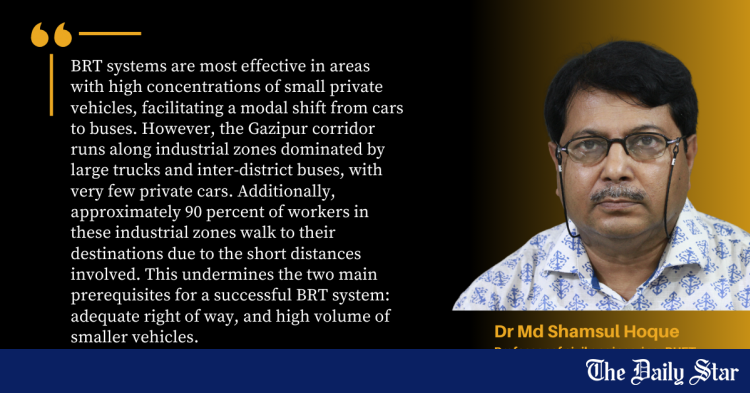
Another challenge lies in the modal composition of traffic. BRT systems are most effective in areas with high concentrations of small private vehicles, facilitating a modal shift from cars to buses. However, the Gazipur corridor runs along industrial zones dominated by large trucks and inter-district buses, with very few private cars. Additionally, approximately 90 percent of workers in these industrial zones walk to their destinations due to the short distances involved. This undermines the two main prerequisites for a successful BRT system: adequate right of way, and high volume of smaller vehicles.

Pedestrian traffic poses another challenge. Industrial workers frequently cross roads to reach factories, creating a constant flow of pedestrians. Physical barriers introduced by the BRT system can lead to a social divide, restricting workers' movement. Even if footbridges or escalators are installed, they are impractical given the high pedestrian volume and workers' time constraints. Delays of even a few minutes can result in wage deductions, prompting many to bypass these barriers and cross the BRT lanes directly.

Could you elaborate on the flaws of the project, particularly regarding the suitability of the chosen corridor and its alignment with the original Strategic Transport Plan (STP)?

The Gazipur-Airport BRT project has been plagued by significant planning and design flaws from its inception. The corridor, with its narrow roads and industrial character, was inherently unsuitable for a BRT system. These factors should have been identified during the feasibility study but were overlooked, allowing the project to proceed without addressing these critical issues.

The placement of infrastructure further compounded the problems. Footpaths were narrowed to accommodate footbridges, reducing pedestrian space in an area where walking is the primary mode of transport. The original plan for BRT-3, as outlined in the STP, proposed the route through a densely populated urban area. However, the current alignment lies outside built-up areas, where demand for such a system is minimal.

Additionally, a fundamental aspect of BRT systems is their ability to serve multiple destinations along the corridor, encouraging high passenger turnover and maximising productivity. The Gazipur-Airport BRT, however, functions more like an intercity bus service, with limited stops and long travel times. This design reduces turnover, rendering the system less efficient and productive.

What operational challenges arise from the coexistence of the BRT system with existing inter-district buses in the Gazipur-Airport corridor, and how does this affect its effectiveness?

BRT systems are usually designed to replace existing bus services within their corridors, creating a streamlined and disciplined transport network. However, in the Gazipur-Airport corridor, inter-district buses continue to operate alongside the BRT system, undermining its purpose. These buses provide flexible, personalised services, stopping wherever passengers need, unlike the fixed stations of a BRT system. Consequently, commuters are less likely to switch to the BRT, resulting in minimal modal shift and rendering the system ineffective.

Successful BRT systems thrive in urban settings with high volumes of small vehicles and commuters. The Gazipur-Airport corridor, however, is characterised by industrial traffic, large vehicles, and limited private car use.

Experts say the BRT's permanent infrastructure, including flyovers, may restrict future modifications. Can you elaborate?

Yes, unlike flexible BRT systems in cities like Jakarta and Chinese metropolises—which utilise lightweight and adaptable infrastructure—the Gazipur-Airport BRT has been implemented with permanent structures, including flyovers. This rigidity precludes future modifications, such as upgrading the corridor to accommodate a metro system—a critical limitation in a rapidly urbanising country like Bangladesh.

Furthermore, the corridor's repurposing from a national highway to a BRT system has disrupted its original functionality without meeting the needs of its users. Narrow footpaths and poorly placed infrastructure have further marginalised pedestrians, compounding the system's inefficiency.

What lessons can be learnt from this project for urban transport planning in Bangladesh? What are your recommendations for the future?

The Gazipur-Airport BRT project highlights the consequences of inadequate planning and coordination in urban transport. So, going ahead, Bangladesh must prioritise comprehensive and integrated transport strategies, addressing key issues such as narrow roads, unorganised bus services, and insufficient pedestrian infrastructure. To make urban transport smoother and more reliable, a franchising system for buses must be introduced to ensure better service. Different transport options, like BRT and metro rail, need to work together so that people can travel easily. This integration must be properly planned and executed, and a dedicated team should be formed under the public transport authority to keep things running efficiently. Safe, accessible walkways must also be prioritised instead of inconvenient footbridges. Finally, learning from successful BRT systems worldwide can help us find practical and affordable solutions that work for us.​
 
Analyze

Analyze Post

Add your ideas here:
Highlight Cite Respond
  • Like (+1)
Reactions: Bilal9

Rapid urbanisation: Boon or bane?
Shiabur Rahman
Published :
Jan 30, 2025 23:32
Updated :
Jan 30, 2025 23:32

1738283722706.webp


The world is fast getting urbanised for an array of benefits - better job opportunities, increased income and better access to education and healthcare, to name but a few. Several small developed and high-income nations like Kuwait, Singapore and Monaco have reached 100 percent urbanisation while developing and even least developed countries are experiencing fast urbanisation. According to the World Population Review, Burundi saw the highest annual urbanisation rate (5.43 per cent) in 2024 followed by Uganda (5.41 per cent), Syria (5.38 per cent) and Tanzania (4.89 per cent). Bangladesh is no exception to the trend. Official data show the country experienced an annual urbanisation rate between 3.0 and 4.0 per cent over the last couple of years with its urban population reaching around 70 million in 2023 --- about 40 per cent of its total population at the time. But this growth in urban population, particularly in cities like Dhaka and Naraynganj, has taken place without proper infrastructure, planning, or sustainability measures in place, posing significant challenges to the country's development. It is obvious that the challenges will be even greater in the future as the United Nations Development Programme (UNDP) estimates Bangladesh's urban population to be 86.5 million by 2030, and over 100 million by 2050.

Urbanisation is a key driver of economic growth, but its unplanned expansion leads to numerous social, economic, and environmental problems. Several factors are responsible for unplanned urbanisation in Bangladesh. The lack of employment opportunities, vulnerability to climate change, and poor living conditions in rural areas force millions to migrate to cities in search of better livelihoods. Thus the rapid increase in population puts immense pressure on urban areas. The absence of a strong regulatory framework and lax enforcement of the existing ones also contribute greatly to the unplanned expansion of cities.

Major cities in Bangladesh are home to millions living in overcrowded slums with inadequate access to basic services such as transport system, water, sanitation and healthcare. Unplanned urbanisation has led to the destruction of wetlands, deforestation, and pollution of rivers, worsening climate change-related vulnerabilities.

The government has taken several initiatives to tackle urbanisation challenges, but initiatives are inadequate and their implementation is weak. Policies such as the Dhaka Structure Plan 2016-2035 and the Detailed Area Plan (DAP) 2022-2035 aim to regulate urban growth but are often not effectively enforced. The ongoing Mass Rapid Transit (MRT) project aims to reduce traffic congestion and improve public transport. Housing projects of the Rajdhani Unnayan Kartripakkha (RAJUK) and the National Housing Authority focus on improving the living conditions of city dwellers. Despite all these efforts, challenges such as corruption, bureaucratic tangles and a lack of coordination among agencies hinder progress.

Urbanisation is inevitable. The authorities cannot stop it. What they can do is to ensure that it takes place in a planned way. A multi-pronged approach involving all necessary agencies and stakeholders is necessary to address unplanned urbanisation. An autonomous urban regulatory authority can be established to ensure better coordination and implementation of urban policies. Efforts should be made to promote regional development by creating economic hubs outside major cities to reduce excessive migration pressure on them. Investment in road networks, public transport, and sustainable housing projects is necessary to reverse the negative impact of rapid population growth. Public-private partnerships to develop affordable housing solutions should be encouraged to help address the housing crisis. Strict enforcement of environmental laws is necessary to protect wetlands, reduce pollution and promote green urban planning.​
 
Analyze

Analyze Post

Add your ideas here:
Highlight Cite Respond
  • Like (+1)
Reactions: Bilal9

Metro rail revenue hits Tk 2.44 billion in FY24
FE ONLINE DESK
Published :
Feb 04, 2025 21:03
Updated :
Feb 04, 2025 21:09

1738712212751.webp


The metro rail service generated around Tk 2.44 billion in revenue during the 2023-24 fiscal year through ticket sales, the managing director of Dhaka Mass Transit Company Limited (DMTCL) said on Tuesday.

After its partial launch in 2022, the metro rail earned over Tk 220 million in the 2022-23 fiscal year, DMTCL Managing Director Mohammad Abdur Rouf told the Reporters for Rail and Road during a meeting in the capital.​
 
Analyze

Analyze Post

Add your ideas here:
Highlight Cite Respond

Company-based bus service: Govt move may clash with owners’ step
Shahin Akhter 08 February, 2025, 01:34

1738971996870.webp


The government initiative to launch company-based bus operations on nine routes under the green cluster in the capital Dhaka under the bus route rationalisation project from February 25 is likely to clash with a similar step taken by the bus owners’ association recently.

Road transport sector experts alleged that the owners’ association took the step to foil the government initiative as it had done before.

Earlier two similar steps under the same project were ended unsuccessfully as other private companies did not stop running buses on the designated routes where the government launched company-based buses.

The authorities concerned are now divided over the owners’ association’s jurisdiction of launching its counter- and e-ticketing system-based city bus services on Abdullahpur route on Thursday.

The plan of running buses under a few companies was initiated back in 1997 under the Dhaka Urban Transport Project to bring order on roads and ease traffic congestion.

Since 2015 late Dhaka North City Corporation mayor Annisul Huq had been setting strategies to implement the plan by the government in cooperation with the other stakeholders, including the Dhaka South City Corporation and the Dhaka Transport Coordination Authority.

After the death of Annisul, a 10-member committee headed by the then DSCC mayor was formed on September 9, 2018 to complete the work.

The DTCA is now planning 42 routes for the proposed 22 bus companies under nine clusters under the project.

Under the project, a pilot route was inaugurated by the buses of Trans Silva company and the BRTC under Dhaka Nagar Paribahan on Ghatar Char-Kanchpur route on December 26, 2021, which is not functional now, as per DTCA officials.

Two more routes under the project, Ghatar Char-Demra and Ghatar Char-Kadamtoli, were inaugurated by the buses of Ovi Motors and the BRTC respectively on October 13, 2022, which services on the Ghatar Char-Demra route is not functional now, the officials said.

After the launching of these services, the private bus companies stopped the services as buses of the other companies continued running on these routes.

Recently the adviser to the interim government for road transport and bridges ministry, Muhammad Fouzul Kabir Khan, on December 2024 said that from February 25 the company-bus operation on nine routes under the green cluster under the Nagar Paribahan would start running in the capital on a pilot basis.

Dhaka Road Transport Owner’s Association general secretary Md Saiful Alam on February 4 at a press briefing said that they would run the buses under 21 companies on Abdullahpur route in Uttara area by counter- and e-ticketing system from February 6 to reduce traffic congestion and bring order on roads.

Under the system, the passengers will have to collect tickets from the counters only while the buses will be stopped at the fixed stoppages only.

On February 6, the association leaders claimed that they had launched the services with 2,610 buses painted pink from Azampur area at Uttara and added that they would also introduce the system on Mirpur, Gabtoli and Mohammadpur routes in this month.

As per the association, in the capital currently about 5,000 buses and minibuses are running under city services.

Dhaka Transport Coordination Authority additional executive director Md Motasim Billah told New Age on February 6 that the bus owners’ association did not take any approval from them in this regard.

The authority’s deputy transport planner Dhrubo Alam, also bus route rationalisation project director, said that the association even did not discuss or share any proposal with them to introduce their services.

Bangladesh Road Transport Authority director Md Shahidullah told New Age on February 6 that the owners’ association did not require any permission from the DTCA or the BRTA as they introduced the services with the buses those were already approved for running on the route.

He, also Dhaka Metro Passenger and Goods Transport Committee member secretary, claimed that once the bus route rationalisation system would be introduced, all of these private buses would run under the system.

SM Salehuddin, a transport sector expert, said that the work (the launching of buses) should be done by the government bodies instead of private companies.

He, also one of the members of the 2018 committee, said that the bus owners did not take any approval from the committee to introduce their services.

Bangladesh University of Engineering and Technology’s Accident Research Institute director professor Md Shamsul Hoque observed that the owners’ association took the initiative to distract people and make the situation uncertain.

Lack of technical people in the implementing committee caused the failure of implementing the project, he said.

Shamsul said that unfortunately the interim government was also following the same method like the previous government in implementing the project.

BUET professor Md Hadiuzzaman, specialised in transportation engineering and a former director of the ARI, said that the forthcoming green cluster bus services would fail like the previous initiatives as a committee was not able to run buses in a complex city like Dhaka.

About the initiative taken by the owners’ association, he said that whenever the government tried to bring order on roads, the owners did not want to follow these initiatives and took some counter-initiatives to foil the government plans.

He urged the government to form a separate state-owned company to implement the bus route rationalisation initiative.

Dhaka Road Transport Owners Association general secretary Md Saiful Alam told New Age on February 6 claimed that they did not need any permission from anyone to introduce their services and they did not have any conflict with the route rationalisation initiative.

‘The DTCA is not doing anything,’ he alleged, and asked, ‘How will the DTCA rationalise route when it failed to fix bus stoppages and bus bays till now.’

Saiful said that if the DTCA’s green cluster initiative became successful, they would assist the authority.

‘But for now the buses will not stop running,’ he added.​
 
Analyze

Analyze Post

Add your ideas here:
Highlight Cite Respond

How will cops file 'video cases' for speeding?

1739055263942.webp

Photo: Rashed Shumon

Dhaka Metropolitan Police is set to file cases based on CCTV footage to prevent speeding on the Dhaka Elevated Expressway from February 21, the expressway authority announced today.

The Daily Star spoke with Md Sarwar, Additional Commissioner (Traffic) of DMP, and Hasib Hasan Khan, head of traffic safety and security of Dhaka Elevated Expressway O&M Company Ltd to understand how the system will work.

Sarwar said currently police file cases against speeding vehicles on the elevated expressway and Purbachal Expressway using speed guns.

However, the speed guns cannot detect the number plates of vehicles that are speeding excessively. He added that in some cases, the vehicles are out of reach by the time the police check their speed.

"To address this issue, we have decided to implement video-based case filing for speeding vehicles," he said.

He said the Dhaka Elevated Expressway authorities will set up a video link at the Gulshan Traffic Division office by February 20. "We hope to start filing video cases from the next day," he added.

Hasib said they have already installed CCTV cameras at different points of the expressway and monitor those from a control room.

He said a link will be shared with the traffic police stationed at the Gulshan Traffic Division office so that they can monitor those and take legal action for over-speeding.

Regarding the process for filing cases, DMP additional commissioner said they are connected to the vehicle registration database of the Bangladesh Road Transport Authority (BRTA) and will file cases matching the number plates of the vehicles.

The notice of the case will be sent to the address of the vehicle owner as listed in the database, he said. If the fine is not paid within a deadline, a warrant will be issued, he added.

A vehicle will be fined Tk 2,500 for over-speeding, and the fine will be doubled if the offence is committed a second time, he said.

In case the ownership of a vehicle is changed and the BRTA database is not updated, he said they will find out the new owner and will realise fine from him or her.

In response to a question, he mentioned that the expressway authority is working to raise the maximum speed limit on the expressway to 80 kmph, up from 60 kmph.

"We will file a case against any vehicle that exceeds the fixed speed limit on the expressway," he said, when asked about the expressway authority's statement that a vehicle will be fined if it exceeds 100 kmph.

The first elevated expressway of Bangladesh opened to traffic partially in September 2023 and over 66,000 vehicles used it daily on an average last month.

But, more than 400 vehicles have been detected running over 100kmph last month, posing threat to road crashes, expressway officials said.

The expressway witnessed 10 major crashes since the opening. However, nobody was killed so far, they said.​
 
Analyze

Analyze Post

Add your ideas here:
Highlight Cite Respond

Members Online

No members online now.

Latest Posts

Back
 
G
O
 
H
O
M
E