Bangladesh Defense
Saif
Senior Member
- Joined
- Jan 24, 2024
- Messages
- 21,241
- Likes
- 9,688
- Nation

- Residence
- Axis Group

Mono rail, LRT not studied under four major plans
Although at least four major transport plans were taken for the capital city since 1990s, the scope of launching mono rail or light rapid transit (LRT) as a mode of mass transit system was never studied. Officials and experts termed lack of right focus on local-level passenger demands as well as d
Mono rail, LRT not studied under four major plans
Munima Sultana
Published :
Jan 31, 2026 08:37
Updated :
Jan 31, 2026 11:57

Although at least four major transport plans were taken for the capital city since 1990s, the scope of launching mono rail or light rapid transit (LRT) as a mode of mass transit system was never studied.
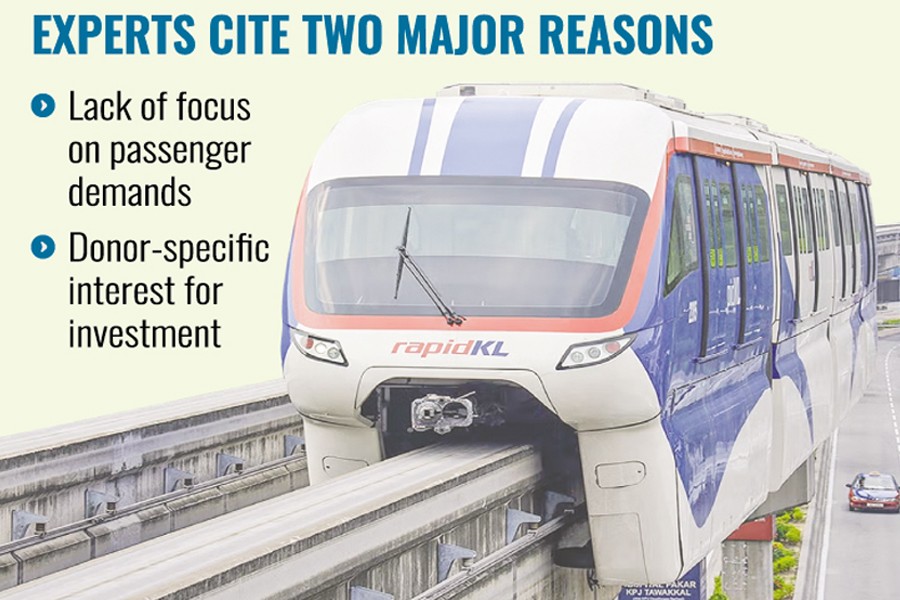
Officials and experts termed lack of right focus on local-level passenger demands as well as dominance of donor-funded studies to meet their own mandate of introducing specific transport modes as the causes behind it.
At present, the capital's transport plans are supposed to be taken following guidance of the strategic transport plan (STP), first formulated in 2005. Due to not following options of the plan properly, the 20-year long transport plan was revised twice in 2015 and 2025, shifting only the number of modes.
The STP 2005 proposed three mass rapid transits (MRTs) and three bus rapid transits (BRTs) for the first time for the Dhaka metropolitan. The number of MRTs increased to five and BRTs reduced to two during the first revision of STP in 2015. Of the total, no MRTs have seen the light of implementation after 20 years, except the MRT-6.
The latest RSTP 2025, which is now at the final stage for approval, has updated transport options, focusing on the extension of all proposed MRTs of the RSTP than new corridor development.
Earlier, the Dhaka Integrated Transport Study (DITS) 1994 and the Dhaka Urban Transport Project (DUTP) 1997 focused on bus and circular waterways, and mixing of bus- and rail-based transit as mass transport respectively. Institutional development, traffic management, road network improvement through various infrastructure facilities, etc, were among the focuses of these plans.
The World Bank (WB) funded the first STP, while the Japan International Cooperation Agency (JICA) funded the RSTP, and the Asian Development Bank funded updating of the RTSP. The DITS was funded with cooperation of the UNDP and the WB, and the DUTP by the WB.
In between, the JICA funded the Dhaka Urban Transport Network Development Study (DHUTS) during 2009-2010, which was the pre-feasibility study for the city's first MRT, based on the STP 2005-proposed mass transit options.
Officials connected with the RSTP 2025 said as monorail or LRT was not included in the terms of reference, the latest revision of STP did not focus on it.
BUET Professor Mohammad Shamsul Hoque alleged that the city's transport master plans have been done on donor-specific interest for investment. Despite requiring much lower investment than metro rail, the donors were not interested in other options (monorail or LRT).
If scopes of exploring these were taken into account, the Dhaka city could have mass transit corridors much earlier with low investment than the present, he claimed.
However, some transport experts and analysts said though MRTs require high investment, their passenger transit capacity and scope of coverage are higher than monorail or LRT.
Speed limit, mileage, and frequency of stations are also limited in one rail-based mass transport systems. Monorail or LRT can be used for feeder corridors than prime, they added.
Chief Advisor's Special Assistant on Rail and Road Transport Sheikh Moinuddin said considering the number of commuters and the reality of city roads, combination of different modes of transport should be considered.
"MRT, LRT or monorail - which system would be prime movers for the city - should be reviewed in the country's context," he told the FE.
According to experts, LRT is like a middle ground solution for the lower demand corridors as a way to connect the MRT lines. The highest capacity of monorail is 30,000 passengers per hour per direction (PPHPD), but it is double in the case of MRTs. The densely-populated Dhaka city's passenger demand on one corridor is said to be 60,000 to higher.
The monorail or LRT has been under discussion in the recent days due to slowing down of the planned MRTs and total stoppage of development of BRTs. The cost of the next metro rail corridor is likely to reach Tk 1.0 trillion due to delay and lack of proper review of its study and design. The BRT corridor development project has also been closed recently due to various reasons.
Munima Sultana
Published :
Jan 31, 2026 08:37
Updated :
Jan 31, 2026 11:57
Although at least four major transport plans were taken for the capital city since 1990s, the scope of launching mono rail or light rapid transit (LRT) as a mode of mass transit system was never studied.
Officials and experts termed lack of right focus on local-level passenger demands as well as dominance of donor-funded studies to meet their own mandate of introducing specific transport modes as the causes behind it.
At present, the capital's transport plans are supposed to be taken following guidance of the strategic transport plan (STP), first formulated in 2005. Due to not following options of the plan properly, the 20-year long transport plan was revised twice in 2015 and 2025, shifting only the number of modes.
The STP 2005 proposed three mass rapid transits (MRTs) and three bus rapid transits (BRTs) for the first time for the Dhaka metropolitan. The number of MRTs increased to five and BRTs reduced to two during the first revision of STP in 2015. Of the total, no MRTs have seen the light of implementation after 20 years, except the MRT-6.
The latest RSTP 2025, which is now at the final stage for approval, has updated transport options, focusing on the extension of all proposed MRTs of the RSTP than new corridor development.
Earlier, the Dhaka Integrated Transport Study (DITS) 1994 and the Dhaka Urban Transport Project (DUTP) 1997 focused on bus and circular waterways, and mixing of bus- and rail-based transit as mass transport respectively. Institutional development, traffic management, road network improvement through various infrastructure facilities, etc, were among the focuses of these plans.
The World Bank (WB) funded the first STP, while the Japan International Cooperation Agency (JICA) funded the RSTP, and the Asian Development Bank funded updating of the RTSP. The DITS was funded with cooperation of the UNDP and the WB, and the DUTP by the WB.
In between, the JICA funded the Dhaka Urban Transport Network Development Study (DHUTS) during 2009-2010, which was the pre-feasibility study for the city's first MRT, based on the STP 2005-proposed mass transit options.
Officials connected with the RSTP 2025 said as monorail or LRT was not included in the terms of reference, the latest revision of STP did not focus on it.
BUET Professor Mohammad Shamsul Hoque alleged that the city's transport master plans have been done on donor-specific interest for investment. Despite requiring much lower investment than metro rail, the donors were not interested in other options (monorail or LRT).
If scopes of exploring these were taken into account, the Dhaka city could have mass transit corridors much earlier with low investment than the present, he claimed.
However, some transport experts and analysts said though MRTs require high investment, their passenger transit capacity and scope of coverage are higher than monorail or LRT.
Speed limit, mileage, and frequency of stations are also limited in one rail-based mass transport systems. Monorail or LRT can be used for feeder corridors than prime, they added.
Chief Advisor's Special Assistant on Rail and Road Transport Sheikh Moinuddin said considering the number of commuters and the reality of city roads, combination of different modes of transport should be considered.
"MRT, LRT or monorail - which system would be prime movers for the city - should be reviewed in the country's context," he told the FE.
According to experts, LRT is like a middle ground solution for the lower demand corridors as a way to connect the MRT lines. The highest capacity of monorail is 30,000 passengers per hour per direction (PPHPD), but it is double in the case of MRTs. The densely-populated Dhaka city's passenger demand on one corridor is said to be 60,000 to higher.
The monorail or LRT has been under discussion in the recent days due to slowing down of the planned MRTs and total stoppage of development of BRTs. The cost of the next metro rail corridor is likely to reach Tk 1.0 trillion due to delay and lack of proper review of its study and design. The BRT corridor development project has also been closed recently due to various reasons.