Home Watch Videos Wars Movies Login

[🇧🇩] City Buses, Metro Rail, Urban Transport & City Road Infra

[🇧🇩] City Buses, Metro Rail, Urban Transport & City Road Infra
181
12K
More threads by Bilal9

G Bangladesh Defense

Gabtoli-Dasherkandi metro rail project to go before ECNEC Wednesday, cost estimated at Tk455.03 billion

Staff Correspondent
Dhaka
1789428393152.webp

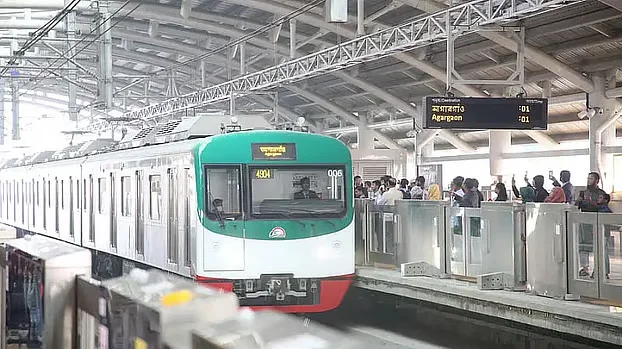
Metro rail Prothom Alo file photo

The government has taken an initiative to build a new metro rail route from Gabtoli to Dasherkandi in Dhaka. The project, titled the “Dhaka Mass Rapid Transit Development Project (Line-5): Southern Route”, is estimated to cost Tk455.03 billion (45,503 crore).

Of this amount, Tk151.97 billion will be financed by the government. The remaining Tk303.06 billion will be secured as project loans from the Asian Development Bank (ADB) and South Korea.

According to the Planning Commission, the project is scheduled to be implemented from September 2026 to August 2033. It may be placed before the Executive Committee of the National Economic Council (ECNEC) on Wednesday for approval.

Speaking about this, transport infrastructure expert and Bangladesh University of Engineering and Technology (BUET) professor Md Hadiuzzaman told Prothom Alo, “The tendering process for the new metro project has created an opportunity for open competition. That opportunity did not exist in the projects financed by Japanese loans. The tenders were designed in such a way that no companies other than Japanese ones could participate.”

He believes that moving away from dependence on a single source of financing will also help reduce costs. However, the expert said the project cost could rise or fall after companies participate in the tender process. Experts have also stressed the need to remain vigilant about quality.

Metro rail route

The proposed new metro route will begin at Gabtoli and run through Technical Mor (Intersection), Kalyanpur, Shyamoli, College Gate, Asad Gate, Sukrabad, Karwan Bazar, Hatirjheel, Tejgaon, Aftabnagar, Aftabnagar Centre, Aftabnagar East and Nasirabad before reaching Dasherkandi.

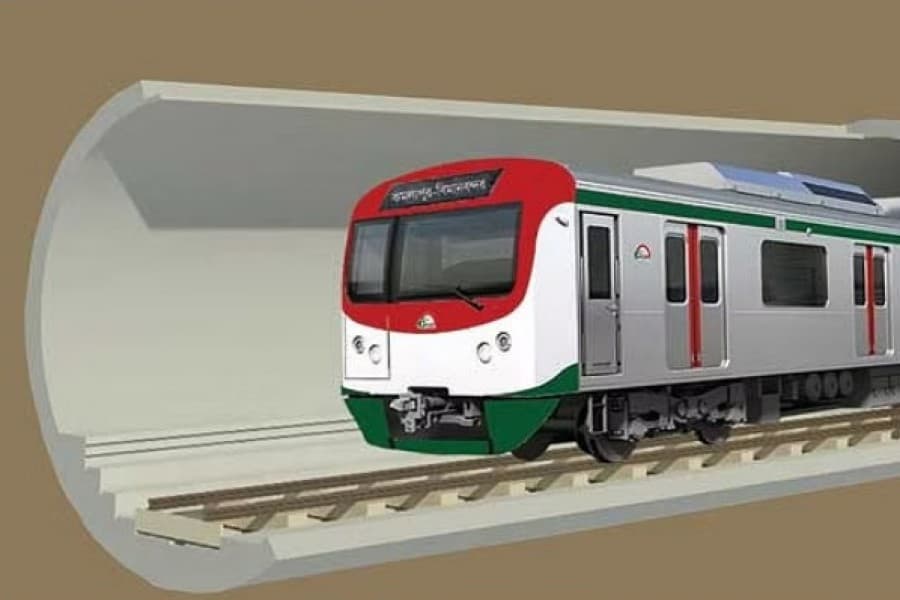
A depot will be built at Dasherkandi under the project. The metro line will run underground from Gabtoli to Aftabnagar and on an elevated viaduct from Aftabnagar to Dasherkandi. Of the total route, 13 kilometres will be underground and the remaining four kilometres elevated.

How much will it cost?

The largest share of the project cost will go towards constructing the main line, stations and depot. An estimated Tk177.37 billion has been allocated for this, accounting for 39 per cent of the total cost.

Another Tk132.58 crore, or 29 per cent of the total, will be spent on electrical and mechanical equipment and the rail system. A further Tk48.21 billion will be spent on procuring trains and depot equipment.

The proposal also includes Tk49.79 billion for land acquisition and rehabilitation and Tk16.26 billion for consultancy services. Another Tk9.31 billion has been allocated for utility relocation. Around 134 hectares of land will need to be acquired and people rehabilitated for the project.

According to Planning Commission documents, the estimated cost of the project has been revised several times. It was initially set at Tk546.19 billion, before being reduced to Tk477.21 billion and then to Tk476.45 billion.

Following the latest review held on 16 July 2026, the project cost was reduced further to Tk455.03 billion. This is Tk21.41 billion lower than the previous proposal.

The project documents state that tunnel boring technology will be used to construct the underground section. The feasibility study was completed in October 2022.

The project has been included in the Annual Development Programme (ADP) for the 2026–27 fiscal year as a new, unapproved project for foreign financing. The Planning Commission has recommended that the project be approved.​
 
Analyze

Analyze Post

Add your ideas here:
Highlight Cite Respond

Tk 126b cut from costs of 3 metro rail projects


1789532673644.webp


A prolonged uncertainty over the costs of three major metro-rail projects is nearing an end, with their revised development proposals set to receive approval soon after the government cut more than Tk 126 billion from their projected costs.

However, even after the reductions, the combined estimated cost of MRT-1, MRT-5 North and MRT-5 South will remain over Tk 2.5 trillion.

Of the three projects, MRT-1 is now proposed to cost around Tk 1.20 trillion, MRT-5 North Tk 899 billion and MRT-5 South Tk 455.03 billion, according to project and Planning Commission officials.

1789532695663.webp


MRT-5 South is set to be placed before the Executive Committee of the National Economic Council (ECNEC) at its meeting on Wednesday, officials said. The project cost has been reduced by Tk 91.15 billion from the original development project proposal (DPP) prepared in 2023 and by Tk 22.18 billion from the estimate made later because of delays in approving the DPP.

The DPPs of MRT-1 and MRT-5 North have also been revised and sent to the Planning Commission, with their costs reduced by Tk 40 billion and Tk 63.99 billion respectively.

Project Evaluation Committee meetings on the two projects were held on 30 August, and Planning Commission officials said they may be placed before the next ECNEC meeting.

The three metro rail projects had remained stalled for nearly two years, mainly over contract packages for MRT-1 and MRT-5 North, after unusually high financial proposals were submitted. The Dhaka Mass Transit Company Limited (DMTCL) had alleged that the high bids resulted from a lack of competition, with a limited number of companies participating in the tenders.

MRT-5 South, meanwhile, remained pending despite its DPP being sent to the Planning Commission first in July 2024 and again towards the end of 2025. The interim government declined to approve the proposal amid concerns over its high estimated cost, leaving the decision for the elected government.

According to DMTCL, MRT-5 South, planned from Gabtoli to Dasherkandi, was initially estimated at Tk 546.18 billion at the design stage in 2023. The estimate was later revised to Tk 477.21 billion when the DPP was submitted for approval during the interim government's tenure. The project is now proposed at Tk 455.03 billion for ECNEC approval.

Meanwhile, Japan International Cooperation Agency (JICA) is financing MRT-1 and MRT-5 North. MRT-1 will connect Hazrat Shahjalal International Airport with Kamalapur, with a branch linking Purbachal and Notun Bazar. The 31.24-kilometre MRT-1 will include both elevated and underground sections.

The MRT-1 project, originally approved in 2019 at Tk 525.61 billion, was sent to the Planning Commission with a revised estimate of Tk 1.14 trillion. It is now proposed at around Tk 1.20 trillion.

MRT-5 North, planned from Hemayetpur to Bhatara, was originally approved in 2019 at Tk 422.34 billion. DMTCL had projected its revised cost at around Tk 930 billion after reviewing unusually high quotations for some contract packages. The revised proposal now puts the cost at Tk 899 billion.

Project officials said the reductions in all three projects were achieved mainly by adjusting internal project components rather than through negotiations with financiers or changes resulting from contract evaluations.​
 
Analyze

Analyze Post

Add your ideas here:
Highlight Cite Respond

How high will fares be on such costly metro rail projects?

Anowar Hossain

1789703154326.webp

Construction works of metro rail project in DhakaProthom Alo file photo

After the government decided to implement three metro rail projects at a cost of Tk 2.5 trillion (Tk 250,000 crore), one question has come to the fore: how high will fares have to be on such an expensive metro rail system? Will the revenue generated by the projects be enough to repay the loans?

At its meeting yesterday, Wednesday, the Executive Committee of the National Economic Council (ECNEC) approved cost increases for two metro rail projects and a new project covering three routes: Hemayetpur to Bhatara, Airport to Kamalapur, and Gabtali to Dasherkandi in Dhaka.

The total cost of the three projects has reached Tk 2.5 trillion. Metro rail revenue comes primarily from fares. To recover such a huge investment, fares would have to be set at a very high level.

Otherwise, the government would have to provide substantial subsidies to repay the loans. That, in turn, would put further pressure on the overall economy.

The Metro Rail Act 2015 states that the purpose of the public transport system is to “provide the public with fast and improved public transport services at low cost”. One provision of the law says that operating costs and people’s ability to pay must be taken into account when setting fares.

The fare set for the Uttara–Motijheel route under the Awami League government, which was ousted in the July mass uprising, is higher than fares on metro systems in neighbouring countries. The government at the time said the metro rail was for both the rich and the poor. Yet poor people are rarely seen using the metro.

The minimum fare on the Uttara–Motijheel route is currently Tk 20. A journey from one end to the other costs Tk 90. The distance is 20 kilometres. No bus in Dhaka charges as much for that distance. The government-set bus fare for travelling the same distance is Tk 50, while the minimum bus fare in Dhaka is Tk 10. The metro, of course, is air-conditioned, whereas most buses in Dhaka are not.

The picture that emerges is that Dhaka is getting a modern public transport system, but not one that is low-cost. Nor is it fully in line with the affordability expected of public transport.

Of the three metro rail projects approved by ECNEC yesterday, one is new and two involve revised proposals. At a total cost of Tk 2.5 trillion, the three projects will build 64.44 kilometres of metro rail, combining underground and elevated sections.

Across the three projects, the average cost of constructing the metro lines and putting the trains into operation will be Tk 38.76 billion per kilometre. The cost on the Uttara–Motijheel route is Tk 15.84 billion per kilometre. The project was taken up in 2012, but its cost has increased several times. The entire route is elevated.

Dhaka Mass Transit Company Limited (DMTCL) is responsible for constructing and operating metro rail in Dhaka. During the interim government’s tenure, DMTCL analysed the costs of metro rail projects being implemented in various Asian countries. The analysis found that, excluding land acquisition and salaries and allowances, metro rail construction in India cost Tk 1.5 billion to Tk 4.5 billion per kilometre.

Two of the projects are being implemented with loans from Japan’s development cooperation agency JICA. Their combined cost is around Tk 2.04 trillion. The other project is being financed by the Asian Development Bank (ADB), with a projected cost of Tk 455 billion.

Government sources said the two JICA-funded projects—MRT Line-1 and MRT Line-5 North—were not initially on the agenda of yesterday’s ECNEC meeting. The plan had been to approve only the new project, Line-5 South, financed by loans from the ADB and South Korea.

The two projects involving proposed cost increases were added at the last moment. The reason, according to the sources, was that the per-kilometre cost of Line-5 South is comparatively low. If that project had been approved first, questions could have been raised about revising the costs of the more expensive projects. The three projects were therefore approved together.

Impossible to repay loans from revenue

Metro rail services began in Dhaka on 29 December 2022. An analysis of revenue shows that ticket sales on the Uttara–Motijheel route generated around Tk 4 billion in the last financial year (2024–25), based on provisional figures.

Ticket revenue was around Tk 2.44 billion in 2023–24. After partial operations began in 2022, revenue from ticket sales was more than Tk 220 million in 2022–23.

In total, passenger fares generated Tk 666 crore up to the end of the latest financial year. In addition, the metro earns around Tk 20 crore a year from shop rentals, advertising and other sources.

According to DMTCL sources, more than Tk 1 billion was spent last financial year on salaries and allowances, electricity and other expenses alone. Initially, when maintenance and equipment were required, the contractors bore the costs under the project. That period ended in January. DMTCL now has to bear the costs of maintenance and equipment purchases itself. As a result, expenditure in this area is expected to rise further in the future.

A loan of Tk 197.18 billion was taken from JICA to build the metro rail from Uttara to Kamalapur. The loan, including interest and principal, has to be repaid over 30 years in two instalments each year. If the value of foreign currencies rises, the amount Bangladesh has to pay in taka will also increase.

According to DMTCL sources, repayment of the principal on the JICA loan was deferred for the first 10 years of construction, known as the grace period. Limited loan repayments began in June 2023.

Around Tk 4.65 billion will have to be repaid this year. More than Tk 37 billion will have to be paid in instalments through 2030–31. The current revenue from the Uttara–Motijheel route will not be enough to cover the instalments.

DMTCL officials said JICA is providing loans of around Tk 1.5 trillion for two new projects being implemented with Japanese financing. These loans, including interest, will have to be repaid over the next 40 years. For the other metro rail project, around Tk 350 billion is being borrowed from the ADB and South Korea.

Why are costs rising?

Officials of the Road Transport and Highways Division and DMTCL said the terms attached to JICA loans give Japanese contractors additional advantages. Japanese companies also play major roles at various stages of the projects, including feasibility studies, design, tender preparation and implementation. JICA approval is required for various tender-related decisions, making it difficult to create genuinely open international competition.

There are also allegations that technical conditions in the tenders are limiting competition. One example is the requirement to use the “one-pass joint” method in the construction of the underground section of MRT Line-1, a technology developed in Japan.

Government sources said the current BNP government had been somewhat concerned about the high cost of metro rail construction after taking office. It held several rounds of discussions with JICA in an effort to reduce the increased costs. But JICA did not agree to reduce costs by opening up the tendering process or through negotiations, the sources said.

Experts and the government agree that Dhaka needs public transport systems such as metro rail. There has also been discussion that the government could face criticism if it does not build the new metro rail projects because of their higher costs.

Professor Shamsul Hoque of the Department of Civil Engineering at Bangladesh University of Engineering and Technology (BUET) told Prothom Alo that the proposed expenditure was undoubtedly a risky investment. “The country is already carrying a heavy debt burden. That burden has now increased further. The question is how the people of the country will be able to bear it,” he said. He added that feasibility studies had shown the Uttara–Kamalapur metro route to be the most financially viable. “Even there, the costs cannot be recovered.”

The professor further said that JICA had conducted the metro rail feasibility study. “The contractor is Japanese, the technology is theirs, and the supervision is also in their hands. They provide the loans in the Japanese currency, the yen. The products are purchased from that country. Bangladesh then has to repay the loans in dollars. With so many weaknesses, it is not possible to implement the projects at competitive prices,” he said.​
 
Analyze

Analyze Post

Add your ideas here:
Highlight Cite Respond

Metro Rail: Nearly 500,000 passengers a day, how much revenue generated?

1789859697214.webp
 
Analyze

Analyze Post

Add your ideas here:
Highlight Cite Respond

DMTCL faces capacity challenge with three new metro projects
Limited manpower and technical expertise raise concerns over simultaneous implementation


1789962229549.webp


Dhaka Mass Transit Company Limited (DMTCL) faces a major institutional capacity challenge as it prepares to implement three metro rail projects simultaneously, with limited manpower and technical expertise raising concerns over its ability to manage the massive workload.

The Executive Committee of the National Economic Council (ECNEC) approved the Mass Rapid Transit (MRT) Line-1, MRT-5 North and MRT-5 South at its meeting on Wednesday, involving a combined estimated cost of about Tk 2.5 trillion.

The projects are scheduled for completion between 2033 and 2035, putting additional pressure on the state-owned metro rail company, which is still grappling with operational and maintenance challenges in the country's first metro rail, MRT-6.

Sources said DMTCL had been struggling with a shortage of skilled manpower and technical expertise in operating and maintaining MRT-6. Against this backdrop, they said, implementing three more projects simultaneously would be a major challenge.

They said the more than two-year delay in approving the three projects had also affected DMTCL's manpower structure, as a number of officials had either moved to other projects under the company or been transferred elsewhere.

Except for MRT-5 South, the project directors of the three projects have been changed.

According to data on the DMTCL website, MRT-6, which is in the final stage of work on its extension, has 55 staff members, while MRT-1 and MRT-5 North have 71 and 66, respectively. MRT-5 South currently has 33 staff members.

"DMTCL's limited capacity has already been reflected in the first metro rail project, MRT-6, as whatever flaws are being faced during its operation and maintenance stage are due to faults at the construction level," said a source, requesting anonymity.

The company's readiness needs to be ensured first before awarding the contracts, as its recruitment and training were also not carried out accordingly since its inception, the source added.

DMTCL's managing director did not respond to the FE's request for comment. The FE also contacted the secretary of the Road Transport and Highways Division, who declined to comment. Additional Secretary Anisur Rahman, however, said DMTCL had the capacity, but declined to elaborate.

Two project directors acknowledged the challenges, saying all necessary steps were being taken to overcome them.

"We have learned from our past experiences and will learn more over the next seven to eight years of the implementation stage," said one of the project directors.

Experts, however, said failure to address the problems and establish accountability for the issues encountered in MRT-6 - including fallen and damaged bearing pads, operating in lower speed, dislocation and cracks in piers - could lead to similar problems in the upcoming projects.

"There is no learning culture in DMTCL due to a lack of good governance, as DMTCL has become a bureaucratic hub like other institutions," said BUET Professor Mohammad Shamsul Hoque.

He said that due to a lack of homegrown expertise, the dedicated metro rail company had to seek assistance from BUET on various technical issues, which was undesirable for a specialised institution.

Sector analysts said that as MRT-5 North and MRT-1 are now at the contract-awarding stage, the project offices must have sufficient capacity to negotiate with contractors and ensure that problems encountered in the first project are not repeated.

They also said weak leadership had contributed to project cost increases running into trillions of taka, resulting in some of the highest construction costs per kilometre.

They argued that transferring MRT-6 officials to the other three projects might help carry forward their experience, but it would be difficult to expect good results from officials who, they alleged, had enjoyed impunity for many of their past wrongdoings.​
 
Analyze

Analyze Post

Add your ideas here:
Highlight Cite Respond

Should construction costs of metro-rail be so high?


1789962827793.webp


The approval of three metro-rail megaprojects at a combined cost of Tk2.5 trillion marks the record high investment in communication in the country's history. Of these three mass rapid transit (MRT) projects, two were approved in 2019 and the third one is new. Revisions of costs and deadline for completion of the two stalled projects MRT-1 and MRT-5 (northern route) had to be made before the approval. The cost of MRT-1, the country's first underground rail tracks, has shot up from Tk618.33 billion to Tk1.14 trillion and its construction has been scheduled for completion in 2033. Similarly, the northern route of the MRT-5 has its budget revised upward to Tk898.48 billion from Tk412.38. The cost escalation is more than double in both cases. Then the MRT-5 (southern route) with 13.10 kilometre underground and 4.10 kilometre overhead will cost Tk455.04 billion.

Here the stated purpose is to jumpstart the city's commute free of long tailbacks as experienced on the city roads on a regular basis. Metro rail will connect the east with the west and the north with the south of the megacity. But before rushing head over heels, there is a need for an objective review of the situation. First comes the question of abnormal costs and their snowballing effects on ticket pricing. When investment on each kilometre is more than double, the commute for the same distance is likely to be costlier too ---if not double the rate of the MRT line-6, at least significantly higher than that. There is every chance that the rate will be beyond affordability of low-income people. This again will contribute to greater social disparities in terms of daily commute.

Other prospects also do not look bright. In an unplanned city with roads and footpaths encroached upon haphazardly, the intra-city metro passengers need feeder roads to move quickly to their destinations. Even if their destinations are at a walking distance, they cannot walk with ease because of the illegal occupation of footpaths and parts of the roads. The traffic anarchy created due to mismanagement of buses mostly unfit and ramshackle with the latest addition of unlimited proliferation of battery-driven three-wheelers is simply nightmarish.

Without addressing the unregulated traffic on the city roads, metro-rail cannot be a panacea for movement of people and vehicles in the capital or other cities. The Strategic Transport Plan-2005 envisioned an integrated system of transportation. There was recommendation for improving the quality of buses, bus route franchising, bus rapid transit etc. Later, bus route franchising was also experimentally introduced but it did not work because of the cosmetic surgery while there was a need for a major reconstructive one. Although announcements for removing unfit or lifespan-completed vehicles off the road were made several times by successive administrations, political clouts have always prevailed to frustrate any such initiative.

Then comes the financial burden of the proposed metro-rail expansion. Although the Asian Development Bank (ADB) and South Korea are expected to finance the MRT-5 (southern route) and the Japan International Cooperation Agency (JAICA) as usual provides the fund for the MRT-1 and MRT-5 (northern route), there are a few unanswered questions. The agreements on construction of the two routes were signed in 2019 and should the revised expenditure on those routes be more than double? Negotiations should have focused on the earlier agreements.

The state minister for planning has tried to justify that cost escalation is due to pricey dollar, extended works and rising costs of construction materials. Well, all these are unlikely to justify the more than double expenditure. Megaprojects need mega-investment but these look far too much. More, the debt payment will as well soar sky-high. In 2024-25 fiscal year, Bangladesh had to repay US$4.09 billion in loan, of which principal repayment was US$2.595 billion and the rest US$1.491 in interest payment. The loan payment obligation may increase to a staggering level, further eroding the country's capacity to finance development programmes. Certainly, not a savouring prospect!​
 
Analyze

Analyze Post

Add your ideas here:
Highlight Cite Respond

Latest Posts

Back
 
G
O
 
H
O
M
E