


 Bangladesh Defense
Saif
Senior Member
- Joined
- Jan 24, 2024
- Messages
- 21,186
- Likes
- 9,688
- Nation

- Residence
- Axis Group

LNG reliance deepens energy crisis, yet Bangladesh doubles down
Shahriar Azam . Dhaka 20 September, 2026, 05:53
Bangladesh is living through an energy crisis largely of its own making, born of a decade-long push to meet its energy needs through heavy reliance on imported fossil fuels.
Billions have been spent on liquified natural gas since its import began in 2018 but the gas crisis is far from over. Households have never seen a shortage reach this far with literally no supply for weeks now.
Yet, nearly every fix now on the table, from emergency spot-market cargoes to new floating LNG terminals, offers ways that started the problem in the first place.
Bangladesh first turned to imported LNG to plug a widening gap between demand and dwindling output from domestic fields, brushing aside warnings that tying the national grid to a volatile global market would eventually expose the country to shocks well beyond its control.
Those warnings have since played out in full. The closure of the Strait of Hormuz amid the latest Middle East conflict choked off a critical import corridor, triggering fuel queues that stretched for kilometres at filling stations, leaving families to go without cooking gas and forcing industrial production lines to scale back.
Yet the response drawn up by the government remains, in essence, a repeat of the old playbook: more LNG purchases, more regasification terminals – this time at prices markedly higher than those Bangladesh paid during the tenure of the Awami League government, which was deposed from power in 2024 by a student-led mass uprising amid a deepening economic crisis.
‘Additional floating LNG terminals cannot provide a sustainable solution,’ said energy expert Badrul Imam, who has argued for years that Bangladesh must prioritise exploring and developing its own gas reserves rather than deepening its reliance on imports.
The scale of that reliance is stark. Domestic gas production, including output from state-run Petrobangla and international oil companies, has fallen to around 1,600 million cubic feet per day, down from roughly 2,700 mmcfd in 2016 – a decline of more than 40% even as demand has climbed.
Bangladesh currently has two floating storage and regasification units in Maheshkhali. The latest emergency began with the disruption at one of them on July 21, but officials and analysts say the vulnerability runs far deeper.
Scrambling to secure cargoes on a volatile spot market, the Cabinet Committee on Government Purchase on September 2 approved deals with BP Singapore Pte Ltd at $28.03 per million British thermal units and Aramco Trading Singapore at $27.54 per MMBtu – well above the $20-$21.50 range of earlier tenders that had gone unapproved.
Officials estimate that every $1 rise in the price of LNG per unit adds roughly Tk 41.33 crore to the government’s bill, or at least Tk 165 crore per cargo.
The annual LNG subsidy for 2026-27 has been burned in just the first two months of the fiscal year.
Rather than reverse course, the government has doubled down.
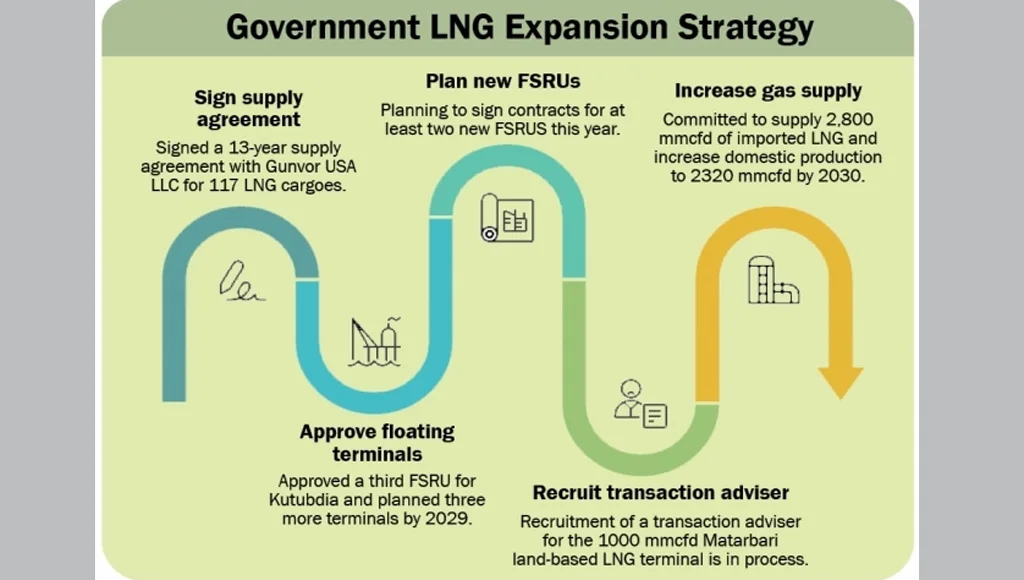
On July 29 it signed a 13-year supply agreement with US-based Gunvor USA LLC for 117 LNG cargoes, locking in long-term volumes but not, analysts caution, insulating the country from price swings or from the geopolitical risk that has already disrupted supply once.
A third FSRU has been approved for Moheshkhali’sKutubdia, with three more floating terminals planned by 2029 at Payra, Mongla and Hiron Point – an expansion that, critics say, entrenches the very dependency that caused the crisis rather than resolving it.
State minister for power, energy and mineral resources Aninda Islam Amit on September 7 said in the parliament, the government was planning to sign contracts for at least two new FSRUs this year with a possibility of a third in the Mongla region. Recruitment of a transaction adviser for the 1000 mmcfdMatarbari land-based LNG terminal was in process.
Amit said domestic gas production is depleting at a rate of 150 mmcfd per year.
The government is committed to supply around 2,800 mmcfd of gas from imported LNG through new infrastructures by 2030, while domestic gas production will be increased to 2320 mmcfd through digging 150 wells by this timeframe, the state minister told parliament.
However, as a welcome move to fast tract clean energy transition, the cabinet on September 7 approved a proposal to exempt the import of machinery and parts required for setting up renewable solar plants from various taxes and duties for six months.
‘The energy sector is falling back into a vicious cycle of capacity payments,’ said FarseemMannanMohammedy, an energy expert, adding that such charges pile up regardless of whether the underlying facility – a power plant, an FSRU, a coal plant or a solar project – is even generating power.
He also pointed to a persistent lack of transparency in how these agreements are struck.
The Power Development Board paid out more than Tk 44,000 crore in capacity payments in the fiscal year through June 2025, a figure projected to top Tk 48,000 crore this year; the FSRUs alone cost an estimated $454,000 a day in such charges.
For the proposed third FSRU in Maheshkhali’sKutubjom, China National Energy Engineering & Construction Co will charge $3,42,000 per day as station charge.
Installed generation capacity stands at 29,158 megawatts across 137 plants, yet fuel shortages mean less than half of that can be used, indicating unplanned development.
Renewable energy remains a fraction of the mix: 1,446 megawatts on-grid and 378 megawatts off-grid, according to the Sustainable and Renewable Energy Development Authority, far short of the 20% by 2030 target set out in the ruling party’s manifesto.
On the ground, the toll is mounting. More than 900 textile mills have shut down or scaled back operations, officials and industry groups say, while steel, paper and other manufacturers are running well below capacity, threatening exports and jobs.
Low gas pressure has disrupted household cooking across the country, pushing families toward costlier alternatives as LPG prices climb, while long queues at CNG refuelling stations have become a fixture of daily life for autorickshaw and ride-share drivers.
Government ministers have conceded there is no quick fix. Zahed Ur Rahman, the prime minister’s adviser on information and broadcasting, recently said resolving the shortage fully could take at least two years – a timeline echoed separately by the power, energy and mineral resources minister and the finance minister.
For now, Bangladesh remains caught between an old strategy that helped create the crisis and a new one that largely extends it.
Breaking that cycle, analysts say, will require sustained investment in domestic exploration, tighter fiscal discipline over costly import contracts, and a genuine push toward energy sources the country does not have to import at all.
Shahriar Azam . Dhaka 20 September, 2026, 05:53
Bangladesh is living through an energy crisis largely of its own making, born of a decade-long push to meet its energy needs through heavy reliance on imported fossil fuels.
Billions have been spent on liquified natural gas since its import began in 2018 but the gas crisis is far from over. Households have never seen a shortage reach this far with literally no supply for weeks now.
Yet, nearly every fix now on the table, from emergency spot-market cargoes to new floating LNG terminals, offers ways that started the problem in the first place.
Bangladesh first turned to imported LNG to plug a widening gap between demand and dwindling output from domestic fields, brushing aside warnings that tying the national grid to a volatile global market would eventually expose the country to shocks well beyond its control.
Those warnings have since played out in full. The closure of the Strait of Hormuz amid the latest Middle East conflict choked off a critical import corridor, triggering fuel queues that stretched for kilometres at filling stations, leaving families to go without cooking gas and forcing industrial production lines to scale back.
Yet the response drawn up by the government remains, in essence, a repeat of the old playbook: more LNG purchases, more regasification terminals – this time at prices markedly higher than those Bangladesh paid during the tenure of the Awami League government, which was deposed from power in 2024 by a student-led mass uprising amid a deepening economic crisis.
‘Additional floating LNG terminals cannot provide a sustainable solution,’ said energy expert Badrul Imam, who has argued for years that Bangladesh must prioritise exploring and developing its own gas reserves rather than deepening its reliance on imports.
The scale of that reliance is stark. Domestic gas production, including output from state-run Petrobangla and international oil companies, has fallen to around 1,600 million cubic feet per day, down from roughly 2,700 mmcfd in 2016 – a decline of more than 40% even as demand has climbed.
Bangladesh currently has two floating storage and regasification units in Maheshkhali. The latest emergency began with the disruption at one of them on July 21, but officials and analysts say the vulnerability runs far deeper.
Scrambling to secure cargoes on a volatile spot market, the Cabinet Committee on Government Purchase on September 2 approved deals with BP Singapore Pte Ltd at $28.03 per million British thermal units and Aramco Trading Singapore at $27.54 per MMBtu – well above the $20-$21.50 range of earlier tenders that had gone unapproved.
Officials estimate that every $1 rise in the price of LNG per unit adds roughly Tk 41.33 crore to the government’s bill, or at least Tk 165 crore per cargo.
The annual LNG subsidy for 2026-27 has been burned in just the first two months of the fiscal year.
Rather than reverse course, the government has doubled down.
On July 29 it signed a 13-year supply agreement with US-based Gunvor USA LLC for 117 LNG cargoes, locking in long-term volumes but not, analysts caution, insulating the country from price swings or from the geopolitical risk that has already disrupted supply once.
A third FSRU has been approved for Moheshkhali’sKutubdia, with three more floating terminals planned by 2029 at Payra, Mongla and Hiron Point – an expansion that, critics say, entrenches the very dependency that caused the crisis rather than resolving it.
State minister for power, energy and mineral resources Aninda Islam Amit on September 7 said in the parliament, the government was planning to sign contracts for at least two new FSRUs this year with a possibility of a third in the Mongla region. Recruitment of a transaction adviser for the 1000 mmcfdMatarbari land-based LNG terminal was in process.
Amit said domestic gas production is depleting at a rate of 150 mmcfd per year.
The government is committed to supply around 2,800 mmcfd of gas from imported LNG through new infrastructures by 2030, while domestic gas production will be increased to 2320 mmcfd through digging 150 wells by this timeframe, the state minister told parliament.
However, as a welcome move to fast tract clean energy transition, the cabinet on September 7 approved a proposal to exempt the import of machinery and parts required for setting up renewable solar plants from various taxes and duties for six months.
‘The energy sector is falling back into a vicious cycle of capacity payments,’ said FarseemMannanMohammedy, an energy expert, adding that such charges pile up regardless of whether the underlying facility – a power plant, an FSRU, a coal plant or a solar project – is even generating power.
He also pointed to a persistent lack of transparency in how these agreements are struck.
The Power Development Board paid out more than Tk 44,000 crore in capacity payments in the fiscal year through June 2025, a figure projected to top Tk 48,000 crore this year; the FSRUs alone cost an estimated $454,000 a day in such charges.
For the proposed third FSRU in Maheshkhali’sKutubjom, China National Energy Engineering & Construction Co will charge $3,42,000 per day as station charge.
Installed generation capacity stands at 29,158 megawatts across 137 plants, yet fuel shortages mean less than half of that can be used, indicating unplanned development.
Renewable energy remains a fraction of the mix: 1,446 megawatts on-grid and 378 megawatts off-grid, according to the Sustainable and Renewable Energy Development Authority, far short of the 20% by 2030 target set out in the ruling party’s manifesto.
On the ground, the toll is mounting. More than 900 textile mills have shut down or scaled back operations, officials and industry groups say, while steel, paper and other manufacturers are running well below capacity, threatening exports and jobs.
Low gas pressure has disrupted household cooking across the country, pushing families toward costlier alternatives as LPG prices climb, while long queues at CNG refuelling stations have become a fixture of daily life for autorickshaw and ride-share drivers.
Government ministers have conceded there is no quick fix. Zahed Ur Rahman, the prime minister’s adviser on information and broadcasting, recently said resolving the shortage fully could take at least two years – a timeline echoed separately by the power, energy and mineral resources minister and the finance minister.
For now, Bangladesh remains caught between an old strategy that helped create the crisis and a new one that largely extends it.
Breaking that cycle, analysts say, will require sustained investment in domestic exploration, tighter fiscal discipline over costly import contracts, and a genuine push toward energy sources the country does not have to import at all.

