Home Watch Videos Wars Movies Login

[🇧🇩] Banking System in Bangladesh

[🇧🇩] Banking System in Bangladesh
411
16K
More threads by Saif

G Bangladesh Defense

Growth in NPLs weakening Bangladesh's banking sector: Experts

The growing trend of non-performing loans (NPLs) in Bangladesh's banking sector is placing severe pressure on the nation's financial system, with default loans now exceeding 32 percent of total disbursements and disrupting the natural cycle of credit recycling.

Mahbub Ullah, former Professor and Chairman of the Department of Development Studies at University of Dhaka, highlighted these concerns while delivering the 23rd Nurul Matin Memorial Lecture on "Ethics in Banking," organized by the Bangladesh Institute of Bank Management (BIBM) on Saturday, reports UNB.

Bangladesh Bank Governor and Chairman of the BIBM Governing Board, Md Mostaqur Rahman, presided over the event. BIBM Director General Dr. Md. Ezazul Islam delivered the welcome address, while Professor and Director (Research, Development and Consultancy) Md. Shihab Uddin Khan offered the vote of thanks.

In his memorial lecture, Dr. Mahbub Ullah observed that the core engine of the banking system—the continuous recycling of loan funds through deposit collection, lending, and reinvestment—has been severely disrupted. Because a significant portion of disbursed loans is not returning on time, banks are facing severe liquidity pressures and constrained lending capacity.

He pointed out that prolonged financial losses and mounting NPLs have left several banks struggling to maintain required capital reserves under international Basel-II standards. Consequently, even solvent institutions are adopting hyper-cautious lending postures, leaving eligible entrepreneurs and industrial enterprises starved of working capital and investment financing—a scenario that threatens national production, employment, and overall economic growth.

Dr. Mahbub Ullah warned that without sustainable measures, systemic risks will escalate, calling for immediate good governance, ethics, accountability, and proper risk management in loan approval and recovery processes.

Presiding over the function, Bangladesh Bank Governor Md Mostaqur Rahman emphasized that a bank's true strength relies not just on capital, technology, or liquidity, but fundamentally on public trust. He urged bankers to uphold the highest professional and ethical standards to safeguard depositor confidence.

BIBM Director General Dr. Md. Ezazul Islam stressed that banking decisions impact the broader economy because banks handle public funds. He noted that board members and top executives must lead by example to establish a culture of integrity, transparency, and accountability across financial institutions.

Concluding the session, BIBM Director Md. Shihab Uddin Khan stated that ongoing banking sector reforms aim not merely to keep troubled banks afloat, but to build a robust, governance-driven financial architecture that protects depositors, directs credit toward productive sectors, and ensures operational transparency.

The lecture was attended by economists, senior bankers, academics, and representatives from various professional sectors.​
 
Analyze

Analyze Post

Add your ideas here:
Highlight Cite Respond

Taxpayers should not have to bear the cost of bad loans

M Kabir Hassan

1789861364667.webp


Bangladesh’s bad loan situation raises a question that accounting alone cannot answer: who should bear the losses? At the end of June 2026, non-performing loans (NPLs) reached about Tk 6,06,555 crore, or 32.78 percent of bank loans. A New Age report says Bangladesh Bank is considering extending the overdue period for classification from three months to nine. That would improve the reported NPL ratio without recovering any money. Delaying recognition leaves the loss where it was.

Besides, repeated loan rescheduling has brought little lasting relief. As a recent commentary published in The Daily Star argues, concessions to large defaulters can make non-payment seem acceptable. Bangladesh needs to acknowledge losses, establish which borrowers can recover to pay off loans, and rebuild viable banks. Further concessions without these decisions will only prolong the problem.

Notably, much of the debate treats loan classification, provisioning, restructuring, write-offs and recapitalisation as interchangeable. Each serves a different purpose, and each has different consequences for the public purse.

Provisions—amounts banks set aside to cover potential losses in case a borrower fails to pay—reduce a bank’s income and capital. They are not government expenditure. Writing off a fully provisioned loan removes it from the bank’s balance sheet, but the borrower’s obligation and the bank’s recovery efforts continue. Public funding becomes relevant only when private capital cannot absorb losses and intervention is needed to protect systemic stability.

The Tk 6,06,555 crore NPL stock therefore does not imply an equivalent taxpayer bill, i.e., it is not an automatic government liability. Banks should first absorb the losses from these NPLs through provisioning and write-offs. Several studies co-authored by me show that how a bank provisions for its loans depends on a number of factors, ranging from institutional incentives to changes in accounting standards and provisioning regulations. Discretionary provisioning can also reduce a bank’s liquidity.

Therefore, the Bangladesh Bank’s move towards risk-based supervision of banks and IFRS 9—an international accounting standard for banks to classify, measure and report loans—requires credible asset-quality reviews of individual banks to establish losses. Besides, the IMF emphasises addressing undercapitalisation in the banking sector, depositor protection, and minimising the fiscal cost of restructuring banks.

Some businesses default because currency shocks, import disruptions, energy shortages or higher interest rates undermine their cash flow. Therefore, restructuring is justified where an independent assessment shows that recovery is possible. Borrowers should contribute equity by putting in more of their own capital, disclose information on beneficial ownership (actual owners who control the business) and accept restrictions on dividends and related-party transfers, and agree on measurable repayment milestones. Non-viable firms, serial reschedulers and diverted funds—used for purposes other than the stated business purpose—warrant different treatment.

Recovery also depends on how quickly disputes are settled. An article in The Daily Star describes Thailand’s out-of-court workouts and specialised bankruptcy procedures. Bangladesh already has a legal basis for mediation: section 22 of the Artha Rin Adalat Ain, 2003, requires court-referred mediation after the defendant (in this case the borrower) has submitted a written statement; section 23 allows a further attempt at alternative dispute resolution (ADR) before judgment.

Banks should use these provisions through mediation lasting 60-90 days, with independent mediators and representatives authorised to settle. Borrowers must disclose their assets and beneficial ownership, and settlements must be enforceable. Recovery proceedings should resume promptly if mediation fails. Parliament could introduce a pre-litigation ADR window for small and medium enterprises and viable corporate borrowers. Clear eligibility rules would help prevent willful defaulters from using mediation to obtain another waiver.

Professionally managed distressed asset companies—specialised firms that buy and manage troubled financial assets—could help banks recover value under Bangladesh Bank oversight. Their usefulness depends on honest transfer prices. Suppose a Tk 100 bad loan has a recovery value of Tk 30. Selling it to an asset management company (AMC) for Tk 90 with a public guarantee conceals a Tk 60 recapitalisation cost, which the taxpayer ultimately bears.

South Korea’s KAMCO and Malaysia’s Danaharta illustrate the importance of credible valuations, professional management, recovery powers and a limited operating life. Ukraine wrote off fully provisioned loans while continuing recovery. These experiences suggest that asset sales work best alongside borrower restructuring, bank recapitalisation and efficient foreclosure, backed by political commitment.

The FY2026-27 budget allocates Tk 36,706 crore to bank mergers and restructuring; the revised FY2025-26 allocation was Tk 41,558 crore. Before drawing on these funds, banks should absorb losses through earnings and capital. Shareholders should face dilution or loss of their investment, and culpable insiders should face clawbacks. Borrower repayments, collateral recoveries and asset sales should reduce the remaining gap. Viable banks should then seek private capital. Taxpayers should supply only the residual capital needed by systemically important banks.

Any public recapitalisation should secure an equity stake in the bank or another recoverable claim. Management changes, recovery targets and a timetable for government exit should be conditions of support.

Bonds issued by the government to recapitalise banks defer cash payments but add to public debt. At an assumed 10 percent financing cost, Tk 36,706 crore would require roughly Tk 3,671 crore in annual interest, alongside about Tk 1,27,500 crore already budgeted for interest payments. Financing insolvency by printing money would create further pressure. Therefore, central bank liquidity should serve only solvent banks experiencing temporary stress.

A three-year timetable should be set up for bad loan clean-up. During the first six months, the asset-quality-review results must be published, distinguishing viable from non-viable banks and restricting dividends at undercapitalised institutions. Over the following 18 months, viable borrowers should be restructured through disciplined workouts and ADR; distressed assets should be sold and fully provisioned loans written off without abandoning recovery. Then, government should recapitalise viable banks and resolve or merge those that cannot survive.

The final year should concentrate on preventing another accumulation of bad loans. Better underwriting (assessment of borrower risk), fit-and-proper tests (strict screening of bank management/directors), board accountability, disclosure of related-party lending and faster collateral enforcement must become routine practice.

A lower reported NPL ratio will mean little if banks still cannot recover their loans. The test is whether Bangladesh restores credible balance sheets, preserves viable businesses and recovers diverted assets while protecting depositors. Taxpayers have a role where stability requires public support, but they should not carry the losses that borrowers, bank owners and responsible insiders can bear.

Dr M Kabir Hassan is professor and Moffett Chair in finance at LSU-New Orleans, US, and member of the AAOIFI Ethics and Governance Board and chairman of its education board.​
 
Analyze

Analyze Post

Add your ideas here:
Highlight Cite Respond

Islamic banks' deposits, investment grow in July


1789962457426.webp


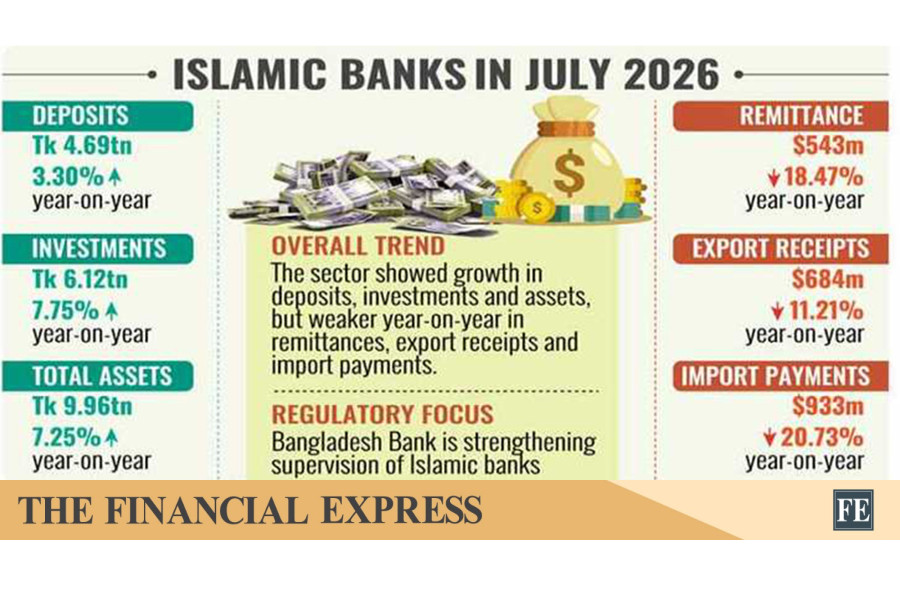
Islamic banks in Bangladesh witnessed mixed trends in deposits, investments, remittances and trade transactions in July, 2026.

Their deposits and investments registered a year-on-year growth while remittances and export receipts declined in the month, according to Bangladesh Bank (BB) data.

The volume of deposits with Islamic banks stood at Tk 4.69 trillion in July 2026, Tk 20 billion or 0.39 per cent up from Tk 4.67 trillion in the previous month (June).

On a year-on-year basis, the amount of deposits increased by Tk 150 billion, or 3.30 per cent, from Tk 4.54 trillion in July 2025.

The central bank data showed that Mudaraba-based deposits continued to dominate Islamic banks' deposit base, accounting for about 87.04 per cent of total deposits.

Private-sector deposits accounted for around 90.01 per cent of the total in July.

Investments by Islamic banks remained almost static at Tk 6.12 trillion in July over the previous month.

However, on a year-on-year basis, their investments increased by Tk 440 billion, or 7.75 per cent, from Tk 5.68 trillion in July 2025.

Islamic banks' workers' remittances rose to $ 543 million in July from $448 million in June, increasing by $ 95 million, or 21.28 per cent.

But on a year-on-year basis, remittances declined by $123 million, or 18.47 per cent, from $ 666 million in July 2025.

On the other hand, total assets of Islamic banks stood at Tk 9.96 trillion in July compared to Tk 9.88 trillion in June, marking an increase of Tk 80 billion, or 0.83 per cent.

Their assets increased by Tk 670 billion or 7.25 per cent year-on-year, from Tk 9.29 trillion.

Islamic banks handled $684 million in export receipts in July, which was $59 million or 7.90 per cent down from US $743 million in June.

The year-on-year export receipts declined by $87 million, or 11.21 per cent, from $771 million.

Despite the decline, Islamic banks continued to handle a relatively stable share of the country's export proceeds, ranging between 17 per cent and 22 per cent.

Import payments through Islamic banks declined to $ 933 million in July from $ 991 million in June, falling by $58 million or 5.91 per cent.

On a year-on-year basis, import payments decreased by $244 million, or 20.73 per cent, from $1.177 billion.

Bangladesh Bank has been strengthening its supervision on Islamic banks, including measures related to liquidity support, identifying weaknesses and improving management capacity, amid efforts to stabilise the sector.​
 
Analyze

Analyze Post

Add your ideas here:
Highlight Cite Respond

Banks fret over deposit buildup sans investment scope
Many banks receiving much money from depositors but finding little avenues for rolling it in economy


1789962712682.webp


Liquidity crunch looks to be a thing of the past now as affluent commercial banks in particular fret over deposit buildup amid squeezing investment avenues for economic slowdown,

An analysis of the paradoxical situation shows various regulatory moves and deposit-mobilising drives by the country's banks helped in gradually restoring people's once-shaken trust in the banking sector. As such, the deposit growth keeps rising, which basically helps boost their stock of excess liquidity.

But such liquidity buildup fails to lighten up mood of the bankers because the demand for private-sector credits has not picked up despite various regulatory moves. On the other hand, yields on government securities are on a downturn feeding on an abundance of liquidity in the banking system.

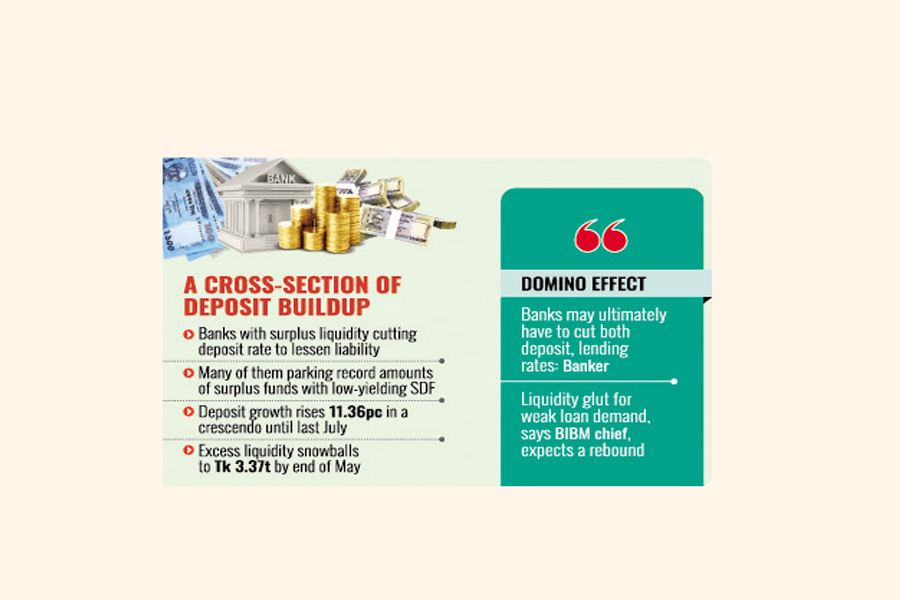
As such, depositors begin to bear its domino effect as banks having surplus liquidity keep cutting deposit rate to lessen the liability while many of them are parking record amounts of surplus funds with the central bank's low-yielding deposit window called Standing Deposit Facility (SDF).

The SDF rate has come down to 7.50 per cent, much lower than that of call money.

According to Bangladesh Bank (BB) data, the deposit growth in the banking system was recorded at 7.77per cent in June last year. Afterwards, it started rising to reach 10.44 per cent in January this year followed by 10. 74 per cent and 11.36 per cent in June and July last respectively.

Seeking anonymity, a BB official said the volume of excess liquidity in the banking industry continued to rise in recent months due mainly to shrinking investment avenues under this macroeconomic sluggishness.

Citing data, the central banker said the volume of excess liquidity was less than Tk 2.80 trillion few months ago but it rose to Tk 3.37 trillion by end of May last--and the rising trend continued.

"So, this (excess liquidity) puts the banks in a problem as loan demand weakens. That's why banks are heavily relying on SDF," the BB official said.

According to the BB data, affluent banks all together kept around Tk 1.50 trillion in the SDF in June last, which is a record in the history of the banking sector.

The official data showed the monthly volume of funds banks parked into the SDF were recorded Tk 545 billion, Tk 578 billion, Tk 444 billion and Tk 444 billion in February, March, April and May last.

Syed Mahbubur Rahman, Managing Director and Chief Executive Officer of Mutual Trust Bank (MTB), feels the growing buildup of excess liquidity is likely to become a pressing challenge for many banks as investment avenues continue to shrink amid prolonged economic sluggishness.

He explains that, in terms of incremental deposit costs, banks are barely making any money, while blended deposit costs remain manageable for some institutions-at least for those considered better managed.

However, Mr. Rahman has cautioned that if the situation persists, commercial banks may ultimately have no alternative but to reduce both deposit and lending rates. In such a scenario, deposit rates may even fall further, thereby rendering the real income of depositors negative.

Managing Director and CEO of Southeast Bank Md. Khalid Mahmood Khan has said the bank has a target of reaching deposit portfolio of Tk 500 billion by the end of upcoming December but they have already reached the milestone.

The lender is concentrating on profitability buildup through reducing the cost of deposit. They have already cut the deposit rate by 50 basis points and the bank will hold an ALCO meeting later this week where further cut in deposit is expected.

Managing Director of Shahjalal Islami Bank Mosleh Uddin Ahmed says the rising stock of un-invested liquidity in banks is turning into a headache for many of them in recent months due to plummeting loan demand.

On squeezing investment avenues, the seasoned banker says the use of central bank's overnight deposit window called SDF by affluent banks is increasing.

According to the BB data, the private-sector-credit growth reached 4.62 per cent by end of July, the second lowest in the history of Bangladesh.

Director-General of Bangladesh Institute of Bank Management (BIBM) Dr Md. Ezazul Islam notes that the liquidity glut in the banking sector is being created because of weak loan demand.

But the number and volume for the opening of LCs or letters of credit are increasing gradually, which gives early indication of economic recovery under the regime of this elected government.

"It's a temporary problem. I believe the credit demand from private sector would go up from the last quarter this year," the economist said, on a note of optimism.

The yields on 91 Days, 182 Days and 364 Days treasury bills stood at 8.31 per cent, 8.45 per cent and 8.47 per cent on Sunday.​
 
Analyze

Analyze Post

Add your ideas here:
Highlight Cite Respond

Latest Posts

Back
 
G
O
 
H
O
M
E