โ˜• Support Us โ˜•
[๐Ÿ‡ง๐Ÿ‡ฉ] - Corruption Watch | Page 11 | PKDefense

[๐Ÿ‡ง๐Ÿ‡ฉ] Corruption Watch

Reply (Scroll)
Press space to scroll through posts
G Bangladesh Defense
[๐Ÿ‡ง๐Ÿ‡ฉ] Corruption Watch
339
11K
More threads by Saif


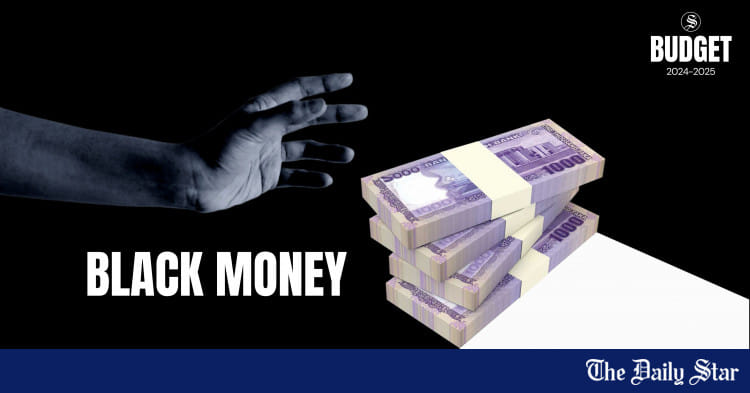
The economics of black money & the budget
HASNAT ABDUL HYE
Published :
Jun 20, 2024 21:49
Updated :
Jun 21, 2024 21:41
1719015710472.png


Like a bee in the bonnet, the proposal in the draft budget for fiscal year 2024-2025 (FY25) to whiten black money after payment of income tax at the rate of 15 per cent has created a buzz in the media and among analysts that has superseded all other criticisms. That the reaction to the proposal would elicit such a virulent response was predictable because it is not the first time this has happened. Knowing that this is going to be 'unpopular' with the vocal section of the population, the decision to go ahead with the proposed amnesty for holders of black money speaks of the desperation of the government to collect revenue from every possible source. It may also be a strategy to bring unaccounted for money from the economy that has come to have the monikers of shadow, parallel, underground and black economy. Since behind most of the vitriolic remarks by critics appears to be the assumption that the holders of black money are corrupt individuals and as such corruption would be rewarded by the proposal, it may be helpful for the discussion to shed some light on the sources of black money

Black money is earned from various sources that elude law of the land and rules and regulations regarding production, sale and distribution of goods and services and through rent seeking, all of which remain outside the tax network because of evasion. While almost all of these sources involve production and sale of goods and services illegally, the last viz rent seeking makes no value addition in the economy at the time of 'earning' and siphons off money from others, misusing power and influence. Since income from all these sources evades tax payment they are termed as 'black'. It should be pointed out that black money may result from both legally and illegally earned income when tax is not paid. Illegally earned money is kept out of tax payment to keep the sources secret lest punitive actions are taken by government law enforcers. Earners of income through legal means may resort to under-reporting with a view to paying less than the tax due. Among the earners of income through illegal means are smugglers, black marketers, drug traffickers, human traffickers, adulterers, hoarders and last but not the least hired killers. The rent seekers, on the other hand, who sponge off legal and illegal income earners belong to government servants, politicians in power, student leaders and staff of local government institutions who engage in extortionate collection of subscriptions or protection money. There may be exceptions in each category but the exceptions serve to prove the rule. The diatribe against the proposal to whiten black money in the proposed budget is mostly directed at the earners of black money through rent seeking as explained above. Given the bad name to the country in the global corruption index under successive governments, the exasperation of the critics over the proposal to whiten black money is understandable. But in finding fault on this account a distinction has to be made between black money earned through rent-seeking (corruption) and from other sources. Though some estimates have been made about the size of the shadow/ black economy, the figure (as percentage of the GDP) has not been disaggregated according to their sources as classified above. But the total size, as revealed in the studies, may lend some justification for the fiscal measure to tap this ice- berg like source for tax collection to augment the fiscal space. A modicum of insight into the murky world of the black or shadow economy through an overview may be helpful for further discussion

To be continued.................
 
TYPES OF BLACK ECONOMIES: According to researchers there are three types of black economies: (a) the illegal economy; (b) the under-reported economy; and (c) the unrecorded economy.

The illegal economy consists of income produced by activities pursued in violation of laws defining the scope of legitimate forms of commerce. Extortion, toll collection, drug dealing etc are part of the illegal economy. The unreported economy seeks to evade the institutionally established fiscal rules as codified in the tax code. Under-the-table-employment and untaxed private transactions that are otherwise legal fall in this category. The unrecorded economy refers to economic activities that circumvent the institutional rules defining the reporting requirements of government statistical agencies. This can be due to deliberate concealment of information for legitimate or illegitimate reasons or due to practical difficulties associated with data collection.

KEY TAKEAWAYS: The key takeaways from discussions and analyses by economists of black money in recent years in a nut shell have been the following:

(i)The black economy includes all economic activity in a given economy that occurs outside or in violation of the prevailing laws and regulations of a country; (ii) Individuals may break or ignore the rules imposed when governments intervene, tax or regulate markets. This can produce net benefits in some cases (making scarce goods available) or costs to society as in the case of drug trafficking; (iii) Activity in the black economy is often illegal ,usually untaxed, and rarely recorded by official economic statistics. In fact, the activity may not consist of formal market transactions at all, making it very difficult to estimate.

To be continued.............​
 
HOW DOES THE BLACK ECONOMY STAY HIDDEN: Because tax evasion or participation in a black market activity is illegal, those who engage in such behaviour often attempt to conceal their activities from government or regulatory authorities. Black economy participants traditionally choose to transact their illegal activities in cash, since use of cash does not leave a footprint. More recently, crypto-currencies have opened up new possibilities for payment, particularly over the dark web. Different types of underground activities are distinguished according to the institutional rules that they violate.

HOW BIG IS THE BLACK ECONOMY IN BANGLADESH: Officially no estimate has so far been made by government regarding the size of the black economy. According to newspaper sources, during the discussion with the IMF review mission last month the concerned NBR officials reportedly mentioned that 30 to 40 per cent of Bangladesh economy remain outside the formal economy, accounting for Tk 136 to Tk.180 billion. Instead of using the term 'black money' this was euphemistically described as 'unaccounted for money' by them. The possibility of tapping this source might have been discussed with the IMF review mission but nothing can be said on this with certainty. But there is the precedence of taxing black money and declaring amnesty on this after bringing the black money within the formal economy in the recent past . Though the move was vehemently opposed by analysts and extensively commented on in the media, the government went ahead with the policy initiative with regard to black money. Instead of riding roughshod over objections raised this time, the government should expatiate the rationale for legitimising the illegitimate wealth. It should, if there are grounds available, argue that it is not immoral at all to allow whitening of black money and neither the policy proposal is meant to condone corruption. This two-fold argument can become all the more potent if an idea is given about the size of the black economy. As everyone knows, when a predatory animal is not identified as dreadful in a recognisable form, attempts to restrain it with tools in hand lacks conviction for the general public, not to speak of the knowledgeable section.

A research paper by an official of the ministry of finance, government of Bangladesh on the subject was made public through the official portal of the ministry in 2011. Though it is not fully an official document, its release through the official channel confers on it a semi-official status. In this research paper the author has pointed out that the underground economy in Bangladesh was only 7 per cent of GDP in 1973. By 2010 the size of the black economy rose to account for as high a percentage as 62.75 per cent of GDP. The researcher based his study and arrived at his estimate using the model by Tanzi (1980, 1983) after some modification to fit into Bangladesh case. He used currency demand method including Tanzi's model, building upon regression models with multiple time variables. The Currency Demand Approach assumes that tax is the main variable impacting on the size of the black economy and that holders of black money use currency to avoid paying taxes. The main assumptions underlying the Currency Demand Approach are: (i) velocity of illegal money equals the legal money; (ii) the velocity of illegal money equals to the velocity of narrow money (M1) and (iii) velocity of illegal money equals to the average velocity of legal money and narrow money. It is under assumption (iii) that the size of black money was estimated by the researcher at 62.7 per cent of GDP in 2010 (Sk Towhidul Haque, Underground Economy of Bangladeshโ€” An Econometric Analysis, 2010)

To be continued.....................​
 
Friedrich Schneider, an European economist estimated the black economy of 110 countries in 2004 including developed, developing and emerging economies using Currency Demand Approach and dynamic multi- factor and multi-variable (MIMIC) approach for estimating the range of the shadow economy. His findings show that Bangladesh had a shadow economy equal to 28.4 per cent of GDP during 1990-90, 32.4 per cent during 1997-99 and 35.6 per cent during 1990- 2000 periods.

Kabir Hassan, another Bangladeshi economist, used an econometric model in 2008 to estimate the underground economy and analysed its impact on government fiscal position, particularly on allocation of resources in the aggregate economy. He used both the Currency Demand Approach and the Dynamic Multi- factor and Multivariate (MIMIC) method. According to the Currency Demand Approach he found the shadow economy in Bangladesh averaging 20 per cent during 1975-2008 but on the basis of the MIMIC approach his estimate of the black economy stood at 29 per cent of GDP in 1996 and 46.60 per cent in 2004.

The historical trend of the underground economy/black economy in Bangladesh under different approaches shows that the size under UGDPM3 in FY 2000 was 37.24 per cent of GDP which is consistent with the findings of Schneider (2004). Under UGDPM3 the underlying assumption is velocity of illegal money equals to the average velocity of legal money.

Though the findings of the empirical works on the black economy varies in details because of the differences in assumptions and econometric models used, the size has been shown to increase dramatically from the early seventies to early 2000, averaging over 30 per cent of GDP.

LEGALISING THE BLACK MONEY: Assuming that roughly 50 per cent of the black money has been laundered abroad, the remaining 50 per cent amounts to a hefty size (Tk.136-Tk180 billion, according to the unofficial estimate by NBR disclosed informally to the visiting IMF mission recently). The question that begs for an answer is what are the costs and benefits of this hidden money being legalised?

The first objection raised by critics of the proposed amnesty is on grounds of ethics and morality. Declaring amnesty to black money holders is considered immoral by many as it encourages corruption and discriminates against the honest tax payers, according to them. The judgement on this debate, however, will depend on what terms the facility of amnesty is being offered. If the terms are punitive in nature (taxes to be paid by black money holders at a rate higher than the rate at which honest tax payers pay taxes) and puts a ceiling on the amount that can be made legitimate ( a maximum of say, Tk 10 crore allowed to be whitened), then the logic behind the criticism about immorality can be removed. But the budget proposal to legalise black money after payment of 15 per cent income tax, with no ceiling of the amount that can be whitened does not satisfy this requirement to obviate the morality issue. This has to be done to assure honest taxpayers that they are not being discriminated through preferential treatment of black money holders and to send the message to the denizens of the underworld that amnesty for ill gotten money comes with the price tag of a penal rate of tax and a ceiling of the amount that can be made white. If this modification is not made to the proposal to legitimise black money, the government cannot extricate itself from the moral bind in which it finds caught now.

To be continued...............​
 
The moral argument against amnesty has to be nuanced and not absolute. It cannot be argued that black money per se is out of bounds of the formal economy. Benefit-cost analysis of taxing black money with a ceiling has to be compared with the scenario where it is kept out of the formal economy under all circumstances as a matter of policy. If the amount of money represented by the black economy is as big as even the most conservative estimate puts it, foregoing the tax revenue on this will mean a high opportunity cost that a cash strapped government can ill afford. Allied to this is the benefit of addition to investment in legal sectors. After the morality argument is taken care of satisfactorily, economic cost-benefit analysis of legalising black money should be front and centre of policy making. As of now very little by way of addressing the morality argument and pointing out the cost- benefit comparisons has been made by policy makers.

An economist of global repute while discussing morally as an ideology melded it with utility of utilitarianism and wrote: ' A society cannot exist unless its members have common feelings about what is the proper way of conducting its affairs'. (Joan Robinson, Economic Philosophy, 1963). Perhaps her words are as relevant today as they were when written.​
 

Whitening black money: 3 MPs slam govt for keeping the provision
1719096845338.png

Two ruling Awami League MPs and a Jatiya Party MP today in parliament criticised the government for keeping the provision of whitening the black money in the proposed budget for 2024-25 fiscal.

They are Pran Gopal Datta from Cumilla-7, former health minister Zahid Maleque from Manikganj-1, and reserved seat JP MP Nurun Nahar Begum.

"As a taxpayer I have to pay more than 30 percent tax if I have Tk 30 lakh. But the person who did not show the money last year is legitimising that undisclosed income by paying 15 percent tax. This will make the taxpayers reluctant to pay taxes," Pran Gopal Datta said.

Datta, a physician and former VC of Bangabandhu Sheikh Mujib Medical University, said, "We always talk about black and white money. But informal grey-money to tax evasion in the informal economy that is not taxed and cannot be controlled in any position."

He said the finance minister did not say anything about grey money in the budget speech.

"Grey-money is worse than undisclosed income. Money laundering cannot be stopped unless it is curtailed," Datta also said.

Often associated with activities such as tax evasion and money laundering, grey money refers to funds that are obtained via legal means but are not fully reported or taxed.

Zahid Maleque, also a former health minister, said they don't want the provision of whitening the black money in the proposed budget.

"We will have to curb corruption and tax rate to reduce black money," he added.

He said it is the while-collar people, not the low-income ones or industrialists who create black money.

Jatiya Party MP Nurun Nahar Begum said with the provision of whitening the black money, many criminals will be able to whiten black money in the country, besides laundering those abroad.​
 

Wealth accumulation: Heaps of stocks expose Matiur's wrongdoing

1719186694580.png


NBR official Md Matiur Rahman, who has come under the scanner amid controversy over his wealth, has made a big fortune through investments in the stock market, raising questions about the means he applied in the process.

In a recent interview with private television ntv, Matiur, who was yesterday removed from NBR and attached to the finance ministry, admitted that he used his expertise and insights about the capital market to buy shares of ailing but potential companies to make financial gains.

In his own admission, the career tax official would sit with owners of listed companies and visit firms to identify their weakness and offer solutions for growth. In essence, he would buy company shares in their rainy days and trade them when the share value shot up.

"This gives you a good gain," he said, adding that he also offered consultancy for initial public offering (IPOs) to help companies float shares to raise money from the public.

Matiur's admissions offer vital clues as to how people with power and influence over public institutions can become a money-making machine. What happened in Matiur's case is simple yet intriguing: he entered the share market with insider information, an unlawful practice as per the capital market regulations, to mint money.

The regulation against inside trading is meant to safeguard general investors against those with privileged information who can make gains or avert losses that the general investors cannot.

The controversy over Matiur and his family's wealth comes amid ongoing investigations and public discussions about massive wealth of a number of other top current and former government officials and their family members.

An initial tally by The Daily Star shows he and his company held more than 3 crore shares of at least 10 companies โ€“ but this figure may rise.

Matiur, who also worked at Chattogram Customs and Large Taxpayer Unit (LTU), VAT, told ntv on Wednesday that he started investing in the capital market in 2008.

He also acknowledged that he made "abnormally high" money from the shares of Fortune Shoes. He bought the company's shares at Tk 8 whose face value was Tk 10, and sold them at Tk 54 each.

"I had a deal with the owner of the shoemaker to offer consultancy to bring the company to the stock market. In return, the owner gave me shares at Tk 8."

He did not respond to our calls and text messages over the last two days.

According to the Companies Act, a company can sell shares at a discount price but with approval from the High Court, and it must be shown in the company's financial reports.

However, the company did not take any approval and did not show it in the financial report of 2015-16 when it got listed. Moreover, the IPO prospectus showed that all shareholders bought shares at face value of Tk 10 each.

Under service rules, government officials cannot work as consultants to facilitate companies to be listed in the capital market. The securities rules also have no option for any individual to offer consultancy related to IPO listing.

It is the job of merchant banks with issue management licences, and there are 66 such merchant banks in Bangladesh, according to BSEC data.

The merchant banks offer their service against a fee, and cannot accept any shares from the company, according to company listing regulations of 2015.

"The issue manager is in no way connected with the issuer and does not hold any of its securities," the regulations say.

Faruq Ahmad Siddiqi, a former chairman of BSEC, said a public service-holder should not offer such consultancy. The securities rules also have no option for that.

To read the rest of the news, please click on the link above.
 

Corruption, irregularities handicap BSMMU unit
Rashad Ahamad 24 June, 2024, 23:59

1719273597665.png


The Super Specialised Hospital of Bangabandhu Sheikh Mujib Medical University could not become fully operational two years after its inauguration due to the absence of the required manpower and logistics.

The new administration of the hospital said that they had found corruption and irregularities at all stages, including in the recruitment of manpower, in the purchasing of equipment and renting of spaces to facilitate services at the specialised hospital.

On September 14, 2022, prime minister Sheikh Hasina inaugurated the 750-bed specialised hospital, which promised to offer medical services that remained unavailable in most other hospitals in Bangladesh.

Following the opening, the hospital's administration began offering some outdoor services, primarily doctor consultations, because other resources, such as diagnostic tests, were not available.

Most allegations of corruption and irregularities were directed at BSMMU's immediate past vice chancellor, Md Sharfuddin Ahmed, during whose tenure the hospital was constructed.

Sharfuddin denied the allegations and shifted the blame on the present administration for slowing down the process of making the hospital fully operational.

He claimed that all purchases and appointments were approved by a university syndicate committee.

'I did nothing on my own. If there were any irregularities, committee members should be held accountable,' he said.

BSMMU registrar Professor ABM Abdul Hannan said that the new administration that took charge of the medical university two months ago was trying to make the hospital functional soon.

To read the rest of the news, please click on the link above.
 

Process on to prepare list of loan defaulters, finance minister tells Parliament
Published :
Jun 24, 2024 23:03

1719274783469.png


Finance Minister Abul Hassan Mahmood Ali on Monday said a process is going on to prepare the list of top loan defaulter persons and organisations.
The minister said this in reply to a tabled query of ruling Awami League MP from reserved seat Farida Yasmin.

In her question, Farida Yasmin wanted to know the names of top 30 loan defaulter persons and organisations and how much money they have taken from banks.

In reply to another query of AL MP Nurunnabi Chowdhury from Bhola-3, the finance minister said the government and the Bangladesh Bank have taken multiple permanent and effective measures to bring discipline in all banks and financial organisations.

In his question, Chowdhury wanted to know whether the government takes any permanent and effective measures to stop loan scams in all banks and financial entities.

In reply, the finance minister said the government has taken four measures including amended the Bank Companies Act, 1991 by adding a new section (27B) for registration of wilful defaulters.

Bangladesh Bank through BRPD Circular No-06 dated: March 12, 2024 has issued guidelines to scheduled banks regarding identification and finalisation of wilful defaulters and action taken against them.

Regular inspection and monitoring activities are ongoing by the bank inspection departments (on-site and off-site) of Bangladesh Bank with the aim of bringing credit discipline to all banks and financial institutions.

By 30 June 2026, Bangladesh Bank has adopted a specific action plan to bring down the classified loan ratio of the entire banking sector to below 8 per cent and ensure corporate governance in the banking sector.

Besides, the minister also said The Finance Company Act, 2023 has been enacted by modernizing the related laws to ensure transparency and accountability of finance companies, management, systematic management, financial structure.

In order to stop the loan fraudsters of financial institutions, various preventive measures have been taken including identification of defaulting borrowers and willful defaulting borrowers following the prescribed process and taking appropriate legal action against said borrowers.

While replying to a query of AL MP M Abdul Latif from Chattogram-11, the finance minister said at present, due to the creation of investment opportunities in various public and private sectors, the depositors are directly investing in various schemes, small industries and income-generating sectors.

"As a result, not because of lack of confidence and inflation, but because of various investment projects are attractive and opportunities for direct investment have been created, the deposits of financial institutions have decreased to some extent," the minister said.

In his question, Latif wanted to know whether it is true that financial institutions lost 95,000 depositors in the last financial year 2022-23 due to lack of confidence and inflation.

In reply to a query of AL MP from Chattogram-1, Mahbubur Rahman, the finance minister informed the House that Currently there is no liquidity crisis in any bank operating in Bangladesh.

However, the minister said, high non-performing loans, capital shortages and liquidity problems exist in some banks.

In order to solve all these problems, one officer of Bangladesh Bank was engaged as an observer in the board of directors of 9 banks and as a coordinator in 7 banks.

In reply to another query of the same MP, the minister informed the House that inflation will come under control in the next financial year due to the reduction in the prices of fuel, food products and fertilisers in the global market, initiatives to maintain the food and supply situation and all the activities that are going on to protect the helpless poor people.

"Accordingly, the annual average inflation is estimated to be 6.5 per cent at the end of the fiscal year 2024-25," the minister added.
 

Postal officials embezzled Tk 55 crore: Palak

1719442324481.png

Zunaid Ahmed Palak. Photo: Collected/File

Postal officials have misappropriated Tk 55 crore from both people and departmental resources, said Zunaid Ahmed Palak, state minister for Posts, Telecommunications, and Information Technology today.

"We have found out that Tk 55 crore was misappropriated by postal officials nationwide, and I have already written to the ACC chairman, urging him to action," he said.

A majority of these fraudulent activities involve postal officials embezzling people's deposits without issuing official documentation for the purchase of government savings certificates.

The state minister made these remarks while speaking to reporters following a workshop jointly organised by the a2i (Aspire to Innovate) Information and Communication Technology Division, and the International Telecommunication Union at the Amari Dhaka hotel.

The minister said they recently became aware of the financial irregularities at post offices when Parul Begum, a resident of Tanore in Rajshahi, attempted suicide after failing to recover Tk 2 lakh from the local postmaster.

The postal official did not provide her with any official documents even though she bought savings certificates, he said.​
 

Members Online

No members online now.

Latest Posts

Latest Posts