[🇧🇩] Energy Security of Bangladesh

[🇧🇩] Energy Security of Bangladesh
639
22K
More threads by Saif

G Bangladesh Defense

Time to run renewable energy system

THE Iran–America–Israel conflict has already begun to create ripple effects far beyond the battlefield and Bangladesh is feeling the pressure. The global energy market has turned volatile, and as a result, the government is facing a difficult situation. Fuel prices have been increased — petrol, diesel, octane and LPG — triggering a chain reaction across the economy. Transport fares have gone up, commodity prices have risen, and the burden has ultimately fallen on ordinary people. What we are witnessing is not just a temporary crisis, but a structural vulnerability that has been building for years.

The government’s recent announcement to generate 10,000 MW of solar power is therefore encouraging, but it must be seen in the context of a much deeper problem. Bangladesh’s increasing dependence on imported fossil fuels has left the economy exposed to global shocks. Petroleum, LNG and LPG have become central to our energy system, even as domestic gas reserves continue to decline.

This dependence requires a large outflow of foreign currency, placing constant pressure on reserves. Over the past decade, energy consumption patterns have shifted significantly, moving away from domestic gas towards imported fuels. While domestic gas production once reached 2,750 million cubic feet per day in 2017, it has since declined sharply, even as demand in industries and urban areas continues to rise. By 2024–25, LNG demand has reached 7.41 million tons, a 19 per cent increase from the previous year, while petroleum demand has remained around 7 million tons annually. With pipeline gas connections suspended, LPG now serves 98 per cent of household cooking needs.Sports news updates

Recent geopolitical disruptions have further exposed the fragility of this system. The closure of the Strait of Hormuz has disrupted oil shipments from the Persian Gulf, affecting supply chains. As a result, more than half of Bangladesh’s power plants have reportedly remained idle due to fuel shortages. The consequences are already visible: the export-oriented garment sector has seen production capacity fall by up to 40 per cent because of irregular gas and electricity supply. What was once presented as a strategy for securing cheap and abundant fuel imports has instead become a long-term financial burden. Since 2018, LNG imports have cost the country around $18 billion, and projections suggest that by 2030, Bangladesh may need to spend at least $8.5 billion annually to meet demand.Environmental news updates

This growing reliance on LNG is increasingly risky. Bangladesh has begun purchasing LNG from the volatile spot market, competing directly with wealthier countries in Europe and East Asia. At the same time, long-term agreements such as the 15-year deal signed in January 2026 with the United States for up to 5 million tons annually may ensure supply stability but also deepen dependence on fossil fuels. Meanwhile, the cost of electricity generation remains high. Furnace oil, which still contributes over 10 per cent of power generation, costs around Tk 18.41 per unit, compared to Tk 14.86 for LNG and just Tk 9.09 for solar power. Despite this, the transport sector continues to rely almost entirely on imported petroleum, consuming over 63 per cent of fuel, while agriculture remains dependent on diesel-powered irrigation.

The economic implications are significant. During the Boro season, over 1.22 million diesel-powered irrigation pumps consume large volumes of imported fuel, requiring substantial subsidies. The industrial sector, heavily reliant on gas and electricity, is also suffering from supply shortages, with reduced production threatening export targets and employment. Taken together, these pressures highlight a fundamental issue: Bangladesh’s energy model is no longer sustainable.

This moment, however, also presents an opportunity. Moving away from import-dependent fossil fuels towards renewable energy is no longer optional but necessary. Regional examples offer useful lessons. In Pakistan, for instance, rising electricity costs during its recent economic crisis pushed both households and businesses towards solar power. By removing import duties and taxes on solar equipment, the government enabled rapid expansion of rooftop solar installations. From importing less than 1,000 MW of solar panels in 2018, Pakistan reached 51,000 MW by early 2026, with decentralised solar capacity significantly reducing its oil and gas import bill.Energy & Utilities

Bangladesh can pursue a similar path. With 42.6 million households consuming more than half of the national electricity supply, there is substantial potential for rooftop solar expansion. Around 20 million households could install at least 1 kW systems, potentially adding up to 16,000 MW of capacity and generating 26,000 million units of electricity annually. This would significantly reduce reliance on expensive furnace oil and save large amounts of foreign exchange. Government buildings, educational institutions, and water bodies also offer untapped potential for solar power generation, including floating solar systems that address land constraints.

In agriculture, replacing diesel-powered irrigation pumps with solar alternatives could reduce import costs and subsidy burdens. However, current progress remains slow, with only a few hundred solar pumps installed each year. A coordinated effort involving public agencies is needed to scale up installation to at least 10,000 units annually. Similarly, policy support in the form of low-interest financing, tax exemptions, and targeted subsidies could accelerate adoption in both residential and industrial sectors.

The transport sector also requires urgent attention. Introducing electric buses in major cities and reducing import duties on electric vehicles could help decrease petroleum dependence. At the same time, broader behavioural shifts such as encouraging energy efficiency, reducing unnecessary travel and promoting rooftop solar can complement structural reforms.

To make this transition effective, policy alignment is essential. Import duties and VAT on renewable energy equipment should be withdrawn and financial incentives should be introduced to encourage widespread adoption. Allocating a larger share of the national energy budget to renewables would signal a clear shift in priorities. Without such measures, vested interests in fossil fuel imports and conventional energy infrastructure may continue to slow progress.Solar Power

Bangladesh now stands at a crossroads. Continuing along the current path will deepen economic vulnerability and environmental risks. A decisive shift towards renewable energy, on the other hand, offers a way to strengthen energy security, reduce financial strain and build resilience against global shocks. The choice is no longer about preference, it is about necessity.​
 

Bangladesh’s energy crisis to persist without renewable transition: CPD

Published :

Apr 27, 2026 15:54
Updated :
Apr 27, 2026 20:26

1777333740862.webp


Bangladesh’s ongoing energy crisis may ease temporarily, but it cannot be fully resolved without a decisive shift to renewable energy, said the Centre for Policy Dialogue (CPD) on Monday.

“We must think beyond fossil fuels,” CPD Research Director Dr Khondaker Moazzem said at the 4th Bangladesh-China Renewable Energy Forum organised by CPD under the theme “Transforming Crisis into Opportunities: Renewable Energy Development under the New Government”, at a hotel in Dhaka, UNB reports.

“The crisis that fossil-fuel dependency has created across the world is not something that will be resolved overnight. Bangladesh needs to seriously consider alternatives in its energy sector,” he said.

The veteran economist underscored China's pioneering role in the global renewable energy revolution and called for maximising bilateral cooperation in the sector.

“China is at the forefront of renewable energy through its innovations. Chinese investment in Bangladesh's renewable energy sector is already substantial. This forum will deliberate on how to further enrich that investment going forward,” he said.

CPD's presentation introduced a conceptual framework: ‘3F-3R’: ‘Fallen Fossil Fuel, Rising Resilient Renewables’, to describe the structural shift Bangladesh must make.

The think tank warned that even if the ongoing Middle East conflict subsided and the Strait of Hormuz reopened immediately, Bangladesh would continue bearing the economic burden of energy-supply disruptions for years to come.

Using econometric modelling, CPD projected that geopolitical oil shocks would inflict limited but persistent macroeconomic damage through multiple channels: GDP losses in the range of 0.21 to 0.53 percent, inflationary pressure between 0.6 and 13.6 percent, and taka depreciation of 0.56 to 4.5 percent in the medium to long term.

The BNP government has announced a target of generating 10,000 megawatts of electricity from renewable sources by 2030, and CPD estimated the associated investment requirement at approximately USD 9.36 billion, spanning utility-scale solar, rooftop and distributed solar, wind, and biomass and biogas installations.

The 4th Forum, unlike its three predecessors, drilled down specifically on Power Purchase Agreements (PPAs) as the central contractual instrument through which investment either flows into or is repelled from Bangladesh's energy sector.

CPD's research found that Bangladesh's PPAs have progressively deteriorated in terms of investor protection.

The country's first renewable energy PPA, drafted with external legal expertise, contained strong sovereign guarantees, well-structured international arbitration clauses, and balanced risk coverage. Subsequent revisions have steadily tilted the framework in the government's favour, the think tank said.

Compounding the problem, the interim government's decision to discontinue Implementation Agreements, which had previously provided sovereign backing for investor commitments, removed a critical layer of payment security precisely when renewable investment was beginning to scale. No credible substitute mechanism has since been introduced, it observed.

CPD flagged that Chinese investors account for over 50 percent of total foreign direct investment in Bangladesh's renewable energy sector, making the health of PPA arrangements disproportionately consequential for Sino-Bangladeshi energy cooperation.

The forum presentation catalogued a series of persistent contractual and institutional failures that have deterred investment across four successive forums since 2023.

On the contractual side, normal payment cycles of two to three months routinely stretch to five to eight months in practice.

Payments are nominally denominated in local currency with US dollar equivalence, yet the PPA structure provides no compensation for exchange rate depreciation during the payment gap, a growing liability as the taka weakens.

In at least one documented case, investors who had signed both a PPA and an Implementation Agreement and completed construction subsequently faced government attempts to revise the agreed tariff, with no contractual remedy available to them.

On the institutional side, approvals required from multiple agencies, including BPDB, PGCB, REB, SREDA, and local authorities, proceed sequentially rather than in parallel, with no coordinated timeline or accountability mechanism for delays, said CPD.

Land deemed officially cleared at the central level has, in multiple cases, faced challenges from local actors, with different ministries operating in silos and unaware of approvals issued by others, it added.

The cancellation of 31 solar project Letters of Intent by the interim government, representing approximately 5.68 gigawatts and USD 6 billion in prospective investment, with USD 300 million already committed through banking channels and 15 companies having purchased land, was cited as a particularly damaging signal to the investment community.

CPD benchmarked Bangladesh's PPA template against those of India, Pakistan, Kenya, Tanzania, Vietnam, the Philippines, and Saudi Arabia.

The analysis revealed that Bangladesh's BPDB tender document, unlike frameworks in Pakistan, the Philippines, and Saudi Arabia, lacks payment security instruments, Implementation Agreement-equivalents, and lender step-in rights, provisions considered standard in bankable renewable energy contracts internationally.

The think tank's diagnostic assessment found that enforcement was the single weakest dimension of Bangladesh's PPA architecture, followed by an imbalanced risk allocation that structurally disadvantages the investor. “In a fair ecosystem, these two dimensions cannot be weak simultaneously.”

Reform Roadmap: Immediate and Medium-Term

In the immediate term, the think tank called for the introduction of a revolving Letter of Credit covering three to six months of payments, backed by a sovereign guarantee or central bank support, describing it as the single most important bankability improvement available within the existing PPA structure.

CPD also recommended that when BPDB extends a Commercial Operations Date deadline, the corresponding Ready for Commercial Operations Date must be extended in parallel, a structural inconsistency that currently exposes developers to liquidated damages for delays of the government's own making.

Over the medium term, CPD urged the establishment of an Inter-Agency Task Force with binding standard operating procedures and time-stamped approval responsibilities; the development of a dedicated Renewable Energy Procurement Guideline covering the post-award phase; the incorporation of lender step-in rights and a Dispute Adjudication Board into the standard BPDB template; and the restoration of a credible sovereign commitment mechanism functionally equivalent to the discontinued Implementation Agreement.

CPD also called on the government to declare the power and energy sector a national priority sector, expand company courts with specialised commercial law expertise, and introduce mandatory tax and duty exemptions on renewable energy equipment, particularly inverters and batteries, on which import levies currently stand at around 61.8 per cent.

On the financing side, the think tank urged Bangladesh Bank to establish a dedicated low-cost fund for rooftop solar and advocated for the use of land from cancelled fossil-fuel power plants and upcoming stranded assets to host renewable energy installations.

It also highlighted the potential of Chinese technology, including solar panels, inverters, and lithium iron phosphate batteries and the possibility of establishing local battery assembly facilities in partnership with Chinese companies to reduce both cost and import dependence.

The EU's Carbon Border Adjustment Mechanism, taking effect in 2027, was cited as an additional structural incentive for urgency: Bangladesh's export-oriented garment and textile sector would be required to demonstrate green energy sourcing to avoid carbon levies and maintain market access in Europe.

CPD noted that the Bangladesh Investment Development Authority is set to open its first overseas office in China within approximately six months, a step expected to directly facilitate Chinese investment inquiries in Bangladesh's renewable energy sector.

Power, Energy and Mineral Resources Minister Iqbal Hassan Mahmood attended the event as the chief guest.

The forum was also attended by Chinese investors, development finance institutions, government officials, and energy sector stakeholders.​
 

Before scaling up renewables, we must first make the grid flexible

27 April 2026, 13:00 PM
Shahriar Ahmed Chowdhury

1777336350122.webp

FILE VISUAL: Shaikh Sultana Jahan Badhon

Bangladesh is on the brink of a major transformation in its power sector. The country has ambitious plans to increase its renewable energy capacity, particularly solar photovoltaic (PV) and wind energy, in line with global climate commitments and its own national development goals. Yet, the promise of renewable energy comes with the challenge of variability. Because, unlike traditional thermal power, solar and wind energy cannot be dispatched on demand. Their output depends on the sun shining and the wind blowing, which varies by the hour, day, and season. Without a flexible and resilient grid, large-scale adoption of these variable renewable energy (VRE) technologies can create instability, inefficiency, and even risk of grid failure.

A flexible grid, capable of accommodating fluctuations in supply while maintaining a stable power flow, is the backbone of any renewable-driven energy system. A modern grid does more than simply transmit electricity from a power plant to a consumer—it balances supply and demand, adjusts to sudden changes in generation, and ensures that voltage and frequency remain within safe operating limits. In Bangladesh, several factors can limit this flexibility.

For example, many of the country’s substations are operating near maximum capacity. Adding more renewable energy without upgrading these nodes could overload the grid. Thermal power plants, particularly those fuelled by natural gas and imported fuels, often face shortages or technical failures, limiting their ability to provide backup power when renewable output drops. Thermal plants also have minimum operating levels and technical constraints that prevent them from adjusting output rapidly enough to match renewable variability. Additionally, solar and wind plants clustered in certain regions can exacerbate local grid stress if not balanced by transmission or storage solutions.

Therefore, a comprehensive analysis of Bangladesh’s electricity system must include supply and demand patterns, transmission and distribution constraints, storage potential, and market mechanisms. Only then can policymakers determine how much VRE can be integrated safely and what upgrades are required to support a renewable-dominant grid. Preliminary simulations of Bangladesh’s power system are encouraging. Studies indicate that, under idealised conditions, the grid can accommodate higher shares of solar and wind without immediate investments in storage or major transmission upgrades. The least-cost scenarios typically involve maximising renewable penetration, suggesting that technically, Bangladesh has room to scale up VRE.

However, these simulations come with important caveats. They assume that thermal plants can reliably operate on standby, ready to ramp up when renewable generation falls. In reality, fuel shortages, made worse by international market volatility following the Ukraine and Gulf wars, have disrupted predictable operation of gas and liquid fuel plants. High global LNG prices and limited domestic gas reserves mean that even if the installed thermal capacity is sufficient, its operational reliability may not match the assumptions of the models. Further, many coal plants and older gas plants have technical constraints that limit ramping speed or minimum operating load. This is particularly critical in areas like Chattogram, Feni, Sirajganj, Jamalpur, and Rangpur where rapid growth in VRE is expected. Without flexible backup, periods of low solar or wind generation could lead to instability, forcing curtailment of renewables or risking load shedding. To navigate these challenges, Bangladesh can begin with several practical, short-term measures.

First, time-of-use electricity pricing can incentivise consumers to shift energy-intensive activities to periods of high renewable output, smoothing demand and reducing grid stress. Second, implementing solar and wind generation forecasting can help thermal plants anticipate dips in renewable output and adjust their operations accordingly. Third, introducing Free Governor Mode Operation (FGMO) in power plants could allow automatic adjustment of generator output in response to grid frequency changes, improving frequency stability and reducing the risk of blackouts.

However, as renewable penetration grows, further interventions will be necessary. First, coal and gas plants may need modifications to reduce minimum operating levels and increase ramping speed, allowing them to complement variable renewables more effectively. Second, battery or other grid storage systems can provide ramping flexibility in regions with limited gas plant availability. Third, smart appliances and building energy management systems can prioritise electricity consumption when supply is limited, contributing to grid stability.

Looking ahead, Bangladesh must adopt structural and policy solutions to create a truly flexible and renewable-friendly grid. For instance, developing local natural gas reserves can reduce dependency on imports and stabilise thermal generation availability. Second, investments in grid-scale storage are essential to absorb excess renewable generation so that it can be released during low-output periods. Electric Vehicles (EV) can act as distributed storage, charging during periods of surplus solar generation and feeding electricity back to the grid when needed. Connecting Bangladesh’s grid with neighbouring countries can provide additional flexibility, allowing power imports or exports to balance supply-demand fluctuations. Modernising the grid with digital controls, automated distribution, and spot-market electricity pricing ensures efficient operation, reduces losses, and improves reliability. Additionally, promoting devices that align with renewable generation patterns can reduce overall demand pressure on the system.

For these solutions to succeed, grid flexibility must become a central consideration in national energy planning. Thermal power plants must be designed and contracted with flexibility in mind, ensuring they can operate at lower loads without financial penalties. Renewable capacity expansion plans should consider geographical diversity to mitigate local variability. Substation upgrades, transmission expansion, and storage deployment must be integrated into long-term planning. Finally, policymakers must create market incentives and regulatory frameworks that encourage innovation, demand response, and private investment in grid-enhancing technologies.

Bangladesh has the opportunity to transition towards a cleaner, more sustainable energy system driven by solar and wind. But without a flexible grid, these ambitions risk inefficiency, curtailment, or worse, grid failure. By combining short-term operational improvements, medium-term retrofits and storage deployment, and long-term structural and policy interventions, Bangladesh can build a resilient, efficient, and renewable-friendly grid. This will not only enable the integration of variable renewables but also reduce dependence on fossil fuel imports, enhance energy security, and position Bangladesh as a leader in sustainable energy transition in South Asia.

Shahriar Ahmed Chowdhury is founding director at Centre for Energy Research at United International University.​
 

Most of Dhaka's rooftop solar systems dead

SAJIBUR RAHMAN

Published :
Apr 28, 2026 08:21
Updated :
Apr 28, 2026 08:21

1777420073351.webp


Hope of transition into clean renewable energy, now a global agendum, dims as most of the rooftop solar-power systems installed in Dhaka have gone dead, a spot survey shows.

Over a decade of policy push had only 113.67-megawatt-capacity panels installed across the capital city, but nearly 70 per cent of the rooftop solar systems in DPDC area are found inactive due to weak maintenance, monitoring gaps, and multi-owner residential complexities.

In 2010, the government made it mandatory for customers to have solar-energy systems to get new electricity connections, in order to boost renewable-energy coverage.

Residential units must generate at least 3.0 per cent of their power from solar systems each while industrial and commercial users exceeding 50KW are required to generate 10 per cent, according to a government rule.

Dhaka Power Distribution Company Limited (DPDC) data show until March 2026, DPDC had installed a total of 52 megawatts of solar capacity since 2014, of which around 9.0mw is currently under net metering.

Overall, only about 30 per cent of the systems are active, while nearly 70 per cent are lying idle.

Until June 2025, Dhaka's distributors-- DPDC and Dhaka Electricity Supply PLC (DESCO)--had reported installed capacity of rooftop solar systems across the capital at roughly 113.67 megawatts.

On December 21, 2025, the Power Division issued a revised circular making rooftop solar installation under the net metering system mandatory for buildings with at least 1,000 square feet of usable roof space for a minimum of 20 years.

This correspondent finds many rooftop solar installations inactive during visits to several areas in the sprawling capital city.

By June 2025, a total of 73.67mw solar-power systems had been installed on the premises of 50,594 consumers within the jurisdiction of DESCO, including systems under the net metering mechanism.

Among these, 896 net meters alone account for a capacity of 12.16mw.

Consumers are directly utilising electricity generated from their solar systems while those under net metering export surplus electricity to the grid and is adjusted with their monthly bills.

Featuring a growing disconnect between policy intent and ground reality, Sabbir Ahmed, a rooftop-solar installer in Dhaka, says many building owners initially installed solar systems only to comply with the requirements for obtaining electricity connections.

"Once they got the connection, some of them removed the systems," he adds, highlighting a major reason behind the high number of inactive installations.

He points out that weak enforcement and a lack of post-installation monitoring had allowed such practices to persist, undermining the effectiveness of rooftop solar policies.

Ahmed also notes that in many cases, poor-quality equipment and the absence of regular maintenance further contributed to systems becoming non-functional over time.

A DPDC official says a key challenge lies in residential buildings where multiple owners made coordination, maintenance, and accountability difficult.

"Despite all this, interest in industrial solar is increasing, driven by rising energy costs and the demand for more reliable power solutions," he adds.

With a target of installing nearly 15 megawatts of solar power in each operation circle, totalling around 120MWp across eight operation circles, DESCO has undertaken a project titled "Design, Build, Finance, Operate and Maintain 120MWp (Approx) On-grid Solar Power System in DESCO Jurisdiction Area".

Another project has been taken up to install a 150kWp solar-power system on the rooftop of the head office of Bangladesh Investment Development Authority (BIDA) located at Agargaon under DESCO's jurisdiction.

On June 30, 2025, the High Court directed the authorities to ensure the installation and activation of adequate and functional solar panels on the rooftops of all residential and commercial buildings across Dhaka city.

Shafiqul Alam, lead analyst, energy, for Bangladesh at the Institute for Energy Economics and Financial Analysis, says rooftop solar could be central to Bangladesh's energy transition, which could ward off the country's highly imported fossil-fuel dependence and thus provide a natural hedge against energy-price shocks on the global energy market.

He mentions that one and a half decades ago, the government made mandatory solar-energy systems for all new electricity connections to boost renewable-power production, but low quality, lack of monitoring, and building-ownership dilemmas limited the effectiveness.

"Rooftop solar remained a low-hanging fruit that could reduce the energy costs of industries and offer a solution to energy-supply problems in load-shedding-prone rural areas, while industries are increasingly installing rooftop solar systems," he says, adding that the potential is still untapped.

Alam feels that the government should urgently reduce or waive the high import duties, ranging from 28.73 per cent to 61.8 per cent, applicable to the rooftop solar components.

To optimise rooftop solar usage in Dhaka, DESCO Managing Director Brigadier-General Shameem Ahmed (retd) announced a push to ensure all installed systems were fully operational.

"Instructions have been issued to audit the existing rooftop panels to identify which systems are active and which inactive."

A 150kWp solar power system was slated for installation at the BIDA head office in Agargaon, he said.

DESCO emphasises that transitioning to renewables is necessity, focusing on public awareness about benefits, Ahmed notes.

Morshed Alam Khan, executive director (engineering) at DPDC, says the utility company had floated tenders five times over the past three months to install rooftop solar systems at government schools and hospitals, but failed to attract any bidders.

"We are planning to invite tenders again next week."

Khan notes that space constraints remain a key barrier, even though many residential buildings with around 2,000 square feet of rooftop area showed interest in adopting solar solutions.

He also mentions that a significant number of rooftop solar systems already installed in residential buildings were currently out of operation.​
 

Gas price hike fuels energy inflation: BB

Star Business Report

1777423463043.webp

VISUAL: ANWAR SOHEL

Bangladesh witnessed a spike in energy inflation during the January-March quarter of the current fiscal year 2025-26 (FY26), driven by gas price hikes, according to a Bangladesh Bank (BB) report published yesterday.

Energy inflation rose to 14.9 percent in the third quarter of FY26 from 14.4 percent in the previous quarter, the central bank said in its report titled Inflation Dynamics in Bangladesh.

The report said solid fuels such as firewood, agricultural by-products, cow dung, and jute sticks have consistently been a major driver of energy inflation.

However, inflation of solid fuels declined to 21.5 percent in the January-March period from 23.1 percent in the previous quarter. Gas inflation surged to 11.3 percent in the third quarter, rebounding from a 6.2 percent inflation in the preceding quarter.

Solid fuels such as firewood, agricultural by-products, cow dung, and jute sticks have consistently been a major driver of energy inflation.

During the January-March period of FY26, inflation averaged 8.81 percent, up from 8.3 percent in the preceding October-December quarter, mainly driven by increased food prices, especially vegetables and spices.

However, protein-based foods remained the top contributor, accounting for 44.6 percent of overall food inflation, the report said.

The average contribution of vegetables to food inflation rose to 22.7 percent in the January-March period of this year. The contribution of cereal items to food inflation saw a notable decline, dropping to 8.1 percent from 41.4 percent in the previous quarter.

In contrast, non-food inflation remained broadly stable at a high level of approximately 8.9 percent.

During the quarter, the BB report said that the contribution of domestic items to inflation increased to 71.7 percent, while the share of import-concentrated items fell to 28.3 percent.

Despite a spike in inflation, the wage-price gap slightly narrowed compared to the previous quarter. “This narrowing was primarily driven by a decline in headline inflation rather than any significant improvement in wage growth,” the report said.

“Despite some positive momentum effects, wage growth remained sluggish throughout the quarter, as the negative base effect persisted,” it added.​
 

LONGi Solar introduces back contact PV modules

FE REPORT

Published :
Apr 29, 2026 13:22
Updated :
Apr 29, 2026 13:22

1777506155858.webp


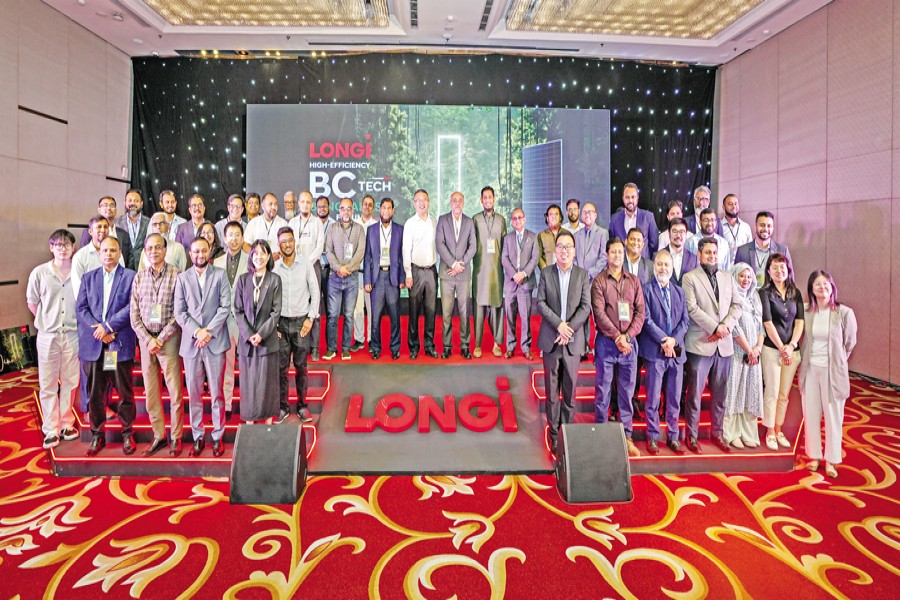
World's largest solar panel manufacturer LONGi Solar introduced its back contact (BC) PV modules at an event in the capital on Monday.

The event, titled "LONGi High-Efficiency BC Techie Bangladesh Forum", served as a major platform for technology experts, industrial entrepreneurs and global business representatives -- notably from China -- to discuss the future of solar energy.

Representatives from Orion Group, Pran-RFL Group, Omera Solar, Teesta Solar, Flo Solar, Confidence Power, UCC, X-Index Group and Rahimafrooz attended the forum.

LONGi's Head of Central Asia and South Asia Region, Talisman Hua, Head of Central and South Asia (High Growth Market), Sandy Jia, and Senior Sales Manager for Central Asia, Ahsan Huda, were present at the event held at a city hotel.

At the forum, LONGi officials introduced the "Hi-MO X10 Anti-Dust Pro" module, which represents a significant shift in how solar panels handle environmental soiling.

The accumulation of dust, sand and mud can reduce energy output by up to 30 per cent. LONGi said its anti-dust technology significantly helps minimise such losses.

Organisers hope the technology will unlock new possibilities in Bangladesh's utility and industrial landscape and accelerate the country's progress in adopting world-class solar power generation standards, according to a press release.

The centrepiece of the event was the introduction of the "Ultimate Back Contact (BC) PV Modules", which the company said marks a significant leap in solar technology efficiency.​
 

The capacity-competence disconnect in Bangladesh's power sector

29 April 2026, 13:00 PM

Sabbir Ahmad

1777508895123.webp

The Rooppur Nuclear Power Plant project might be the clearest illustration of the capacity-competence disconnect of the country’s energy sector. PHOTO: WIKIMEDIA COMMONS

Somewhere in Bangladesh, a power plant stands ready to run but sits idle anyway. On most days, it remains offline not because fuel is scarce, but because of a commercial stalemate: decision-makers with dispatch authority lack the expertise to balance operational costs against a mounting revenue deficit. Recent fuel shortage is compounding the picture further as households endure hours of load-shedding while capacity payments accumulate. Either way, the turbines stay silent. This is symptomatic of systemic dysfunction.

Since 2009, installed generation capacity has grown from under 5,000MW to more than 30,000MW in 2025, and electricity access expanded from 47 percent of the population to over 99 percent. Yet, the reserve margin now stands at around 61.3 percent. Per a simplistic calculation, more than half of installed capacity draws capacity payments while generating nothing on a given day. Average unit generation cost has reached roughly Tk 12.35 against a bulk tariff of around Tk 6.63. Annual losses of Bangladesh Power Development Board (BPDB) rose from Tk 5,468 crore in FY2015 to Tk 50,565 crore in FY2025. Between FY2020 and FY2024, the resulting subsidies totalled Tk 1,26,700 crore. A government review found that capacity increased fourfold over the last 15 years while costs jumped elevenfold. Meanwhile, merit-order dispatch—that is, the basic principle of running cheaper plants first—is not consistently applied.

Bangladesh has poured billions into infrastructure, but this investment has not been matched by commitment to the human capital and governance frameworks essential for operational success. The Integrated Energy and Power Master Plan (IEPMP) 2023 maps a future that includes the Rooppur Nuclear Power Plant (RNPP), ultra-supercritical coal technology, and a massive scale-up of renewable energy. Each of these demands a qualitatively different capability, engineers who understand nuclear safety, grid integration of variable renewables, Supervisory Control and Data Acquisition (SCADA) and smart grid operations, and high-voltage systems. Above all, we need leaders who can outmanoeuvre political pressure with commercial logic. Shallow knowledge of energy economics, power purchase agreements (PPAs), and the regulatory framework risks locking the sector into contracts it cannot afford for decades.

The clearest illustration of the competency gap is the 2,400MW RNPP project, financed largely by a $11.38 billion Russian loan. Its first unit secured a commissioning licence for fuel loading this month (which started on yesterday), marking a critical step towards operational readiness. However, a licence is not a substitute for local competency. It requires at least 1,600 trained engineers for safe long-term operation. Despite 1,000 personnel being trained since 2019 and ongoing specialised training, Bangladesh will remain heavily dependent on Russian engineers for the initial years of operation. This gap will reflect a heavy cost on operating margins, safety accountability, and strategic leverage that all remain, for now, in foreign hands.

However, Bangladesh Power Management Institute (BPMI) does act as the sector’s apex training body, offering programmes in power system planning, load flow analysis, PPA training and, more recently, solar PV project development and wind energy feasibility. A joint ADB-government-financed Power Sector Capacity Development Program (2007-2014) trained over 4,400 professionals and sent 335 personnel to the Asian Institute of Technology in Bangkok. The BPDB maintains its own training directorate, and the Sustainable And Renewable Energy Development Authority (SREDA) carries an explicit training mandate for the renewable energy transition.

But these are disconnected parts rather than a cohesive system synchronised for performance. BPMI operates from a rented facility in Purbachal, while its permanent 25-acre campus in Keraniganj remains unbuilt. With a workforce of tens of thousands, the BPDB finds its Training Directorate’s internal “on-site” capacity stretched thin. The ADB programme ended in 2014 and was never succeeded by a sustained equivalent. And SREDA lacks the institutional capacity to fulfil its own mandate, let alone an expanded one for renewable transition demands.

In contrast, India’s National Power Training Institute (NPTI), for example, has trained over 470,000 professionals across 11 regional centres, spanning smart grids, SCADA, thermal, hydro, renewable energy, and regulatory affairs. What separates NPTI from BPMI is not ambition but structure. Success at NPTI, South Korea’s KEPCO, or Malaysia’s Tenaga Nasional were built on consistent funding and the institutional independence to attract top-tier experts. They treated competency as a prerequisite for success, not a reward for it. Even as BPMI launches a new Renewable Energy Training Facility with German support, the core truth remains: we cannot govern what we have not mastered.

The solution lies in mobilising existing institutions, not creating new ones. BPMI must break ground in Keraniganj and fast-track the campus to full functionality under leadership with deep engineering credentials and a board that bridges public and private expertise. To meet the sector’s needs, annual training must scale up from a few thousand to tens of thousands. While the NPTI took five decades to train 470,000 professionals in India, Bangladesh lacks the luxury of time; our investment must be faster and far more aggressive. Furthermore, BPMI must establish a state-of-the-art laboratory to drive world-class training, testing, and research and development.

We must consolidate BPMI, the BPDB training directorate, SREDA, and Power Cell into a national framework rewarding competence over seniority. Certification for everyone, from operators to controllers, should be based on verifiable exams rather than mere attendance. Real gains happen when the system rewards measurable outcomes, not just time spent in a classroom.

It should also be noted that financial haemorrhaging starts at the top. The massive subsidy burden reflects mismanagement via opaque contracts and unchecked demand forecasts made without sound financial analysis. To mitigate this, we must equip a new generation of leaders with regulatory and contractual expertise required for the domestic market.

Bangladesh’s achievement of universal electrification in a single generation is remarkable. Yet, despite established institutions like BPMI and SREDA, the sector faces a stark reality: wholesale losses exceeding Tk 3 per unit, a 61.3 percent reserve margin coupled with persistent load-shedding, and a continued reliance on foreign expertise for its first nuclear plant. These factors signal a gap between our institutional frameworks and operational realities.

The country’s energy story is shifting from a race for megawatts to a quest for competence. The mission is no longer simply to build but to manage, negotiate and optimise. Since the country’s ability to construct at scale has been proven, the test now is whether it has the determination to govern too.

Dr Sabbir Ahmad is a researcher and expert in project delivery and engineering.​
 

Bangladesh’s solar ambition needs skilled hands to succeed

Mohammad Iftekharul Islam and Md Tuhin Ahmed

1777595756079.webp


Bangladesh needs a highly skilled workforce competent in maintaining its solar infrastructure. Photo: Collected

Bangladesh’s economy remains highly susceptible to price volatility in the international energy market. This vulnerability became fairly evident when the Russia-Ukraine war broke out in 2022 and more recently, when the Iran-US conflict began in March this year. The war in the Middle East has resulted in an abnormal hike in the price of liquefied natural gas (LNG), forcing the country to seek costlier spot cargoes. This event exposed how quickly a distant war can travel through the Strait of Hormuz into domestic power shortages, industrial anxiety, and fiscal pressure. Imported LNG accounts for more than 25 percent of Bangladesh’s national total gas consumption, and about 42 percent of total gas consumption goes to the power sector. And this is precisely why solar must be treated as an energy security strategy, not merely a climate aspiration.

The recent national energy policy of Bangladesh is the Renewable Energy Policy (REP) 2025 that sets a target to generate 20 percent of the country’s electricity from renewable sources by 2030 and 30 percent by 2041. The policy recognises the country’s dependence on natural gas and other fossil fuels and connects renewable expansion with local manufacturing capability, cost competitiveness, and human resource development. There is no lack of ambition when it comes to increasing renewable energy capacity. Current SREDA dashboards on renewables show that Bangladesh has about 1.74 gigawatt (GW) of installed renewable capacity, accounting for about 5.24 percent of total installed energy generation capacity, of which 1.45 GW is represented by solar, consisting of solar parks, rooftop net metering, and solar home systems (SHS). Apart from solar installations, there are initiatives in solar panel exports and foreign investment in solar. In June 2025, Radiant Alliance, a Bangladesh-based company, exported solar panels to the US market for the first time. In March 2025, Chinese solar manufacturer Longi revealed plans to invest in solar panel manufacturing in Bangladesh.

The government has also pushed some big rollouts on solar expansion. In December 2025, the erstwhile interim government approved 12 new private solar plants with a combined capacity of 918 MW. As part of the National Rooftop Solar Program 2025, the government aims to install 3,000 MW equivalent of solar panels on state-owned buildings, alongside net metering reforms that now allow systems up to 100 percent of sanctioned load, compared to about 70 percent in the past. The sanctioned load is the maximum amount of power that an electricity provider authorises a consumer to use at any given time. However, so far most of such scaling only exists on paper and we are left with an uncomfortable question: who will build, install, test, service, and maintain all this capacity? This is where the bottleneck begins.

Bangladesh may be announcing a solar manufacturing and deployment push, but its training pipeline is not ready for it yet. A 2024 future-skills study on Technical and Vocational Education and Training (TVET) in Bangladesh found a serious shortage of skilled workers and a persistent mismatch between what graduates learn and what employers need. Around 60 percent of the study’s respondents said that their technical skills needed further improvement after graduation. The same study also claimed that the National Technical and Vocational Qualifications Framework (NTVQF) is not implemented fully and the student enrolment exceeds infrastructural capacity. Furthermore, the students do not benefit from learning to operate old and obsolete machines when companies recruit for newer technologies. The graduates also ultimately struggle in the labour market due to a lack of coordination between training institutions and employers. This becomes problematic when it comes to readying a workforce to maintain the country’s solar infrastructure as the sector is heavily reliant on practical know-how than just theoretical knowledge.

The REP 2025 opens doors to production-based incentives, tax exemptions, and duty or VAT cuts on certain solar components. These measures can help local industries grow, but they do not run on policy alone. They run on technicians, supervisors, quality inspectors, electricians, operators, trainers, and after-sales service teams. Solar localisation without skills localisation is unlikely to achieve much. Meanwhile, implementation problems are already visible in reality. There are debates over rooftop solar costs, import duties on accessories, and whether the policy mix is helping adoption fast enough. Apparel sector entrepreneurs argue that import taxes increase system costs just when rooftop solar could decrease both energy vulnerability and carbon emissions. At the same time, the government wants to protect and nurture local manufacturing. However, even if tariffs are perfectly balanced, Bangladesh will still struggle unless it produces enough competent workers for a growing solar ecosystem.

The good news is that the REP 2025 already has a practical opening. It directs SREDA to support training and research, encourage renewable energy curriculum from the school level to university, and maintain a national database for designers, installers, maintenance professionals, suppliers, importers, manufacturers, and EPC companies. The database could become the backbone of certification, accountability, and labour market visibility. The conflicts around the world may calm down soon enough and shipping routes may regain normalcy too, resulting in spot LNG prices to stabilise. However, Bangladesh’s skills gap will persist unless the country treats it as seriously as it treats capacity targets. A panel on a rooftop cannot secure a factory, a school, or a grid if no one is there to install it properly, certify it credibly, or repair it when it breaks down. Bangladesh needs more solar, but it needs a workforce for it even more. Energy security will not come from solar panels alone but from the skilled hands that make them work.

Mohammad Iftekharul Islam is research associate at South Asian Network on Economic Modeling (Sanem).

Md. Tuhin Ahmed is lecturer of economics at Mawlana Bhashani Science and Technology University and honorary deputy director at Sanem.​
 

Latest Posts

Back