[🇧🇩] Corruption Watch

[🇧🇩] Corruption Watch
374
14K
More threads by Saif

G Bangladesh Defense

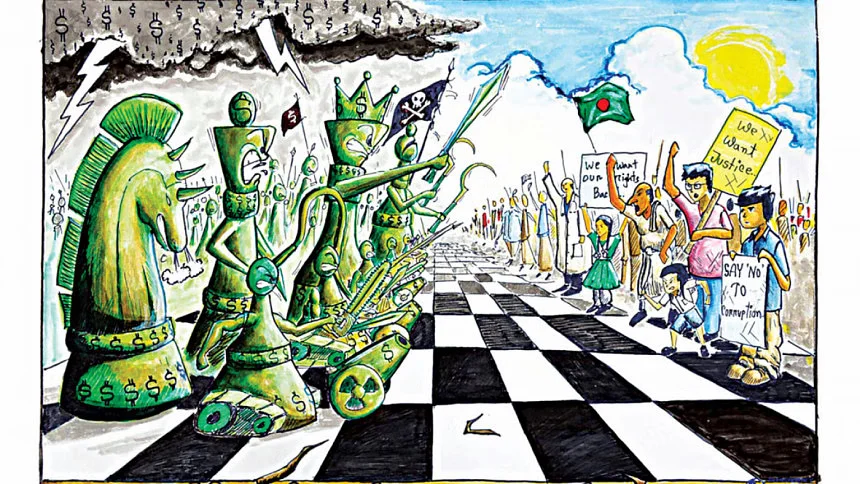
What options are left for us to fight unbridled corruption?
1720394824890.webp

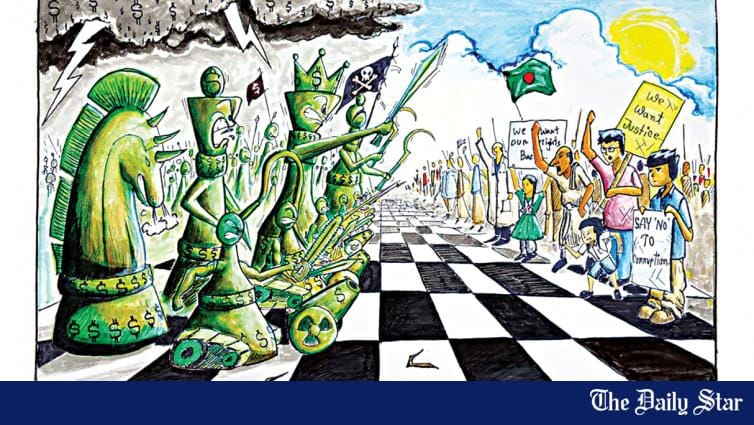
What can ordinary citizens do to put a stop to the rampant corruption taking place in our government institutions? SOURCE: TIB

In recent times, allegations of serious corruption against a number of government officials have come to light. From former army chief Aziz Ahmed, former IGP and Rab chief Benazir Ahmed, and former Dhaka Metropolitan Police (DMP) Commissioner Asaduzzaman Mia and his family members, to public servants working in much lower positions in the government, corruption seems to have spread its tentacles across the country's public service sector.

During the Covid pandemic, we learnt how a driver of the Directorate General of Health Service (DGHS) named Abdul Malek acquired crores of taka through corruption. At the same time, graft allegations emerged against former DGHS chief Abul Kalam Azad as well. These two stories illustrate how corruption has become institutionalised from the very top to the very bottom echelons of our government.

Another recent case of sensational corruption involves a National Board of Revenue (NBR) official named Md Matiur Rahman, and his wife Laila Kaniz Lucky, chairman of Narsingdi's Raipura Upazila Parishad. What's interesting about their case is how they came to light. Matiur's corruption was revealed only after a video of Matiur's son buying a goat at Tk 15 lakh for Eid-ul-Azha went viral. Ironically, even the sellers of the goat were allegedly involved in corruption in the selling process as well as in other operations. Matiur's wife Lucky even submitted her tax files to the Election Commission (EC) before the upazila parishad polls earlier this year. But the commission failed to unearth the corruption of Lucky and her family at that time.

This brings into question how well our public institutions are doing in terms of identifying and addressing corruption. How is it that the EC failed to notice that Lucky had understated her wealth? In fact, prior to the last national election, this newspaper had reported how this election witnessed the highest number of candidates with movable or liquid assets of Tk 1 crore or more. A number of ministers saw their wealth increase by more than a few thousand percent. And the EC showed no curiosity as to how these ministers managed to multiply their wealth by such absurd amounts. Are they just that good at business and investment? If they are such financial geniuses, why isn't our economy doing as well under their leadership?

And the same absurd wealth increase was seen among candidates during the upazila parishad polls. Again, the EC showed the least bit of interest to find out how these candidates managed to acquire such massive wealth, similar to the national election candidates.

Far from addressing corruption, our public institutions seem to be doing the opposite. For example, right after the reports of alleged corruption concerning former law enforcement high-ups came out, the Bangladesh Police Service Association (BPSA) released a statement which seemingly threatened the media against reporting on corruption by law enforcers. Without being able to identify a single victim who was maligned by the media reports, the BPSA labelled the reports as "partial, motivated, exaggerated, and misleading."

The BPSA also claimed that the reports were "tarnishing the police's image," while ignoring the damage done by the alleged corruption of its former members. Such claims have become the go-to tactic whenever allegations of corruption are raised. For example, Awami League General Secretary Obaidul Quader recently alleged—as many of his party members had previously done—that corruption accusations were being brought forth to portray AL as a corrupt party. Making such claims, without verifying the authenticity of the allegations, can often be seen as the most commonly used tactic in kleptocracies around the world.

And this is what the Opposition Leader and Jatiya Party Chairman GM Quader recently pointed out in parliament: that corruption, at the scale that it is happening, has become the biggest threat to our economy. Quader rightly said that a wealthy circle has emerged comprising corrupt individuals, loan defaulters, and money launderers; in other words, we are being ruled by a kleptocratic and corrupt elite. And this has come about as a result of lack of accountability and governance failures.

Awami League MP AFM Bahauddin Nasim also rightly spoke about the fact that government bodies are doing the nation a huge disservice by coming to the defence of the corrupt. But the fact remains that it is his party that has weakened the law when it comes to identifying and preventing corruption by public servants—through the Government Services Act, 2018, for example, which even AL leader and lawmaker Mahbubul Alam Hanif said could be "considered a law to protect criminals."

Through an amendment to the Government Servants (Discipline and Appeal) Rules, 1985, the authorities in 2018 included "reprimand" as a penalty for corruption that has been proven through investigations. Before this amendment, the punishment was either "compulsory retirement," "removal from service" or "dismissal from service." To simply "reprimand" a public servant who has been found to be involved in corruption, while allowing them to remain in "service," is a slap in the public's face. And since 2018, numerous public servants proven to be involved in corruption have continued to remain in service due to this amendment, with only a slap on the wrist.

And it's not only the AL, but the BNP too, which through the 2002 amendment to the Government Servant (Conduct) Rules, 1979 relaxed the anti-graft rules for public servants. This only demonstrates the mindset of our political class in general: their primary motivation is to curry favour from public servants, rather than ensure transparency and accountability in public service for the sake of the public.

The only way to change this mindset is to get honest politicians into positions of power and hold to account those who are not truly serving the people. Unfortunately, all the mechanisms meant to do so seem to have been weakened, if not completely destroyed, one after another in recent decades. That's why the AL managed to make such an amendment to the public service rules, which can easily be argued to have breached Article 20 (2) of the constitution, while no other branch of government stepped in to prevent it.

So, ordinary citizens have only two options now: 1) allow corruption to run rampant and cost them in every sphere of life as a result; or 2) form mass movements that are strong enough to force politicians, public servants and other government authorities to not only rectify the legal issues that they have created, but enforce them to the letter, which will automatically deter government employees from getting involved in corruption.

Eresh Omar Jamal is deputy head of editorial at The Daily Sta​
 

Anti-Corruption Commission must live up to mandate
08 July, 2024, 00:00

THE failure of the Anti-Corruption Commission to complete 4,008 inquiries and investigations and 3,348 cases that the commission filed having been pending with court are worrying on a couple of counts. Official statistics show that trial proceedings are under way in 2,919 cases out of the total 3,348 cases pending with courts while trial proceedings have been stalled in 429 cases on High Court orders. Besides, 732 writ petitions, 927 criminal miscellaneous cases, 1,223 criminal appeals and 681 criminal revision cases are pending for disposal until March. Yet, which is more worrying is that the commission has failed, as official data show, to complete inquiries and investigations in 4,008 cases although, as commission rules lay out, an officer gets a maximum of 75 days to complete an inquiry and 270 days to complete an investigation. The commission has showed similar failures in 2023, too, when it could complete 2,029 inquiries but the rest of 2,399 inquiries remained pending. The commission that year could complete 555 investigations but investigation of 1,609 more cases remained pending. The failure to complete inquiries and investigations and delay in trial benefits corruption suspects because it creates the scope for the suspects to find a way out of the commission's net. The event of delayed or no punishment in corruption ultimately adds to the culture of impunity and entails injustice on people.

Experts criticise the commission for its failure to complete the investigation of 52 cases filed against former NRB Global Bank managing director Proshanta Kumar Halder and 85 others in 2020–2022 in connection with the embezzlement of Tk 34 billion from various financial institutions. In January 2023, the commission formed a two-member team for inquiries to establish whether the Dhaka Water Supply and Sewerage Authority managing director amassed illegal wealth and laundered money after the media had reported on his buying 14 houses in the United States. The inquiry has stalled. In 2019, the commission began inquiries of 22 former and sitting members of parliament, including several of the ruling Awami League, on charges of corruption, but the inquires have not been completed. The inquiry of the non-funded part of the Hallmark Group scam involving the embezzlement of Tk 12 billion has been pending for 12 years. The inquiry began in 2012. Most of the inquiries and investigations of corruption and irregularities in the health sector during the Covid outbreak has been pending for three years. More than a hundred people listed by the commission are suspected to have been involved in corruption in recruitment, tender forgery, purchase wrongdoings, illegal involvement in business and the accumulation of illegal wealth. The commission seeks to put the failure down to inadequate human resources, claiming to have put efforts in completing the tasks in time and hoping for a better future.

But what it comes down to is the commission's glaring failure to complete its tasks in time and making delays that not only denies justice, going by the legal maxim of 'justice delayed is justice denied', but also adds to the culture of impunity, entailing further injustice. The commission also must learn to rise above politics if there were any political considerations in the failure and delay at hand. The commission must live up to its mandate.​
 

Another public project gone awfully awry
Lack of progress in hi-tech parks project is unacceptable

1720485956652.webp

VISUAL: STAR

It is totally unacceptable that a project that was slated for completion in three years has achieved only 14.34 percent of physical progress after seven years. This glacial and, frankly, ridiculous pace of work has been noticed in an undertaking meant to build 12 hi-tech parks in various districts. Considering its nature, you would have thought a government so intent on bringing about the country's digital transformation would take it more seriously, especially when most of the budget is being borrowed from outside the country, indicating its significance. But this is how the project has ended up, like so many others before it, according to a report citing findings of the planning ministry's Implementation Monitoring and Evaluation Division (IMED).

The government initiated the project in April 2017, with the strategically placed hi-tech parks envisioned to prepare the nation for the future by fostering a skilled workforce in the information technology sector. It was originally scheduled to be complete by June 2020, but has since seen its deadline extended multiple times. The latest proposal is asking for a 2027 deadline, and an increase from the original budget of Tk 1,796 crore to Tk 2,000 crore. Even though project authorities claim more progress than shown by the IMED report, the level of progress claimed to have been achieved is still miniscule and varies widely among the parks, with some barely even started.

How will the authorities justify this abysmal pace of work? As per our report, it has been attributed to various financial and logistical issues, including insufficient allocations, COVID-19 pandemic, land acquisition issues, etc. But this is hardly convincing. Those behind the project should have accounted for potential challenges and have contingency strategies in place to deal with them. A proper feasibility study would have resolved many of the issues that arose. Clearly, what has really slowed the progress is systemic neglect and mismanagement which, combined with a lack of accountability for public officials, have undone so many projects before. The economic implications of such frequent cost and time overruns cannot be stressed enough.

The hi-tech parks project was meant to be a cornerstone of Bangladesh's vision for a digital future. Instead, it has become a cautionary tale of how ambitious plans can falter without effective execution. We urge the authorities to put their foot on the accelerator and resolve all issues preventing the timely execution of this project.​
 

ACC seeks info over Islami Bank's Tk 3,300cr loan scam
Staff Correspondent 09 July, 2024, 00:52

1720486598842.webp


The Anti-Corruption Commission on Monday sent letters to Bangladesh Bank and Islami Bank Bangladesh for second time, seeking information regarding the Tk 3,300 crore loan scam.

The ACC in the letters sought the audit reports of loans along with the related documents of 11 companies of Nabil Group from the central bank and Islami bank.

A team of the commission, led by its deputy director Yasir Arafat, sent the two letters as part of the inquiry over the embezzlement of Tk 3,300 crore in the name of loan in favour of three fake companies, said the ACC officials.

The ACC sent the letters requesting the BB and Islami Bank to provide the information within seven working days for the relevant documents.

The commission sought information regarding the loans of Islami Bank's Chattogram's Chaktai branch customer, M/s Murad Enterprise; Khatunganj branch customer, Century Food Products Limited; and Jubilee Road branch's customer, United Super Trader.

The ACC secretary Khorsheda Yasmeean on Monday said that, 'A complaint of embezzlement of about Tk 3,300 crore from the related branch of Islami Bank PLC in Chittagong came to the ACC.'

A three-member inquiry team has been formed, and the team sent letters to the authorities concerned for the sake of inquiry, she said.

The ACC letter stated that the commission was conducting an inquiry against the owner of the United Super Traders, Golam Kibria Chowdhury, and others over the allegations of misappropriation of 3,300 crore of taka in the name of a loan from Islami Bank.

In the letter, the information of 11 companies of Nabil Group was sought from the Islami Bank's Gulshan Corporate Branch in Dhaka, Rajshahi and New Market Branch, Rajshahi, and Pabna Branch.

Nabil Group companies include Nabil Naba Foods Limited, Nabil Cold Storage, Nabil Feed Mills Limited, Nabil Auto Rice Mills, Nabil Auto Flower Mills, Shimul Enterprises, Naba Agro Trade International, Anwara Trade International, Naba Pharma Limited, Nabil Green Crops Limited, and International Product Palace.

The ACC officials said that it sent the first letter to the BB in November 2023, seeking the documents. But in January, the central bank said that as the inspection of the mentioned institutions was ongoing, the prepared report would be sent after the completion of the inspection.

According to the inspection report of the BB in the past year, loans of Tk 3,300 crore were given to Century Food Products, United Super Traders, and Murad Enterprises through those three branches of Islami Bank.

The central bank, however, did not find the existence of these institutions at the address used in the loan documents. In these nominal papers, new debts are created in the name of the companies, and the previous liabilities are adjusted.​
 

Looking to live in luxurious flats of ex-police chief in Gulshan? Contact ACC
BDNEWS24.COM
Published :
Jul 08, 2024 20:39
Updated :
Jul 08, 2024 20:39
1720486866287.webp


The Anti-Corruption Commission, or ACC, has taken over four flats owned by Benazir Ahmed's family in Dhaka's Gulshan as the former inspector general of police faces graft investigation.

A team led by Manjur Morshed, the ACC director of asset management, made an inventory of goods in the flats at Rancon Icon Tower on road No. 126 on Monday as the receiver appointed by the court.

"We'll try to rent the flats out and submit the money to the exchequer," Manjur said.

Benazir bought the flats in March 2023 within six months from his retirement – three registered with the name of his wife Zeeshan Mirza, and the other with his own name as the guardian of their younger daughter.

Two of the flats have an area of 2,242 square feet each and the others 2,353 square feet each. All four were connected to use as a single unit on the 12th and 13th floors of the building.

Dhaka Metropolitan Senior Special Judge Mohammed Ash-Shams Joglul Hossain had earlier ordered the attachment of the four flats and then on Jun 30 appointed a magistrate to open those.

The ACC has been investigating the assets of the former inspector general of police and his family following media reports that he had accumulated wealth beyond means.

The High Court has also ordered seizure of their properties and freezing of their bank accounts.

But media reports suggest the former police chief had withdrawn most of the funds from his accounts and left the country before the court passed the order.​
 

Anti-graft drive: How has Awami League fared in first six months?
1720658770826.webp

VISUAL: BIPLOB CHAKROBORTY

The Awami League-led government completes six months of its fourth consecutive term in office today. Generally, six months is not enough time to assess the performance of a government. But for an incumbent government in seat since 2009, whose comeback was accompanied with many promises, it seems a good enough timeframe to evaluate its deeds over the last six months in the context of its 15-year rule.

In the past six months, the issue of corruption has truly come to the fore, and the government has acted in a handful of high-profile cases. Prime Minister Sheikh Hasina recently vowed that no one indulging in corruption will be spared, irrespective of their identity, and that the ongoing drive against graft will continue. At the maiden cabinet meeting on January 15, she also gave strict instructions to not tolerate corruption and irregularity.

However, there are as yet no indications that the government is ready to tackle corruption holistically. No policy reforms have been suggested, no directives have been issued to concerned agencies, nor have law enforcement authorities been bolstered to act against those deemed corrupt. Instead, what seems to be clearer as days go by is that the government is cherry-picking certain individuals who may no longer be in favour, and conducting isolated drives against them, while others go scot-free.

The Anti-Corruption Commission is currently investigating the accumulation of illegal wealth by former inspector general of police Benazir Ahmed and his family members, former National Board of Revenue (NBR) official Matiur Rahman, immediate past NBR first secretary Quazi Abu Mahmud Faisal, customs commissioner Enamul Haque, former NBR commissioner Wahida Rahman, former additional inspector general of police Shamsuddoha Khondoker, Rajdhani Unnayan Kartripakkha (Rajuk) director Mobarak Hossain and his wife, among others.

The amount of assets that the initial investigation by ACC has unearthed is mindboggling. It found illegal assets worth Tk 43.5 crore belonging to Benazir Ahmed, his wife, and two daughters. But the actual price of his wealth is many times higher than the amount shown in the documents.

Meanwhile, former NBR official Faisal has accumulated about Tk 1,000 crore by taking bribes for transferring income tax officials, intimidating taxpayers and resorting to other irregularities, according to ACC documents submitted to the court.

But the question that must be asked is, why is ACC investigating them now, rather than when they were at the helm of power? Does the ACC truly deserve compliments for acting on command, rather than doing its constitutionally mandated duty? While the AL throws its sacrificial offerings to a crowd thirsty for blood, the one prickly issue getting sidelined is whether the AL government can escape responsibility for such unbridled corruption.

There have been innumerable occasions when the party has quite blatantly used the state machineries for political benefits. There has been widespread immunity for overreach of influential individuals and institutions, which has given many the illusion of unbridled power—a perfect breeding ground for corruption and tyranny. The flurry of corruption allegations that have been raised against some former and incumbent government officials in recent times is nothing but an outcome of that situation.

Even a portion of AL leaders believe the government has failed to ensure accountability of government bodies, and is predominantly responsible for giving corruption its current institutional shape. On June 25, AL joint general secretary Mahbubul Alam Hanif told the parliament that corruption is overshadowing all the government's achievements and that despite its policy of zero-tolerance against corruption on paper, corruption remains out of control in reality.

The very next day, AL General Secretary Obaidul Quader said it isn't just government officials who are corrupt, but politicians too. But then, in the very next minute, he tried to justify corruption in the country by saying it is a common phenomenon across the globe.

Such contradiction, unfortunately, seems to be the very mantra of the party's professed commitment to tackling corruption. The Awami League, in its manifestos before the last four national elections, vowed to strengthen the ACC, but Bangladesh Public Service Act 2018 essentially limits the anti-graft watchdog's power to arrest corrupt government officials, as it must get prior permission from the authorities concerned to arrest public servants.

On June 10, ACC Chairman Moinuddin Abdullah accused ministries of fostering corruption by not including anti-corruption clauses in their regulations. The former bureaucrat also stated that all ministries have opened the floodgates to corruption. Meanwhile, ACC Commissioner (investigation) Md Jahurul Haque said, "Those in power in society are the ones who commit corruption. The CIP and VIP individuals, whom you try to honour, are involved in corruption."

The corrupt, indeed, are running the country, with impunity. Around Tk 92,261 crore has been plundered from the country's banking sector in 24 major scams over the past 15 years, as a result of irregularities, misuse of power, and potential money laundering, according to a report of the Centre for Policy Dialogue (CPD). The figure can only confirm the ineffectiveness of the Money Laundering Prevention Act and the futility of the government's commitments to safeguard the banking sector.

The AL, in its manifesto, promised to recover default loans through enforcement of laws, but the total defaulted loan in the banking sector stood at Tk 1,82,295 crore as of March, highest in the country's history. But in 2009 when the AL-led government came to office, the figure of total defaulted loan was Tk 22,000 crore.

We see the same impunity in the stock market. Low-performing stocks frequently appear on lists of top gainers or highest traded volumes in the stock market due to manipulations. Even when the Bangladesh Securities and Exchange Commission (BSEC) detects such manipulations, the BSEC's punishments are too lenient, discouraging effective deterrence. For instance, in 2023, the BSEC fined Abul Khayer Hiru and his associates only Tk 5.25 crore for manipulating the stocks of NRB Commercial Bank and Fortune Shoes. This fine pales in comparison to their estimated gains exceeding Tk 68 crore, according to BSEC enforcement records.

Data suggests this may be a recurring issue. In 2022, the BSEC uncovered manipulation in several stocks, where the perpetrators gained an estimated Tk 253 crore but were only fined Tk 21 crore. In contrast, the US Securities and Exchange Commission (SEC) identified 16 individuals involved in a stock manipulation scheme in June 2023 that generated over $35 million in illegal profits. Consequently, the SEC imposed collective fines exceeding $75 million, as reported on their website. This example highlights the significant disparity in how market manipulation is penalised in Bangladesh compared to the US. Instead of strong deterrents, we seem to be encouraging such practices by either turning a blind eye to them or letting perpetrators off the hook with a slap on the wrist.

Meanwhile, the success of every development project in the country is tainted by cost-overruns and innumerable project extensions due to corruption at every level for which no one is ever held to account. All this comes at a tremendous cost—the burden of foreign debt, which has now crossed $100 billion, a nearly four-fold increase compared to $25.3 billion in 2009.

And while the corrupt hoards wealth beyond our wildest imagination, ordinary people are barely surviving the onslaught of rising costs. The AL's top promise before the January 7 national poll was to address inflation and ensure a smooth supply chain to bring down commodity prices. But food inflation stood at 10.76 percent in May, a seven-month high. In June 2009, when the AL formed the government, the point-to-point inflation was 2.25 percent, while the average inflation rate was recorded at 6.66 percent.

The finance minister, while placing the proposed budget for FY 2024-2025, hoped to bring the inflation down to 6.5 percent. But given the country's current economic health and in the absence of any clear policy directives, it appears nothing more than a lofty assurance.

The party also promised to take strict action against illegal wealth acquisition in its election manifesto. The government, however, has taken the opposite position by once again deciding to allow black money holders to legalise undisclosed wealth without any scrutiny by paying a 15 percent tax.

The AL has long promised to establish a humane society by reducing social inequality, but the latest data of Household Income and Expenditure Survey reveals a totally different picture. Income inequality is at an all-time high in the country, with the top 10 percent of the wealthiest households now holding 40.92 percent of its total income.
The above-scenario paints a depressing picture of the first six months of the government's tenure. We can only hope that morning does not show the day. Sheikh Hasina has proven be the strongest leader of the country and we want to have faith in her to clamp down on corruption, regardless of affiliation, with greater vigour and steer her government to prioritise the welfare of the people.​

Partha Pratim Bhattacharjee is planning editor at The Daily Star.
 

The rot has gone too deep
SHAMSUL HUQ ZAHID
Published :
Jul 10, 2024 22:17
Updated :
Jul 10, 2024 22:17

1720662886490.webp


In recent months, financial or other scams have been hitting the news headlines one after another. Indeed, it has become difficult for people to keep track of those who are coming at them thick and fast.

First came the incidents of bank money plundering that eroded the financial health of many private banks. Some people have strong links with the powers-that-be, who allegedly managed to take control of several banks and financial institutions and divert funds worth billions of taka.

This unique development added a new dimension to the country's financial sector. Until then, a considerable volume of non-performing loans (NPLs) was a matter of intense debate in the public domain and at the policymakers' level. Instead of improving, the NPL situation has deteriorated, with the total soured asset soaring to more than Tk. 4.0 trillion. The amount includes loans under rescheduling, litigation and written-off categories.

As if to divert the public attention from scam stories involving the financial sector to something else, there came stories of how some high-level government officials, former and present, acquired wealth in unbelievable proportions, resorting to corruption and abuse of power. Those proved to be saucy. People are now devouring such stories, courtesy of print and electronic media.

Amidst all the scams, financial or otherwise, at least a couple of revelations have drawn widespread attention. They are the involvement of the chairperson and some other officials and employees of Bangladesh Technical Education Board in preparing and selling forged educational certificates and the leak of PSC exam question papers.

A private TV channel made yet another shocking revelation early this week. It has unearthed how question papers are leaked by a syndicate of officials and employees of the Public Service Commission (PSC). What has been revealed until now is that the syndicate leaked question papers to people seeking second-class and other government jobs in various departments. The police have arrested at least 17 persons, including two deputy directors and one assistant director. According to media reports, the syndicate has been active inleaking question papers for more than 12 years for various government jobs, including those for the Bangladesh Civil Service (BCS) examinations. The private TV channel prepared an investigative report based on allegations of irregularities received from some people who had taken part in a recruitment examination for Bangladesh Railway on July 05 last.

Following the detection of such cases, the newspapers are now agog with reports highlighting the wealth amassed by individuals involved in corruption, bank loan fraud, and other irregularities. With PSC people's latest question paper leaks, a former PSC chauffeur has received the most attention. He allegedly made disproportionate wealth, amounting to Tk.500 million, out of the occasional question paper leaks.

The PSC high-ups were aware of the developments surrounding periodic recruiting exams. In 2014, following the detection of question paper leaks, they took action against some of its officials and employees. However, the actions were half-hearted, leading to the recurrence of such criminal activities in the following years.

The unearthing of PSC question papers comes as thousands of university and college students have taken to the streets to support the demand for reforming the quotas in government jobs. They have been blocking roads and railways to press home their needs, which include abolishing the reserved quota for grandchildren of freedom fighters.

If people can get government jobs using leaked question papers, what is the use of engaging in street protests? They will eat up most jobs reserved for both quota and non-quota candidates. The street demonstrators should add yet another demand to their list-- -make the PSC examination systems free from manipulation and irregularities.

Leaking question papers prepared for public and admission examinations is a familiar practice. It has been happening in Bangladesh and many other developing countries, in particular.

Only recently, the leaking of question papers for medical examinations rocked neighbouring India. The integrity of the entry exam came under severe scrutiny when the news of a massive question paper leak broke. Anurag Yadav, a key figure in this scandal, confessed that the leaked papers matched the actual ones.

Question paper leaks have been a persisting issue in the education sector. Despite taking all safeguards, some question papers get leaked because of the involvement of insiders who can hardly resist the lure of unearned income. Because of these greedy individuals, the credibility of public examinations is undermined.

It is beyond dispute that the traditional methods of paper setting and distribution need to be revised to prevent loopholes and plugging of the same necessitates something different.

Secure technology-driven solutions might help the authorities concerned to stem the rot. Setting of personalized questions much like GRE and GMAT, generation of AI-driven questions, last-minute delivery of question papers to examination centres, multi-factor authentication in the matters of opening and accessing of question papers, advanced encryption of information, implementation of an effective question paper generation solution etc., might help stop, to a large extent, the incidence of question papers leaks.

Stringent laws should supplement technological advancements to deal with question leaks. The crime of leaking question papers prevents competent people from securing government jobs and deprives deserving students of their best in public examinations. It needs to be stopped at any cost.​
 

Tk 500 million deposited in bank accounts of Faisal's 14 relatives
AsaduzzamanDhaka
Updated: 08 Jul 2024, 15: 41

1720680961002.webp

Quazi Abu Mahmud Faisal Official photo

Around Tk 500 million was deposited in bank and other financial institutions' accounts of National Board of Revenue's former first secretary Quazi Abu Mahmud Faisal and his 14 relatives in the last eight years.

The relatives include Faisal's mother, brother, sister, sister-in-law, wife and in-laws.

According to an investigation of the Anti-Corruption Commission (ACC), the amount was deposited (including investment at savings certificates) between 2016 and 2023. Besides, flats, plots and land worth Tk 210 million (as shown in deeds) were bought in the names of Faisal and his relatives. None of the relatives of Faisal are involved with any large business. They neither do any jobs in high posts in government or private jobs.

Faisal's mother, sister, mother-in-law, sister of mother-in-law are housewives. Of the relatives, Faisal's brother-in-law Syed Abdullah is a police inspector. He was officer in charge of Mothbaria police station in Pirojpur and is now attached with Feni police lines. Faisal's brother is a lawyer.

An official of ACC said the information of NBR official Faisal's huge wealth was leaked mainly during the investigation of his brother in law Abdullah's wealth. Abdullah allegedly amassed huge wealth while he was OC of Mothbaria police station. Later, an investigation committee consisting of three ACC officials of Pirojpur was formed in February last year to investigate police officer Abdullah's wealth.

Syed Abdullah was the OC in the police station between 29 March in 2019 and 24 March in 2020.

The ACC official said the probe body primarily learnt about the huge wealth of Abdullah during the investigation. The ACC later in May last year got information that Abdullah's wife Farhana Akhter (Faisal's sister) owns two flats and a commercial space in Dhaka, mother-in-law Karima Khatun owns a flat in Gulshan. Also, the ACC investigators traced millions of taka transactions in the bank accounts of Faisal's sister. The ACC applied to the court for confiscation and attachment of wealth amassed in the names of Faisal's sister, mother and brother-in-law. The court on 28 May last year ordered confiscation of the movable and immovable properties of them worth Tk 180 million.

After 11 months of the order, ACC submitted the wealth lists of Faisal and his 10 relatives to the court. Based on this, Dhaka metropolitan senior special judge Mohammad As Shams Jaglul Hossain directed to confiscate properties of Faisal and his 11 relatives on 27 June. During the court order, Faisal was the first secretary of NBR Dhaka office (tax). He was later 'released' from the NBR and transferred to Bogura tax zone.

The ACC in its report to the court said Faisal amassed huge amounts of wealth through misuse of power and corruption including transfer of income tax officials in exchange of money and intimidating the taxpayers.
Prothom Alo tried to contact Quazi Faisal several times in the last seven days for his comment on an allegation of amassing illegal wealth. But he did not respond to calls.

The ACC in its report to the court said Faisal amassed huge amounts of wealth through misuse of power and corruption including transfer of income tax officials in exchange of money and intimidating the taxpayers.

The ACC report also made similar observations about Faisal's brother-in-law Syed Abdullah in a separate report submitted to the court. The report said Abdullah amassed huge wealth by restoring to corruption including misuse of power and relations with drug traders.

Prothom Alo tried to contact Syed Abdullah also. He received the call only once, and after knowing the identity of this journalist, he hung up the phone saying he cannot talk now.

Properties of Faisal's mother-sister

ACC investigation finds that most of the wealth of police official Abdullah is in the names of his wife and mother-in-law. Both of them are housewives.

According to the court order on confiscation of wealth, Abdullah's wife Farhana has saving certificates worth Tk 10 million. She has nine bank accounts in her name, of which six were opened in 2021-2022. A total of Tk 10 million was deposited in an account opened in 2021. A total of Tk 17.6 million was deposited in her nine bank accounts. Besides, Farhana owns a 2386-square feet commercial space in a building in Kakrail worth Tk 27 million. She also has a Tk 20 million flat in Moghbazar and Tk four million flat in Khilgaon. Faisal's mother Karima Khatun has a Tk 88.3 million flat in the city's Gulshan.

Faisal's brother-in-law Abdullah has a 12-katha plot at Ananda Police Housing Limited in Narayanganj's Rupganj.

Wealth of Faisal and other relatives

According to the ACC investigation, Faisal's properties are mainly in the names of his wife Afsana Naznin, father-in-law Ahammed Ali and mother-in-law Momtaz Begum. He bought plots in Dhaka and Narayanganj in his own name. He has six bank accounts. A total of Tk 52.1 million was deposited in these accounts from 216 to 2023.

Faisal's wife has savings certificates worth Tk five million. Besides, there are five bank accounts in her name. A total of Tk 22.5 million was deposited in these accounts opened between 2016 and 2023. Besides, a total of 10 katha plots in Dhaka and Rupganj were bought in his name.

Meanwhile, another 10 katha plot was bought in the name of Faisal's mother-in-law in Dhaka in 2022. Although the price of the land was shown Tk 5.2 million in deeds, the ACC told the court that the land is actually worth Tk 45 million. Besides, over Tk 60 million was deposited in eight bank accounts opened in her name between 2016 and 2023.

According to ACC investigation, a flat worth Tk 10 million was bought in the name of Faisal's father-in-law Ahammed Ali (retired bank officer) last year. Besides , savings certificates worth Tk 3 million were bought in his name in 2020-2021. The ACC investigation finds that Tk 110 million was deposited in eight bank accounts in his name. Savings certificates worth Tk 3 million were bought in the name of Faisal's brother-in-law Aftab Ali in 2020 and 2021. Five bank accounts were opened in his name between 2016 and 2023 where Tk 14 million was deposited.

ACC investigation finds that Savings Certificates worth Tk 3 million were bought in the name of Faisal's brother Quazi Khalid Hasan in 2021. A total of Tk 21.2 million was deposited in his six bank accounts in 2021-2023. A total of Tk 17.1 million was deposited in two accounts Sheikh Nasir Uddin, maternal uncle-in-law of Faisal, in 2021-2022. Besides, Tk 37.6 million was deposited in a bank account of Mahmuda Hasan, Faisal's maternal aunt-in-law, in 2021. Tk 12.1 million was deposited in four bank accounts of Farhana Afroze, Mahmuda's daughter.

According to the ACC report submitted to the court, saving certificates worth Tk 4 million were bought in the name of Khandakar Hafizur Rahman, an acquaintance of Faisal, in 2021. Besides, Tk 137.2 million was deposited in five bank accounts in his name between 2019 and 2021.

Transparency International, Bangladesh's executive director Iftekharuzzaman told Prothom Alo that it is not possible for anyone to amass such a large amount of money legally. A section of corrupt officials have become wealthy due to lack of transparency and accountability.
Hafizur is from Boyra area in Khulna city. A visit to his house in Khulna on 25 June revealed that Hafizur has a one storied building. Hafizur's wife Rizia Begum told Prothom Alo that her husband is a seasonal paddy trader. He cannot renovate his house for want of money. Rainwater seeps into their house.

Asked about his relations with Faisal, Rizia said they are not relatives but Faisal's father is a family friend.

According to the ACC investigation report, a total of Tk 84.5 million was deposited in two bank accounts in the name of Faisal's relative Rowshan Ara Khatun. The bank accounts were opened in 2019 and 2020.

Transparency International, Bangladesh's executive director Iftekharuzzaman told Prothom Alo that it is not possible for anyone to amass such a large amount of money legally. A section of corrupt officials have become wealthy due to lack of transparency and accountability. The government should see the wealth statement of public servants and take strict actions against those who have ill-gotten money.​
 

Latest Posts

Back