Bangladesh Defense
Saif
Senior Member
- Jan 24, 2024
- 19,319
- 8,946
- Nation

- Residence
- Axis Group

Date of Event:
Mar 30, 2025
250,000 buildings to collapse in Chattogram by magnitude 7 earthquake like Myanmar
Sujan Ghose
Chattogram
Published: 29 Mar 2025, 22: 25
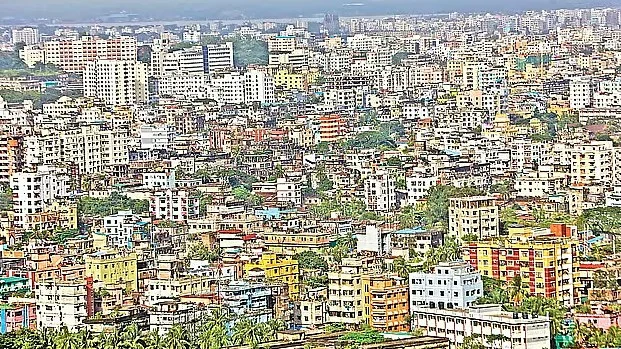
An arial photo showing the buildings in Chattogram city which are constructed connectedly in an unplanned way defying the building code File photo
The port city of Chattogram is one of the major earthquake-prone areas of the country. A high magnitude earthquake like in Myanmar would damage nearly 70 per cent buildings in the city. As such, around 267,000 buildings of the total 382,000 buildings in the city would be somewhat affected.
The experts raised the concern, following a magnitude 7 earthquake in Myanmar yesterday which claimed at least 1000 lives with the casualty likely to grow far.
They say that the risk is high due to non-compliance with building construction regulation, erecting establishments without following the approved design and the use of substandard construction materials.
They also claim that the relevant government and non-government agencies practically do not have any preparation to run rescue operations and deal with the situation in case of a high magnitude tremor.
Experts and fire service officials allege the Chattogram Development Authority (CDA) was negligent and deficient in its role as the monitoring agency in building construction. The agency did not do its work properly. The situation has become grave due to this.
The CDA officials too have admitted that they cannot monitor properly due to lack of manpower. They are also concerned that a magnitude 7 earthquake in Chattogram will make at least 60 to 70 per cent of the buildings in the city grounded or affected to some extent.
The concerns centering Chattogram’s vulnerability to earthquake resurfaced following the 7.7-magnitude earthquake that struck Thailand and central Myanmar Friday at 12:50 am local time. It was followed by a Magnitude 4 aftershock at 01:12 pm local time. Already more than 1,000 have been reported dead in Myanmar alone and the casualties are rising. A number of buildings in Myanmar and Thailand totally collapsed in the two countries.
There hasn’t been any major casualty in Chattogram from earthquakes in recent times. However, in 2016, there were reports of 12 buildings leaning over following a 6.99-magnitude earthquake in the city on 13 April.
In 1997, there were reports of casualties as a five-storey building collapsed in the tremor originated from a 6.1-magnitude earthquake on 21 November.
According to the CDA, there are some 382,111 buildings in the city at the moment, including 278,005 one-storey building, 90,444 two-five-storey buildings, 13,135 buildings with six to 10 floors and 527 more than 10-storey and 10 more than 20-storey buildings in the city. However, most of these buildings were not constructed in compliance with the regulations.
Speaking to Prothom Alo, former Chittagong University of Engineering and Technology (CUET) vice-chancellor and CDA chief engineer Kazi Hasan Bin Shams said, “If an earthquake of the magnitude that hit Myanmar jolts the city, then at least 70 per cent buildings will be directly affected. Nearly 267,000 city buildings are at this risk.”
Meanwhile, there haven’t been any surveys in recent times regarding the vulnerability of the buildings and establishments in the region in the face of a strong earthquake.
The city of Chattogram is under a severe threat of earthquake. Almost 70 per cent of these buildings will be damaged in case of a magnitude-7 earthquake or above. National Building Codes were totally ignored while constructing most of these buildings. Mohammad Jahangir Alam, Former vice chancellor, CUET.
However, the disaster management ministry conducted a survey under the Combined Disaster Management programme to evaluate the earthquake threats in the Chattogram region from 2009 to 2011.
According to the survey, there were some 182,000 buildings, mostly one-storey, in the city at the time. Of these, 168,150 buildings were under risk, which is 92 per cent of the total buildings in the city. These buildings were not constructed following the National Building Code of Bangladesh. The survey stated that the hospitals, clinics and educational institutions were at the highest risk.
Former CUET vice chancellor Mohammad Jahangir Alam led the survey in Chattogram region.
Speaking to Prothom Alo on Saturday, he said, “The city of Chattogram is under a severe threat of earthquake. Almost 70 per cent of these buildings will be damaged in case of a magnitude-7 earthquake or above. National Building Codes were totally ignored while constructing most of these buildings. In case of a strong earthquake, most of these buildings will totally collapse and the remaining will be partially damaged which will lead to massive casualties.”
The former CUET vice chancellor stressed on identifying the vulnerable buildings under risk on an emergency basis and taking other relevant measures soon afterwards.
He further said, “In a word, we are totally unprepared to tackle the post-earthquake situations. The fire service, the city corporation and the CDA do not have any special preparation or a course of actions on earthquake situations. They do not have the necessary equipment either.”
“In some places, the lanes are too narrow for the rescue vehicles or ambulances to reach the spot. Where a country like Thailand is struggling to tackle the situation, what could be the consequence in Bangladesh is anybody’s guess.”
The south-eastern part of Bangladesh is known as an earthquake-prone zone. So we have to prepare from now. We need short, medium and long term planning for this. At the same time, there is no alternative to raise public awareness in this regard. Besides, regular exercise is also crucial. Humayun Akhter, Earthquake expert and former geology professor at DU.
As per the Chittagong Metropolitan Building Act 2008, one has to get eight approvals from the development authority in different phases while constructing a building. These are land use clearance, construction approval, notification of commencement of construction work and consent letter from technical personnel, report from technical personnel on the work up to the plinth (foundation) of the building, notification letter of completion of construction work of the building, certification letter from technical personnel, occupancy certificate and renewal of occupancy certificate after five years.
Although the building owners in Chattogram take approval from the authority for building design, they don’t bother following the next steps.
Speaking to Prothom Alo, Fire Service and Civil Defence Chattogram zone assistant director Md Anwar Hossain said his force were always ready to follow the official instructions that had to be followed to run rescue missions in post-earthquake periods.
Besides, most of the buildings in the city have been constructed defying the rules and regulations, which further raised the risk of earthquakes. The CDA-monitoring has not been up to the mark in this case, he claimed, adding, “Instead of monitoring, the CDA has approved building construction in such places where it is difficult to run a rescue operation.”
CDA chief engineer Kazi Hasan Bin Shams admitted to the limitations in monitoring citing lack of manpower. However, he claimed, “We are monitoring regularly now. They are checking on the buildings up to 10-storey in person. We are sending experts to check buildings that are further higher.”
Former Geology professor at Dhaka University and earthquake expert Humayun Akhter said, “The south-eastern part of Bangladesh is known as an earthquake-prone zone. So we have to prepare from now. We need short, medium and long term planning for this. At the same time, there is no alternative to raise public awareness in this regard. Besides, regular exercise is also crucial.”
*This report appeared on the online version of Prothom Alo and has been rewritten in English by Ashish Basu
Sujan Ghose
Chattogram
Published: 29 Mar 2025, 22: 25
An arial photo showing the buildings in Chattogram city which are constructed connectedly in an unplanned way defying the building code File photo
The port city of Chattogram is one of the major earthquake-prone areas of the country. A high magnitude earthquake like in Myanmar would damage nearly 70 per cent buildings in the city. As such, around 267,000 buildings of the total 382,000 buildings in the city would be somewhat affected.
The experts raised the concern, following a magnitude 7 earthquake in Myanmar yesterday which claimed at least 1000 lives with the casualty likely to grow far.
They say that the risk is high due to non-compliance with building construction regulation, erecting establishments without following the approved design and the use of substandard construction materials.
They also claim that the relevant government and non-government agencies practically do not have any preparation to run rescue operations and deal with the situation in case of a high magnitude tremor.
Experts and fire service officials allege the Chattogram Development Authority (CDA) was negligent and deficient in its role as the monitoring agency in building construction. The agency did not do its work properly. The situation has become grave due to this.
The CDA officials too have admitted that they cannot monitor properly due to lack of manpower. They are also concerned that a magnitude 7 earthquake in Chattogram will make at least 60 to 70 per cent of the buildings in the city grounded or affected to some extent.
The concerns centering Chattogram’s vulnerability to earthquake resurfaced following the 7.7-magnitude earthquake that struck Thailand and central Myanmar Friday at 12:50 am local time. It was followed by a Magnitude 4 aftershock at 01:12 pm local time. Already more than 1,000 have been reported dead in Myanmar alone and the casualties are rising. A number of buildings in Myanmar and Thailand totally collapsed in the two countries.
There hasn’t been any major casualty in Chattogram from earthquakes in recent times. However, in 2016, there were reports of 12 buildings leaning over following a 6.99-magnitude earthquake in the city on 13 April.
In 1997, there were reports of casualties as a five-storey building collapsed in the tremor originated from a 6.1-magnitude earthquake on 21 November.
According to the CDA, there are some 382,111 buildings in the city at the moment, including 278,005 one-storey building, 90,444 two-five-storey buildings, 13,135 buildings with six to 10 floors and 527 more than 10-storey and 10 more than 20-storey buildings in the city. However, most of these buildings were not constructed in compliance with the regulations.
Speaking to Prothom Alo, former Chittagong University of Engineering and Technology (CUET) vice-chancellor and CDA chief engineer Kazi Hasan Bin Shams said, “If an earthquake of the magnitude that hit Myanmar jolts the city, then at least 70 per cent buildings will be directly affected. Nearly 267,000 city buildings are at this risk.”
Meanwhile, there haven’t been any surveys in recent times regarding the vulnerability of the buildings and establishments in the region in the face of a strong earthquake.
The city of Chattogram is under a severe threat of earthquake. Almost 70 per cent of these buildings will be damaged in case of a magnitude-7 earthquake or above. National Building Codes were totally ignored while constructing most of these buildings. Mohammad Jahangir Alam, Former vice chancellor, CUET.
However, the disaster management ministry conducted a survey under the Combined Disaster Management programme to evaluate the earthquake threats in the Chattogram region from 2009 to 2011.
According to the survey, there were some 182,000 buildings, mostly one-storey, in the city at the time. Of these, 168,150 buildings were under risk, which is 92 per cent of the total buildings in the city. These buildings were not constructed following the National Building Code of Bangladesh. The survey stated that the hospitals, clinics and educational institutions were at the highest risk.
Former CUET vice chancellor Mohammad Jahangir Alam led the survey in Chattogram region.
Speaking to Prothom Alo on Saturday, he said, “The city of Chattogram is under a severe threat of earthquake. Almost 70 per cent of these buildings will be damaged in case of a magnitude-7 earthquake or above. National Building Codes were totally ignored while constructing most of these buildings. In case of a strong earthquake, most of these buildings will totally collapse and the remaining will be partially damaged which will lead to massive casualties.”
The former CUET vice chancellor stressed on identifying the vulnerable buildings under risk on an emergency basis and taking other relevant measures soon afterwards.
He further said, “In a word, we are totally unprepared to tackle the post-earthquake situations. The fire service, the city corporation and the CDA do not have any special preparation or a course of actions on earthquake situations. They do not have the necessary equipment either.”
“In some places, the lanes are too narrow for the rescue vehicles or ambulances to reach the spot. Where a country like Thailand is struggling to tackle the situation, what could be the consequence in Bangladesh is anybody’s guess.”
The south-eastern part of Bangladesh is known as an earthquake-prone zone. So we have to prepare from now. We need short, medium and long term planning for this. At the same time, there is no alternative to raise public awareness in this regard. Besides, regular exercise is also crucial. Humayun Akhter, Earthquake expert and former geology professor at DU.
As per the Chittagong Metropolitan Building Act 2008, one has to get eight approvals from the development authority in different phases while constructing a building. These are land use clearance, construction approval, notification of commencement of construction work and consent letter from technical personnel, report from technical personnel on the work up to the plinth (foundation) of the building, notification letter of completion of construction work of the building, certification letter from technical personnel, occupancy certificate and renewal of occupancy certificate after five years.
Although the building owners in Chattogram take approval from the authority for building design, they don’t bother following the next steps.
Speaking to Prothom Alo, Fire Service and Civil Defence Chattogram zone assistant director Md Anwar Hossain said his force were always ready to follow the official instructions that had to be followed to run rescue missions in post-earthquake periods.
Besides, most of the buildings in the city have been constructed defying the rules and regulations, which further raised the risk of earthquakes. The CDA-monitoring has not been up to the mark in this case, he claimed, adding, “Instead of monitoring, the CDA has approved building construction in such places where it is difficult to run a rescue operation.”
CDA chief engineer Kazi Hasan Bin Shams admitted to the limitations in monitoring citing lack of manpower. However, he claimed, “We are monitoring regularly now. They are checking on the buildings up to 10-storey in person. We are sending experts to check buildings that are further higher.”
Former Geology professor at Dhaka University and earthquake expert Humayun Akhter said, “The south-eastern part of Bangladesh is known as an earthquake-prone zone. So we have to prepare from now. We need short, medium and long term planning for this. At the same time, there is no alternative to raise public awareness in this regard. Besides, regular exercise is also crucial.”
*This report appeared on the online version of Prothom Alo and has been rewritten in English by Ashish Basu
Last edited: