Bangladesh Defense

Saif
Senior Member
- Joined
- Jan 24, 2024
- Messages
- 22,283
- Likes
- 9,869
- Nation

- Axis Group

Gas reserves drying up, output falls 39pc in decade
Shahriar Azam . Dhaka
Bangladesh has depleted 74 per cent of its 30 trillion cubic feet of extractable natural gas reserve so far, while the production has fallen 39 per cent over the past decade.
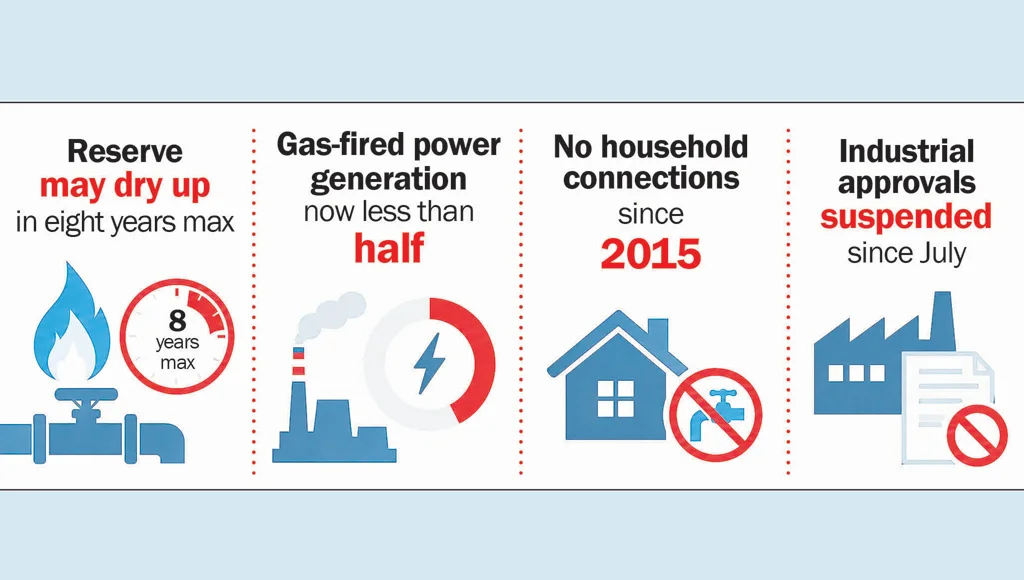
Energy experts warn that without any major discovery, the country’s existing gas fields could go dry in maximum eight years.
According to a Hydrocarbon Unit report, national and international oil companies were producing around 2,660 million cubic feet of gas a day in 2015-16, with the peak production reaching 2,786 mmcfd in May 2015.
Domestic gas production has since fallen to around 1,620 mmcfd, a decline of about 39 per cent in a decade.
The decline in production has largely been caused by the depletion of the country’s mature gas fields and wells.
Bibiyana, the country’s largest gas field, was producing around 1,175 mmcfd a decade ago. Petrobangla’s latest data show that its average production fell to around 732 mmcfd on Friday.
State Minister for Energy and Mineral Resources Aninda Islam Amit told parliament in September that domestic gas production was declining by around 150 mmcfd annually.
The energy minister told the Jatya Sangsad in April that Bangladesh had an estimated 29.74 trillion cubic feet of extractable natural gas reserve. Of the total reserve, 22.11 TCF had been extracted by December 2025, leaving 7.63 TCF, or about 26 per cent, remaining.
Meanwhile, the gas demand has continued to rise while domestic production has declined.
The decline in gas reserves is affecting households and industries alike. In July, the government froze new industrial gas approvals amid a worsening supply crunch, leaving 1,857 applications pending with gas distribution companies.
Gas-fired power plants have a combined generation capacity of 12,472 MW, but severe gas shortages force the Power Division to generate less than half of that capacity during peak summer demand.
Households have received no new gas connections since 2015, while CNG-run vehicles often face low pipeline pressure. Gas-dependent industries also require substantial investment to replace existing machinery and adopt alternative technologies.
To bridge the gap between rising gas demand and dwindling supply, the previous government initiated liquefied natural gas import in 2018. Over the years, the dependency on imported LNG has grown and now it accounts for more than 35 per cent of the daily gas supply.
Energy expert M Tamim says the country has persistently failed to significantly increase domestic gas output through traditional state mechanisms though there remains various alternative options.
Due to the renewed tension in the Middle East, spot market prices saw a fresh hike. Market analytics firm Trading Economics reported Asian spot LNG benchmark Japan Korea Marker, or JKM, crossed $32 per MMBtu on Friday.
Energy economist Shafiqul Alam says the cost of domestically produced natural gas is around Tk 12-15 per cubic metre.
But Asian spot LNG price benchmark Japan Korea Marker, or JKM, was hovering above $32 per Million British thermal units on Friday, he said, explaining that if LNG was priced at $30 per MMBtu the imported cost would be around Tk 127 per cubic metre gas.
The spot LNG price surge to $32 per MMBtu marks the highest rate since December 2022.
The government allocated Tk 6,000 crore for LNG subsidies in the current financial year, but escalating conflict in the Middle East could push up the annual bill to more than six times the budgeted amount.
The government has already spent Tk 10,000 crore on LNG subsidies in the first three months of the financial year.
Energy minister Iqbal Hassan Mahmood told New Age on October 25 that the government was working to increase domestic gas production.
The BNP-led government, which took office in mid-February, has since developed some strategies to strengthen domestic production, including floating a bidding round for offshore gas exploration for 26 blocks in the Bay of Bengal.
However, identifying commercially viable gas reserves and connecting them to the national grid takes seven to 10 years, ruling out an immediate solution.
In a September 14 presentation to the prime minister, the Energy Division outlined plans to raise gas supply capacity to 5,819 mmcfd by 2030 and 8,000 mmcfd by 2035 through LNG imports and domestic production.
Short-term plans include a 1,000mmcfd land-based LNG terminal at Matarbari, a 600mmcfd floating terminal at Kutubjom, a 96km Feni-Bakhrabad pipeline and 150 wells.
Long-term plans include three additional floating terminals, diversified imports, a proposed Myanmar gas pipeline and another 150 wells.
M Shamsul Alam, energy adviser at Consumers Association of Bangladesh, warned that the government’s current initiatives could make gas and electricity prices more volatile rather than contain increases.
He said Bangladesh should have resorted to a strategy to control energy costs by utilising domestic gas resources, particularly those available in Bhola and the Chhatak East gas fields, rather than relying increasingly on imported fuels.
The global LNG market remains volatile and imports at high prices will increase the cost burden, he added.
The total domestic gas production stood at 49 billion cubic feet in June, while international oil companies were producing 28 bcf or more than 57 per cent from 42 wells and national oil companies were producing 21 bcf from 70 wells.
The imported LNG accounted for another 29 bcf in that month.
The government has increasingly relied on imported LNG to meet rising demand, raising concerns over long-term sustainability amid global tensions and market volatility.
Bangladesh’s two floating LNG terminals have a combined regasification capacity of 1,100 mmcfd, accounting for more than 35 per cent of the daily gas consumption.
Without major new gas discoveries, the country could eventually become entirely dependent on imported LNG to meet its gas demand, experts say.
Without urgent investment in domestic exploration and production, they also say, Bangladesh’s reliance on costly imported LNG will deepen, leaving gas and electricity prices increasingly vulnerable to global market volatility.
Shahriar Azam . Dhaka
Bangladesh has depleted 74 per cent of its 30 trillion cubic feet of extractable natural gas reserve so far, while the production has fallen 39 per cent over the past decade.
Energy experts warn that without any major discovery, the country’s existing gas fields could go dry in maximum eight years.
According to a Hydrocarbon Unit report, national and international oil companies were producing around 2,660 million cubic feet of gas a day in 2015-16, with the peak production reaching 2,786 mmcfd in May 2015.
Domestic gas production has since fallen to around 1,620 mmcfd, a decline of about 39 per cent in a decade.
The decline in production has largely been caused by the depletion of the country’s mature gas fields and wells.
Bibiyana, the country’s largest gas field, was producing around 1,175 mmcfd a decade ago. Petrobangla’s latest data show that its average production fell to around 732 mmcfd on Friday.
State Minister for Energy and Mineral Resources Aninda Islam Amit told parliament in September that domestic gas production was declining by around 150 mmcfd annually.
The energy minister told the Jatya Sangsad in April that Bangladesh had an estimated 29.74 trillion cubic feet of extractable natural gas reserve. Of the total reserve, 22.11 TCF had been extracted by December 2025, leaving 7.63 TCF, or about 26 per cent, remaining.
Meanwhile, the gas demand has continued to rise while domestic production has declined.
The decline in gas reserves is affecting households and industries alike. In July, the government froze new industrial gas approvals amid a worsening supply crunch, leaving 1,857 applications pending with gas distribution companies.
Gas-fired power plants have a combined generation capacity of 12,472 MW, but severe gas shortages force the Power Division to generate less than half of that capacity during peak summer demand.
Households have received no new gas connections since 2015, while CNG-run vehicles often face low pipeline pressure. Gas-dependent industries also require substantial investment to replace existing machinery and adopt alternative technologies.
To bridge the gap between rising gas demand and dwindling supply, the previous government initiated liquefied natural gas import in 2018. Over the years, the dependency on imported LNG has grown and now it accounts for more than 35 per cent of the daily gas supply.
Energy expert M Tamim says the country has persistently failed to significantly increase domestic gas output through traditional state mechanisms though there remains various alternative options.
Due to the renewed tension in the Middle East, spot market prices saw a fresh hike. Market analytics firm Trading Economics reported Asian spot LNG benchmark Japan Korea Marker, or JKM, crossed $32 per MMBtu on Friday.
Energy economist Shafiqul Alam says the cost of domestically produced natural gas is around Tk 12-15 per cubic metre.
But Asian spot LNG price benchmark Japan Korea Marker, or JKM, was hovering above $32 per Million British thermal units on Friday, he said, explaining that if LNG was priced at $30 per MMBtu the imported cost would be around Tk 127 per cubic metre gas.
The spot LNG price surge to $32 per MMBtu marks the highest rate since December 2022.
The government allocated Tk 6,000 crore for LNG subsidies in the current financial year, but escalating conflict in the Middle East could push up the annual bill to more than six times the budgeted amount.
The government has already spent Tk 10,000 crore on LNG subsidies in the first three months of the financial year.
Energy minister Iqbal Hassan Mahmood told New Age on October 25 that the government was working to increase domestic gas production.
The BNP-led government, which took office in mid-February, has since developed some strategies to strengthen domestic production, including floating a bidding round for offshore gas exploration for 26 blocks in the Bay of Bengal.
However, identifying commercially viable gas reserves and connecting them to the national grid takes seven to 10 years, ruling out an immediate solution.
In a September 14 presentation to the prime minister, the Energy Division outlined plans to raise gas supply capacity to 5,819 mmcfd by 2030 and 8,000 mmcfd by 2035 through LNG imports and domestic production.
Short-term plans include a 1,000mmcfd land-based LNG terminal at Matarbari, a 600mmcfd floating terminal at Kutubjom, a 96km Feni-Bakhrabad pipeline and 150 wells.
Long-term plans include three additional floating terminals, diversified imports, a proposed Myanmar gas pipeline and another 150 wells.
M Shamsul Alam, energy adviser at Consumers Association of Bangladesh, warned that the government’s current initiatives could make gas and electricity prices more volatile rather than contain increases.
He said Bangladesh should have resorted to a strategy to control energy costs by utilising domestic gas resources, particularly those available in Bhola and the Chhatak East gas fields, rather than relying increasingly on imported fuels.
The global LNG market remains volatile and imports at high prices will increase the cost burden, he added.
The total domestic gas production stood at 49 billion cubic feet in June, while international oil companies were producing 28 bcf or more than 57 per cent from 42 wells and national oil companies were producing 21 bcf from 70 wells.
The imported LNG accounted for another 29 bcf in that month.
The government has increasingly relied on imported LNG to meet rising demand, raising concerns over long-term sustainability amid global tensions and market volatility.
Bangladesh’s two floating LNG terminals have a combined regasification capacity of 1,100 mmcfd, accounting for more than 35 per cent of the daily gas consumption.
Without major new gas discoveries, the country could eventually become entirely dependent on imported LNG to meet its gas demand, experts say.
Without urgent investment in domestic exploration and production, they also say, Bangladesh’s reliance on costly imported LNG will deepen, leaving gas and electricity prices increasingly vulnerable to global market volatility.