New Tweets

[๐Ÿ‡ง๐Ÿ‡ฉ] Energy Security of Bangladesh

G Bangladesh Defense
[๐Ÿ‡ง๐Ÿ‡ฉ] Energy Security of Bangladesh
533
18K
More threads by Saif


Getting rid of shady private power deals

FE
Published :
Jul 18, 2025 23:31
Updated :
Jul 18, 2025 23:56

1752883620550.webp


As a temporary answer to the acute supply shortage in the national grid, a number of power plants were set up in the private sector during the previous autocratic regime. But the contracts for those quick rental, rental and independent power plants (IPPs) were arbitrarily awarded to companies favoured by the authorities of that time and not through any competition by way of open biddings. So, to shield such deals from any legal challenge as well as provide impunity to those power companies, the government of the time passed an indemnity law, styled, "The Quick Enhancement of Electricity and Energy Supply (Special Provision) Act 2010". Notably, section 9 of the Act states that no court may question the validity of any actions, decisions or orders made under the law. Section 10 of the Act, on the other hand, provides complete immunity to employees/officers performing their tasks from any criminal or civil criminal proceedings in the court.

Run by expensive fossil fuels like diesel, furnace oil and coal, those private power plants were meant to be replaced within three to five years with less expensive state-owned power plants. But their operation continued though many government-owned power plants were meanwhile built resulting in a 50 per cent overcapacity of all the power generation units so installed. Under the condition of the contracts, the government went on paying capacity charge meaning payments made to the private power companies according to their installed capacities, and not on the basis of how much power they actually produced. Naturally, after the fall of the autocratic government followed by establishment of the current interim administration, energy experts advised the incumbent government to review and even cancel, where necessary, the contracts awarded to the rental power plants. Also, in September last year, the High Court (HC) issued a rule asking why the provision that acquits rental and quick rental power plants from any questioning regarding their establishment and operations should not be declared illegal. However, the HC made allowance for any action already taken in good faith in exercise of the two noted sections of the indemnity law to avoid any legal complexities. Given that all the quick rental and rental power plant contracts under the ousted regime were concealed from the public scrutiny under cover of the indemnity law, it is hard to speculate what legal and financial fallouts of any cancellation of the contracts might be. The financial consequences may involve capacity charges against the rental power plants' renewed contract periods. That is why, it calls for careful scrutiny, especially of the renewed power purchase deals, which can provide important clues to dealing with any shady power contracts made during the past autocracy.

Against this backdrop, to address widespread allegations of inconsistencies/anomalies in those power deals reached with the privately run independent power plants then, the incumbent administration, in line with the HC directive, approved last week a proposal to seek legal assistance and hold deliberations as necessary so the controversial agreements inked earlier with the private power companies could be recast. Since some foreign companies are also involved in these power deals, the proposed review of the contracts cannot the done one-sidedly, the Finance Adviser Dr Salehuddin Ahmed who briefed journalists on the issue, explained. So is the need for legal support.

The government move is likely to not only help relieve the nation of some bad legacies handed down from the past autocracy, but also stop making some oligarchs richer at the expense of the state exchequer. Reportedly, the previous regime extended the rental power plants' tenure of contract three times beyond their recommended efficient operational life, thereby paying them to the tune of Tk330 billion between 2009 and 2023.​
 
Analyze

Analyze Post

Add your ideas here:
Highlight Cite Respond

Govt moves to curb power generation costs

M Azizur Rahman
Published :
Jul 18, 2025 10:46
Updated :
Jul 18, 2025 10:46

1752884166039.webp


In a bid to rein in soaring electricity subsidies and generation costs, the government has initiated a plan to reduce expenditure at power plants where it holds full or partial ownership, officials said.

The initial focus will be on trimming operating and maintenance (O&M) costs through discussions and negotiations with state-owned power companies and joint ventures in which the government has substantial stakes.

Entities under review include major state-run firms such as Bangladesh Power Development Board (BPDB), Electricity Generation Company of Bangladesh Ltd (EGCB), Northwest Power Generation Company Ltd (NWPGCL), Ashuganj Power Station Company Ltd (APSCL), and Coal Power Generation Company of Bangladesh Ltd (CPGCBL).

Joint venture companies involving state entities and foreign partners include Bangladesh China Power Company Ltd (BCPCL), Bangladesh India Friendship Power Company Ltd (BIFPCL), and RPCL-NORINCO International Power Ltd.

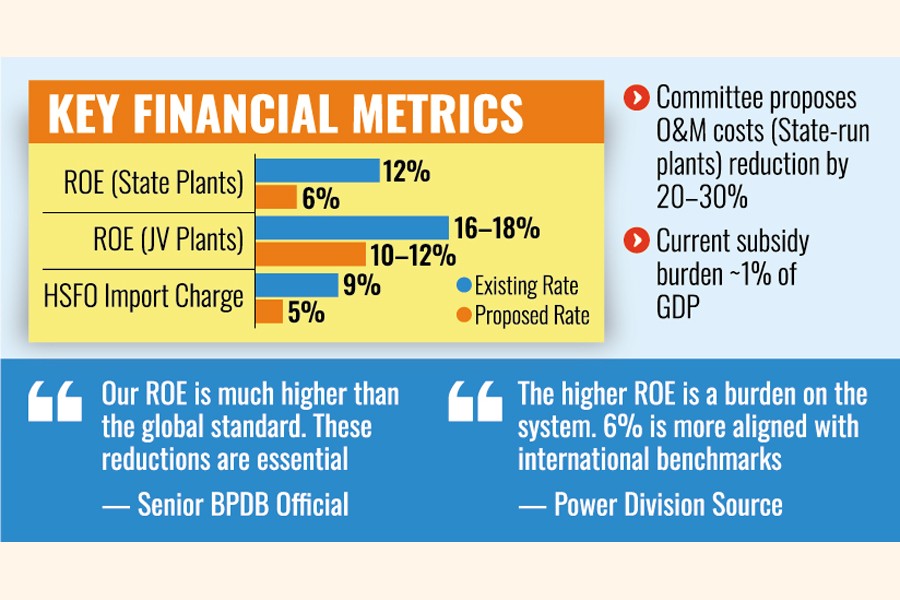
Officials said a committee formed by the Power Division has already recommended slashing the return on equity (ROE) of state-owned plants to around 6.0 per cent-down from the current 12 per cent.

The prevailing ROE is notably higher than global standards, a senior BPDB official told The Financial Express on Wednesday.

Additionally, the committee has proposed reducing the O&M costs of state-run plants by 20-30 per cent.

State-owned NWPGCL and APSCL are reportedly close to signing deals with the Power Division to implement these cuts, a senior official of the division under the Ministry of Power, Energy and Mineral Resources (MPEMR) said.

For joint venture plants, the committee suggested lowering the ROE to 10-12 per cent from the current range of 16-18 per cent.

These cost reduction efforts in public sector power plants are expected to contribute to the government's broader goal of cutting overall electricity generation costs by 10 per cent-a benchmark set in the national budget, according to sector insiders.

Meeting this target could help reduce the estimated Tk 110 billion subsidy currently allocated to the power sector. According to Ministry of Finance data, power subsidies currently amount to around 1.0 per cent of the country's gross domestic product (GDP).

Separately, the interim government has already taken action to reduce electricity generation costs in the private sector by lowering the service charge on high-sulfur fuel oil (HSFO) imports to 5.0 per cent from the previous 9.0 per cent for privately-owned power plants.

Back in 2011, the government first allowed a few private operators to import HSFO. Over time, most were permitted to do so with a 9.0 per cent service charge that covered transport, taxes, and evaporation losses.

Two national committees are also working to reduce generation costs in private-sector plants by renegotiating tariffs and associated charges, sources said.

These committees are expected to submit final reports soon to accelerate the government's cost-cutting drive.

The committees are headed by Dr Md Kamrul Ahsan, a retired professor of Bangladesh University of Engineering and Technology (BUET) and currently a distinguished professor at Green University of Bangladesh, and Moinul Islam Chowdhury, a retired judge of the High Court Division.​
 
Analyze

Analyze Post

Add your ideas here:
Highlight Cite Respond

Govt to fix tariffs for nine power plants after years of anomalies

M Azizur Rahman
Published :
Jul 21, 2025 10:18
Updated :
Jul 21, 2025 10:18

1753141156845.webp


The interim government has moved to set rates for nine large power plants that have been selling electricity to the Bangladesh Power Development Board (BPDB) without official tariff approval. However, the power plants in question are owned by the state-run entities, fully or partially.

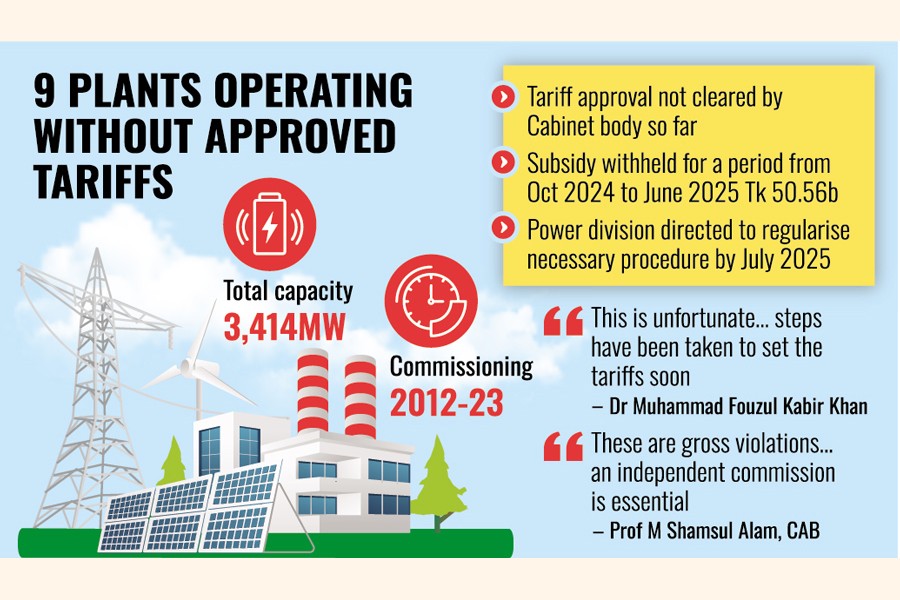
These power plants, with a combined capacity of 3,414 megawatts, were implemented during the previous Awami League government.

Despite supplying power to the national grid, their tariffs were never formally endorsed by the Cabinet Committee on Government Purchase -- a mandatory requirement for such deals, according to official sources.

Instead, the state-run Bangladesh Power Development Board (BPDB) has been buying electricity from these plants solely on the basis of power purchase agreements (PPAs) signed with the respective operators.

These deals were reportedly approved by senior government officials at the time, bypassing the necessary cabinet committee clearance, sources familiar with the matter told The Financial Express on Sunday.

The irregularities came to light during an internal audit conducted by the interim administration, which has now asked the Power Division and the BPDB to clarify how such contracts remained in effect without proper authorisation.

All nine plants began operations between 2012 and 2023. They include two major coal-fired joint ventures -- the 1,320MW Rampal plant under the Bangladesh-India Friendship Power Company Ltd (BIFPCL) and the 1,320MW RPCL-Norinco plant in Patuakhali.

Other facilities include four plants under Rural Power Company Ltd (RPCL), two by BR PowerGen Ltd, and one solar power plant under North-West Power Generation Company Ltd (NWPGCL).

The list of plants operating without cabinet-approved tariffs includes: Bangladesh India Friendship Power Company Ltd (BIFPCL)-owned 1,320MW Rampal Power Plant, RPCL-NORINCO International Power Ltd-owned 1,320MW Patuakhali Power Plant, 210MW Mymensingh Power Plant, 52.194MW Kodda Power Plant, 25.50MW Rowzan Power Plant, and 105MW Gazipur Power Plant owned by Rural Power Company Ltd (RPCL), 163MW Mirsharai Power Plant and Kodda 150MW Power Plant owned by BR PowerGen Ltd, and Sirajganj 68MW Solar Park owned by Bangladesh-China Renewable Energy Power Company Ltd.

"This is unfortunate that these [nine] power plants are selling electricity to the BPDB without approved tariffs," said Dr Muhammad Fouzul Kabir Khan, Adviser to the Ministry of Power, Energy and Mineral Resources (MPEMR), speaking to The Financial Express on Sunday.

He added that steps have now been taken to finalise and approve the tariffs.

Due to the lack of formal approval, the Ministry of Finance (MoF) has recently withheld Tk 50.56 billion in subsidies earmarked for these plants for the period from October 2024 to June 2025.

The Finance Division has instructed the Power Division to obtain approval from the Advisory Council on Public Purchase by July 2025 in order to facilitate future disbursement of subsidies.

In response, the BPDB informed the Finance Division that it had obtained consent from the Power Division for eight of the nine plants during the tenure of the previous government.

The remaining plant, Bangladesh-China Power Company Ltd, reportedly received clearance from the Cabinet Committee on Economic Affairs, the BPDB claimed.

"These are gross violations of the country's existing regulations," said Professor M Shamsul Alam, energy adviser to the Consumers Association of Bangladesh (CAB).

He called for the formation of an independent commission, headed by a retired judge, to investigate corruption and irregularities in the power and energy sector.

"Energy stakeholders must be included in such a commission," Mr Alam added, stressing the need for transparency and accountability in a sector he described as plagued by 'energy crimes'.​
 
Analyze

Analyze Post

Add your ideas here:
Highlight Cite Respond

Govt approves import of fertilisers, LNG cargoes, other goods

UNB
Published :
Jul 23, 2025 20:57
Updated :
Jul 23, 2025 20:57

1753317791675.webp


The government on Wednesday approved several major procurement proposals involving the import of fertilisers, LNG cargoes, wheat, and lentils worth Tk 28.10 billion to meet the countryโ€™s growing domestic demands.

It approved separate proposals for procuring some 1.40 lakh MTs of fertiliser, 2 cargoes of LNG, and 2.20 lakh tonnes of wheat to meet the growing demand for the country.

The approvals came from the 28th meeting of the Advisers Council Committee on Government Purchase this year held on Wednesday with Finance Adviser Dr Salehuddin Ahmed in the chair at Cabinet Division at Bangladesh Secretariat.

Of the approved eight proposals, four were from the Ministry of Agriculture, two were from the Energy and Mineral Resources Division, and one each from the Ministry of Commerce and the Ministry of Food.

Following four separate proposals from the Ministry of Agriculture, the Bangladesh Agricultural Development Corporation (BADC) will procure some 30,000 tonnes of MOP fertilizer from JSC Foreign Economic Corporation (Prodintorg), Russia with TK 1.30 billion.

The BADC will procure 30,000 tonnes of TSP fertilizer from OCP, NUTRICROPS, Morocco with around Tk 2.12 billion, the BADC will import 40,000 tonnes of DAP fertilizer from OCP, NUTRICROPS, Morocco with around Tk 3.78 billion while the BADC would import 40,000 tonnes of MOP fertilizer from Canadian Commercial Corporation (CCC) with around Tk 1.73 million.

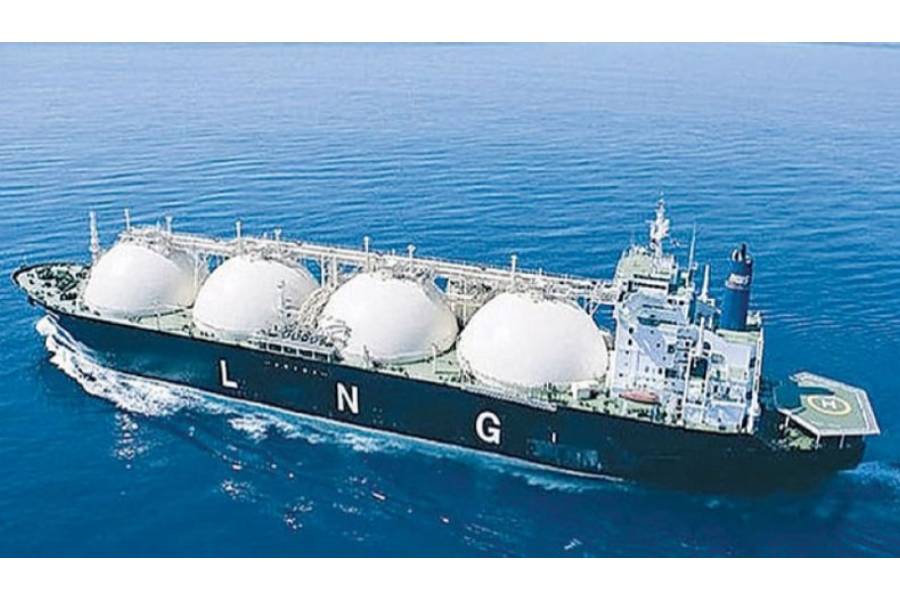
Following two separate proposals from the Energy and Mineral Resources Division, the Petrobangla would procure one cargo LNG from the spot market through following international quotation method from M/S Gunvor Singapore Pte Ltd Singapore with around Tk 5.13 billion while the Petrobangla would import one cargo LNG from Vitol Asia Pte Ltd Singapore with around Tk 5.22 billion.

Following a proposal from the Ministry of Food, the government would procure 2.20 lakh tonnes of wheat the USA on G2G basis from Agrocorp International Pte Limited as authorized by the US Wheat Associates with around Tk 8.17 billion.

The dayโ€™s purchase committee meeting approved another proposal from the Ministry of Commerce under which the state-run Trading Corporation of Bangladesh (TCB) would procure 7,000 tonnes of lentil through following local Open Tender Method (OTM) from KBC Agro Products Private Limited, Dhaka with around Tk 643.2 million.​
 
Analyze

Analyze Post

Add your ideas here:
Highlight Cite Respond

Bangladesh to buy 3 more spot LNG cargoes in Aug & Sept

FE ONLINE REPORT
Published :
Jul 24, 2025 19:46
Updated :
Jul 24, 2025 19:46

1753402889110.webp


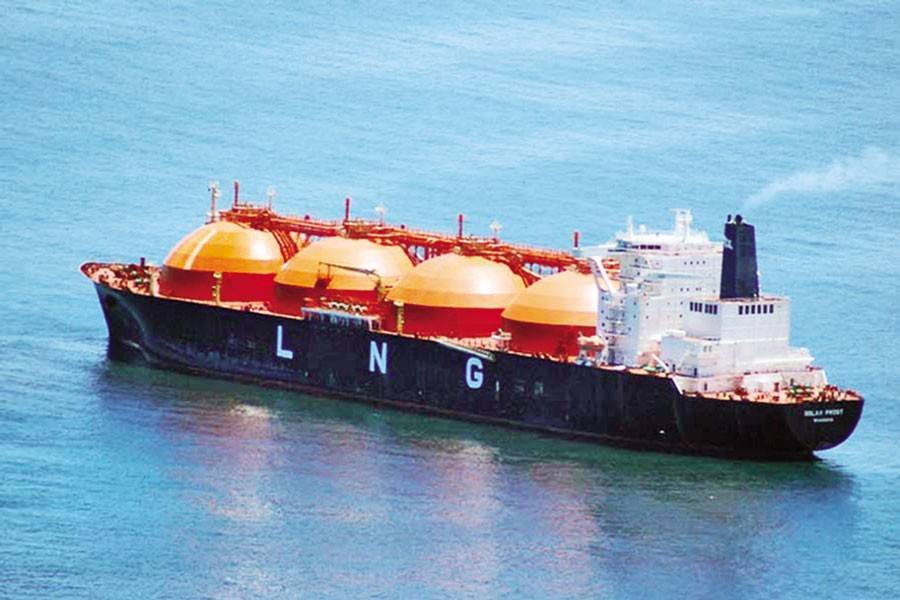
The government is eyeing to import three liquefied natural gas (LNG) cargoes from spot market in late August and September.

State-run Rupantarita Prakritik Gas Company Ltd (RPGCL) floated a tender to these spot LNG cargoes for August 30-31, September 10-11, and September 21-22 delivery windows expecting reasonable price quotes, a senior RPGCL official said.

The bid submission deadline is July 27, he said.

The volume of the spot LNG cargo is around 3.36 million Brithish thermal unit (MMBtu).

The cargoes are to be delivered to Moheshkhali Island, with an option to discharge it at either of the countryโ€™s two floating storage re-gasification units located on the island.

Bangladesh already bought four spot LNG cargoes for delivery in August, and if the tender turns out successful, the countryโ€™s spot LNG cargo purchase for August deliveries would be five.

Bangladesh has procured five spot LNG cargoes for July delivery.

The South Asian country has been purchasing increased volume of spot LNG cargoes over the past several months under a plan to boost natural gas supplies to industries, said the RPGCL official.

Bangladesh awarded its latest spot LNG cargo tender to Vitol Asia Pte Ltd for August 28-29 delivery window at US$12.43 per MMBtu, the RPGCL official said.

The RPGCL is a part of Petrobangla and looks after LNG trading in Bangladesh.

In addition to spot LNG cargoes, Bangladesh has been importing LNG from its two existing long-term suppliers -- QatarEnergy LNG (formerly Qatargas) and OQ Trading International -- for regasification at its two operational floating, storage and re-gasification units (FSRUs).

Bangladesh has been rationing gas supply to industries, power plants and other gas-guzzling consumers to cope with the mounting natural gas demand.

The countryโ€™s overall natural gas output -- local gas and imported LNG combined -- was around 2.832 million cubic feet per day (mmcfd) including 1,022 mmcfd of re-gasified LNG, against the demand for over 4,000 mmcfd, according to official data as on July 23, 2025​
 
Analyze

Analyze Post

Add your ideas here:
Highlight Cite Respond

CPD lauds govt move to add 3000mw electricity from rooftop solar system

BSS
Published :
Jul 27, 2025 16:29
Updated :
Jul 27, 2025 16:29

1753660124879.webp


Centre for Policy Dialogue (CPD) has appreciated the government's initiative to add around 3,000 megawatts (MW) of electricity to the national grid through rooftop solar installations on public buildings.

Focusing on proper pre-planning and effective implementation guidelines for the successful implementation of the initiative, the think tank observed that it will help Bangladesh achieve the renewable energy goals.

CPD on Sunday made the observation at a discussion on "National Rooftop Solar Energy Programme: Proposals for its Design, Implementation, Monitoring, and Evaluation" at CPD office in the city.

CPD and Bangladesh Sustainable and Renewable Energy Association (BSREA) jointly organised the discussion.

CPD Research Director Dr Khondaker Golam Moazzem moderated the discussion while CPD Senior Research Associate Helen Mashiyat Preoty and BSREA Member Md Nasir Uddin delivered presentations.

In her presentation, Helen Mashiyat Preoty said the programme should kick start with the piloting of the selected areas instead of going full swing.

The piloting sample should be selected based on radiation impact, available finances in different divisions, grid readiness, major load shedding areas and presence of REB Somities, she added.

The new programme must learn from the failure of the previous programme and must not repeat the similar policy, she added.

She said the policy on the programme must refrain from becoming a "tick-box" culture in public buildings by designing policies that tie budget disbursement to actual energy generation, not installation.

"There should be a policy guideline for the successful implementation of the programme. All sorts of customs duty, import duty, VAT and Tax should be exempted from solar panels, battery and inverters," she added.

To maximize the effectiveness of the National Rooftop Solar Programme, Preoty said, site selection must be driven by solar radiation potential and the geographic distribution of government offices.

"A tailored, location-specific approach is essential to ensure technical and financial feasibility across diverse regions of Bangladesh," she added.

To ensure the success of Bangladesh's National Rooftop Solar Programme, she said, each installation must undergo a comprehensive feasibility study covering rooftop and structural assessment with shadow analysis, solar irradiation and tilt optimization, and site-specific equipment selection.

During the grid implementation process, she said, the NEM tariff should be discussed and finalised with utility providers.

As the full procurement process of the programme is highly technical, she said, there must be a technical committee to facilitate the process.

She said different renowned labs in the country should be entrusted with the testing of the equipment before and after installation.

She said Bangladesh Bank should introduce a refinance scheme or a dedicated green energy fund targeting rooftop solar on public buildings.

"In both CAPEX and OPEX-based rooftop solar projects on government buildings, a sovereign guarantee or bank guarantee mechanism should be institutionalized. A sovereign guarantee, issued by the Ministry of Finance or a central authority, would provide assurance of timely payments and contract enforcement," she added.

She said given transparency issues in public procurement and infrastructure, it is critical to introduce third-party monitoring and verification (M&V) mechanisms.

She also said a government-backed Guarantee Fund should be introduced to support urgent repairs and critical maintenance of rooftop solar systems, particularly in public institutions under the CAPEX model, where annual maintenance budgets are insufficient or absent.

Among others, former director of the Bangladesh Bank Sustainable Finance Division Khondaker Morshed Millat and Managing Director of the Geosolar Bangladesh Limited Eng. Nazneen Akhter spoke on the occasion.​
 
Analyze

Analyze Post

Add your ideas here:
Highlight Cite Respond

JERA announces commercial operation of its Meghnaghat 718MW power plant

FE Online Report
Published :
Jul 28, 2025 20:50
Updated :
Jul 28, 2025 20:50

1753749246046.webp


JERA Meghnaghat Power Limited (JMPL) has announced the commencement of commercial operation at one of Bangladeshโ€™s largest gas-fired power plants located in Meghnaghat, Narayanganj.

This milestone marks a significant step forward in JMPLโ€™s effort to enhance Bangladeshโ€™s energy security and support its economic growth. With a gross capacity of 745 megawatts (MW) and net output of 718 MW, this combined-cycle gas turbine (CCGT) project is one of the largest and most efficient power plants in Bangladesh, said a company statement Monday.

The project will be able to meet up to 5.0 per cent of the countryโ€™s peak electricity demand.

Electricity generated will be sold under a long-term power purchase agreement with the Bangladesh Power Development Board (BPDB) for a period of 22 years from the start of commercial operation.

As Bangladesh continues to balance affordability, energy access, and infrastructure modernization, it is critical to view large-scale power projects through a multi-decade lens. Bangladeshโ€™s electricity demand is estimated to reach 51,000 MW as the country works towards its goal of becoming a developed nation by 2041, it said.

Access to a reliable power supply is essential to enable a thriving economy and improve livelihoods.

โ€œThis project, supported by a consortium of banks including the Japan Bank for International Cooperation and the Asian Development Bank, is designed to bring highly efficient and flexible power generation that can meet the current and future demand reliably, in a sustainable manner. By supporting the development of much-needed energy infrastructure in the country, we are empowering local industries and creating employment opportunities. We will continue to work closely with the relevant authorities and our local partners to contribute to a more energy-secure Bangladesh,โ€ said Yasunori Katsumata, Chief Executive Officer of JMPL.

With the successful commencement of commercial operation, JMPL is pleased to support Bangladeshโ€™s energy transition journey and remains focused on fostering meaningful partnerships to achieve sustainable outcomes over the long term, the statement said.​
 
Analyze

Analyze Post

Add your ideas here:
Highlight Cite Respond

A moment of opportunity: Supercharging the clean energy age
Antรณnio Guterres
Published: 29 Jul 2025, 18: 26

1753926153391.webp


Energy has shaped humanityโ€™s path โ€“ from mastering fire, to harnessing steam, to splitting the atom. Today, weโ€™re at the dawn of a new era. The sun is rising on a clean energy age.

Last year, nearly all new power capacity came from renewables. Investment in clean energy soared to $2 trillion โ€“ $800 billion more than fossil fuels.

Solar and wind are now the cheapest sources of power on Earth, and clean energy sectors are creating jobs, boosting growth and powering progress -- despite fossil fuels still receiving far greater subsidies.

Countries that cling to fossil fuels are not protecting their economies, they are sabotaging them โ€“ undermining competitiveness, and missing the greatest economic opportunity of the 21st century.

Clean energy also delivers energy sovereignty and security. Fossil fuel markets are at the mercy of price shocks, supply disruptions, and geopolitical turmoil, as we saw when Russia invaded Ukraine. But there are no price spikes for sunlight, no embargoes on wind, and almost every nation has enough renewable resources to be energy self-sufficient.

Finally, clean energy spurs development. It can reach the hundreds of millions of people still living without electricity -- quickly, affordably and sustainably, particularly through off-grid and small-scale solar technologies.

All this makes the clean energy era unstoppable. But the transition is not yet fast or fair enough. Developing countries are being left behind. Fossil fuels still dominate energy systems, and emissions are still rising when they must plummet to avoid the worst of the climate crisis. To fix this, we need action on six fronts.

First, governments must fully commit to the clean energy future. In the coming months, every country has pledged to submit new national climate plans โ€“ known as Nationally Determined Contributions โ€“ with targets for the next decade. These plans must align with limiting global temperature rise to 1.5 degrees Celsius, cover all emissions and sectors, and lay out a clear path to clean energy. G20 countries, responsible for around 80 per cent of global emissions, must lead.

Second, we must build 21st century energy systems. Without modern grids and storage, renewable power canโ€™t fulfil its potential. But for every dollar invested in renewable power, just 60 cents go to grids and storage. That ratio needs to be one- to-one.

Third, governments must aim to meet the worldโ€™s surging energy demand with renewables. Major tech companies must also play their part. By 2030, data centres could consume as much electricity as Japan does today. Companies should commit to power them with renewables.

Fourth, we must embed justice in the energy transition. This means supporting communities still dependent on fossil fuels to prepare for the clean energy future. And it means reforming critical minerals supply chains. Today, theyโ€™re riddled with rights abuses and environmental destruction, and developing countries are trapped at the bottom of value chains. This must end.

Fifth, we must make trade a tool for energy transformation. Clean energy supply chains are highly concentrated and global trade is fragmenting. Countries committed to the new energy era must work to diversify supplies, cut tariffs on clean energy goods, and modernize investment treaties so they support the transition.

Sixth and finally, we must drive finance to developing countries. Africa received just two percent of renewables investment last year, despite having 60 per cent of the worldโ€™s best solar resources. We need international action โ€“ to prevent debt repayments sucking developing country budgets dry, and to enable multilateral development banks to substantially increase their lending capacity, and leverage far more private finance. We also need credit rating agencies and investors to modernise risk assessments, to account for the promise of clean energy, the cost of climate chaos, and the danger of stranded fossil fuel assets.

A new energy era is within reach โ€“ an era where cheap, clean abundant energy powers a world rich in economic opportunity, where nations have the security of energy autonomy, and the gift of electricity is a gift for all.

This is our moment of opportunity to supercharge the global shift. Letโ€™s seize it.

Antรณnio Guterres is the Secretary-General of the United Nations
 
Analyze

Analyze Post

Add your ideas here:
Highlight Cite Respond

Members Online

No members online now.

Latest Posts

Back
PKDefense - Recommended Toggle