Bangladesh Defense
Saif
Senior Member
- Jan 24, 2024
- 21,100
- 9,688
- Nation

- Residence
- Axis Group

Bidding for 26 offshore blocks shortly with baits for IOCs
A much-sought-after bidding round offering some 26 offshore hydrocarbon blocks to potential international oil companies (IOCs) with sweetened terms is expected to be launched shortly, says a senior official of Petrobangla. The energy and mineral resources division (EMRD) under the Ministry of Powe
Decisive push for domestic energy harnessing
Bidding for 26 offshore blocks shortly with baits for IOCs
Surplus gas export, full profit repatriation among sweeteners on contract
M Azizur Rahman
Published :
May 02, 2026 23:49
Updated :
May 02, 2026 23:49
A much-sought-after bidding round offering some 26 offshore hydrocarbon blocks to potential international oil companies (IOCs) with sweetened terms is expected to be launched shortly, says a senior official of Petrobangla.
The energy and mineral resources division (EMRD) under the Ministry of Power, Energy and Mineral Resources (MPEMR) has forwarded the model production-sharing contract (MPSCs) to the cabinet committee on economic affairs for final approval.
The MPSC is expected to get the seal of approval in the cabinet committee next week and the bid round for the offshore oil-and-gas exploration would be launched immediate after obtaining the nod, the state corporation official adds.
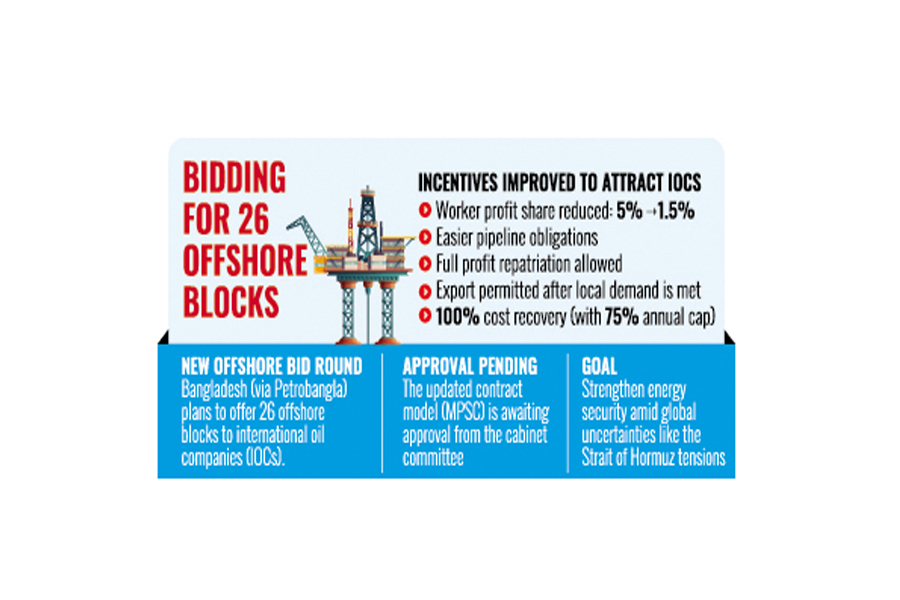
The newly elected BNP-led government has moved fast to launch the bid round to ensure the country's future energy security through delineating new hydrocarbon reserves against the backdrop of persistent Middle East crisis and restrictions on vessels passing through the Strait of Hormuz.
The state-run Petrobangla has already sweetened further the drafts of the model production -sharing contract to lure the IOCs in the forthcoming bidding rounds, Petrobangla chairman Md Arafanul Hoque told The Financial Express.
He says the mandatory portion to workers' profit -participation fund (WPPF) has been reduced to 1.5 per cent from previous 5.0 per cent.
Besides, decision has been taken for easing responsibility on construction of hydrocarbon pipeline after discovery and subsequent operations, he adds.
Sources say not a single IOC did take part during the latest offshore bidding although half a dozen IOCs purchased bid documents.
Lack of confidence from the IOCs coupled with inadequate data on offshore blocks resulted in the non-response in the bidding, market insiders say.
Petrobangla had put the offer on board for nine months after floating the international tender on March 10, 2024.
Twenty-four offshore blocks -- 15 in deep sea and nine in shallow sea -- were on offer for exploration lease.
The 15 deep-sea blocks on offer are DS-08, DS-09, DS-10, DS-11, DS-12, DS-13, DS-14, DS-15, DS-16, DS-17, DS-18, DS-19, DS-20, DS-21 and DS-22.
The nine shallow-water blocks are SS-01, SS-02, SS-03, SS-05, SS-06, SS-07, SS-08, SS-10 and SS-11.
The gas prices for the offered blocks were tagged to the price of Brent crude on the international market during the previous year's bid so that the gas price becomes flexible in line with the movement of global oil-price indices.
The gas price was offered at 10 per cent of Brent Crude, meaning if the Brent crude is traded at $100 per barrel, the gas price would be $10 per million British thermal unit (MMBTu).
The pricing modalities were fixed same for both shallow-and deep-water blocks. Petrobangla will purchase the explored IOC gas at the Brent crude-linked rate, which will have no capping.
Capping-free price means Bangladesh will have to purchase the gas, to be extracted by the contractors, at a rate as high as it goes or as low as it slips. The foreign firms also had the liberty to export natural gas after meeting domestic demand following Petrobangla's first right of refusal.
They were offered the facility to repatriate full profit, too.
There was the provision for assignment of interest and share-transfer and 100-percent cost recovery with an annual cap of 75 per cent.
Contractor must have to have a mandatory work programme consisting of a 2D seismic survey and the mandatory purchase of available 2D multi-client seismic data to get relief from mandatory work obligations proportionately.
Over the last decade, Bangladesh had launched only one bidding round - in 2017 - and that was only for three deep-water blocks, according to Petrobangla data.
Although Posco-Daewoo was awarded one deep-water block - DS-12 - after the bidding, the South Korean oil-and-gas -exploration company left the block in 2020 after carrying out a 2D seismic survey.
Previously Petrobangla had floated a bidding round in 2012, through which three shallow-water blocks and one deep-water block were awarded to contractors.
Currently, four IOCs have active PSCs, either individually or under joint venture, to explore three shallow-water blocks in Bangladesh.
US oil-major Chevron is active in exploring and producing natural gas in three gas fields under onshore blocks 12, 13 and 14. Singapore's KrisEnergy is producing natural gas from the Bangura field under Block 9. ONGC Videsh and Oil India are jointly exploring shallow -water blocks SS-04 and SS-09.
Bidding for 26 offshore blocks shortly with baits for IOCs
Surplus gas export, full profit repatriation among sweeteners on contract
M Azizur Rahman
Published :
May 02, 2026 23:49
Updated :
May 02, 2026 23:49
A much-sought-after bidding round offering some 26 offshore hydrocarbon blocks to potential international oil companies (IOCs) with sweetened terms is expected to be launched shortly, says a senior official of Petrobangla.
The energy and mineral resources division (EMRD) under the Ministry of Power, Energy and Mineral Resources (MPEMR) has forwarded the model production-sharing contract (MPSCs) to the cabinet committee on economic affairs for final approval.
The MPSC is expected to get the seal of approval in the cabinet committee next week and the bid round for the offshore oil-and-gas exploration would be launched immediate after obtaining the nod, the state corporation official adds.
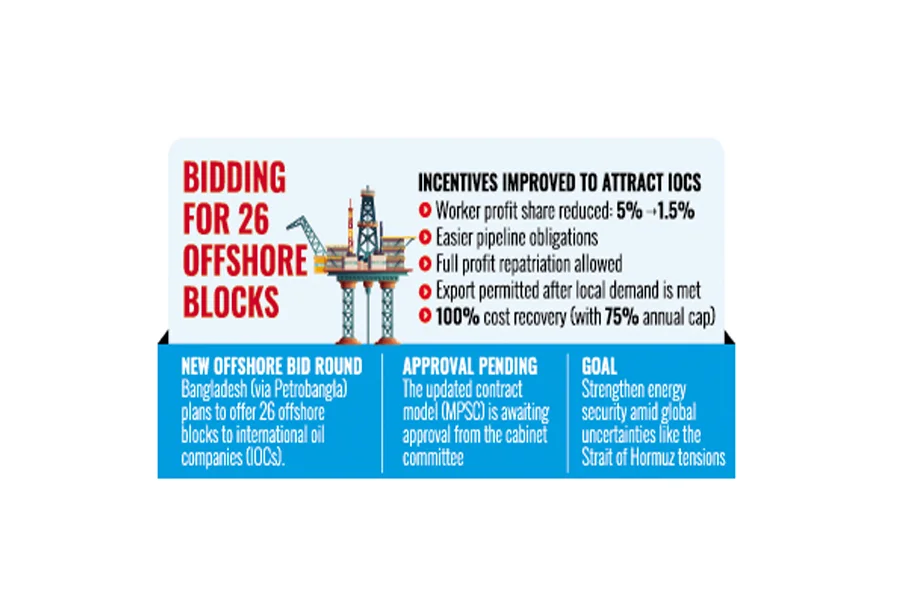
The newly elected BNP-led government has moved fast to launch the bid round to ensure the country's future energy security through delineating new hydrocarbon reserves against the backdrop of persistent Middle East crisis and restrictions on vessels passing through the Strait of Hormuz.
The state-run Petrobangla has already sweetened further the drafts of the model production -sharing contract to lure the IOCs in the forthcoming bidding rounds, Petrobangla chairman Md Arafanul Hoque told The Financial Express.
He says the mandatory portion to workers' profit -participation fund (WPPF) has been reduced to 1.5 per cent from previous 5.0 per cent.
Besides, decision has been taken for easing responsibility on construction of hydrocarbon pipeline after discovery and subsequent operations, he adds.
Sources say not a single IOC did take part during the latest offshore bidding although half a dozen IOCs purchased bid documents.
Lack of confidence from the IOCs coupled with inadequate data on offshore blocks resulted in the non-response in the bidding, market insiders say.
Petrobangla had put the offer on board for nine months after floating the international tender on March 10, 2024.
Twenty-four offshore blocks -- 15 in deep sea and nine in shallow sea -- were on offer for exploration lease.
The 15 deep-sea blocks on offer are DS-08, DS-09, DS-10, DS-11, DS-12, DS-13, DS-14, DS-15, DS-16, DS-17, DS-18, DS-19, DS-20, DS-21 and DS-22.
The nine shallow-water blocks are SS-01, SS-02, SS-03, SS-05, SS-06, SS-07, SS-08, SS-10 and SS-11.
The gas prices for the offered blocks were tagged to the price of Brent crude on the international market during the previous year's bid so that the gas price becomes flexible in line with the movement of global oil-price indices.
The gas price was offered at 10 per cent of Brent Crude, meaning if the Brent crude is traded at $100 per barrel, the gas price would be $10 per million British thermal unit (MMBTu).
The pricing modalities were fixed same for both shallow-and deep-water blocks. Petrobangla will purchase the explored IOC gas at the Brent crude-linked rate, which will have no capping.
Capping-free price means Bangladesh will have to purchase the gas, to be extracted by the contractors, at a rate as high as it goes or as low as it slips. The foreign firms also had the liberty to export natural gas after meeting domestic demand following Petrobangla's first right of refusal.
They were offered the facility to repatriate full profit, too.
There was the provision for assignment of interest and share-transfer and 100-percent cost recovery with an annual cap of 75 per cent.
Contractor must have to have a mandatory work programme consisting of a 2D seismic survey and the mandatory purchase of available 2D multi-client seismic data to get relief from mandatory work obligations proportionately.
Over the last decade, Bangladesh had launched only one bidding round - in 2017 - and that was only for three deep-water blocks, according to Petrobangla data.
Although Posco-Daewoo was awarded one deep-water block - DS-12 - after the bidding, the South Korean oil-and-gas -exploration company left the block in 2020 after carrying out a 2D seismic survey.
Previously Petrobangla had floated a bidding round in 2012, through which three shallow-water blocks and one deep-water block were awarded to contractors.
Currently, four IOCs have active PSCs, either individually or under joint venture, to explore three shallow-water blocks in Bangladesh.
US oil-major Chevron is active in exploring and producing natural gas in three gas fields under onshore blocks 12, 13 and 14. Singapore's KrisEnergy is producing natural gas from the Bangura field under Block 9. ONGC Videsh and Oil India are jointly exploring shallow -water blocks SS-04 and SS-09.