New Tweets

[🇧🇩] Energy Security of Bangladesh

G Bangladesh Defense
[🇧🇩] Energy Security of Bangladesh
574
20K
More threads by Saif


Bangladesh keen to work with Nepal in power sector: Adviser Fouzul Kabir
UNB
Published :
Sep 08, 2024 19:45
Updated :
Sep 08, 2024 19:45


1725841355761.webp


Adviser of the interim government for Power and Energy Muhammad Fouzul Kabir Khan has expressed Bangladesh’s keen interest in working jointly with Nepal in the power sector.

He said that Bangladesh is also interested in increasing trade relations with the Himalayan nation.

He made remarks when a 2-member delegation, led by Ambassador of Nepal to Bangladesh Ghanshyam Bhandari, met him in the conference room of the Ministry of Power, Energy and Mineral Resources on Sunday.

Welcoming the Nepalese Ambassador, the adviser said that Nepal is a long-time neighbor of Bangladesh.

They discussed various aspects of strengthening the relationship between the two countries through SAARC.

Ambassador Ghanshyam Bhandari congratulated Power and Energy Adviser on his new responsibility and said that Nepal recognised the student movement from the beginning and expressed solidarity with the people of Bangladesh.

The Nepalese Envoy said that Nepal has good relations with Bangladesh from the beginning and expressed the hope that it will continue in the future.

They also discussed the purchase of 40 MW of hydroelectric power from Nepal, the setting up of a 683 MW Sunkoshi-3 hydropower plant in a joint venture with Nepal and a Power Sale Agreement (PSA) for the import of 500 MW of power from Nepal’s GMR Upper Karnali Hydropower Limited (GUKHL).

During the meeting, Senior Secretary of Power Division Md. Habibur Rahman and Secretary of Railway Ministry Abdul Baki were present.​
 
Analyze

Analyze Post

Add your ideas here:
Highlight Cite Respond
  • Like (+1)
Reactions: Bilal9

Power outages on the rise again

1725929282098.webp

Photo: Collected

Power cuts are getting more frequent as power generation has failed to keep up with the high demand caused by the rising mercury.

For instance, the power generation shortfall hit nearly 2,000 megawatts (MW) yesterday -- the highest in recent weeks, according to data from the Bangladesh Power Development Board.

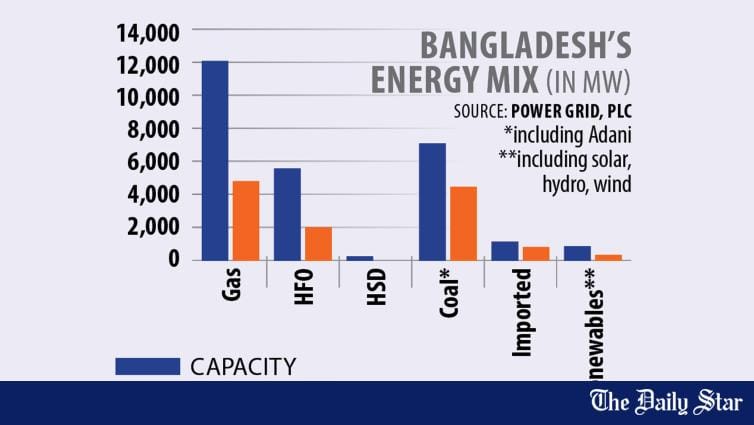
From this month, PDB has started generating up to 13,900 MW of electricity a day against the highest demand of 16,200MW, which is much higher than the previous month's average. Last month, the demand was 14,000MW to 14,500MW.

The temperature in Dhaka is now in the mid-30s during the day.

Rajshahi, Rangpur, Cumilla, Mymensingh and Sylhet areas are mostly affected by power cuts, the PDB data shows.

Frequent power cuts started in the last three to four days, said Rafiul Islam, a resident of the Sambhuganj area of Mymensingh.

"It's unbearable amid the sweltering heat."

The situation stays normal from midnight to 7 in the morning and then the power goes out in one to two-hour intervals throughout the day, Rafiul said.

A businessman, who ran a steel workshop in Biswas Para of Joypurhat, said they need to take a break for at least an hour every couple of hours. "Sometimes, the power is gone for three to four hours," he added.

PDB officials are pinning the blame for frequent power cuts on insufficient electricity generation by the coal-based power plants due to various technical issues. Gas shortage, too, has become a regular scenario.

Power plants with at least 10,000MW unutilised capacity are sitting idle due to fuel shortage or maintenance: 6,300MW due to fuel shortage and 3,600MW for maintenance.

Compared to last month, the unutilised capacity has increased due to fuel shortage this month.

Gas-fired plants of 4,093MW capacity are sitting idle due to a shortage of fuel, according to PDB data.

The country has a total of 11,428MW installed capacity from gas sources.

At least 25 gas-fired power plants have been shut since May 27 when cyclone Remal hit the coastal areas.

The cyclone damaged one of the country's two floating storage and regasification units (FSRUs), which brought down the LNG regasification capacity to 600 million cubic feet per day (mmcfd) from 1,100 mmcfd.

The FSRU tried to resume operations several times but failed.

It is now slated to resume operations from September 15, as per the recent announcement of Muhammad Fouzul Kabir Khan, the adviser to the ministry of power, energy and mineral resources.

Then the PDB's largest single power supplier, the 1,496MW Adani Godda power plant located in India's Jharkhand, is producing around 1,000MW of electricity.

Recently, they have sent letters to the ministry, the Bangladesh Bank and the chief adviser of the interim government to clear their eight months' outstanding bills amounting to $800 million.

"We are forced to inform you that the Godda plant is struggling hard to sustain its operations on account of running expenses towards procurement of coal, debt service obligations, operation and maintenance," said a PDB official quoting the letter as saying.

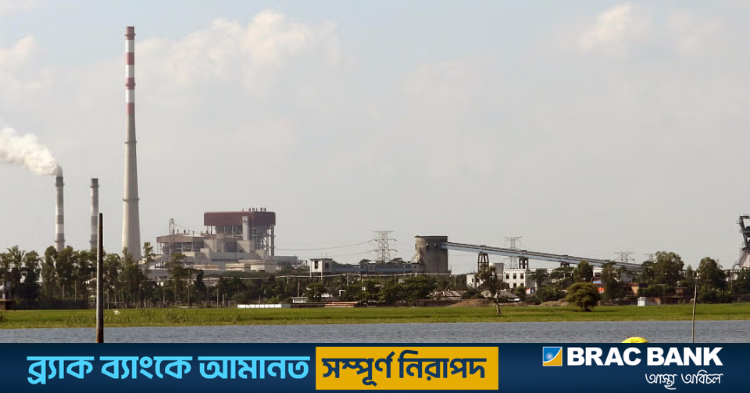
The Matarbari power plant is also producing less than its capacity due to coal shortage, while one of the two units of Chattogram's SS power plant is under maintenance.

At present, about 2,300MW -- or one-third of the total coal power capacity of 6,604MW -- remains idle, according to data from PDB.

Furnace oil imports also faced a dip due to the dollar crunch, according to PDB officials.

As of September 4, gross foreign exchange reserves stand at about $20.6 billion, enough to service about four months' import bill, according to data from the BB.

The country's total power generation capacity is 27,086MW.​
 
Analyze

Analyze Post

Add your ideas here:
Highlight Cite Respond

Power supply may not improve anytime soon

1726016104400.webp


The power supply situation has further deteriorated across the country as another power plant has completely shut and there is no sign of increasing generation in the immediate future.

Load-shedding or gap in power demand and supply hit the highest 2,312MW early yesterday, a record in recent weeks, according to the data of Power Grid Bangladesh PLC.

Rajshahi, Rangpur, Cumilla, Mymensingh and Sylhet areas are mostly affected by power cuts, the data shows.

From Monday evening, Dinajpur's 525-megawatt Barapukuria thermal power plant, the country's first coal-fired power producer, suspended operations after its lone functioning unit shut down for technical glitches, leaving the greater Rangpur area without electricity for a large part of the day.

The unit was supplying around 200MW of electricity.

Md Abu Bakkar Siddique, the chief engineer of the power plant, attributed the shutdown to the failure to conduct timely repairs by the Chinese contractor Harbin International.

Harbin did not adhere to contractual obligations regarding maintenance, he said, adding that the Chinese contractor had requested two weeks to resolve the technical fault.

Until then, small-scale businesses and battery-run autorickshaws will have to suffer.

Abdul Hannan, a rice miller in Bochaganj upazila of Dinajpur, said his mill's output has dropped significantly because of the unusual power cuts.

Sultan Mahmud, who runs a PVC printing business in Nawabganj upazila, said his business was affected by the frequent power cuts for the last couple of days.

"We are getting at least six hours' of power cuts every 24 hours," he said.

Load-shedding has hit Dhaka as well, according to data from the two distribution companies -- Dhaka Power Distribution Company and Dhaka Electric Supply Company. The two companies faced around 500MW of supply shortfall yesterday.

At least 25 gas-fired power plants have been shut since May 27 when cyclone Remal hit the coastal areas.

The cyclone damaged one of the country's two floating storage and regasification units (FSRUs), which brought down the LNG regasification capacity to 600 million cubic feet per day (mmcfd) from 1,100 mmcfd.

The FSRU tried to resume operations several times but failed.

It is now slated to resume operations on September 15, as per the interim government's recent announcement.

However, a PDB official said even if the FSRU comes into operation then, the situation will not improve immediately as the liquefied natural gas cargo will not arrive.

The government initiated the purchase process only recently and it will take at least two weeks for the cargo to arrive, he said.

Besides the gas shortfall, PDB officials are pinning the blame for frequent power cuts on insufficient electricity generation by the coal-based power plants due to various technical issues.

In the meantime, the Adani Godda power plant, which has outstanding bills of about $800 million, is supplying about 500MW less following instructions from PDB.

PDB has outstanding bills of about Tk 35,000 crore, most of which need to be paid in dollars, The Daily Star has learnt from officials involved with the proceedings.

Due to the dollar crunch, those payments have been put on hold, they said.

As of September 4, gross foreign exchange reserves stood at about $20.6 billion, enough to service about four months' import bill, according to data from the Bangladesh Bank.

The dollar crunch has interrupted the import of primary fuel including coal, gas and furnace oil, which hit the power sector, according to the officials concerned.

Subsequently, PDB has been unable to ramp up production despite higher demand due to the rising mercury.

The country's total power generation capacity is 27,086MW.​
 
Analyze

Analyze Post

Add your ideas here:
Highlight Cite Respond

Production fully suspended at Barapukuria power plant due to technical glitch

1726019396362.webp

Photo: Star

Power generation at Dinajpur's Barapukuria coal-based thermal power plant was fully suspended yesterday after its third unit was forced to shut down due to a technical glitch.

The unit had stopped operating from 6:00pm, our Dinajpur correspondent reports quoting Md Abu Bakkar Siddique, the power plant's Chief Engineer.

The Barapukuria plant, managed by Bangladesh Power Development Board (BPDB), has the capacity to produce 575-megawatt of electricity from its three units.

The 275-MW third unit is operated by the Chinese contracting firm, Harbin International. The two other units have the capacity of producing 125MW electricity each.

However, it used to generate 200 MW of electricity daily, which was supplied to the national grid.

This latest shutdown has further exacerbated power outages, resulting in frequent power outages in the greater Rangpur area.

Load-shedding or gap in power demand and supply was calculated at around 2,200MW last night, which is the highest in recent weeks, according to data of Power Grid Bangladesh PLC

The unit that shut down yesterday was the last operational unit of the power plant, as its first and second units went out of service long ago due to technical glitches, the chief engineer said. Each of the three units requires two electro-hydraulic oil pumps to function, which supply oil to the units for power generation. Since 2022, one of the pumps in the third unit remained out of service, and the plant was running depending on a single pump, leading to operational risks. Despite repeated notifications to the contractor, the problems remained unresolved.

After a 36-day shutdown, the third unit resumed operation on Friday (September 6), but its last oil pump broke down yesterday evening, halting production completely, the chief engineer said.

He said they had informed the Chinese contractor about the issue, and they requested two weeks to resolve it.

The plant will be able to resume operations once the necessary parts arrive from China.​
 
Analyze

Analyze Post

Add your ideas here:
Highlight Cite Respond

Govt trying to solve power cuts within 2-3 weeks: Rizwana

1726187211596.png

File photo

The interim government is trying to solve the power outage problem within the next two-three weeks, Adviser for Environment and also Water Resources Syeda Rizwana Hasan said yesterday.

She said the load-shedding issue was discussed in the advisory council meeting held with Chief Adviser Prof Muhammad Yunus in the chair at his office.

"We'll try to reach a solution to this problem within two-three weeks," Rizwana said while replying to a question at a press briefing at the Foreign Service Academy after the meeting.

Election to be held after necessary reforms

The environment adviser said there were two main aspirations behind the mass uprising -- one, to end rampant discrimination, and the other, much-needed reforms.

Referring to the formation of six commissions to reform six key sectors, Rizwana said, "We initially expect that the commissions would place their reports within three months."

She said the implementation of the recommendations to be placed by the six commissions would depend on whether the government can build a political consensus on these. "We'll go for dialogue at one stage."

"We're thinking about elections after taking specific commitments on reforms or bringing specific amendments in some cases by reaching a political consensus through dialogues," she said.

Rizwana said the political parties have already made it clear that they would go for election after reforms.​
 
Analyze

Analyze Post

Add your ideas here:
Highlight Cite Respond
  • Like (+1)
Reactions: Bilal9

Reformation to power, energy sector: BWGED places 16-point proposals
BWGED places 16-point proposal for power sector reform

1726187377770.webp


Bangladesh Working Group on Ecology and Development today proposed 16-point proposals for reforming the power and energy sector to ensure good governance, transparency and sustainable development to the sector.

The organisation made the proposals at a press conference at Dhaka Reporters' Unity.

The working group urged the interim government to adopt "No Coal or Coal Moratorium Policy", cancel any new coal-based plant from the power sector masterplan, move away from dependency on liquefied natural gas, and cancel the earlier-announced third LNG terminal.

They also asked the government to backtrack from the previous government's plan to introduce Japanese technologies including carbon capture and ammonia co-firing, which they termed as "unproven and false technologies".

BWGED also demanded removing 26-56 percent taxes in the renewable energy sector, revoking the Quick Enhancement of Electricity and Energy Supply (Special Provisions) Act 2010, initiating a public investigation committee, making Initial Environmental Examination and Environmental Impact Assessment mandatory for all projects, and initiating new masterplan aiming Net Zero carbon emission.

BWGED member secretary Hasan Mehedi said despite the country's commitment to reduce dependence on fossil fuel for power generation, it did not happen.

"Gas-based power plants generate electricity for half of a year and remain ineffective for rest of the time. As such, the previous government had been increasing LNG-based power plants," he added.

Addressing the event, Khondaker Golam Moazzem, research director at the Centre for Policy Dialogue, said it is high time to prioritise knowledge-based policy decisions and break the syndicate that has long been dominating the power and energy sector.

Mentioning that the previous government took decisions to favour certain individuals or groups, he said, "Now, decisions regarding formulation of laws and policies have to be taken in the light of people's welfare and science-based knowledge."

Moazzem also called for ensuring independence of the Bangladesh Energy Regulatory Commission and Sustainable and Renewable Energy Development Authority, and awarding all new plants through a competitive bidding process.

He further demanded the concerned ministry to disclose the Power Purchase Agreements to ensure transparency and accountability, and urged the interim government to prioritise civil society organisations' voices from local to national levels​
 
Analyze

Analyze Post

Add your ideas here:
Highlight Cite Respond
  • Like (+1)
Reactions: Bilal9

PDB says Adani dues inflated by 32pc
Emran Hossain 12 September, 2024, 23:11

1726190644139.webp


The Bangladesh Power Development Board estimated that it owed to the Indian Adani Power $547 million, about 32 per cent less than what was claimed by the company, a sister concern of the controversial Indian Adani Group conglomerate.

The group’s chairman Gautam Adani sent a letter to chief adviser to the interim government of Bangladesh Muhammad Yunus last month seeking his intervention to clear his outstanding power bill of $800 million, Indian media reported on September 10.

The PDB confirmed that Adani Group asked for payment of $800 million in dues.

Officials at the power development board’s finance division explained that an unequal power purchase agreement that brought Adani into the country’s power scene last year in a deal patronised by Sheikh Hasina and Narendra Modi allowed price manipulation and the overpricing.

Power, energy and mineral resources adviser Muhammad Fouzul Kabir Khan said that a special committee was engaged in evaluating power and energy deals, including the one with Adani, signed during the tenure of the now overthrown Awami League government.

‘We are also writing a reply to the letter sent to the chief adviser explaining our position on the matter,’ he said sharing his knowledge regarding the difference in the estimates of its dues payable to Adani.

The power purchase agreement, better known as PPA, allowed Adani Power to generate electricity in its 1,600MW Godda power plant by burning coal carrying a calorific value of 4,600 kcal/kg, but charge Bangladesh for the use of coal carrying the calorific value of 6,322 kcal/kg.

It means, Bangladesh is being charged by Adani for a high quality coal use, while in reality the plant is using a lesser quality coal.

The price of coal varies greatly depending on its quality, explained officials at the PDB’s finance division, citing different prices of coal on the Indonesian index on Wednesday.

The price of a tonne of coal on the Indonesian index drops down to $51.18 from $127.72 between the categories of the coal producing 4200 kcal/kg and 6500 kcal/kg. The lowest quality of coal on the Indonesian index costs $31.78.

The PPA also allowed Adani to combine prices of coal on the Indonesian and Australian indexes and average them to claim a price from Bangladesh.

The Australian coal is of very high quality and more expensive than the Indonesian coal. Adani is allowed to use the high price to inflate its profit though importing coal from Indonesia entirely.

The provision of averaging the combined prices is rather unique since other similar power plants were never allowed such privileges. Power plants, such as Rampal and Payra, were allowed to use only one index for pricing.

The Adani power plant initially raised eyebrows as it had planned to use coal from an Australian mine owned by the Adani Group. The international media reported that Adani was allowed to dump its coal on Bangladesh as the fossil fuel was rapidly losing its market. Adani had to abandon the plan following widespread criticism.

The PPA, termed unequal by energy experts, allowed Adani to charge 60 per cent higher prices than the actual market price early last year, causing widespread outrage in Bangladesh.

In February, Adani demanded about $400 for each tonne of coal for running its Godda power plant in Jharkhand though the same coal was available for $250.

After the uproar over the coal price amidst a severe dollar crisis plaguing the past Awami League government, Adani agreed in what PDB calls a side letter that the company would charge price for coal keeping up with other coal-based power plants.

The PPA however remained unchanged.

The PPA, which was never made public, also lacked discount provision provided by the 1200MW Payra power plant in case of a sudden increase in the price of energy. The Payra plant gives up to 40 per cent discount.

Globally, PPAs offer the discount benefit, up to 55 per cent, for large-quantity coal purchases, energy experts said.

The effectiveness of the side letter expired in June this year, the PDB said.

Letters sent to Adani requesting an extension of the side letter after the autocratic Hasina government fell in early August was not replied.

PDB officials said that Adani rather insisted that their dues to be paid based on the PPA conditions.

Bangladesh is currently receiving a $4.7 billion loan from the International Monetary Fund based on agreeing to implement at least four dozen conditions.

In April, 2018, in a report the US-based Institute for Energy Economics and Financial Analysis said that the Godda project would be one of the most expensive sources of electricity for Bangladesh.

The report pointed out that Bangladesh’s Godda electricity deal was clearly designed to benefit Adani.

In December 13, 2022, the institute in another report said that Bangladesh could not afford electricity produced by Adani without frequently increasing power tariff.

Ever since Adani rolled into operation last year, power price was increased several times.

The Washington Post showed the Godda project as the centrepiece of a report published in December 2022 for demonstrating how political influence and abuses enabled the Adani Group to build its coal empire in India and beyond.

‘The coal will probably come on Adani ships to an Adani-owned port in eastern India, then arrive at the plant on a stretch of Adani-built rail. The electricity generated will be sent to the border over an Adani-built high-voltage line. Under the contract, shipping and transmission costs will be passed on to Bangladesh,’ read a paragraph of the Washington Post report.

The Institute for Energy Economics and Financial Analysis estimated that the coal shipping would involve an 8,000-km sea and a 700-km railway journeys.

Adani also built over 100-km power transmission lines and is entitled to charge Tk 0.29 per unit with a yearly increase rate of 1 per cent, according to a report published in June by the Bangladesh Working Group on External Debt.

The working group report estimated that Adani would have its investment returned in maximum six years while the capacity charge stipulated in the deal with Bangladesh would earn Adani over its 25-year lifetime some $12 billion.

Adani’s Godda investment was estimated to be $2 billion.

The power cell director Muhammad Hossain last year blamed lack of experience for the shortcomings in the deal with Adani.

Bangladesh’s current installed capacity is 27,791MW, but the country is struggling to generate even 13,000MW.

A crippling energy crisis is sweeping through the country amidst humid, hot days, prompting up to 20 hours of power cuts in many places.

Adani-appointed public relation agency in Bangladesh in reply to a request for comment said that what the BPDB said was correct as overdue amount. Amount remained not paid within two months due date.

It also said that Adani had not officially told any news media about any amount outstanding.​
 
Analyze

Analyze Post

Add your ideas here:
Highlight Cite Respond
  • Love (+3)
Reactions: Bilal9

Govt must move back on Adani power agreement
14 September, 2024, 00:00

THE agreement with India’s Adani Power by way of which it supplies Bangladesh with power from a 1.6GW Godda plant built in the Indian state of Jharkhand exclusively for the purpose has aired fresh fears as the Power Development Board has estimated that it owes Adani $547 million, about 32 per cent less than what the Indian entity has claimed. The Adani Group that owns Adani Power, as Indian media reported on September 10 which Bangladesh authorities have also confirmed, has written to the chief adviser to the interim government of Bangladesh in August seeking an intervention in the clearance of $800 in outstanding power bill. The power board says that the agreement, which brought Adani to Bangladesh’s power scene in 2023 under the patronisation of the deposed prime minister Sheikh Hasina, allows price manipulation and overpricing. Whilst the power board is reported to be writing to the chief adviser to the interim government on Bangladesh’s position on the agreement, the adviser on power, energy and mineral resources says that a special committee was evaluating all power and energy agreements, including the one with Adani, that were signed during the 15 years’ tenure of the Awami League government, overthrown on August 5 amidst a student-mass uprising.

The agreement has allowed Adani to generate power from coal carrying a calorific value of 4,600 kcal/kg but charge Bangladesh for the use of coal carrying 6,322 kcal/kg in calorific value. This comes down to the use of low-value coal for the payment of high-value coal. Besides, the agreement has allowed Adani to charge Bangladesh an average of coal prices on the Indonesian Index, in which a tonne of coal in the range of 4,200 kcal/kg–6,500 kcal/kg costs in the range of $51.18–$127.72, and the Australian Index, which is of very high quality and is more expensive, to inflate its profit although Adani sources its coal for the plant entirely from Indonesia. The provision for averaging the combined prices of coal is unique to the Godda project as no other similar plants have been given such privilege. The agreement, thus, allowed Adani to charge Bangladesh 60 per cent higher than the actual market price in 2023. Adani in February demanded about $400 for a tonne of coal although it was available for $250. The agreement also has no provision for discount, which is up to 55 per cent globally, in the case of a sudden increase in coal price as is the case with the 1.2GW Payra plant. Adani, which has invested an estimated $2 billion in the Godda plant, is reported to be getting its investment returns in six years and the capacity charge in the deal would earn Adani some $12 billion more in its 25-year lifetime.

Bangladesh’s installed power generation capacity is about 2.78GW, but it struggles to generate even 1.3GW, with a burdening overcapacity and consequent capacity charge payment. The interim government must, therefore, move back on the Adani power purchase agreement and, rather, improve on the use of generation capacity after a thorough review of the power and energy situation.​
 
Analyze

Analyze Post

Add your ideas here:
Highlight Cite Respond
  • Love (+3)
Reactions: Bilal9

Latest Posts

Back
PKDefense - Recommended Toggle