Fuel price adjustment & wider economic interests
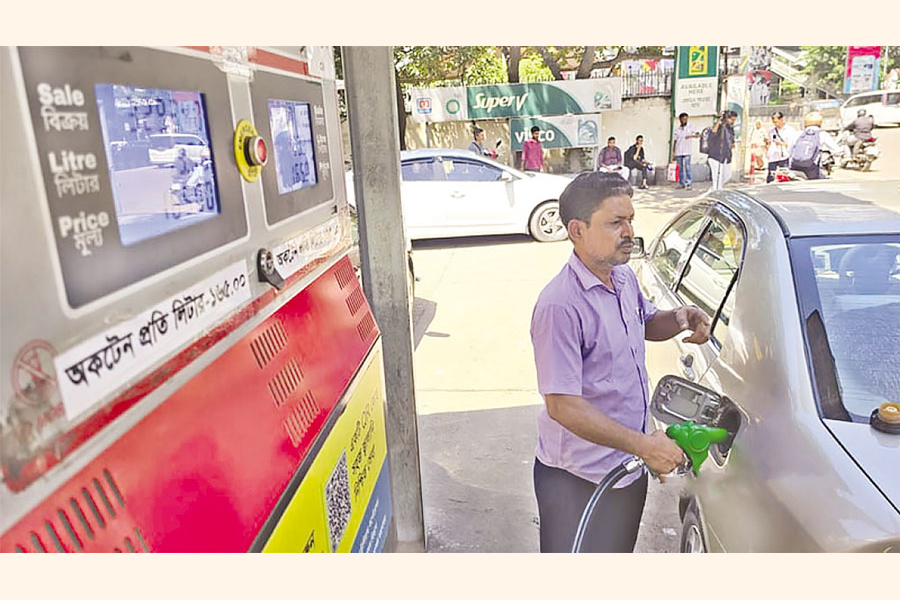
Filling stations start to sell fuel at newly hiked prices on Monday — bdnews24.com Photo
Bangladesh government’s decision to raise retail prices of fuel oil including diesel, petrol, octane and kerosene—by Tk 20 per litre on September 21, 2026, has once again highlighted the country’s challenging energy economic realities. Bangladesh remains fully import dependent for fuel oil. It is compelled to import most of its fuel oil in refined form due to its limited domestic refining capacity (Eastern Refinery can refine approximately 1.2 million tonnes of imported crude petroleum annually). Currently, Bangladesh imports approximately 7 million tonnes of crude and refined petroleum (including diesel, octane, jet fuel, furnace oil, lubricant and others) annually. Annual spending on petroleum imports fluctuates heavily based on global market prices. During last fiscal year Bangladesh spent approximately 10.6 billion US dollars on fuel imports. With the country’s primary energy supply heavily dependent on imports, the government has limited immediate alternatives to ensure an uninterrupted supply of fuel oil.
The abrupt fuel price hike has triggered a domino effect across the economy, multiplying the hardships faced by ordinary people. A rise in fuel prices never remains confined to petrol stations; it drives up costs across transport, agriculture, industry and services. This, in turn, fuels inflation, reduces purchasing power and weakens the competitiveness of exporters. Higher transport fares and rising prices of everyday essentials not only increase people’s financial burden on citizens but also contribute to widespread frustration.
Consequently, the government has raised bus fares by Tk 0.17 per kilometre, while long-distance bus fares have already increased by Tk 50–100. Local buses on the Dhaka–Chattogram route are charging an additional Tk 5–10. Truck freight rates have surged by Tk 2,000–8,000. Furthermore, private container depot operators have imposed a 9.85 per cent fuel surcharge on container handling.
The government has announced fare increases for buses, minibuses and launch services, but not for air-conditioned buses, goods-carrying trucks or covered vans. This has left considerable room for operators to impose their own charges. Some are reportedly charging an additional Tk 50 to Tk 200 for each trip, while truck and covered-van operators are imposing even higher increases. Truck owners, for example, have reportedly been charging an additional Tk 4,000–6,000 on some routes.
The increase in fuel prices is also affecting the handling of import-export containers, as the machinery and vehicles used at private inland container depots are largely diesel-powered.
The higher price of diesel will be an additional burden on farmers who are already struggling with a fertiliser shortage. As reported, around 15-24 per cent of total diesel consumed in Bangladesh (about 0.97- 1.25 million tonnes of diesel annually) are used in agriculture. Diesel is required not only for irrigation but also to operate machinery used for land preparation, planting, harvesting, threshing and transporting agricultural produce.
The increase in diesel prices will therefore affect almost every stage of agricultural production, putting further pressure on farmers and food production while potentially worsening food insecurity and inflation.
At a time when inflation is already high (reaching 8.26 per cent in August 2026) and wages are rising at a slower pace, higher transport costs are likely to push up food prices and service charges, placing an even greater burden on ordinary people.
For lower-income households, higher fuel costs are particularly difficult to absorb because a larger share of their income is spent on essential goods and services, whose prices are heavily influenced by transportation and energy costs.
Media reports suggest that the chairman of Bangladesh Petroleum Corporation (BPC) wrote to the Energy Division about the corporation’s financial crisis and mounting losses. In the BPC letter dated September 8, two factors were identified as the main causes of BPC’s financial difficulties. The first was that domestic fuel prices had not been adjusted regularly in line with global prices. The second was a change in the method of assessing duties and taxes on petroleum products introduced in June 2025.
Under the new system, duties and taxes on imported petroleum products are calculated based on their actual import or invoice value rather than a fixed tariff value. As a result, when international fuel prices rise, the amount of duty payable also increases, contributing significantly to BPC’s losses. According to BPC, the change has increased its tax burden by around Tk 15–20 per litre compared with the previous system.
Following the rise in international fuel prices amid the conflict in the Middle East, the import duty and taxes rose to Tk 38.64 per litre in March, Tk 38.90 in April, Tk 29.74 in July, and Tk 32.44 in August. In September, the duty is expected to be around Tk 38–40 per litre.
Government officials have described fuel price adjustments as “the only acceptable option” to prevent a massive fiscal deficit, ease pressure on the treasury and reduce the government’s subsidy burden. According to published reports, BPC’s accumulated losses amounted to more than Tk 22,875 crore between March and August 2026 as conflicts in the Middle East disrupted energy supply chains and increased energy procurement and shipping costs.
Officials have also argued that adjusting domestic fuel prices was necessary to prevent cross-border smuggling to neighbouring countries where fuel prices are higher. At the same time, the government has faced the challenge of reducing subsidies on fuel imports while preserving resources for social safety-net programmes.
Against this backdrop, the government has chosen to impose additional costs on the public in order to reduce BPC’s annual losses by Tk 10,000 crore.
Some economists argue that the government could seek to balance the expenditure burdens through stricter austerity measures and more disciplined public spending (government has repeatedly announced and introduced austerity measures including reducing fuel and electricity consumption in public offices by 30 per cent, halting new vehicle procurement and restricting foreign travels) while directing resources that generate broader economic and social benefits.
Dhaka University professor and economist Selim Raihan has highlighted the concerns that the government ministries frequently fail spending and savings targets because there is little or no quarterly or half yearly oversight to ensure compliance. Moreover, efforts to cut expenditures foreign training, vehicle purchases and hospitality budgets often face resistances from bureaucrats and administrative bodies.
At the same time, the government has decided to implement a new pay scale for government employees. Published reports suggest that the new pay scale is expected to increase government expenditure by Tk 1,05,380 crore over three years: Tk 37,372 crore in the current year, Tk 44,838 crore in 2027 and Tk 23,170 crore in 2028.
The government has also committed thousands of crores to major and costly purchases, (including several Boeing passenger aircrafts, fighter jets and other equipment. This raises a broader question about government’s spending priorities. On the one hand, the government considers reducing BPC’s annual losses by Tk 10,000 crore by raising fuel prices, imposing additional costs on households and businesses. On the other hand, it has committed expenditures many times larger through higher government salaries, major equipment purchases and infrastructure projects.
The central issue, therefore, is not simply BPCs financial discipline or the need to balance its budget. It is also a question of government priorities: how limited public resources should be allocated, which expenditures should receive precedence, and how the burden of economic adjustment should be distributed between the government, businesses and ordinary citizens. Ultimately, the challenge is to reconcile the financial sustainability of the energy sector with the wider economic interests of households, businesses, farmers and the national economy.
Mushfiqur Rahman is a mining engineer. He writes on energy and environment issues.


 Bangladesh Defense