Home Watch Videos Wars Movies Login

[🇧🇩] Monitoring Bangladesh's Economy

[🇧🇩] Monitoring Bangladesh's Economy
1K
47K
More threads by Saif

G Bangladesh Defense

Bangladesh receives $8.02b in remittances through Sept 23

1790316187981.webp


Bangladesh received US$8.022 billion in workers’ remittances during the July 1-September 23 period of the current fiscal year (FY2026-27), registering a 13.6 percent year-on-year growth.

According to Bangladesh Bank data, the country received US$7.064 billion in remittances during the corresponding period of FY2025-26, BSS reports.

The remittance inflow also showed a positive trend in September. Expatriate Bangladeshis sent US$2.196 billion during September 1-23, compared to US$2.164 billion during the same period last year, marking a 1.5 percent increase.

On September 23 alone, the country received US$62 million in workers’ remittances.

The sustained growth in remittance inflows is contributing to strengthening the country’s foreign exchange inflow and supporting overall external-sector stability.​
 
Analyze

Analyze Post

Add your ideas here:
Highlight Cite Respond

Will disinflation go away?
1790465758851.webp


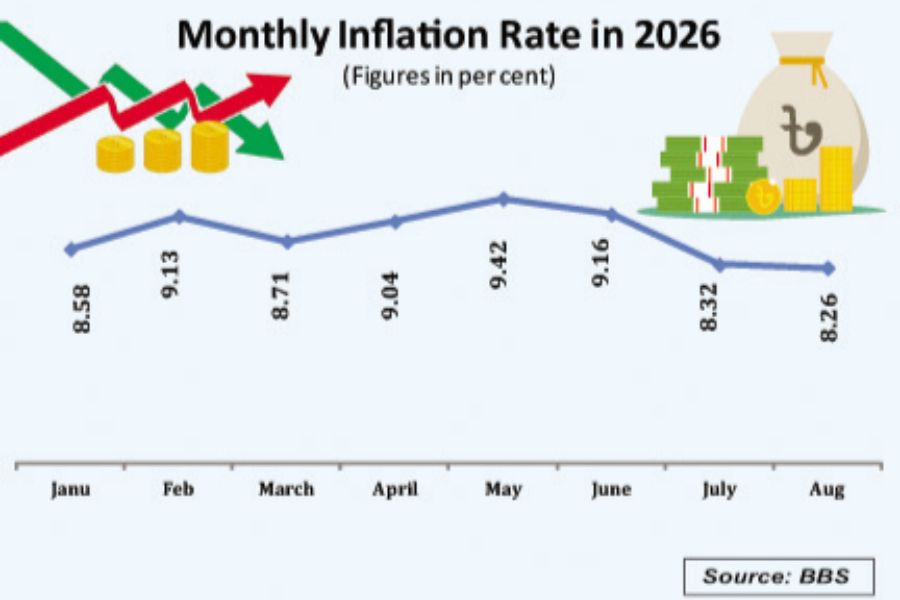
For the last few months, Bangladesh economy has gone through a phase of disinflation which means there was a slowdown in the rate of inflation although overall price level did not decline. The rate of inflation, on point-to-point basis, came down to 9.16 per cent in June from 9.42 per cent in May this year. The rate dropped again in July to 8.32 per cent and further came down to 8.26 per cent in August. The trend showed that inflation rate is going down slowly. The rates of food and non-food inflation declined during the period under review driving the overall decline in inflation rate. Food inflation came down to 7.02 per cent in August from 8.60 per cent in June this year while non-food inflation dropped to 9.32 per cent from 9.61 per cent respectively. At present, the weight of food is 45 per cent in the Consumer Price Index (CPI) and non-food 55 per cent.

Theoretically, disinflation is ‘a temporary slowing of the pace of price inflation.’ The term is generally used to ‘describe instances when the inflation rate has reduced marginally over the short term.’ So, disinflation is a short-term phenomenon that brings temporary relief for the consumers. As price level does not decline substantially during the period, prices of various goods and services remain high. That’s why when media reported the decline in inflation in July or August, many also raised the authenticity of the inflation data released by Bangladesh Bureau of Statistics (BBS). The question, raised by them, was: how could inflation decline when prices of essential commodities remained high? There is nothing wrong on raising such question especially when people have been suffering from high prices and their real wage has also been eroding. A missing point of the discussion is that despite a decline in inflation, the rate is still above 8 per cent which is also high.

Disinflation is usually viewed as a success of tight monetary stance. To put it simply, by raising interest rates, the central bank in an economy tightens the supply money in the market. As money supply reduces, the rate of inflation also starts to decline and a disinflation takes place for the time being. If the inflation rate comes down to the targeted or optimal level, the central bank may again go for rate cut slowly.

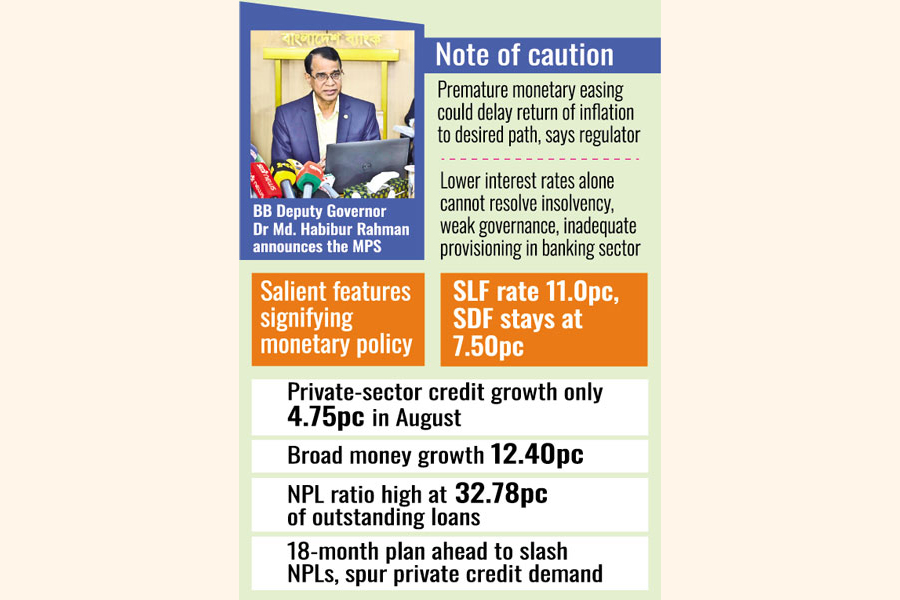
Bangladesh Bank has long been pursuing for the tight monetary policy to bring down the high rate of inflation. It kept the policy rate, repo rate to be precise, at 10 per cent for 22 months and finally brought it down by 50 basis points to 9.50 per cent two months back. The move came under criticism as inflation rate had not reduced to the optimal level of 7.50 per cent. A few weeks earlier, in the half yearly monetary policy statement, Bangladesh Bank announced that it would maintain its ‘contractionary monetary policy stance’ throughout the first half of FY27 to ‘rein in headline inflation and anchor long-term inflation expectations.’ So, the rate cut triggered debate on the policy consistency of the central bank.

Nevertheless, central bank’s move to cut policy rate modestly was based on its assumption that disinflation is already there. The rate cut was announced at the end July when complete data of inflation of the month was not at hand. Relevant data also came under review before the rate cut. For instance, private sector credit growth was 5 per cent since March this year. It was significantly below the projected 8.50 per cent growth rate.

Bangladesh Bank was probably expectating that disinflation would continue for a couple of months further and modest rate cut would not arrest there declining trend shortly. If disinflationary trend continued for longer period, it would reflect the decline in overall price level. But the fuel price hike by the government last week has changed the equation. The government increased the prices of all four major petroleum products by Tk 20 a litre in a bid to offset the higher costs of imports partially. The new prices came into effect from Monday, pushing up diesel to Tk 135 per litre from Tk 115, octane to Tk 165 from Tk 145, petrol to Tk 160 from Tk 140, and kerosene to Tk 155 from Tk 135. It is the third adjustment of fuel prices by Tarique Rahman-led BNP government since its assumed power in February this year.

As Bangladesh is largely dependent on the imports of fuel, volatility in the global market due to geopolitical tension makes it gradually expensive. The country imports around 85 per cent of the total demand of crude oil annually. The America-Israel joint assault on Iran in February suddenly restricted the supply of crude oil from the Gulf countries making it expensive. Iran retaliated and chocked the Strait of Hormuz so that no oil tanker can pass through it. After a fragile truce, the strait opened but faced restrictions time to time as the United States (US) breached the truce at regular intervals. Now the situation turned more complex as Iran-backed Huti militias in Yemen advanced to Bab el-Mandeb, a strategically important waterway connecting the Red Sea with the Gulf of Aden. The intensified conflicts and crisis in the Gulf region put the global oil market into turmoil.

Now, the sharp rise in oil prices will obviously push the inflation up in Bangladesh as transport fares and power tariffs are set to jump. Rise in transport fare means rise in transportation costs of goods and people’s mobility. Transport alone contributes around 10 per cent of the total CPI. Also, ‘housing, water, electricity, and gas’ contribute 15 per cent to the consumer basket. The cascading effect of oil price hike will also make electricity expensive. The rise in energy price will increase the cost of production and distribution.

Thus, disinflation will vanish soon. Will it be reflation, the opposite of disinflation? Theoretically, reflation aims to ‘expand output, stimulate spending, and counteract deflation after economic slowdowns.’ The fuel price hike does neither expand output nor stimulate spending. So, the fuel price shock will not lead to reflation. Instead, the country will return to a higher-inflation path. Bangladesh Bank, on Wednesday last, also decided to keep the policy rate at 9.50 per cent unchanged, as it anticipated a rise in inflation in the coming days due to the fuel price hike coupled with the implementation of the government’s upward-revised pay scale. It may even be forced to hike rates in the coming days to contain the inevitable surge in inflation.​
 
Analyze

Analyze Post

Add your ideas here:
Highlight Cite Respond

Injection of high-powered money up amid rising inflationary pressure

BB's growing quasi-fiscal activities, liquidity support to struggling banks among factors

1790551012538.webp


A downturn in the funneling of inflation-fueling high-powered money into the market reverses significantly and stokes fear of spikes in the inflationary pressure on living and economy.

Money-market experts have pinpointed several factors, including the central bank's growing quasi-fiscal activities and the regulator's liquidity support to the struggling banks, largely contributing to the recent leaps in reserve-money growth.

Under a tight monetary-policy regime pursued by the central bank until July last to tame obdurate inflation, the inflow of the reserve money dropped to a negative growth of 0.12 per cent in June 2025. In a rebound since, it has risen significantly in recent months.

Apart from the regular liquidity-feeding instruments of the Bangladesh Bank (BB), they said, the flow of subsidised credits or money injection through irregular arrangements keeps rising on the money market, which is contradictory to the spirit of contractionary monetary-policy stance.

As a matter of fact, the BB-claimed tight monetary policy is not transmitting into the money market properly and not being able to contain the inflationary pressure at the expected level.

This shortcoming in regulating money supply as per policy is ultimately hurting common people through eroding their purchasing power.

According to latest BB data, the growth in the reserve money was recorded 0.12-percent negative in June last year. Afterwards it started leaping to 2.52 per cent, 3.47 per cent, 9.23 per cent, 13.35 per cent and 14.39 per cent, 15.25 per cent and 17.86 per cent in July, September, December of 2025, February, April, June and August this year respectively.

Reserve money is the total amount of currency in circulation plus commercial banks' deposits held at the central bank, acting as the foundation for the entire monetary system.

It is also called "high-powered money" because it forms the foundation for the expansion of bank deposits through the money-creation process.

Seeking anonymity, a BB official said the central bank, in fact, did nothing to control the higher inflation apart from continuing a higher policy rate of 10 per cent since October in 2024.

"The volume of quasi-fiscal activities by the BB through which commercial banks avail credits from the regulator at subsidised rates, ranging from 0.5 per cent to 5.0 per cent, is still quite large," he told The Financial Express

On the other hand, the central banker added, regular government borrowing from the central bank through using ways and means, amounting to maximum Tk 120 billion, and overdraft worth maximum Tk 120 billion, goes on to operate some 119 accounts at 8.0 per cent and 9.0 per cent respectively.

"Certainly, it (reserve money growth) is a concern for all of us because it fuels inflation to some extent," he said.

Considering possible spikes in inflation following latest upward revision of fuel prices and reserve-money growth, the central banker said, the banking regulator decided not to cut the policy rate (now it is 9.50 per cent) until December next.

Overall inflation in Bangladesh eased slightly to 8.26 per cent in August 2026, down from 8.32 per cent in July, according to data from the Bangladesh Bureau of Statistics (BBS).

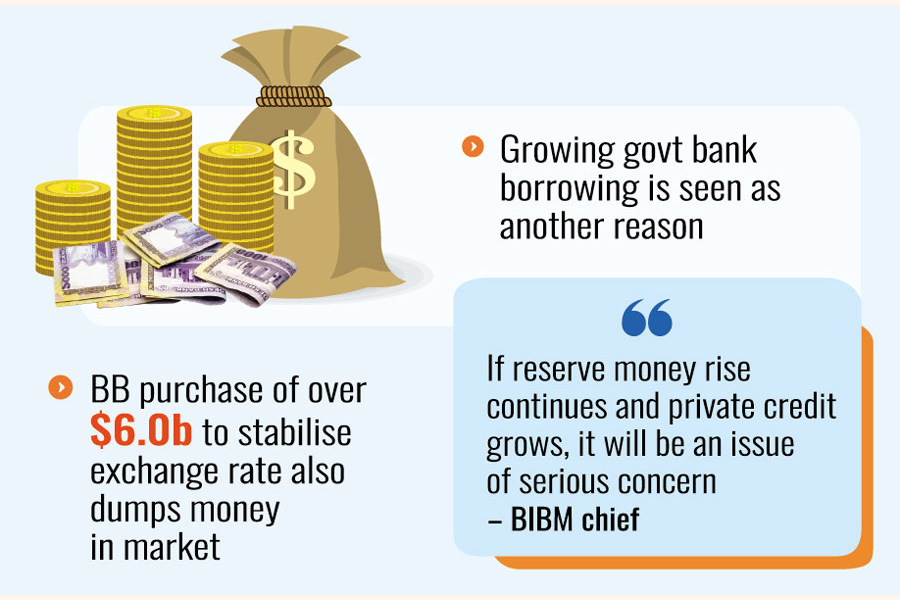
Apart from growing government bank borrowing and quasi-fiscal activities, Director-General of Bangladesh Institute of Bank Management (BIBM) Dr Md. Ezazul Islam points out that the regulator has purchased more than US$6.0 billion since July 13 last year to stabilise the exchange rate and injected huge volumes of money into the market. These all factors contributed to the rising growth of reserve money.

But the money-multiplier effect was not too high because of lower credit demand by the private sector. The credit appetite of the entrepreneurs is expected to increase in the coming days.

"If the uptrend in reserve money continues and private-sector-credit growth gets enhanced, it will be an issue of serious concern in the context of a tight monetary stance," the monetary economist added.​
 
Analyze

Analyze Post

Add your ideas here:
Highlight Cite Respond

Latest Posts

Back
 
G
O
 
H
O
M
E