Donate ☕
201 Military Defense Forums
[🇧🇩] - Everything about Hasina's misrule/Laundered Money etc. | Page 27 | PKDefense
Home Login Forums Wars Watch Videos
Serious discussion on defense, geopolitics, and global security.

[🇧🇩] Everything about Hasina's misrule/Laundered Money etc.

Reply (Scroll)
Press space to scroll through posts
G Bangladesh Defense
[🇧🇩] Everything about Hasina's misrule/Laundered Money etc.
261
8K
More threads by Saif

Sheikh Hasina was a classic autocrat: M Sakhawat Hossain
Published :
Aug 05, 2024 22:03
Updated :
Aug 05, 2024 22:03


1722901534183.png

Sheikh Hasina was a classic autocrat who dismissed the people, and this disdain has led to her current predicament, according to Brigadier General (Retd) M. Sakhawat Hossain, an election analyst and former military officer. In a special interview with UNB news agency over the phone, he expressed these views.
He stated that today's events were inevitable and were bound to happen. "We have seen similar situations in Tunisia, Libya, and Syria. Popular uprisings are unstoppable. The student quota reform movement could have been resolved easily, but due to Prime Minister Sheikh Hasina's stubbornness, so many people lost their lives."

Hossain criticised the media's portrayal of the casualties, claiming that the true number is closer to 400, with a significant portion being students and young people. He questioned the whereabouts of the remaining bodies, mass graves, and the extent of innocent lives lost. "She has gone, but who will answer for this?" he asked.

He accused the ruling government of carrying out the "most heinous massacre" and of misleading the public by blaming criminals while those responsible were, in fact, their own countrymen. "Such things should not happen in a free country," he remarked.

Hossain also noted that for the past 15 years, people have been unable to vote properly, with widespread election fraud. He stated that Sheikh Hasina should have understood her and her party's unpopularity, and questioned who would be held accountable for the bloodshed. He criticized the severe lack of good governance, which he believes Sheikh Hasina failed to provide.

Furthermore, he alleged that Sheikh Hasina has created criminal gangs within the country and turned the police and Rapid Action Battalion (RAB) into her personal enforcers.

Reflecting on the plight of the family members of the so-called Father of the Nation, he questioned why they had to face such a tragic fate, attributing it to Hasina's arrogance and pride. He drew a parallel with the 2009 BDR mutiny, where 57 army officers were killed, and questioned who would answer for that incident as well.

He criticised Sheikh Hasina's control over TV media and her suppression of free speech, citing it as a reason he avoided talk shows. He claimed he had urged the Prime Minister in various meetings to ensure good governance, but was labelled as an 'agent of the opposition' for his criticisms.

"Today, Sheikh Hasina has fled the country, and now the army has had to take responsibility for the nation's situation," he concluded.​
 
Last edited:
Analyze

Analyze Post

Add your ideas here:
Highlight Cite Fact Check Respond
  • Like (+1)
Reactions: Bilal9

S Alam threatens int’l legal action against govt: FT

1734997704939.webp

Collected photo

S Alam Group owner Mohammed Saiful Alam has initiated a legal effort as a Singaporean citizen to recover financial losses he claims were caused by the Bangladeshi government freezing his assets and harming his investments, The Financial Times reports.

The dispute stems from actions taken by the interim government following the ousting of prime minister Sheikh Hasina.

Alam says his family's bank accounts were frozen, they were subjected to travel bans, and they lost control of their companies, all while facing investigations for alleged money laundering without formal notification.

S Alam has sent a "notice of dispute" to Chief Adviser Prof Muhammad Yunus and key advisers, warning that if the matter is unresolved within six months, he will pursue international arbitration under a 2004 bilateral investment treaty between Bangladesh and Singapore.

The December 18 notice states that the family obtained permanent residence in Singapore in 2011 and citizenship between 2021 and 2023. It adds that they all renounced their Bangladeshi nationality in 2020.

The notice was sent by lawyers of Quinn Emanuel Urquhart & Sullivan, an American law firm, according to the FT report.

It states that banks owned by S Alam have been restricted from lending and had their management teams changed, while deals they had in place have been cancelled by the government "arbitrarily and without due process".

"The value of the investors' investments has been destroyed, in whole or in part, through the acts and omissions of Bangladesh, its agencies and instrumentalities," the Quinn Emanuel notice states.

"Those acts and omissions, which are ongoing, have violated and continue to violate the investors' rights under [investment treaties] and the laws of Bangladesh, and give rise to the present dispute."

The Bangladesh government did not respond to a request for comments on the letter.

Ahsan H Mansur, who was appointed Bangladesh's central bank governor following the toppling of Hasina's regime in August, told the FT in October that Saiful Alam, his associates, and other groups had siphoned money out of the banking system after taking over leading banks with the help of members of a powerful military intelligence agency.

Mansur, a former IMF official, alleged that they used methods such as loans to the banks' new shareholders and inflated import invoices as part of what he called the "biggest, highest robbing of banks by any international standards".

S Alam Group, which has interests in sectors including food, construction, garments, and banking, has said there is "no truth" to Mansur's allegations.

A spokesperson for Bangladesh's central bank said, "The issues are under investigation and the central bank has refrained from any comment for the betterment of the investigation outcomes."

Alam's letter is an early indicator of the hurdles Bangladesh's interim government faces in its attempts to reclaim money it says was taken out of the banking system under the regime of Hasina.​
 
Analyze

Analyze Post

Add your ideas here:
Highlight Cite Fact Check Respond

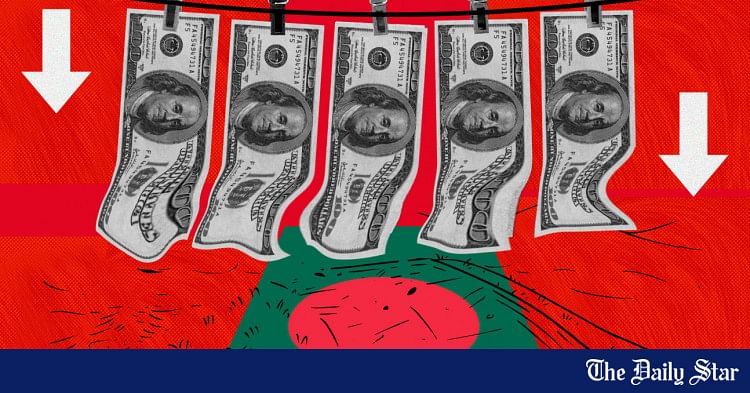
A guide to smuggling dreams and national nightmares

1734998326729.webp

VISUAL: SALMAN SAKIB SHAHRYAR

In the vast tapestry of human creativity, few heists match the sheer audacity of the Awami League's 15-year saga of economic escapades. It's as though the government took cues from Ocean's Eleven, but instead of Danny Ocean and his suave crew, we had a merry band of bureaucrats, politicians and their cronies, all playing fast and loose with public funds. The white paper report on $234 billion (approximately Tk 28 lakh crore) in smuggled money isn't just a document; it's the script of a dystopian drama where "the tumour" of corruption metastasised across the economy, creating villains more cunning than Moriarty and institutions more fragile than Humpty Dumpty.

Jerry Maguire's famous line seems to have been taken as gospel by corrupt leaders and business moguls, who perfected the art of money laundering during the Awami League's tenure. According to the white paper, an average of Tk 1.8 lakh crore was smuggled abroad annually—enough to buy private islands, fund covert lunar missions or, more realistically, snap up overpriced condos in Dubai. Bangladeshis now own 532 properties in Dubai, worth a cool $375 million, which makes one wonder: is Bangladesh exporting labour or landlords?

Meanwhile, the Malaysia My Second Home programme welcomed more than 3,600 Bangladeshis, proving that while the poor migrate for better opportunities, the rich migrate for better villas. These transactions read like chapters from The Great Gatsby, where extravagance and deceit coexist in splendid harmony. But unlike Jay Gatsby's mysterious fortune, this loot comes with a paper trail—albeit one guarded by layers of bureaucratic misdirection.

Banks have been called the lifeblood of economies, but during this regime, they morphed into black holes, swallowing Tk 6.75 lakh crore in distressed loans. That's enough to build more than 13 metro rails or 22 Padma Bridges—or, in the true satirical spirit, one really long bridge to nowhere. Like Littlefinger from the Game of Thrones, the regime's players used banks not to build but to destabilise, enriching themselves while the kingdom crumbled.

These "distressed loans" weren't just numbers; they were lifelines for a select few oligarchs. Loans were disbursed with the generosity of Santa Claus, except the gifts were misappropriated funds, and the recipients were neither naughty nor nice—just connected.

Remember The Truman Show, where everything was a perfectly crafted illusion? That's precisely how the previous regime approached development projects. Roads, bridges, and hospitals became vanity projects, bloated with unnecessary costs and laced with bribes. It's almost poetic how money flowed like champagne at Gatsby's parties—except it wasn't enjoyed by the citizens who footed the bill.

Even the Annual Development Programme (ADP) was a masterpiece of creative accounting. Tk 7.2 lakh crore was spent over 15 years, with Tk 1.61 lakh crore to 2.8 lakh crore of it just wasted and looted. This wasn't development, it was performance art, a Kafkaesque nightmare where bridges connected not cities but offshore accounts.

If the banking sector was a black hole, the stock market was its rowdy cousin. Tk 1 lakh crore was embezzled through IPO fraud and placement scams, orchestrated by a shadowy cabal of politicians, bureaucrats, and "entrepreneurial" visionaries. These schemes rivalled Jordan Belfort's exploits in The Wolf of Wall Street.

This isn't just fraud—it's artistry. It takes a genius to convince an entire nation that the stock market is a viable investment while you quietly pocket the proceeds.

In 1984, George Orwell described a world where truth was malleable, and facts were twisted to serve the ruling party. The Awami League apparently took this as a blueprint, manipulating GDP and inflation statistics to paint a rosy picture. The Bangladesh Bureau of Statistics (BBS) became the Ministry of Truth, churning out data that would make even Big Brother blush.

Meanwhile, corruption flourished unchecked. Bribes were no longer local transactions but global ventures. Funds once used to fuel the shadow economy at home were now smuggled abroad, funding lifestyles more lavish than Crazy Rich Asians. The report calls this phenomenon a "malignant tumour," but perhaps it's more akin to Voldemort—an ever-present, parasitic force sucking the life out of the nation.

If Charles Dickens were alive today, he might rewrite A Tale of Two Cities as A Tale of Two Classes: one that tightened its belt and another that loosened its purse strings abroad. The white paper reveals how capitalism birthed oligarchs who manipulated policy, entrenched corruption, and hoarded wealth overseas.

Imagine Walter White in Breaking Bad, but instead of cooking meth, he's cooking up development budgets. The white paper reveals how inflated project costs were systematically looted, with money laundered through shell companies and overseas investments. Every construction project became a criminal enterprise, and every politician a Gustavo Fring, a respectable façade hiding a sinister core.

As we sift through this economic rubble, the interim government faces a Herculean task: restoring integrity to institutions gutted by corruption. But let's not kid ourselves. There will be no sweeping reforms overnight. Instead, we're in for a gritty reboot, where every move is calculated, and every step forward is hard-earned.

The white paper ends with a plea for political will, but one must wonder: is will alone enough to undo 15-plus years of systemic plunder? Perhaps the answer lies not in politics but in public vigilance. For now, though, the Tk 28 lakh crore smuggled remains a testament to a regime that prioritised greed over governance, corruption over competence, and illusion over integrity.

Like all great tragedies, this saga offers a glimmer of hope. The exposure of these crimes marks a turning point—a chance for redemption. But the road ahead is long, winding, and riddled with potholes, many of which were paid for with our stolen money.

So here's to the future—a cleaner, fairer, and more transparent Bangladesh. And to the past? Well, that's best left as a cautionary tale. Let's just hope the next generation writes a different story, one where the villains are vanquished, and the heroes don't need offshore accounts.

H.M. Nazmul Alam is lecturer at the Department of English and Modern Languages of the International University of Business, Agriculture and Technology (IUBAT).​
 
Analyze

Analyze Post

Add your ideas here:
Highlight Cite Fact Check Respond

Tulip Siddiq interrogated in United Kingdom over corruption claims in Bangladesh
United News of Bangladesh . Dhaka 23 December, 2024, 14:55

1735000396407.webp

Tulip Siddiq. | UNB Photo

Tulip Siddiq, a United Kingdom labour minister and niece of Bangladesh’s ousted prime minister Sheikh Hasina, has been questioned over claims she and her family members embezzled £4b (around Tk 60,000 crore) from a power plant project in Bangladesh

The cabinet office propriety and ethics team questioned Tulip Siddiq on Sunday over the allegation, reports The Telegraph.

Tulip Siddiq is facing investigation over claims that she and four family members embezzled £4 billion through Roopur Nuke Power Plant Deal in Bangladesh.

British prime minister Keir Starmer has stood by Tulip, who denies the claims and said no authority has contacted her so far about the allegations.

Labour party officials described the claims as ‘spurious’ and made for political reasons by opponents of Hasina.

In October, National Crime Agency investigators visited Bangladesh to ‘support’ its anti-corruption probes.

A Tory MP has written to the Parliamentary Standards Commissioner asking them to launch a probe into Tulip over the allegations.

The Anti-Corruption Commission in Bangladesh decided to start probe the embezzlement allegation against former prime minister Sheikh Hasina, her sister Sheikh Rehana, son Sajeeb Wazed Joy and niece Tulip Siddiq recently following a High Court order.

Tulip Siddiq, 42, the Treasury’s economic secretary, is responsible for tackling corruption in UK financial markets.

The Mail on Sunday reported that five investigators are gathering ‘documentary evidence’ related to Tulip and others, and are expected to contact them within weeks for their responses.

The report stated that the ACC would send any correspondence to her through the British High Commission in Dhaka.

Citing anonymous officials, the paper noted that once responses are received, investigators will decide whether to file First Information Reports.​
 
Analyze

Analyze Post

Add your ideas here:
Highlight Cite Fact Check Respond

Graft allegation: ACC to launch probe against Hasina's military adviser, 7 others

The Anti-Corruption Commission (ACC) has decided to launch an investigation against eight individuals, including former Prime Minister's military advisor Tariq Ahmed Siddiqi and senior secretary Mohibul Haque, over allegations of embezzlement in the name of airport development projects.

A senior ACC official confirmed it to The Daily Star today.​
 
Analyze

Analyze Post

Add your ideas here:
Highlight Cite Fact Check Respond

ACC files cases against ex-state minister Mohibbur, his wife

1735169764630.webp


The Anti-Corruption Commission (ACC) has filed separate cases against former State Minister of Disaster Management and Relief and ex-lawmaker for Patuakhali-4, Mohibbur Rahman, and his wife, Fatema Akhter, on charges of corruption.

The ACC accuses Mohibbur, 67, of embezzling Tk 31 crore and Fatema, 58, of acquiring Tk 19 crore illegally.

ACC Assistant Director Minhaj Bin Islam filed the cases at the ACC head office on December 23, said Patuakhali ACC Assistant Director Russel Rony.

The allegations state that Mohibbur acquired undeclared assets worth Tk 7.64 crore and made illegal transactions of Tk 23.72 crore through 23 bank accounts from September 2000 to October 2024. Fatema is accused of earning Tk 3.92 crore from undeclared sources and conducting suspicious transactions of Tk 15.51 crore through 11 accounts.

Mohibbur was elected as a lawmaker for Patuakhali-4 in 2018 and 2024 as a Bangladesh Awami League candidate. He served as state minister for Disaster Management and Relief from January 2024 to August 2024. During his tenure, he acquired immovable assets worth Tk 6.21 crore, along with Tk 3.39 crore in savings and DPS accounts, totalling Tk 9.60 crore.

After deducting permissible income sources and expenses, the ACC found Tk 7.64 crore unaccounted for. He also laundered Tk 23.72 crore via suspicious bank transactions.

Fatema, a senior lecturer at Alhaj Jalal Uddin Degree College in Kalapara, allegedly amassed her illegal assets with help from Mohibbur. Her case involves Tk 3.92 crore of undeclared income and suspicious transactions of Tk 15.51 crore.

Following the fall of the Sheikh Hasina-led government on August 5, cases were also filed against Mohibbur in Kalapara and Mohipur police stations for an attack on the Kalapara BNP office and a Tk 50 lakh extortion demand. Both Mohibbur and Fatema have been in hiding since August.

Kalapara Upazila Awami League Senior Vice President SM Rakibul Ahsan accused Mohibbur of widespread corruption, intimidating opponents, buying land at nominal prices, and causing internal divisions within the party. He stated that Mohibbur's actions severely harmed the Awami League's reputation.​
 
Analyze

Analyze Post

Add your ideas here:
Highlight Cite Fact Check Respond

Members Online

⤵︎

Latest Posts

Latest Posts