Donate ☕
201 Military Defense Forums
[🇧🇩] - Everything about Hasina's misrule/Laundered Money etc. | Page 8 | PKDefense
Home Login Forums Wars Watch Videos
Serious discussion on defense, geopolitics, and global security.

[🇧🇩] Everything about Hasina's misrule/Laundered Money etc.

Reply (Scroll)
Press space to scroll through posts
G Bangladesh Defense
[🇧🇩] Everything about Hasina's misrule/Laundered Money etc.
261
8K
More threads by Saif

Sheikh Hasina was a classic autocrat: M Sakhawat Hossain
Published :
Aug 05, 2024 22:03
Updated :
Aug 05, 2024 22:03


1722901534183.png

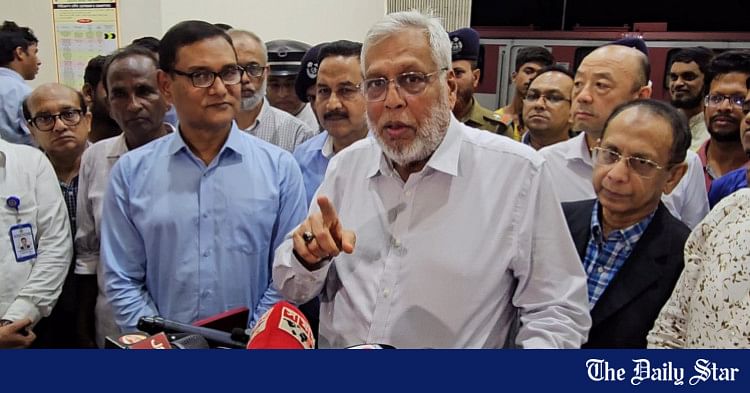
Sheikh Hasina was a classic autocrat who dismissed the people, and this disdain has led to her current predicament, according to Brigadier General (Retd) M. Sakhawat Hossain, an election analyst and former military officer. In a special interview with UNB news agency over the phone, he expressed these views.
He stated that today's events were inevitable and were bound to happen. "We have seen similar situations in Tunisia, Libya, and Syria. Popular uprisings are unstoppable. The student quota reform movement could have been resolved easily, but due to Prime Minister Sheikh Hasina's stubbornness, so many people lost their lives."

Hossain criticised the media's portrayal of the casualties, claiming that the true number is closer to 400, with a significant portion being students and young people. He questioned the whereabouts of the remaining bodies, mass graves, and the extent of innocent lives lost. "She has gone, but who will answer for this?" he asked.

He accused the ruling government of carrying out the "most heinous massacre" and of misleading the public by blaming criminals while those responsible were, in fact, their own countrymen. "Such things should not happen in a free country," he remarked.

Hossain also noted that for the past 15 years, people have been unable to vote properly, with widespread election fraud. He stated that Sheikh Hasina should have understood her and her party's unpopularity, and questioned who would be held accountable for the bloodshed. He criticized the severe lack of good governance, which he believes Sheikh Hasina failed to provide.

Furthermore, he alleged that Sheikh Hasina has created criminal gangs within the country and turned the police and Rapid Action Battalion (RAB) into her personal enforcers.

Reflecting on the plight of the family members of the so-called Father of the Nation, he questioned why they had to face such a tragic fate, attributing it to Hasina's arrogance and pride. He drew a parallel with the 2009 BDR mutiny, where 57 army officers were killed, and questioned who would answer for that incident as well.

He criticised Sheikh Hasina's control over TV media and her suppression of free speech, citing it as a reason he avoided talk shows. He claimed he had urged the Prime Minister in various meetings to ensure good governance, but was labelled as an 'agent of the opposition' for his criticisms.

"Today, Sheikh Hasina has fled the country, and now the army has had to take responsibility for the nation's situation," he concluded.​
 
Last edited:
Analyze

Analyze Post

Add your ideas here:
Highlight Cite Fact Check Respond
  • Like (+1)
Reactions: Bilal9

S Alam group withdraws Tk 90,000cr from IBBL
Staff Correspondent 05 September, 2024, 17:21

1725605003267.webp

| Collected photo.

The controversial S Alam Group has withdrawn over Tk 90,000 crore loans from Islami Bank Bangladesh alone, accounting for more than 50 per cent of the shariah-based bank’s total loan portfolio, according to newly appointed chairman Md Obayed Ullah Al Masud.

He disclosed this shocking figure during a press briefing on Thursday, following a meeting with Bangladesh Bank governor Ahsan H Mansur. Other board members of the bank were also present.

By the end of August, Islami Bank’s total loans stood at nearly Tk 1.80 lakh crore, according to bank officials.

Masud stated, ‘The group secured over 50 per cent of the bank’s total loans, both in their name and through anonymous accounts, while the exact figure is still being determined.’

He added that it would take approximately a week to finalise the loan data. Three audit firms have been appointed to investigate all kinds of irregularities that occurred at the bank.

S Alam Group, under the patronage of the ousted Awami League-led government, seized full or partial control of eight banks, central bank officials said.

The group has been accused of rampant irregularities, particularly in recruitment and loan disbursement, they said.

Bank insiders allege that S Alam withdrew close to Tk 2 lakh crore from the banking sector, primarily from the eight banks under its control, with much of the amount funnelled through anonymous channels, they said.

These banks are First Security Islami Bank, Social Islami Bank, Union Bank, Global Islami Bank, Islami Bank Bangladesh, Al-Arafah Islami Bank, National Bank, and Bangladesh Commerce Bank.

The central bank has now reconstituted all eight banks and appointed independent directors to oversee their operations.

New Islami Bank chairman said that the S Alam Group allegedly inflated the value of their assets to secure massive loans, and the bank is now re-evaluating these assets.

The collateral offered was inadequate to cover the debts, therefore, the bank made a formal request to the Ministry of Law to track down other assets owned by the group.

On August 22, Bangladesh Bank freed Islami Bank from S Alam’s control, reconstituting the board and appointing Masud, former managing director of Rupali Bank, as the new chairman.

S Alam Group, reportedly with the backing of a state agency, forcibly took over the bank in 2017, side-lining its founding shareholders and directors.

Bangladesh Bank, under the leadership of former governor Abdur Rouf Talukder, provided all kinds of possible liquidity support to these banks despite knowing that these banks continued allowing the S Alam Group to withdraw money as anonymous loans.

This occurred even though the banks’ current accounts remained negative, leaving them incapable of making any transactions.

After exhausting all legal avenues, Bangladesh Bank resorted to unethical and illegal means to provide these banks with additional liquidity.

Despite the banks having no funds in their current accounts, the central bank printed money to keep them afloat, according to Bank Bank officials.


As criticism mounted from various corners, Bangladesh Bank was forced to halt this unsustainable practice and began searching for alternative methods to support the struggling banks.

At last, the central bank provided total $1.1 billion equivalent in financial support to Islami Bank Bangladesh since January based on a fake dollar purchase quotation.

On July 3, Bangladesh Bank falsely reported a $550 million purchase from Islami Bank, even though no actual dollars were transferred. In this fabricated transaction, Islami Bank received Tk 6,490 crore at a rate of Tk 118 per dollar, the officials said.

Islami Bank only returned $100 million, leaving $450 million unpaid. After the fall of Sheikh Hasina, Bangladesh Bank hurriedly adjusted the remaining amount in the bank’s current account which had already been negative.

This review underscored the severity of financial mismanagement and exposed the deep-rooted collusion between the central bank and a private institution wielding enormous power through political connections.

In the press briefing, Masud expressed hope that the bank would return to positive growth by the end of the year.

Addressing concerns about customer difficulties in withdrawing deposits, he reassured that the recent influx of deposits has exceeded withdrawals, leading to a net positive balance.

When questioned about punitive actions against officials who abetted S Alam, Masud clarified that while lower-level employees would not be removed immediately to avoid a destabilisation risk, removal of senior officials was already underway.

He promised that all those involved would face legal consequences with no exceptions.

There will be no more restrictions on the business operations and opening Letter of Credits (LCs) in Islami Bank from now on, he said.

Masud also unveiled a recovery roadmap for the bank. The first phase, running through December 31, focuses on identifying and addressing critical issues.

The second phase, from 2025 to 2026, aims at full recovery, while the 2027–2029 period is designated for progress and growth, according to the bank’s new chairman.​
 
Analyze

Analyze Post

Add your ideas here:
Highlight Cite Fact Check Respond

CID to probe Bashundhara Group chair, MD over alleged money laundering
Staff Correspondent 05 September, 2024, 18:34

1725605157758.webp

From left, Bashundhara Group chairman Ahmed Akbar Sobhan, managing director Sayem Sobhan Anvir. | BSS file photo

The Criminal Investigation Department on Thursday said that the agency launched an investigation against Basundhara Group chairman Ahmed Akbar Sobhan and managing director Sayem Sobhan Anvir for their alleged involvement in money laundering.

Superintendent of CID media wing Azad Rahman in a press release said that the CID had decided to investigate the allegations of embezzlement, laundering of thousands of crores of taka through fraudulence, forgery, tax evasion, VAT evasion, under-invoicing and over-invoicing against different organisations related to Bashundhara Group.

Bashundhara Group had allegedly bought land at Tk 20-25 lakh per bigha by cheating the land owners. But it borrowed more than TK 42,000 crore from bankshowing the price of per katha land at Tk 3 crore.

The company allegedly was implementing projects by filling up public and government properties like canals and rivers without the approval of RAJUK, the press release said.

It has been accused of illegally occupying a total of 1, 016 acres of land including 800 acres of government properties in Bashundhara residential area and 216 acres of Bhawal Raj Estate.

Besides, there are allegations of grabbing vast land by East West Properties Limited in different blocks of Bashundhara Residential Area, which is estimated to be worth more than Tk 1.5 lakh crore.

Ahmed Akbar Sobhan and his on Sayem Sobhan Anvir were involved in laundering money to Dubai, Singapore, Cyprus, London, Malaysia and other countries, the press release said.

Bashundhara Group›s Singapore office is being looked after by Ahmed Akbar’s elder son Sadat Sobhan Tanveer, who allegedly took thousands of crores of taka loan from different banks by showing one project after another, but never repaid the loans.

Meanwhile, Bashundhara Oil & Gas (Keraniganj, Dhaka) had been accused of importing bitumen worth approximately Tk 2,000 crores from abroad with the help of trade-based money laundering and later supplying the imported bitumen to different parts of Bangladesh through a monopoly business under the control of a powerful syndicate controlling the price.

The CID said that Sayem Sobhan Anvir allegedly controlled the syndicate of gold smuggling in Bangladesh.​
 
Analyze

Analyze Post

Add your ideas here:
Highlight Cite Fact Check Respond

Hasina's anti-corruption drive was a farce
Mainul Islam
Updated: 09 Sep 2024, 17: 27

1725934685649.webp


Before the fall of the autocrat Hasina's government, there was a flurry of sensational news in the media about the corruption of former IGP Benazir Ahmed, former army chief Aziz Ahmed and the NBR director Matiur Rahman. But the steps taken by Hasina were nothing but a farce, making a fool out of the people. Hasina institutionalised corruption by entering corruption in the very pores of the economy.

The former inspector general of police (IGP) Benazir Ahmed came to limelight in 2009 as a favourite of Sheikh Hasina, one who enjoyed her full patronage. He was from Gopalganj. And he actively devoted himself to meeting all objectives of Hasina -- political and non-political, legal and illegal.

Benazir Ahmed's career graph shot up in no time, from Dhaka Metropolitan Police commissioner to director general of RAB and then IGP. His most despicable offence was during the 2018 election, orchestrating the stuffing of ballot boxes in most constituencies on the night before the election, with the direct participation of the police and civil administration.

The Hasina government took no action whatsoever against these thousand or so money launderers who brought the country to the brink of economic collapse by siphoning off thousands and thousands of crore of taka overseas

As he was instrumental in carrying out huge illegal activities of the Hasina government, while he was in service neither Hasina nor Anti-Corruption Commission or any other authority uttered a word about this unrestrained corruption and his amassing massive wealth.

It was only after he was no longer useful to the government that various details of his corruption and misappropriations were supplied to the media and published with much fanfare. But the media also exposed that it was only after Benazir and his family had made a safe exit overseas that these stories hit the headlines, a mere eyewash.

It was the same in the case of the former army chief General Aziz. Those who watched the Al-Jazeera documentary, "All the Prime Minister's Men" are aware of how General Aziz used his clout during Hasina's rule to get a presidential pardon for one of his brother's would was convicted for murder.

The Al Jazeera documentary revealed many more stories of Aziz's corruption. It was Aziz who was the army chief during the 2018 election rigging. Ever since the Sheikh Hasina government ascended to power back in 2009, Hasina had an extremely indulgent attitude towards corruption.
Hasina's government kept the country's banking sector in the throes of embezzlement. Of the total Tk 18 lakh crore loans taken from the banking system, at least Tk 5.5 lakh crore became defaulted and most of this was siphoned out of the country. (A recent report of The Business Standard claims that the default loans exceed 7 lakh crore).

Yet the Hasina government was totally oblivious about trying and punishing these kingpins of corruption, the few hundred who embezzled banks funds through deliberate default. (In 1998 President Justice Shahabuddin Ahmed had recommended a tribunal be set up for the trial of the top 10 loan defaulters of all banks.)

Quite to the contrary, the biggest loan defaulter of the country, Salman F Rahman, was appointed as an advisor to the prime minister. One of the main collaborators of the autocrat Hasina, Salman Rahman was nabbed on 13 August while trying to escape by river, in disguise. This pitiful predicament of the country's biggest bank embezzler and biggest loan defaulter Salman Rahman created a huge stir among the people.

He would go around with a white beard, white hair and white panjabi, dressed almost like as ascetic, for which the people would ironically call him 'Darbesh' (dervish). He would dress in this 'saintly' manner, sending a message out quite opposite to his constant devious misdeeds. And Hasina had kept him for a long time as her private investment and industries advisor.

Over the past 52 years, with government patronage, Salman Rahman became a synonym for money laundering. The Business Standard on 15 August 2024 reported that over the past 52 years, by means of loans and embezzlement, he misappropriated Tk 36,867 crore from seven banks. From Janata Bank alone he took loans exceeding Tk 23,000 crore. He reportedly unlawfully took loans totalling Tk 11,000 crore from IFIC Bank which he himself owned. Very little of this loan has returned to the bank or will ever be returned in the future.

The Hasina government took no action whatsoever against these thousand or so money launderers who brought the country to the brink of economic collapse by siphoning off thousands and thousands of crore of taka overseas. The country's foreign exchange reserves dwindled by USD 30 billion over the past three years, but the Hasina government remained unperturbed.

The Hasina government was not sincere at all about preventing corruption, halting the growth of non-performing loans or preventing capital flight. "Zero tolerance" towards corruption was mere rhetoric. Capital flight was fueled by corruption and unrestrained default loans. Embezzlers and money launderers are the top enemies of the country.

I strongly state that after restoring law and order in the country, the priority of the interim government will be to take all-out action against corruption and capital flight. I recall the success of the strong anti-corruption drive by the 2007-08 military backed caretaker government. The anti-corruption commission led by retired Lt Gen Hasan Mashhud Chowdhury managed to give the corrupt politicians, businessmen and civil servants a good shakedown, according to the next ACC chairman Golam Rahman.

Golam Rahman said that when she came to power in 2009, Hasina did not ratify the ACC ordinance drawn up by the caretaker government and simply made it a toothless tiger. General Hasan Mashhud resigned in despair.

I recommend that we revert to that ACC ordinance speedily. Also, a bold person must be appointed as the chairman of ACC, someone who can take stern measures against corruption. There are several persons in our administration who have won renown for their bold steps against corruption and who have won the respect and love of the people.

  • Moinul Islam is an economist and former professor at the economics department of Chittagong University.
  • This column appeared in the print and online edition of Prothom Alo and has been rewritten for the English edition by Ayesha Kabir
 
Analyze

Analyze Post

Add your ideas here:
Highlight Cite Fact Check Respond

Spyware over scholarship: How Bangladesh's priorities shifted under Hasina

1726017430869.webp

VISUAL: STAR

In an era where Bangladesh desperately needs to foster critical thinking and innovation, a look at the spending priorities of the ousted Awami League government during its 15 years of rule paints a troubling picture. This analysis exposes the stark contrast between the government's lavish expenditure on spyware versus its paltry investment in academic research between 2009 and 2024. While national security is undoubtedly important, one must question whether the scales have tipped dangerously in favor of watching minds at the expense of nurturing them.

The numbers reported by various media and rights platforms over the years speak for themselves, revealing a government more interested in monitoring citizens than nurturing their intellect. For example, spyware spending skyrocketed from a mere $3 million in 2012 to an eye-watering $25 million in 2024—a staggering 733 percent increase. In stark contrast, academic research funding crawled from $50 million in 2010 to just $90 million in 2024—a comparatively anemic 80 percent growth.

This disparity becomes even more alarming when we dig deeper. Reportedly, a shocking 70 percent of so-called "academic research" funds over the past 15 years were squandered on construction and procurement in a trickle-down embezzlement model, keeping bureaucrats, pseudo-intellectuals, and other interest groups aligned with the interests of the regime that consequently leveraged managing elections, political upheavals and dissenters. This cronyism left actual empirical research across STEM, social sciences, and humanities with a budget so thin that it was practically transparent, so to speak. Is it any wonder that our scholarly output is so abysmal?

Meanwhile, the government's appetite for surveillance seemed to be insatiable. The period from 2015 to 2020 saw a particularly aggressive push for spyware acquisition: in 2016, $10 million was allocated for surveillance systems; in 2018, $15 million was poured into digital monitoring; in 2022, a whopping $20 million was budgeted for spyware and related technologies; and in 2024, the budget was projected to reach $25 million.

But even these (official) figures may just be the tip of the iceberg. Anonymous industry sources suggest a staggering $53 million in unreported spyware expenditure between 2019-2024 alone. This clandestine spending allegedly funded projects with Orwellian overtones (see Table), including i) Audio interception project (tapping 120,000 calls simultaneously); ii) National information portal (connecting 42 government databases to efficiently track down individuals); iii) Content blocking and filtering project; iv) Data retention system (updating all data every 15 minutes); and v) a nefarious spyware dubbed "Hello Pakhi" was covertly commissioned at the cost of approximately $2.2 million. This invasive tool, designed to brazenly infiltrate private communications on popular messaging platforms like WhatsApp, among others, represents a flagrant violation of citizens' privacy rights.

The Hacking Team, as an aftermath, pitched mined data to the Rapid Action Battalion (RAB), a unit described by Human Rights Watch as a "death squad" involved in torture and extrajudicial killings. Arguably, RAB enjoyed its own autonomous budget and its personnel, especially top-ranking officials, had an obligation to show expenditure on suppressing dissent within a given fiscal year. Equally alarming is the duplicitous manner in which these exorbitant expenses were concealed from public scrutiny.

Anonymous sources involved in data traffic have exposed the state's underhanded tactics, revealing that these costs were deliberately obfuscated within seemingly innocuous budget items. The government disguised these surveillance expenditures as mundane office events, routine supplies, construction materials, and basic technological equipment for various ministries and security agencies. It can be argued that the state concealed its cost for operating the torture cells, notably Aynaghar, in a similar fashion.

This was the hallmark of the former authoritarian government which was obsessed with control. So, the pressing questions for Bangladesh 2.0 will be: How to locate and remove these surveillance apparatuses? How to identify and bring to justice those who breached privacy and aided the old regime in its surveillance operations? And how to enact safeguards to ensure such intrusive surveillance is not reinstated to suppress the masses again?

Now, let's turn our focus to the Awami League government's lukewarm approach to academic research over the last decade. While there have been modest budgetary increases, they pale in comparison to the surveillance spending spree—i) 2016: $65 million for research and development; ii) 2018: $70 million; iii) 2022: $80 million; and iv) 2024: projected $90 million. The question that must be asked is, what tangible results have these investments yielded? Beyond new buildings and computers, Bangladesh's investment on research and knowledge generation remains worryingly inadequate and ineffective.

The above analysis lays bare a government that evidently favoured control over creativity, and surveillance over innovation. The long-term consequences of this misguided prioritisation could be severe, potentially stunting the nation's intellectual growth and competitiveness for generations to come. It's high time for a critical re-evaluation of our priorities.

Dr Mustahid Husain teaches at the Department of Anthropology, University of Toronto.​
 
Analyze

Analyze Post

Add your ideas here:
Highlight Cite Fact Check Respond

Probe starts on how Tk 25cr vanished from Monirul’s office

The Police Headquarters has formed a three-member committee to investigate the allegation of looting Tk 25 crore from the room of the former Special Branch (SB) of Police chief Monirul Islam.

The Deputy Inspector General (DIG) of the Special Security and Protection Battalion Golam Kibria has been made the head of the committee.

There is no deadline to submit the report, but the committee has been asked to submit it as soon as, according to police sources.

Confirming the development, Moazzem Hossain, DIG (special affairs) of the SB, also a member of the committee, told The Daily Star last night, "We have started our investigation to find out what happened in the room of the former SB chief."

Asked about any suspects or findings, Moazzem refused to disclose details.

"We are trying to conduct an impartial investigation to find out what happened."

Sources alleged that Monirul, also the former additional inspector general of police, brought Tk 25 crore from the Sheikh Hasina government on August 3 and kept it in his room to spend on suppressing the Anti-discrimination Student Movement.

But before the money could be spent, Hasina's government fell on August 5.

Monirul did not go to the office since then.

But some SB officials knew that there was Tk 25 crore in his room and a number of them moved the money, sources alleged.

The PHQ formed the committee to investigate the incident following media reports about the incident.

Sources said intelligence agencies used to receive such money for which they did not have to provide expenditure details.

A police officer said Monirul was one of the most influential officers during the last regime. On August 13, the home ministry in a circular sent him into forced retirement. He has 11 cases filed against him.​
 
Analyze

Analyze Post

Add your ideas here:
Highlight Cite Fact Check Respond

Members Online

⤵︎

Latest Posts

Latest Posts