[🇵🇰] Everything about latest Kashmir attack

[🇵🇰] Everything about latest Kashmir attack
145
4K
More threads by Saif

G Pakistan Affairs

War is no solution, negotiations may find one
Nilratan Halder
Published :
May 09, 2025 00:26
Updated :
May 09, 2025 00:26
1746753779777.webp


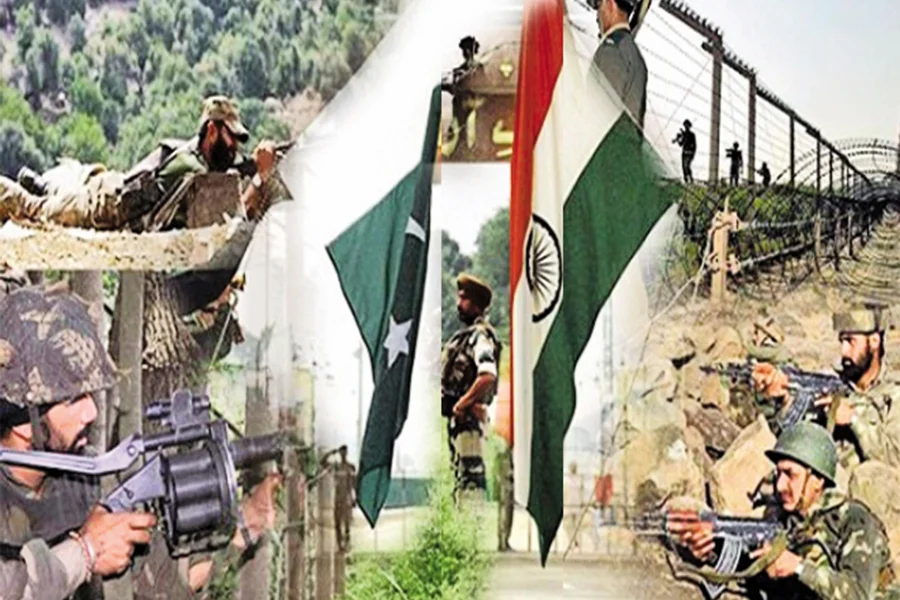
Internal armed conflicts, wars and proxy wars---some of those prolonged--- have been continuing in quite a few regions of the world. But none of those between two nuclear powers! The latest air strike codenamed "Operation Sindoor" launched on Pakistan by India on the early morning of Wednesday now brings the two nuclear-armed neighbours on to the brink of an all-out war. This has some similarities with the invasion of Ukraine by Russia but the contexts and stated aims are totally different.

While Russia wanted to get back its strategic territories such as Crimea that was attached to Ukraine during the Soviet Union and stop the latter from joining the North Atlantic Treaty Organisation (NATO), the arch rivals of the subcontinent have fought over Kashmir ever since its division into the two nations in 1947. This time tension started to build up following the killing of 26 innocent tourists in Pahalgam in India-administered Kashmir on April 22.

Although India claims it carried out 'precision attacks' non-escalatory in nature, once such attacks are unleashed, escalation of the feud is no longer under its control. Since there is India's rival which claims it has been unjustifiably blamed for the Pahalgam massacre, much will depend on how the latter reacts. The Indian air strike, as Pakistan considers, is violence of its sovereignty. So, the National Security Committee of Pakistan government also authorised the country's armed forces to respond to Indian aggression at "time and manner" of their choosing. Retaliatory action is on the cards.

How intense and extensive the counter offensive will be may decide whether the war will be a large-scale conventional war or worse, will trigger a nuclear war. A top leader of Pakistan did not rule out such a possibility. Can India and Pakistan afford even a conventional war of scale? Spokesperson for UN chief Antonio Guterres has put it succinctly even in a broader context, "The world cannot afford a military confrontation between India and Pakistan".

At a time when global trade and manufacturing have been severely jolted by Donald Trump's reciprocal tariffs, the fallouts of a war between India and Pakistan will not only cripple the economies of the two warring nations but also cause those of the South Asian nations to bleed. Even its negative ramification for the global economy is likely to be significant. Already Israel's escalating aggression on Palestine, Syria, Lebanon and Yemen has turned the Middle East into a cinder box and the Ukraine war shows no sign of ceasing. The Myanmar conflict stays at a stalemate because of the earthquake. Another war in South Asia, a region already counting trade losses because of aggressive tariff policy, will either harm or shatter economies of some of the neighbours.

Flight and cargo operation will be costlier and import and exports are likely to face disruptions or may be delayed. But the greatest casualty will be the regional tie that has been under stress for sometime. The India-Pakistan rivalry has made the South Asian Association for Regional Cooperation (SAARC) non-functional. The political non-cooperation has been responsible for rendering the South Asian Free Trade Area (SAFTA), a free trade arrangement within the bloc, equally irrelevant. Now this latest escalation of conflict between the two powerful nation in the region will have its adverse impacts on social, people-to-people and cultural relations as well. The least said about economic and commercial cooperation the better.

World leaders have urged restraint from both sides. The Iranian Foreign Minister Abbas Araghchi has started shuttling between Islamabad and New Delhi to impress upon the leaders of the two nations about the futility of armed aggressions against each other. Meanwhile, the news that Jaish-e-Mohammed confirmed that 10 relatives of its leader Masood Azhar, the architect of terrorist attacks on Indian parliament in 2001and the Taj Hotel in Mumbai, were killed in Indian air strike gives some idea about the objective India had in mind. The fate of Masood who was released from Indian jail in exchange for 155 hostages from a hijacked Indian Airlines plane in 1999, however, is not known.

Undeniably, terrorist groups from Pakistan have a long history of carrying out operations inside India. This has no doubt soured relations between the two neighbours. Yet war cannot be an option for settling contentious issues. History offers lessons for non-aggression. Adolf Hitler in his demonic theory of "Final Solution" wanted to exterminate the Jewish people within reach, not limited to the European continent. The irony is that today, the Jews planted in Palestine from all across the world, are now carrying out one of the worst genocides in human history.

Thus war does not settle things, rather it sows the seeds of future enmity and worse crimes again humanity. The India-Pakistan armed conflict may not be solved right away but at least the two sides should opt for de-escalation of tension and status quo in the interest of their economy and the civilians who will suffer the most in case the war escalates and prolongs. Right now the stakes are high for both countries because the war will push them back by a few years because of the turmoil the global economy is in on account of Trump's indiscriminate and aggressive tariff policy.​
 

Conflict spreads as India, Pakistan fight with drones and missiles
REUTERS
Published :
May 08, 2025 21:59
Updated :
May 08, 2025 22:00

1746754460034.webp


Graphics showing the military power of India and Pakistan

Pakistan and India accused each other of launching drone attacks on Thursday, and Islamabad’s Defence Minister said further retaliation was “increasingly certain”, on the second day of major clashes between the nuclear-armed neighbours.

Pakistan said it shot down 25 drones from India, while India said it air defences had stopped Pakistani drone and missile attacks on military targets, dashing hopes they would soon bow to pressure to end their worst confrontation in more than two decades.

World powers from the U.S. to Russia and China have called for calm in one of the world's most dangerous, and most populated, nuclear flashpoint regions. The U.S. Consulate General in Pakistan's Lahore ordered staff to shelter in place.

Thursday's reported exchanges came a day after India said it hit nine "terrorist infrastructure" sites in Pakistan in retaliation for what it says was a deadly Islamabad-backed attack in Indian Kashmir on April 22.

Pakistan says it was not involved and denied that any the sites hit by India were militant bases. It said it shot down five Indian aircraft on Wednesday, a report the Indian embassy in Beijing dismissed as "misinformation".

1746754481897.webp


Pakistani retaliation "is increasingly becoming certain now," Pakistan's Defence Minister, Khawaja Muhammad Asif, told Reuters. "I will still refrain from saying it is 100%. But the situation has become very difficult. We have to respond."

The relationship between India and Pakistan has been fraught with tension since they gained independence from colonial Britain in 1947. The countries have fought three wars, two of them over Kashmir, and clashed many times.

The countries that both claim Kashmir in full and rule over parts of it separately acquired nuclear weapons in the 1990s.

TRADING HALTED

Trading was halted on Pakistan's benchmark share index after the index slumped 6.3% on news of the drone attacks. Pakistan's international bonds extended their losses with the 2036 bond down 2.4 cents to bid at 72.4 cents.

Indian equities, rupee and bonds fell sharply in late afternoon trading after the Indian defence ministry statement, with the stock market benchmark Nifty 50 settling 0.58% lower in the most volatile trading session in a month.

Pakistan shot down 25 Israeli-made drones from India at multiple locations, including the two largest cities of Karachi and Lahore, and their debris is being collected, Pakistan military spokesperson Ahmed Sharif Chaudhry said.

One drone was also shot down over the garrison city of Rawalpindi, home to the Pakistan army's heavily fortified headquarters, he added.

One drone hit a military target near Lahore and four personnel of the Pakistan army were injured in this attack, Chaudhry said.

"Indian drones continue to be sent into Pakistan airspace...(India) will continue to pay dearly for this naked aggression," he said.

The Indian defence ministry said Pakistan attempted to engage a number of military targets in northern and western India from Wednesday night into Thursday morning and they were "neutralised" by Indian air defence systems.

In response, Indian forces targeted air defence radars and systems at a number of locations in Pakistan on Thursday, the ministry said. The "Indian response has been in the same domain with the same intensity as Pakistan," it added.

The Indian ministry accused Pakistan of increasing the intensity of its firing across the ceasefire line, the de facto border, in Kashmir. Sixteen people, including five children and three women, were killed on the Indian side, the statement said.

Pakistan says at least 31 of its civilians were killed and about 50 wounded in Wednesday's strikes and in cross-border shelling across the frontier in Kashmir that followed, while India says 13 of its civilians died and 59 were wounded.

On Thursday, Indian government ministers told a meeting of political parties in New Delhi that the strikes on Pakistan had killed more than 100 militants and that the count was still ongoing, government sources said.

Pakistan's Information Minister Attaullah Tarar told parliament that Pakistani forces had killed 40-50 Indian soldiers on the de-facto border in Kashmir and "blown" Indian military installations.

Reuters could not independently verify claims of both countries.

Blackout drills were conducted in India's border regions on Wednesday night.

Local media reported panic buying in some cities in the Indian state of Punjab which shares a border with Pakistan, as people hoarded essentials fearing a Pakistani retaliation to the Indian strikes.

Indian Foreign Minister Subrahmanyam Jaishankar said New Delhi did not intend to escalate the situation. "However, if there are military attacks on us, there should be no doubt that it will be met with a very, very firm response," he said at a India-Iran Joint Commission Meeting.

His Pakistani counterpart, Ishaq Dar, told Reuters that there have been contacts between the offices of the national security advisers of the two countries and the hotline between their heads of military operations was also working. He did not give more details.​
 

India-Pakistan conflict: Another chapter of misfortune in South Asia
Altaf Parvez
Researcher on South-East Asian History
Updated: 08 May 2025, 18: 34

1746754849167.webp


The people to face death or injuries along the borders and within both countries are the poor from all segments of society—some in uniforms, others not. Reuters.

India’s latest airstrike in Pakistan, carried out just after midnight on Tuesday and into the early hours of Wednesday, is tragic—but not entirely surprising. Over the last 15 years, and particularly following the recent terror attack in Pahalgam, war-like fervour has been building up in Indian public sentiment. A retaliatory strike on Pakistan seemed almost inevitable.

The Pakistanis were anticipating it. Their stock market had been steadily falling amid fears of an Indian strike. Through this action, the BJP government in India has partially satisfied public demands for retaliation. Politically, the move has also allowed them to save face. Yet a crucial question remains—has this strike made India any safer? Starting a war is always easier than ending one.

Lack of international support for India’s attack

The brutal bloodshed in Pahalgam drew widespread global condemnation. However, even two weeks after the incident, India failed to provide credible post-investigation evidence to support its claims. As a result, India has struggled to gain international support for blaming Pakistan. Neither the US nor Russia—India’s allies—have publicly held Pakistan accountable for the attack. This adds weight to the argument that India’s retaliatory airstrike on 6 May could be interpreted internationally as an act of aggression.

Just as the 26 victims in Pahalgam were innocent victims of terrorism, those killed by Indian bombing in Punjab and Azad Kashmir may also be considered victims of state terror. It's hard to dismiss the logic behind that viewpoint. Likewise, the Indian civilians dying in Pakistan’s retaliatory shelling are casualties of an escalating war hysteria.

Those actually responsible for these deaths in both countries—the rulers, the general, and the media bosses—will not go to the battlefield. They have never been in the past. The people who will die or be injured along the borders and within both countries are the poor from all segments of society—some in uniforms, others not.

These unfortunate souls will become the subjects of emotional content flooding YouTube, while in the background, both countries will quietly increase their military budgets once again. The influence of the military bureaucracy will grow stronger than ever, and religious and ethnic frenzy will reach new heights across society. Meanwhile, even though ordinary Hindus, Muslims, and Sikhs have no direct stake in the war, they will begin to view each other with renewed suspicion and distrust.

Across South Asia, it's important to note that the RSS approaching its 100-year anniversary. Its current ideological agenda is crystal clear: to legally declare India a Hindu nation. This is no secret. BJP is aiming to win 350–400 seats in the next Lok Sabha. Despite building a grand temple on the Babri Masjid site, they didn’t get expected results in Uttar Pradesh. They have now revised their political and military strategies.
Pakistan has already shut down schools, markets, and institutions in parts of Punjab and Azad Kashmir. India will likely have to follow suit in some areas. In the short term, this war will empower right-wing forces across South Asia, and its consequences will primarily harm the poor—both directly and indirectly.

Across America and Europe, the rise of far-right nationalists in politics is gaining momentum, and they will likely view this war as the rise of their South Asian allies. As a result, the business of selling military equipment in those countries will also thrive. With the help of the Modi administration, the Trump and Israeli governments have successfully diverted global attention away from their brutal actions in Gaza and redirected it toward South Asia. Regardless of what Trump says publicly, the 6 May 'Operation Sindoor' has been a welcome development for them.

Modi-Shah alliance strengthens

The ongoing war is elevating right-wing dominance across South Asia, and this is evident in India, where calls to expel or silence secular forces are being made repeatedly. Even the country’s main opposition party preemptively offered full support to the government’s strike on Pakistan and has already issued statements congratulating the move. This desperate attempt to remain politically relevant will ultimately serve to strengthen the BJP-RSS supremacist politics in a significant way.

Nearly all of India’s media are portraying the strike on Pakistan as an attack on a 'terrorist base'. It is as if they view all of Pakistan in Pakistan as terrorists. Such a dangerous mindset poses serious risks for South Asia's future. On the other hand, for the first time in history, the RSS-BJP alliance faces virtually no ideological opposition across India. They have managed to equate war-mongering with political strategy and present it as the only path forward for the nation.

The alarming possibility is that the BJP could exploit this war-like situation to call for early elections, win a large majority in the Lok Sabha, and then amend the Constitution to officially declare India a Hindu state—leaving the country’s secular forces with no effective recourse.

In the past the commentators used to say that war begins where politics ends. But the reality is that many political ideologies actively pursue war. Throughout history, many political movements have been cultivated with blood.

Across South Asia, it's important to note that RSS is approaching its 100-year anniversary. Its current ideological agenda is crystal clear: to legally declare India a Hindu nation. This is no secret. The BJP is aiming to win 350–400 seats in the next Lok Sabha. Despite building a grand temple on the Babri Masjid site, they didn’t get expected results in Uttar Pradesh. So, they have now revised their political and military strategies.

What they need now is a heightened, anti-Pakistan and anti-Muslim war environment. This has already socially cornered the Congress Party and other major opponents. Rahul Gandhi has effectively surrendered to Modi and Amit Shah’s political and military maneuvers. The Sangh Parivar has embarked on capitalising on the Pahalgam episode in the best possible way.

Right-wing surge serves US strategic interests

Modi’s latest move is also strategically beneficial to the US. Although Washington has outwardly distanced itself from the conflict and Trump called the attack disappointing, the more China sides with Pakistan, the closer India will move toward the US—a development America welcomes. India also needs the US, and this polarisation aligns with the broader US agenda of countering China.

After achieving strategic objectives in Ukraine and the Middle East, the US is preparing its own society to view China as the next major adversary. India’s policy toward Pakistan will play supportive role. As a result, military tensions are spreading across South Asia and the Arabian Sea—undermining the region’s potential to emerge as a self-reliant economic zone. Trump's trade wars had prompted South Asian nations to consider strengthening intra-regional trade, but this war is now a major setback to that vision.

Multiple risks for Bangladesh

This ongoing war poses several risks for Bangladesh. Both warring countries will try to pull Bangladesh to their side. The danger lies in the fact that Bangladesh currently has no elected government, and there is no institutional platform for the public to express their opinions. Any reaction from the Bangladeshi public could be interpreted by India or Pakistan as a sign of support or hostility.

For over seven months now, anti-Bangladesh rhetoric has been intensifying across India. These propagandists may now try to present Bangladesh as an enemy alongside Pakistan. In this situation, both the Bangladeshi government and civil society must respond with caution. Discussions with Myanmar over humanitarian corridors should also be put on hold for now. Bangladesh must remain on high alert to prevent sudden border push-ins.

*Altaf Parvez is a researcher about history. The article is of the writer's opinion.​
 

Explosions rock Indian Kashmir

1746756630197.webp

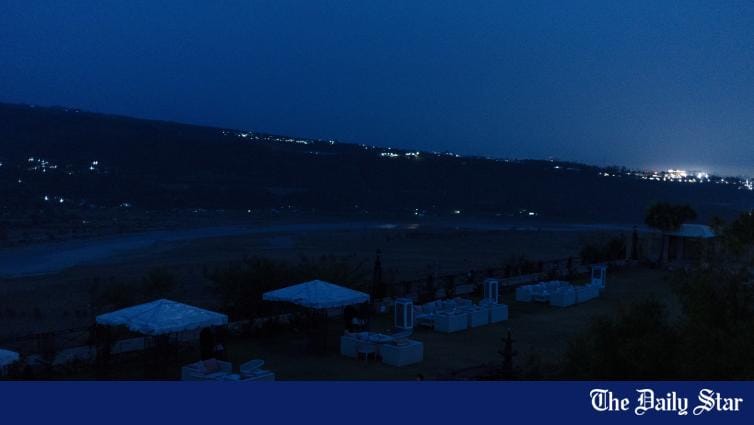
A family sits in an open restaurent just before a suspected Pakistan attack in Jammu, May 8, 2025. Photo: Reuters/Adnan Abidi
  • Sirens ring out in Jammu, projectiles in night sky​
  • Pakistan earlier said retaliation 'increasingly certain'​
  • Islamabad says Indian drones earlier entered its airspace​
Blasts rang out across the Indian city of Jammu late on Thursday during what the government said was a Pakistani drone and missile attack on military stations around the Kashmir region on the second day of clashes between the nuclear-armed neighbours.

Sirens sounded and red flashes and projectiles erupted in the night sky above Jammu for about 2-1/2 hours, a Reuters journalist said, in what appeared to be an escalation in the countries' worst confrontation in more than two decades.

Two days of fighting have killed nearly four dozen people.

"Military stations at Jammu, Pathankot & Udhampur were targeted by Pakistani-origin drones and missiles along the international border in J&K today," India's Ministry of Defence said on X, citing places in and near the federal territory of Jammu and Kashmir.

"The threats were swiftly neutralised .... No casualties or material losses were reported."

1746756732648.webp

A hotel staff uses a moblie phone as others look for shelter amid a suspected Pakistan attack in Jammu, May 8, 2025. Photo: Reuters/Adnan Abidi

Indian TV channels also showed flares and flashes in the sky above Jaisalmer city in Rajasthan state, which shares a border with the southern Pakistani province of Sindh.

In a statement, Islamabad denied attacking Pathankot in India's Punjab state, Srinagar in the Kashmir Valley and Jaisalmer and said the accusations were "entirely unfounded, politically motivated, and part of a reckless propaganda campaign aimed at maligning Pakistan".

Pakistan's Ministry of Foreign Affairs said the country would respond to any escalation "with full resolve and determination to safeguard Pakistan's sovereignty and territorial integrity."

Electricity in Jammu was slowly being restored after a blackout during the attack, a Reuters journalist said.

Eight missiles, fired from Pakistan at the Jammu region towns of Satwari, Samba, Ranbir Singh Pura and Arnia, were intercepted by air defence units, added an Indian military source who asked not to be named.

They were part of a wider attack, the source added.

A hotel staff runs for cover amid a suspected Pakistani attack in Jammu, May 8, 2025. Photo: Reuters/Adnan Abidi
Pakistan's Defence Minister Khawaja Muhammad Asif earlier said further retaliation was "increasingly certain" after both countries accused each other of launching drone attacks.

World powers from the US to Russia and China have called for calm in one of the world's most dangerous and populated nuclear flashpoint regions. The US Consulate General in Pakistan's Lahore ordered staff to shelter in place.

US Secretary of State Marco Rubio called for de-escalation in separate calls with Indian Foreign Minister Subrahmanyam Jaishankar and Pakistani Prime Minister Shehbaz Sharif on Thursday, the State Department said.

The relationship between India and Pakistan has been fraught with tension since they gained independence from colonial Britain in 1947. The countries have fought three wars, two of them over Kashmir, and clashed many times.

The neighbours, which both claim Kashmir in full and rule over parts of it, separately acquired nuclear weapons in the 1990s.

DRONES, MISSILES, AIR DEFENCES

In the latest confrontations, India said it hit nine "terrorist infrastructure" sites in Pakistan on Wednesday in retaliation for what it says was a deadly Islamabad-backed attack in Indian Kashmir on April 22.

Pakistan says it was not involved and denied that any of the sites hit by India were militant bases. It said it shot down five Indian aircraft on Wednesday, a report the Indian embassy in Beijing dismissed as "misinformation".

Pakistan's military said earlier on Thursday it shot down 29 drones from India at multiple locations including the two largest cities of Karachi and Lahore and the garrison city of Rawalpindi, home to the army's headquarters.

The Indian defence ministry said Pakistan attempted to engage a number of military targets in northern and western India from Wednesday night into Thursday morning and they were "neutralised" by Indian air defence systems.

In response, Indian forces targeted air defence radars and systems at a number of locations in Pakistan on Thursday, the ministry said.

Before trading ended, both countries saw their stocks, bonds and currencies decline, and Pakistan's benchmark share index .KSE closed down 5.9%.

Local media reported panic buying in some cities in the Indian state of Punjab, which shares a border with Pakistan, as people hoarded essentials.​
 

Pakistan's Chinese-made jet brought down two Indian fighter aircraft: US officials

1746756939451.webp

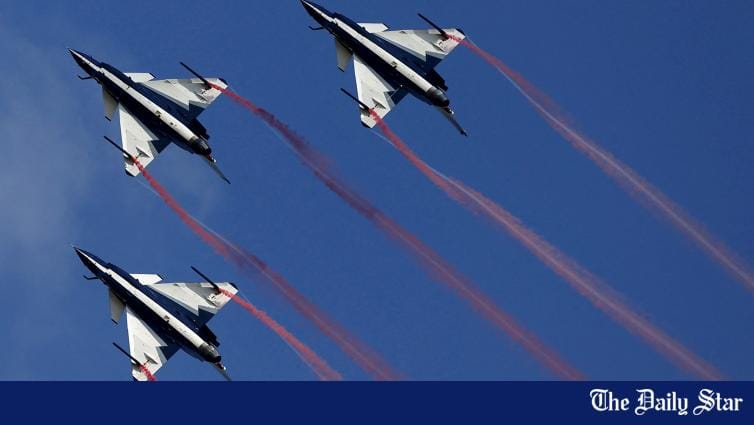
China's J-10 fighter jets from the People's Liberation Army Air Force August 1st Aerobatics Team perform during a media demonstration at the Korat Royal Thai Air Force Base, Nakhon Ratchasima province, Thailand, November 24, 2015. Photo: Reuters/Athit Perawongmetha

A top Chinese-made Pakistani fighter plane shot down at least two Indian military aircraft on Wednesday, two U.S. officials told Reuters, marking a major milestone for Beijing's advanced fighter jet.

An Indian Air Force spokesperson said he had no comment when asked about the Reuters report.

The performance of a leading Chinese fighter jet against a Western rival is being closely watched in Washington for insights into how Beijing might fare in any showdown over Taiwan or the wider Indo-Pacific.

One US official, speaking on condition of anonymity, said there was high confidence that Pakistan had used the Chinese-made J-10 aircraft to launch air-to-air missiles against Indian fighter jets - bringing down at least two.

Another official said at least one Indian jet that was shot down was a French-made Rafale fighter aircraft.

Both officials said Pakistan's F-16 aircraft, made by Lockheed Martin, were not used in the shootdown.

Delhi has not acknowledged the loss of any of its planes and instead said it carried out successful strikes against what it claimed was "terrorist infrastructure" inside Pakistan.

World powers from the US to Russia and China have called for calm in one of the world's most dangerous, and most populated, nuclear flashpoint regions.

In France, Rafale manufacturer Dassault Aviation and the MBDA, BAE Systems, Leonardo SpA, which makes the Meteor air-to-air missile, could not immediately be reached for comment on a public holiday.

While Reuters reported on Wednesday that three Indian planes went down, citing local government officials in India, this marks the first Western confirmation that Pakistan's Chinese-made jets were used in the shootdowns.

Pakistan's Defence Minister Khawaja Muhammad Asif told Reuters on Thursday that the J-10 was used to shoot down three French-made Rafale planes, which were newly acquired by India.

Altogether, Pakistan says it downed five Indian planes in air-to-air combat.

CLOSELY EYING

The Rafale and the model of the J-10 used by Pakistan are both considered generation 4.5 fighter jets, placing them at the leading edge of combat aircraft.

Western analysts and defense industry sources said the live use of some of the advanced weapons that could be deployed in future major power conflicts would be scrutinized in minute detail, but emphasized it was too early to draw firm conclusions.

"Air warfare communities in China, the US and a number of European countries will be extremely interested to try and get as much ground truth as they can on tactics, techniques, procedures, what kit was used, what worked and what didn't," said Douglas Barrie, senior fellow for military aerospace at the International Institute for Strategic Studies.

Social media posts highlighted the face-off between China's PL-15 air-to-air missile against the Meteor, produced by European missile group MBDA, BAE Systems and Leonardo SpA.

But the analysts and sources said crucial details were unclear including whether Meteors were carried or how they may have been deployed.

"At the moment it's not possible to judge anything. We know so little," a Western defence industry source said.

Nuclear-armed India and Pakistan have fought three major wars, as well as numerous smaller conflicts.

Blasts rang out across the city of Jammu in Indian Kashmir late on Thursday during what Indian military sources said they suspected was a Pakistani drone attack across the region on the second day of clashes between the neighbors.

Pakistan said earlier on Thursday it shot down 25 drones from India overnight, while India said its air defenses had stopped Pakistani drone and missile attacks on military targets.​
 

Latest Posts

Back