โ˜• Support Us โ˜•
[๐Ÿ‡ต๐Ÿ‡ฐ] - Everything about latest Kashmir attack | Page 5 | PKDefense

[๐Ÿ‡ต๐Ÿ‡ฐ] Everything about latest Kashmir attack

Reply (Scroll)
Press space to scroll through posts
G Pakistan Affairs
[๐Ÿ‡ต๐Ÿ‡ฐ] Everything about latest Kashmir attack
145
3K
More threads by Saif

Got it while surfing the net.
 

Attachments

  • rafale.jpg
    rafale.jpg
    183.6 KB · Views: 18
  • rafale2.jpg
    rafale2.jpg
    93.2 KB · Views: 18
Last edited:

India dominates in overall strength, Pakistan leads in nuclear arsenal
Staff Correspondent Dhaka
Published: 07 May 2025, 18: 20

View attachment 17124
India and Pakistan flags File Photo

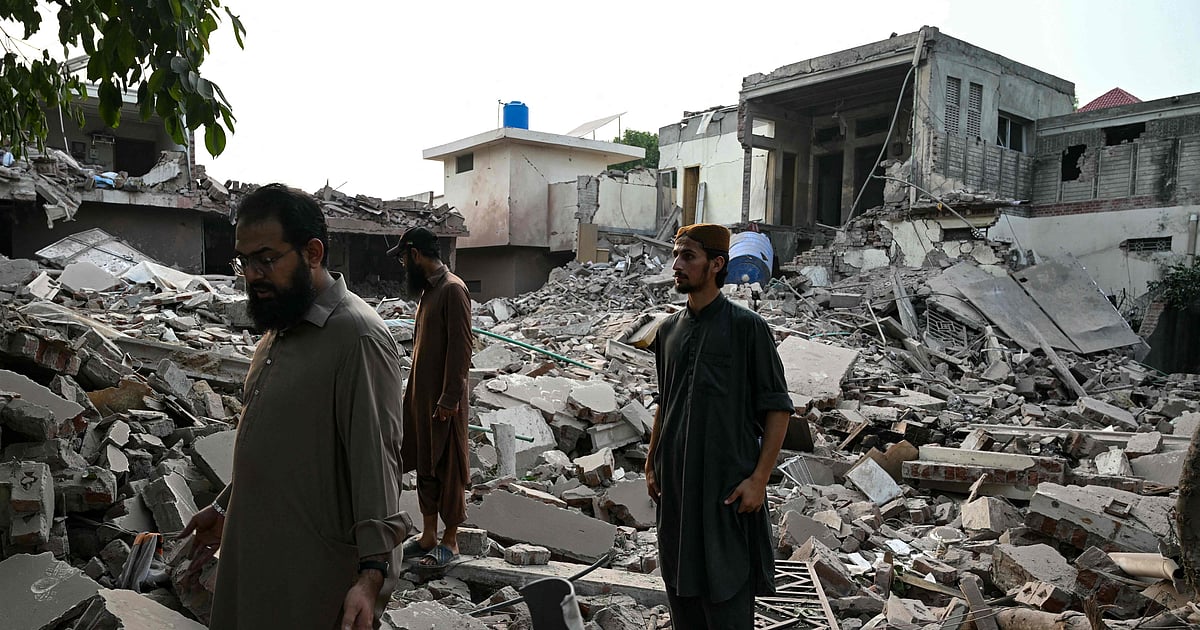
India and Pakistan exchanged heavy artillery along their contested frontier on Wednesday after New Delhi launched deadly missile strikes on its arch-rival, in the worst violence between the nuclear-armed neighbours in two decades.

At least 36 deaths were reported. Islamabad said 26 civilians were killed by the Indian strikes and firing along the border, while New Delhi said at least eight died from Pakistani shelling, according to AFP.

However, the terrorist attack in Kashmir on 22 April that killed 26 people was the beginning of the renewed hostilities between India and Pakistan, who have been arch rivals and have fought several wars since their partition in 1947, but they have been maintaining military power for long considering the geopolitical perspectives.

As many people feared both would eventually test their militarily might amid escalating tension, thus, the military capabilities of both countries have come to limelight. Recently, Malaysia-based website Defence Security Asia published an analysis on the military capabilities of both countries, citing Global Firepower Index 2025.

Overall military ranking and power index

India with a Power Index (PwrIndx) score of 0.1184 and Pakistan with a score of 0.251 ranked 4th and 12th respectively in the Global Firepower Index (GFP) 2025, which evaluates 145 nations based on over 60 factors including manpower, equipment, finances, geography, etc.

Lower PwrIndx scores indicate stronger militaries. Indiaโ€™s higher ranking reflects its larger population, bigger defense budget, and more extensive military assets. On the other hand, Pakistan, while formidable, faces constraints due to a smaller economy and reliance on foreign suppliers, particularly China, according to Defence Security Asia.

Manpower

Manpower is a critical factor in conventional warfare, especially for India and Pakistan, given their large populations and reliance on ground forces.

India has 1.4 billion populations (second largest in the world), 662 million available manpower, 1.46 million active personnel (second globally), 1.16 million reserve personnel (seventh globally), 2.53 million paramilitary forces (second globally) and 5.1 million total military strength including active, reserve, and paramilitary.

Pakistan has 252 million population (fifth in the world globally), 108 million available manpower, 654,000 active personnel: (7th globally), 650,000 reserve personnel. The countryโ€™s paramilitary forces are not explicitly quantified in GFP but it has significant, including Rangers and Frontier Corps. Its total military strength including active, reserve, and paramilitary is 1.7 million.

India has over twice the active personnel and significantly larger reserve and paramilitary forces than Pakistan has, but Pakistan has a high proportion of its population dedicated to military service and leverages irregular forces like โ€˜Mujahids coordinated by the Inter-Services Intelligence (ISI).

Defense budget

India increased defense budget by 9.5 per cent to USD 79 billion in the 2025-26 fiscal, which is 2.1 per cent of the GDP. India becomes the third largest military spenders after the US and China.

Pakistan spends USD 10-12 billion in the 2025-26 fiscal, which is 3.6 per cent of the GDP. The country is not in the top tier because of economic challenges, but received USD $100 million in 2018 in foreign military assistance, primarily from the US and China.

Indiaโ€™s defense budget is approximately 6-8 times larger than Pakistanโ€™s, enabling greater investment in advanced technology, infrastructure, and force modernisation while Pakistan faces budget constrains on maintaining a large standing army and nuclear arsenal, but Chinese support bolsters its capabilities.

Land Forces

Ground forces are central to India-Pakistan conflicts. Both countries share 3,323 km border and have a history of engaging in conventional wars in 1947, 1965, 1971 and 1999.

India has 4,614 tanks (6th globally), 151,248 armoured vehicles and 9,719 artillery pieces. Its special forces include Para SF, Ghatak Force and MARCOS.

Pakistan has 3,742 tanks, about 50,000 armoured vehicles and 4,472 artillery pieces including 375 self-propelled howitzers. Its special forces include Special Services Group (SSG), SSG Navy, Special Service Wing, respected but smaller in scale.

India certainly has a numerical advantage in tanks, armoured vehicles, and artillery while Pakistan maintains a competitive tank fleet, with Chinese VT-4 tanks offering modern capabilities, and also possesses infantry fighting vehicles (IFVs) with diverse platforms like the M113 and Al-Fahd.

Air Forces

Air superiority is critical in modern warfare, predominantly for rapid response and precision strikes.

India has a total of 2,229 aircraft, including 513-606 fighter jets. Its air force has fighter jets include Sukhoi Su-30MKI, Rafale, Tejas Mk1 (indigenous), MiG-29, Mirage 2000, as well as Apache AH-64E and Chinook helicopters. Its support aircraft operates 4 airborne early warning and control (AEW&C) systems and Ilyushin Il-78 tankers. Indiaโ€™s air defense has S-400 systems (deliveries began 2020), enhancing long-range defense.

Pakistan has 1,399-1,434 aircraft, including 328-387 fighter jets, which include F-16 Fighting Falcon, JF-17 Thunder (Chinese) and Mirage III/V. The country has more attack helicopters than India, including AH-1F Cobras. Support aircraft consists of 7 AEW&C systems, outperforming India in ISR capabilities. Pakistan is upgrading F-16s with Turkish Roketsan missiles and trialling CZ Bren, FN-SCAR. Its air defense HQ-9 (Chinese) is less advanced than Indiaโ€™s S-400.

Indiaโ€™s air force is larger and more diverse while Pakistan has a smaller air force, but it is modernising, Pakistan has advantage in AEW&C systems bolsters situational awareness, but it lags in advanced air defence and overall fleet size.

Naval Forces

Naval capabilities are vital for Indiaโ€™s maritime interests in the Indian Ocean and Pakistanโ€™s Arabian Sea operations.

India has 67,700 navy personnel, 294 vessels, 2 aircraft carriers (INS Vikramaditya, INS Vikrant), 18 submarines, including nuclear-powered INS Arihant, 13 destroyers, 14 frigates, 106 patrol vessels and 75 combat-capable aircraft, including MiG-29K.

Pakistan has 23,800 navy personnel, 121 vessels, 8 submarines (Agosta-class, Chinese Yuan-class), 9 frigates, 17 patrol vessels: 17 and 8 combat-capable aircraft.

Indiaโ€™s navy is significantly larger and more capable, with aircraft carriers enabling power projection across the Indian Ocean. Pakistanโ€™s smaller navy focuses on coastal defense and regional operations, with submarines posing a threat to Indian shipping lanes. The absence of carriers and limited naval aviation restricts Pakistanโ€™s maritime reach.

Nuclear capabilities

Both India and Pakistan are nuclear-armed, shaping their deterrence strategies.

India has 130-140 warheads. Its delivery systems include Agni-III/V ballistic missiles (3,000-5,000 km range), Mirage 2000, Rafale for air delivery, INS Arihant for sea-based deterrence. India maintains No First Use (NFU) doctrine, with massive retaliation against nuclear attack.

Pakistan has 140-150 warheads, slightly more than India. Its delivery systems consist of Shaheen-II/III ballistic missiles, F-16s, Babur cruise missiles, naval platforms under development. The country follows a full-spectrum deterrence doctrine, including tactical nuclear weapons to counter Indiaโ€™s conventional superiority.

Strategic and operational considerations

India maintains strong ties with Russia, France, Israel, and the US to enhance technology access and the countryโ€™s participation in exercises like RIMPAC improves interoperability while Pakistan has deep ties with China and limited US support (MNNA status) to bolster capabilities.

India focuses on conventional superiority and deterrence against both Pakistan and China. The โ€œCold Startโ€ doctrine envisions rapid, limited incursions to punish Pakistan without triggering nuclear escalation. Pakistan emphasises asymmetric warfare and nuclear deterrence to counter Indiaโ€™s conventional edge.

Indiaโ€™s bureaucratic interference, slow acquisitions, and counterinsurgency focus have diluted conventional war readiness, while, for Pakistan, economic constraints limit fuel and equipment maintenance.

Indiaโ€™s broader strategic focus (China and Pakistan) stretches its resources but drives modernisation while Pakistanโ€™s narrower focus on India allows efficient resource allocation, but economic woes and border clashes with regional tension Afghanistan weaken its posture.​

All the so-called tactical nukes are not good enough to match even a single city buster of India of MT scale. The days are gone when you continue to promote terrorism under the cover of Nuke. I dare Pakistan to use Nuke. One small mistake and Lahore and Karachi evaporated into vapor.
 

Pakistan PM Shehbaz vows 'every drop of blood' spilt to be avenged

View attachment 17126
Pakistan's Prime Minister Shehbaz Sharif. File Photo/Reuters

PM Shehbaz has vowed that "every drop of blood" spilt by those slain in last night's air strikes by India would be avenged.

"This is the cowardly enemy that attacks unarmed civilians and thinks itself stronger. But we proved last night that Pakistan knows how to deliver a befitting response in its defence. The nation pays tribute to the bravery and strength of the armed forces."​

Do it. Who stops you? Remember one advice clearly. Now death of every Indian will be avenged in most brutal manner and in more horrific manner than previous revenges. You identified Hindus and killed them by separating them from Muslims and challenged our P.M. See what did we do. Now try something silly like attacking civil area etc. so that we have free hands to strike you where it hurts most. This time it will be Ravalpindi. Days of your hooliganism are over now. every mischief will be punished severely. With every incident of terror strike, Severity of punishment will rise. These attacks are more brutal than Balakot. If this happens next time, you will not be able to count dead bodies.
 

Explosions at Jammu airport in Indian Kashmir
Al Jazeera
Published :
May 08, 2025 23:19
Updated :
May 08, 2025 23:19

1746752730939.png


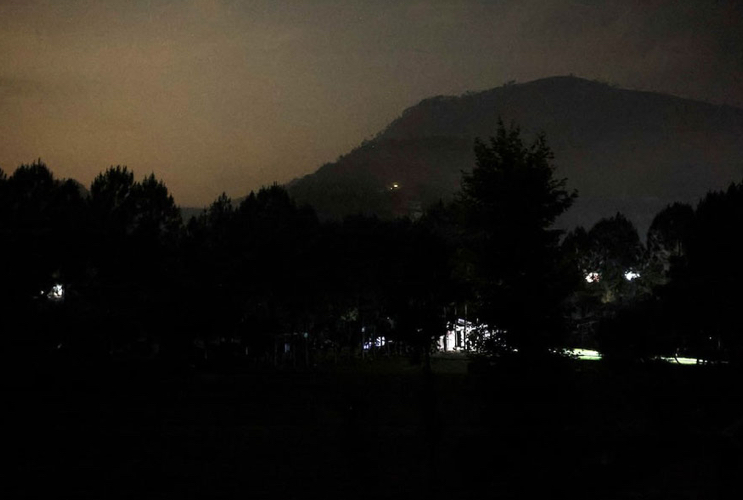
Residents in Indian-administered Kashmir have said there are major and multiple explosions and sirens in the city of Jammu, causing a complete blackout.

Shesh Paul Vaid, the regionโ€™s former director-general of police and a resident of Jammu, said on social media: โ€œBombing, shelling, or missile strikes suspected.โ€

โ€œThe Indian news outlets are reporting that they have intercepted drones and attacks on several locations in Jammu,โ€ journalist Umar Meraj told Al Jazeera from Srinagar, in Indian-administered Kashmir.

Sirens are being heard in Jammu and several villages near the Line of Control, Meraj added.

โ€œThe clashes between the India and Pakistan forces are far more intense than in previous years. What used to be occasional small firearms have escalated to the heavy exchange of artillery,โ€ the journalist explained.

The news agency Reuters, citing an unnamed Indian official, reported Pakistani attacks in Akhnoor, Samba, Kathua and multiple other locations in Jammu.

Indian and Pakistani authorities did not immediately comment.​
 

Pakistan's Chinese-made jet brought down two Indian fighter aircraft, US officials say
REUTERS
Published :
May 08, 2025 22:01
Updated :
May 08, 2025 22:01

1746753405947.png


An Indian security force trooper moves past parked vehicles during a cordon and search operation, following an attack on tourists near Pahalgam, in Gudder village of south Kashmir's Kulgam district April 26, 2025. Photo : REUTERS/Stringer/Files

A top Chinese-made Pakistani fighter shot down at least two Indian military aircraft on Wednesday, two US officials told Reuters, marking a major milestone for Beijing's advanced fighter jet.

One US official, speaking on condition of anonymity, said there was high confidence that Pakistan had used the Chinese-made J-10 aircraft to launch air-to-air missiles against Indian fighter jets - bringing down at least two.

Another official said at least one Indian jet that was shot down was a French-made Rafale fighter aircraft.

Delhi has not acknowledged the loss of any of its planes and instead said it carried out successful strikes against what it said was "terrorist" infrastructure inside Pakistan.

In France, Rafale manufacturer Dassault Aviation (AM.PA) and the MBDA (AIR.PA), (BAES.L), (LDOF.MI), consortium, which makes the Meteor air-to-air missile, could not immediately be reached for comment on a public holiday.​
 

War is no solution, negotiations may find one
Nilratan Halder
Published :
May 09, 2025 00:26
Updated :
May 09, 2025 00:26

1746753779777.png


Internal armed conflicts, wars and proxy wars---some of those prolonged--- have been continuing in quite a few regions of the world. But none of those between two nuclear powers! The latest air strike codenamed "Operation Sindoor" launched on Pakistan by India on the early morning of Wednesday now brings the two nuclear-armed neighbours on to the brink of an all-out war. This has some similarities with the invasion of Ukraine by Russia but the contexts and stated aims are totally different.

While Russia wanted to get back its strategic territories such as Crimea that was attached to Ukraine during the Soviet Union and stop the latter from joining the North Atlantic Treaty Organisation (NATO), the arch rivals of the subcontinent have fought over Kashmir ever since its division into the two nations in 1947. This time tension started to build up following the killing of 26 innocent tourists in Pahalgam in India-administered Kashmir on April 22.

Although India claims it carried out 'precision attacks' non-escalatory in nature, once such attacks are unleashed, escalation of the feud is no longer under its control. Since there is India's rival which claims it has been unjustifiably blamed for the Pahalgam massacre, much will depend on how the latter reacts. The Indian air strike, as Pakistan considers, is violence of its sovereignty. So, the National Security Committee of Pakistan government also authorised the country's armed forces to respond to Indian aggression at "time and manner" of their choosing. Retaliatory action is on the cards.

How intense and extensive the counter offensive will be may decide whether the war will be a large-scale conventional war or worse, will trigger a nuclear war. A top leader of Pakistan did not rule out such a possibility. Can India and Pakistan afford even a conventional war of scale? Spokesperson for UN chief Antonio Guterres has put it succinctly even in a broader context, "The world cannot afford a military confrontation between India and Pakistan".

At a time when global trade and manufacturing have been severely jolted by Donald Trump's reciprocal tariffs, the fallouts of a war between India and Pakistan will not only cripple the economies of the two warring nations but also cause those of the South Asian nations to bleed. Even its negative ramification for the global economy is likely to be significant. Already Israel's escalating aggression on Palestine, Syria, Lebanon and Yemen has turned the Middle East into a cinder box and the Ukraine war shows no sign of ceasing. The Myanmar conflict stays at a stalemate because of the earthquake. Another war in South Asia, a region already counting trade losses because of aggressive tariff policy, will either harm or shatter economies of some of the neighbours.

Flight and cargo operation will be costlier and import and exports are likely to face disruptions or may be delayed. But the greatest casualty will be the regional tie that has been under stress for sometime. The India-Pakistan rivalry has made the South Asian Association for Regional Cooperation (SAARC) non-functional. The political non-cooperation has been responsible for rendering the South Asian Free Trade Area (SAFTA), a free trade arrangement within the bloc, equally irrelevant. Now this latest escalation of conflict between the two powerful nation in the region will have its adverse impacts on social, people-to-people and cultural relations as well. The least said about economic and commercial cooperation the better.

World leaders have urged restraint from both sides. The Iranian Foreign Minister Abbas Araghchi has started shuttling between Islamabad and New Delhi to impress upon the leaders of the two nations about the futility of armed aggressions against each other. Meanwhile, the news that Jaish-e-Mohammed confirmed that 10 relatives of its leader Masood Azhar, the architect of terrorist attacks on Indian parliament in 2001and the Taj Hotel in Mumbai, were killed in Indian air strike gives some idea about the objective India had in mind. The fate of Masood who was released from Indian jail in exchange for 155 hostages from a hijacked Indian Airlines plane in 1999, however, is not known.

Undeniably, terrorist groups from Pakistan have a long history of carrying out operations inside India. This has no doubt soured relations between the two neighbours. Yet war cannot be an option for settling contentious issues. History offers lessons for non-aggression. Adolf Hitler in his demonic theory of "Final Solution" wanted to exterminate the Jewish people within reach, not limited to the European continent. The irony is that today, the Jews planted in Palestine from all across the world, are now carrying out one of the worst genocides in human history.

Thus war does not settle things, rather it sows the seeds of future enmity and worse crimes again humanity. The India-Pakistan armed conflict may not be solved right away but at least the two sides should opt for de-escalation of tension and status quo in the interest of their economy and the civilians who will suffer the most in case the war escalates and prolongs. Right now the stakes are high for both countries because the war will push them back by a few years because of the turmoil the global economy is in on account of Trump's indiscriminate and aggressive tariff policy.​
 

Conflict spreads as India, Pakistan fight with drones and missiles
REUTERS
Published :
May 08, 2025 21:59
Updated :
May 08, 2025 22:00

1746754460034.png


Graphics showing the military power of India and Pakistan

Pakistan and India accused each other of launching drone attacks on Thursday, and Islamabadโ€™s Defence Minister said further retaliation was โ€œincreasingly certainโ€, on the second day of major clashes between the nuclear-armed neighbours.

Pakistan said it shot down 25 drones from India, while India said it air defences had stopped Pakistani drone and missile attacks on military targets, dashing hopes they would soon bow to pressure to end their worst confrontation in more than two decades.

World powers from the U.S. to Russia and China have called for calm in one of the world's most dangerous, and most populated, nuclear flashpoint regions. The U.S. Consulate General in Pakistan's Lahore ordered staff to shelter in place.

Thursday's reported exchanges came a day after India said it hit nine "terrorist infrastructure" sites in Pakistan in retaliation for what it says was a deadly Islamabad-backed attack in Indian Kashmir on April 22.

Pakistan says it was not involved and denied that any the sites hit by India were militant bases. It said it shot down five Indian aircraft on Wednesday, a report the Indian embassy in Beijing dismissed as "misinformation".

1746754481897.png


Pakistani retaliation "is increasingly becoming certain now," Pakistan's Defence Minister, Khawaja Muhammad Asif, told Reuters. "I will still refrain from saying it is 100%. But the situation has become very difficult. We have to respond."

The relationship between India and Pakistan has been fraught with tension since they gained independence from colonial Britain in 1947. The countries have fought three wars, two of them over Kashmir, and clashed many times.

The countries that both claim Kashmir in full and rule over parts of it separately acquired nuclear weapons in the 1990s.

TRADING HALTED

Trading was halted on Pakistan's benchmark share index after the index slumped 6.3% on news of the drone attacks. Pakistan's international bonds extended their losses with the 2036 bond down 2.4 cents to bid at 72.4 cents.

Indian equities, rupee and bonds fell sharply in late afternoon trading after the Indian defence ministry statement, with the stock market benchmark Nifty 50 settling 0.58% lower in the most volatile trading session in a month.

Pakistan shot down 25 Israeli-made drones from India at multiple locations, including the two largest cities of Karachi and Lahore, and their debris is being collected, Pakistan military spokesperson Ahmed Sharif Chaudhry said.

One drone was also shot down over the garrison city of Rawalpindi, home to the Pakistan army's heavily fortified headquarters, he added.

One drone hit a military target near Lahore and four personnel of the Pakistan army were injured in this attack, Chaudhry said.

"Indian drones continue to be sent into Pakistan airspace...(India) will continue to pay dearly for this naked aggression," he said.

The Indian defence ministry said Pakistan attempted to engage a number of military targets in northern and western India from Wednesday night into Thursday morning and they were "neutralised" by Indian air defence systems.

In response, Indian forces targeted air defence radars and systems at a number of locations in Pakistan on Thursday, the ministry said. The "Indian response has been in the same domain with the same intensity as Pakistan," it added.

The Indian ministry accused Pakistan of increasing the intensity of its firing across the ceasefire line, the de facto border, in Kashmir. Sixteen people, including five children and three women, were killed on the Indian side, the statement said.

Pakistan says at least 31 of its civilians were killed and about 50 wounded in Wednesday's strikes and in cross-border shelling across the frontier in Kashmir that followed, while India says 13 of its civilians died and 59 were wounded.

On Thursday, Indian government ministers told a meeting of political parties in New Delhi that the strikes on Pakistan had killed more than 100 militants and that the count was still ongoing, government sources said.

Pakistan's Information Minister Attaullah Tarar told parliament that Pakistani forces had killed 40-50 Indian soldiers on the de-facto border in Kashmir and "blown" Indian military installations.

Reuters could not independently verify claims of both countries.

Blackout drills were conducted in India's border regions on Wednesday night.

Local media reported panic buying in some cities in the Indian state of Punjab which shares a border with Pakistan, as people hoarded essentials fearing a Pakistani retaliation to the Indian strikes.

Indian Foreign Minister Subrahmanyam Jaishankar said New Delhi did not intend to escalate the situation. "However, if there are military attacks on us, there should be no doubt that it will be met with a very, very firm response," he said at a India-Iran Joint Commission Meeting.

His Pakistani counterpart, Ishaq Dar, told Reuters that there have been contacts between the offices of the national security advisers of the two countries and the hotline between their heads of military operations was also working. He did not give more details.​
 

Members Online

Latest Posts

Latest Posts