Donate ☕
201 Military Defense Forums
[🇧🇩] - Everything about our constitution | PKDefense
Home Login Forums Wars Watch Videos
Serious discussion on defense, geopolitics, and global security.

[🇧🇩] Everything about our constitution

Reply (Scroll)
Press space to scroll through posts
G Bangladesh Defense
[🇧🇩] Everything about our constitution
56
3K
More threads by Saif

HC questions 15th amendment that scrapped caretaker govt system
Staff Correspondent 19 August, 2024, 13:05


1724111853103.png


The High Court on Monday asked the government to explain in 10 days why the 15th amendment to the constitution, scrapping the caretaker government system in 2011, would not be declared illegal.

The court also asked the government to explain why all the government’s actions taken on the basis of the 15th amendment would not be declared illegal.

The court asked the secretaries of the law ministry and Jatiya Sangsad’s secretariat to explain the rule in 10 days.

The bench of Justice Naima Haider and Justice Sashanka Shekhar Sarkar issued the rule after hearing a writ petition filed on Sunday by five eminent citizens challenging the legality of the amendment made by the government of deposed prime minister Sheikh Hasina.

The citizens are Sushashoner Jonno Nagorik president M Hafizuddin Khan, its secretary Badiul Alam Majumder, local government expert Tofail Ahmed, and two individuals, Md Jobirul Hoque and Zahrah Rahman.

The court heard attorney general Md Asaduzzaman before issuing the rule.

The citizens’ lawyer, Sharif Bhuiyan, argued that the parliament scrapped the national election-time non-governmental caretaker system through the 15th amendment in violation of the Appellate Division’s May 10, 2011, short order that observed that the elections of the 10th and 11th parliaments could be held under the caretaker government system.

The lawyer argued that the caretaker government system was abolished on the recommendations of deposed prime minister Sheikh Hasina, although a 15-member special parliamentary committee and all civil citizens opined for the retention of the caretaker government system.

As the 15th amendment was unconstitutional, the incorporation of new Articles 7A and 7B into the constitution was illegal, he argued.


Article 7A. (1) says, ‘If any person, by show of force or use of force or by any other un-constitutional means-

(a) abrogates, repeals or suspends or attempts or conspires to abrogate, repeal or suspend this Constitution or any of its article ; or

(b) subverts or attempts or conspires to subvert the confidence, belief or reliance of the citizens to this Constitution or any of its article, his such act shall be sedition and such person shall be guilty of sedition.

(2) If any person,

(a) abets or instigates any act mentioned in clause (1); or (b) approves, condones, supports or ratifies such act, his such act shall also be the same offence.

(3) Any person alleged to have committed the offence mentioned in this article shall be sentenced with the highest punishment prescribed for other offences by the existing laws.

On Sunday, Supreme Court lawyer Muzahidul Islam filed a case against former chief justice ABM Khairul Haque for illegally changing the verdict on the caretaker government provision.​

The lawyer in the case alleged that Khairul, in his written verdict on September 16, 2012, after his retirement, changed the original verdict, stating that the caretaker government could only be formed with elected lawmakers.

The case said that Justice Khairul, in the changed verdict, also observed that the parliament would be dissolved 42 days before the national election and a small cabinet might be formed to carry out routine work until a new cabinet assumed office.
 
Last edited:

Analyze

Analyze Post

Add your ideas here:
Highlight Cite Fact Check Respond
  • Love (+3)
Reactions: Bilal9

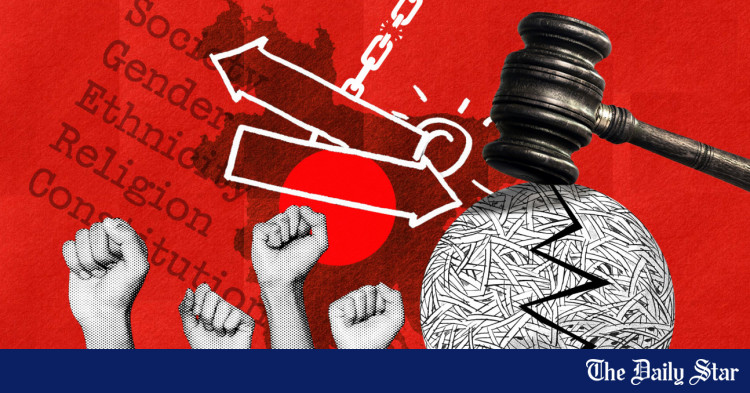
The reason we need a new constitution

1728521269819.webp

Visual: Fatima Jahan Ena

The debate regarding a new constitution for Bangladesh has now reached mainstream politics. Responding to the discourse, the interim government has recently formed a nine-member commission for constitutional reform. In my opinion, adopting a new constitution for Bangladesh is a must if we want to achieve a robust democratic system with peaceful transitions of governmental power and I presuppose that the new constitution will be adopted by a democratically elected constituent assembly, not the interim government. Moreover, a fresh constitution is a must if we want to bypass the problem of the doctrine of basic structure, otherwise, all substantial constitutional changes that may be brought to reform the country may be reversed.

The judiciary imported the doctrine of basic structure into our legal system through the Anwar Hossain Chowdhury v Bangladesh (1989) case and applied it in other important constitutional instances in which the legality of a constitutional amendment was challenged. The basic structure doctrine notes that the constitution has an unamendable basic structure. It holds that the parliament's power to amend the constitution has inherent limitations, and an amendment will lose its legality if it changes the basic structure of the constitution. In simpler words, the constitution cannot be amended in a way that it loses its identity.

In theory, the doctrine of basic structure is a principle that aims to maintain the integrity of the original constitution. However, the doctrine is intrinsically vague, as discussed in my paper titled "The Intrinsically Uncertain Doctrine of Basic Structure" published in the Washington University Jurisprudence Review. While using the doctrine of basic structure, judges note that certain provisions of the constitution cannot be changed. However, they have not provided an exhaustive list of these unamendable provisions, which allows the judges to decide what the basic structure of the constitution is on a case-to-case basis. Although it reads as an originalist principle, it has also been used to contradict a provision present in the original constitution.

The reforms needed to fix the problems of the transition of governmental power and restore democracy in Bangladesh would definitely change the basic structure of the constitution. For example, Brigadier General (retired) M Sakhawat Hussain, adviser to the Ministry of Textile and Jute, recently suggested that Bangladesh may be converted into a federal state, dividing the country into five provinces. Some people suggested a shift to a presidential form of government with a strict separation of powers between the executive and the legislature. Some are advocating for a bicameral legislature. However, these proposed reforms would destroy Bangladesh's unitary form of government. The Supreme Court (SC) has previously struck down the Eighth Amendment that decentralised the High Court Division of the SC because the decentralisation changed the unitary form of the government, which is connected to the basic structure of the constitution. Similarly, the SC might strike down any amendment that challenges the unitary form of government.

If the current constitution stays, the basic structure doctrine will remain. If we try to amend the constitution to get rid of the basic structure doctrine, that too would be a violation of the basic structure and can be struck down by the court. The Indian Parliament has tried innovative ways to amend the basic structure away, but their Supreme Court struck down those amendments.

One way to ensure that the doctrine of basic structure is not used to reverse any substantial progress we achieve in restoring democracy in Bangladesh would be to make the constitutional amendment-making process more rigid. If the process possesses more democratic legitimacy, the court would lose its justification for using the basic structure doctrine. Consider the US system: their Supreme Court is theoretically as powerful as its Indian and Bangladeshi counterparts. However, the US Supreme Court has never struck down a constitutional amendment because the US Constitutional amendment-making process is very rigid and has a lot of democratic legitimacy. An amendment to the US Constitution can be proposed by either two-thirds of the two chambers of US Congress or by a request of two-thirds of the US states through a special convention called for that purpose. A proposed amendment must be ratified by three-fourths of all states to be valid. Because of its rigid nature, the US Constitution has been amended only 27 times despite more than 11,000 attempts. An amendment passing such a long and rigorous process with multiple democratic hurdles cannot be struck down by the judiciary without facing severe criticism.

Unfortunately, making the constitutional amendment process more rigid may also alter the basic structure of the constitution and may be reversed by the Supreme Court of Bangladesh. Thus, to ensure that the constitutional reforms remain unaffected by the politicisation of the judiciary, we have no other option but to adopt a new constitution by calling a constituent assembly.

Nafiz Ahmed teaches jurisprudence at North South University.​
 
Analyze

Analyze Post

Add your ideas here:
Highlight Cite Fact Check Respond
  • Love (+3)
Reactions: Bilal9

Why constitutional reform is essential

1728606624105.webp

File Visual: Anwar Sohel

The dream of building a nation rooted in equality, human dignity, and social justice has been a cornerstone of Bangladesh's formation. However, over the past 15 years, this very nation has witnessed a stark departure from those ideals, succumbing to the grip of fascism. Democratic institutions have been systematically dismantled, paving the way for authoritarian rule. Fundamental human rights and democratic freedoms have been trampled, and the aspirations that once drove the people to fight for independence have been replaced by dynastic and repressive systems.

The constitution is, in essence, the "manual" for governing a state. Yet, the present Bangladesh Constitution contains elements that neither reflect the spirit of the country's Liberation War nor safeguard against the rise of fascism. It has, instead, facilitated the authoritarianism of the previous regime in power. While there may be differences of opinion on whether to amend or entirely rewrite the constitution, there is little disagreement that the existing one poses significant obstacles to any future democratic process.

At first glance, one might believe that Bangladesh Constitution upholds the spirit of its independence. However, the principles of equality, human dignity, and social justice enshrined in the declaration of independence have been compromised. This constitution has enabled unchecked power to concentrate in the hands of the prime minister. Through successive amendments, the constitution has primarily centralised authority, serving the interests of those in power.

The constitution's core principles are meant to guide the governance of the state. But what should those principles be? They must be value-based, not ideologically driven. Ideological frameworks inevitably lead to conflict, as society is made up of diverse beliefs. One person might support an Islamic system of governance, while another advocate for secularism. One individual may be a proponent of Bengali nationalism, while another subscribes to Bangladeshi nationalism. If the constitution aligns with any single ideology, it inherently dismisses and alienates those with differing views, posing a serious barrier to building an inclusive society.

What, then, should the foundation of the constitution be? It should rest solely on democracy and the values of equality, human dignity, and social justice, as proclaimed in the declaration of independence. Beyond this, no other ideology—whether socialism, nationalism (Bengali or Bangladeshi), secularism, or religious beliefs—should serve as the guiding principle of the constitution. These ideologies do not align with the needs of a modern state.

The past 50 years of governance under various regimes have shown that ideological frameworks have brought Bangladesh no lasting benefit, instead deepening divisions. The constitution must not embrace any ideology that sparks opposition from any part of society. Its focus should remain on the rules and regulations that govern the state's operations. The state itself should be devoid of any ideological affiliation. Its sole aim is to serve the people and ensure their security through a system of accountable governance. When any ideology—especially one linked to the two dominant political forces of the past 50 years, Awami League and BNP—becomes the basis for governance, the nation is pushed towards conflict. Embracing such an ideological basis means returning to the divisive politics that have already fractured the country.

The four ideological principles enshrined in the current Bangladesh Constitution are essentially the core tenets of a political party, often referred to as "Mujibism." This ideological basis was included without a broader national consensus, reflecting the dominance of one political group's agenda over the people's collective will. The post-independence constitution was drafted by members of the constituent assembly, who had been elected for Pakistan's legislative body, not to create an independent nation. Following a nine-month independence war, the hopes and aspirations of the people had evolved. Given this transformation, it would have been appropriate to form a new constituent assembly through elections, with the mandate to draft the constitution and submit its guiding principles for a public referendum. However, instead of taking such inclusive measures, one party's ideology was imposed as the national ideology through the constitution.

The second critical issue lies in the relationship between the state and religion. A state should not endorse any particular religion; it must belong to all its citizens, regardless of faith. The state's primary role is to ensure equal rights and dignity for all religious groups and people. The constitution must, therefore, be secular in the truest sense, reflecting a commitment to equal treatment for all. However, the current constitution retains elements linking the state to political ideologies and religious identities, leading to an inherent contradiction.

One of the most glaring problems with the constitution is that it concentrates enormous power in the hands of the prime minister. The officeholder simultaneously holds four crucial positions: prime minister, head of the ruling party, leader of the parliamentary party, and leader of the parliament itself. While the president is technically the highest-ranking official in the state, the constitution subordinates the president to the prime minister. The president must act on the advice of the prime minister, rendering the role largely ceremonial and devoid of real power. This has led to the repeated election of presidents who are seen as loyal to the prime minister rather than independent figures who can serve as a check on executive power.

The prime minister's unchecked authority extends across the government, from the formation of the cabinet to appointments in key constitutional posts. Without the prime minister's approval, no one can be appointed to a significant constitutional position. This consolidation of power has transformed the prime minister into a de facto autocrat, particularly in a parliamentary system where the government (executive branch) is formed from the majority party in parliament. Given the additional powers granted to the prime minister by the constitution, the position has taken on the characteristics of a dictatorship.

Moreover, the current constitution has effectively transferred the same authority and power that a president would hold in a presidential system to the prime minister without the necessary mechanisms for accountability. Since the ruling party typically holds a majority in parliament, it becomes nearly impossible for parliament to hold the prime minister accountable. Instead of serving as a body that scrutinises the executive's actions, the parliament has become a rubber stamp that merely approves executive decisions and the government's agenda.

One of the most contentious elements of our constitution is Article 70, which severely restricts the ability of members of parliament (MP) to vote against their party. No MP is permitted to vote against their party's decisions, including decisions made by the government if their party is in power. If an MP dares to defy this rule, they risk losing their parliamentary seat. Rather than representing the interests of their constituents, this provision forces MPs to toe the party line and reduce them to voicing the will of the party leadership, eliminating any possibility of dissent or debate within the legislative body.

The implications of Article 70 are far-reaching, particularly when the head of the party, the parliamentary leader, and the prime minister are all the same person. This concentration of authority leads to a situation where both the executive and legislative branches of government are controlled by a single individual.

In light of this, it becomes evident that the current constitution contains all the necessary ingredients for a prime minister to evolve into an authoritarian ruler. With no constitutional provision limiting how many times a person can hold the office of prime minister, the same individual can remain in power indefinitely. This creates a cycle in which power is concentrated in the hands of a single person, with no meaningful checks from either parliament or the judiciary. The concentration of power, absence of genuine accountability, and the intertwining of state and party ideology have all contributed to a deeply flawed system of governance.

The only way to address these critical flaws is through substantial reform of the constitution or even a complete rewriting of it. Without meaningful reforms to the constitution—especially those that restore the balance of power and ensure true accountability—Bangladesh risks continuing down the path of authoritarian rule, with its democratic institutions weakened and its people further marginalised.

To ensure a balanced, inclusive, and accountable system of governance, several key issues must be addressed:

1. Term limits for the prime minister: A constitutional provision should be introduced to prevent any individual from serving more than two terms as prime minister. In addition, the selection process for the prime minister could be modified to resemble that of the president, with an indirect election by members of parliament, ensuring a more democratic and less autocratic process.

2. Separation of key leadership roles: The constitution must ensure that the positions of party leader, head of the executive (prime minister), leader of the parliamentary party, and leader of parliament are never held by the same individual. This separation is crucial to avoid the dangerous concentration of power in a single person, which undermines both democracy and accountability.

3. Abolition of Article 70: Article 70 infringes on the independence of MPs and contradicts the spirit of parliamentary democracy, as it eliminates the possibility of meaningful debate and dissent within parliament and prevents MPs from voting against their party. Its removal is essential for ensuring government accountability through a truly functional legislature.

4. Balancing powers between the prime minister and president: There must be a redistribution of power between the prime minister and the president to prevent an excessive concentration of authority in the hands of a single person. Furthermore, the constitution must include mechanisms to ensure "checks and balances" among the three branches of government—executive, legislative, and judicial—so that no single branch can dominate the others unchecked.

5. Framework for transfer of power: A clear and robust framework for peaceful power transfer, including provisions for an interim government (caretaker government), is essential to safeguard free and fair elections. The reintroduction of a caretaker government system, with necessary amendments, should be considered.

6. Bicameral legislature: To reduce the concentration of power within a single political party, a bicameral (two-chamber) legislative system should be established. This would allow for broader representation and promote a more inclusive democratic process, ensuring that different voices are heard and represented in the legislative process.

7. Value-based constitution, not ideology-based: The constitution should be rooted in universal values such as democracy, equality, human dignity, and justice rather than any particular political ideology. Divisive issues should be excluded from the constitution to help prevent further division and conflict in society.

Without substantial reform of the constitution, it is impossible to create a balanced system of governance where power is properly distributed among different branches of the government and the democratic process is safeguarded. A revised constitution must prioritise the establishment of checks and balances, ensure the independence of parliament, and place meaningful limitations on executive power, including term limits for the prime minister. Only then can Bangladesh hope to restore true democratic governance and prevent the rise of authoritarianism.

Sahid Islam is pursuing PhD at the University of Florida.​
 
Analyze

Analyze Post

Add your ideas here:
Highlight Cite Fact Check Respond
  • Love (+3)
Reactions: Bilal9

First meeting of constitution reform commission held virtually

1728864040460.webp


The first meeting of the Constitution Reform Commission was held virtually yesterday evening, according to a press release.

During the meeting, discussions were held regarding the commission's scope of work and operational procedures. The press release stated that a decision was made to create an official email account for public communication, and a website for the commission will be launched soon.

The next meeting of the commission is scheduled to be held on October 21 at its office in Dhaka. The press release also mentioned that the government is in the process of setting up the commission's office in the parliament area.

The meeting was presided over by the commission's head, Professor Ali Riaz, and attended by members Professor Sumaiya Khair, Barrister Imran Siddique, Professor Mohammad Ikramul Haque, Barrister M Moin Alam Ferozi, Firoz Ahmed, Md Mustain Billah, and Md Mahfuz Alam.​
 
Analyze

Analyze Post

Add your ideas here:
Highlight Cite Fact Check Respond
  • Love (+3)
Reactions: Bilal9

The case for overhaul of constitution in post-Hasina Bangladesh
CAF Dowlah
Published :
Oct 21, 2024 21:41
Updated :
Oct 21, 2024 21:41

1729558981698.webp


The interim government, led by Prof. Yunus, has established more than half a dozen commissions, signaling an agenda that goes beyond merely organising free and fair elections. The government appears intent on initiating broad reforms across key sectors, including a potential overhaul of the nation's constitution.

The call for constitutional reform has gained momentum, especially among the leaders of the student-led movement that ousted Sheikh Hasina's autocratic regime. These leaders argue that the current constitution enables the concentration of power in the hands of a single individual, a concern echoed by many in civil society and the intelligentsia.

Unsurprisingly, various suggestions have emerged on how to reform the constitution to ensure a true separation of powers among the executive, legislative, and judicial branches, and to establish effective checks and balances to prevent future autocratic regimes.

Under the previous regime, power was largely concentrated in the hands of the prime minister, who selfishly manipulated the parliamentary system outlined in the country's original 1972 constitution. Though this system has been disrupted several times by martial laws and shifts to a presidential system, it remains the default framework of governance.

The constitution has already been amended 17 times in about five decades. In comparison, the U.S. Constitution has been amended 27 times in 250 years, India's 106 times since 1950, and Pakistan's 25 times.

Blaming the parliamentary system itself for Sheikh Hasina's excesses is however misguided. In theory, parliamentary systems offer mechanisms to ensure the executive is accountable to the legislature. The problem arises when, as in Bangladesh, the prime minister leads both branches, concentrating excessive power.

Moreover, outcomes of parliamentary systems have varied significantly. The system has functioned effectively in the UK, its birth place, for centuries. In India also it worked well, except during Indira Gandhi's emergency rule in the early 1970s. While some countries like Singapore and Malaysia have shown authoritarian tendencies, some countries, like Canada and Japan, have enjoyed stable governance under parliamentary rule.

Presidential systems are however more widespread, with over 100 countries using full or semi-presidential systems compared to only about three dozen countries with parliamentary systems. Many countries-such as the U.S., Brazil, Mexico, and Indonesia-have adopted full presidential systems, while others, like France and Russia, have adopted semi-presidential systems where power is shared between a president and a prime minister.

Given Bangladesh's troubled experience with parliamentary rule, some argue the country should switch to a presidential system to ensure a better separation of powers and prevent future autocracies. This commentator also believes that to modernize governance, strengthen democracy, and prevent the return of autocracy or dictatorship, Bangladesh must undergo some targeted constitutional reforms, as outlined below.

First, switch to a Presidential Form of government to ensure proper separation of powers and checks and balances between the executive, legislative, and judicial branches.

Second, adopt a Bicameral Legislature, under which an Upper House could provide a check on the Lower House, and approve top-level appointments, such as chairs and members of statutory commissions and agencies, the High Court, and Supreme Court judges, and so on.

Third, grant the president emergency powers so that in times of national crisis or other emergencies, or general elections, the head of state can dissolve parliament, and appoint interim or national government, without requiring consent of the prime minister.

Fourth, introduce a Federal structure by transforming the existing Divisions into Provinces, and placing the provinces under elected governors. This would result in massive decentralization and de-concentration of power, on top of bringing the government closer to the people.

Fifth, impose term limits for key positions such as the president, prime minister, members of parliament, and High Court and Supreme Court judges-this will prevent long-term entrenchment of power.

Sixth, make the Caretaker government system a permanent feature of the constitution to ensure free and fair elections for foreseeable future. The caretaker system has a proven record of conducting transparent elections-there was no fair and free election in the country since its discontinuation.

Seventh, ensure independence of judiciary by creating a legal framework. The existing constitution not only denies independence to the judiciary, it also does not provide a legal framework for its independent operation. The judiciary, however, must be subject to public scrutiny to ensure its accountability.

Finally, add a Due Process Clause into the constitution to ensure that no citizen can be deprived of life, liberty, or property without following proper legal procedures, following the Magna Carta in the UK and the Fifth Amendment of the U.S. Constitution. Such a clause would constitutionally prevent arrests from homes or properties without a court order. The police would only be allowed to make arrests when individuals are actively committing a crime. Additionally, the authority to file legal cases would be transferred from the police to state-appointed attorneys to ensure more objective legal process.

In conclusion, some observers have questioned in the press whether the interim government has the authority to reform or rewrite the constitution. However, as several retired Bangladesh Supreme Court judges have pointed out recently, any government that assumes power through mass uprising or revolution gains the legitimacy to enact sweeping reforms, and even to abrogate the constitution. The 1971 Liberation War, for example, granted legitimacy to those who framed the original constitution of Bangladesh in 1972.

Therefore, there is little ground to debate the interim government's authority to pursue constitutional reforms. However, the government's approach to these reforms appears flawed. For instance, the Constitutional Reform Commission is led by a political scientist, when it should be chaired by a distinguished legal expert to ensure both expertise and public confidence in the process.

Dr. Dowlah is a retired Professor of Economics and Law in the United States. Currently, he serves as the Chairperson of the Bangladesh Institute of Policy Studies.​
 
Analyze

Analyze Post

Add your ideas here:
Highlight Cite Fact Check Respond
  • Love (+3)
Reactions: Bilal9

Members Online

⤵︎

Latest Posts

Latest Posts