[🇧🇩] July Charter

Afghanistan Albania Algeria Andorra Angola Antigua Austria Azerbaijan Bahamas Bahrain Bangladesh Barbados Canada China Egypt Finland Germany India Iran Israel Japan Lebanon North Macedonia Pakistan Palestine Qatar Russia Syria Turkey Ukraine United Kingdom United States Yemen
[🇧🇩] July Charter
63
2K
More threads by Saif

G Bangladesh Defense

Constitutional amendment a must to fully implement July Charter: CW
"Those who have received the people's mandate in this election have a primary objective -- to implement every line, semicolon, and punctuation of the July Charter in its entirety"

FE REPORT

Published :
Apr 28, 2026 09:22
Updated :
Apr 28, 2026 09:22

1777594005542.webp


Chief Whip (CW) of the Jatiya Sangsad, Nurul Islam Moni, has said amending the Constitution is indispensable for fully implementing the July Charter and fulfilling the people's mandate.

Speaking as the chief guest at a press interaction held at the LD Hall of the Parliament building on Monday, he stated that the current government has no alternative but to amend the Constitution to carry out state reforms pledged in the July Charter.

"Those who have received the people's mandate in this election have a primary objective-to implement every line, semicolon, and punctuation of the July Charter in its entirety," he said.

Emphasising economic and social security, the Chief Whip highlighted the vision of Prime Minister Tarique Rahman, saying it centers on ensuring food for every citizen and creating employment opportunities for all professions, including blacksmiths, potters, weavers, and goldsmiths.

He raised a rhetorical question: "If your brother remains unemployed and your neighbour goes hungry, what is the value of that state?"

He stressed that food is the most basic human need and argued that a functioning democracy is essential to meet such needs.

According to him, a democratic environment and social stability enable people to become economically self-reliant. "Without democracy, neither a rickshaw-puller nor a big businessman can feel secure," he added.

However, he criticised the past one-and-a-half decades of governance, claiming that both democracy and the economy had been severely weakened, alleging that Tk27 trillion was siphoned out of the country, leaving the economy in a fragile state.

On constitutional reform, he noted that the current Parliament operates under Article 115 and 153 provisions of the Constitution, and that even the interim government and the Election Commission of Bangladesh have taken oath under the same framework.

"But to reflect the aspirations of the people, there is no alternative to constitutional amendment," he asserted.

He added that Tarique Rahman remains committed to fulfilling all conditions of the July Charter. He mentioned that around 220 newly-elected MPs are still gaining familiarity with parliamentary practices, while also acknowledging the presence of capable and educated members in the opposition.

He expressed hope that through constructive participation, as well as through commissions and parliamentary committees aligned with the July Charter, meaningful state reforms would be achieved.

Highlighting recent government initiatives, the Chief Whip said that within just over two months in office, the government has introduced changes across sectors, including the recruitment of 10,000 teachers and initiatives like agriculture and family cards.

He also claimed that working on 133 ordinances within just five days was an unprecedented achievement. He added that the head of government is working tirelessly from morning till midnight to stabilise the state structure.

Calling on journalists to play a constructive role, he said, "The tree of democracy we have planted must be nurtured, and you share that responsibility." He urged unity among all stakeholders to safeguard national interests and protect democracy.​
 

Govt committed to implementing every point of July Charter: PM

DC conference begins

Bangladesh Sangbad Sangstha . Dhaka 03 May, 2026, 12:03

1777856249635.webp

The prime minister, Tarique Rahman, along with deputy minister and commissioners poses for a photo after the inauguration of the four-day DC Conference 2026 at the Osmani Memorial Hall in the capital on Sunday. | PID photo

Prime minister Tarique Rahman on Sunday said that the government would gradually implement its election manifesto and every point and every commitment made in the July Charter.

‘We want to gradually implement our election manifesto and every point and every commitment we made in the July Charter. We are committed in this regard,’ he said, adding, ‘I hope you will be able to play a role in efficiently implementing every promise made by the government to the people with your talent and qualifications.’

The prime minister made the remarks while addressing the deputy commissioners’ conference in Dhaka.

Earlier, the prime minister opened the four-day conference 2026, the first DC conference since the BNP formed the government in February, at the Osmani Memorial Auditorium.

Cabinet members, advisers, cabinet secretary, chiefs of three services, other senior officials and divisional commissioners were present at the inaugural ceremony.

Thirty-four sessions will be held during the conference. Among these, 30 will be working sessions and the number of participating ministries or divisions is 56.

The DCs have submitted 1,729 proposals to the government on different issues related to governance. Out of those proposals, 498 have been included in the working papers. The highest 44 proposals came related to the Health Services Division.

Ministers and state ministers of 56 ministries and divisions will provide necessary instructions to the deputy commissioners regarding their respective ministries at the conference.

Stating that every position in public administration is important for the government, the prime minister said, ‘It is essential for government officials to have the mentality to work in all positions.’

If professionalism is compromised only for promotion or posting in one’s preferred place, you may benefit temporarily, but it negatively affects the efficiency and neutrality of public administration as a whole, mentioned Tarique Rahman, also ruling BNP chairman.

He said that the mentality of always wanting appointment or posting in preferred positions was one of the main reasons for making the government officials corrupt and unprofessional.

‘Therefore, my special request to you is to consider every path in public administration as important and inevitable. Keep you mentally prepared to perform duties in any position of public administration, at any place in the country, at any time,’ he urged.

Noting that honesty, merit and efficiency are the main principles in recruitment, transfer or promotion in public administration, the PM said that the government was firmly committed to ensuring accountability in the effectiveness of the administrative structure everywhere, including quick recruitment of manpower in vacant posts with transparency, formation of a strong Public Service Commission and formulation of private service rules.

The government is the reflection of the aspirations of general people, who have long expected an accountable, justice-based and welfare-oriented governance system, mentioned the prime minister. ‘It is normal that the people would want to see a real reflection of their aspirations through every work of the government.’

Divisional commissioners and deputy commissioners are the main bridge between the government and the people, he pointed out, adding, ‘The success of the activities undertaken by the government depends entirely on your honesty, efficiency and sense of responsibility.’

At the beginning of the event, Tarique Rahman thanked the government officials, who demonstrated their professionalism and performed national duty in the last national election.

You have proved in the February 12 election that if public administration works properly, the people’s verdict is definitely reflected. On the other hand, we have also seen in 14, 18 or 2024 what can happen if you are not allowed to work, he said.

‘Yesterday afternoon you saw a sports event for children. You saw with what spirit the children want to move forward. I think the main spirit or motto of today’s deputy commissioners’ conference should be that motto of those children. That is, moving forward—let that be the spirit of today’s event,’ added Tarique Rahman.

Tarique Rahman said that the government had to start its journey amid the most fragile economy, weak and divided public administration and deteriorating law and order situation in the country’s history.

‘However, with your cooperation, we have been able to change much of that situation in these two and a half months. During fascist rule, corruption and looting had burdened the state and the people with debt. On the other hand, the current war situation has emerged as a challenge for the new government,’ he mentioned.

‘Perhaps, no country in the world has been spared from the war situation at this moment while Bangladesh has also been affected,’ noted Tarique Rahman, adding, ‘However, our effort is how we can all together face the situation without increasing the suffering of the people. With your cooperation, we have continued that effort.’

While facing this very situation, the current government wants to establish a justice-based welfare state in the light of the country’s eternal religious and social values, said the prime minister.

‘To achieve this goal, the government has started implementing various initiatives to improve the living standards of the people from every profession and class in the country,’ he said, mentioning the introduction of Family Card, Farmer Card, Sports-related initiatives and monthly honorariums for imams, muezzins and other religious leaders in the country.

Advising deputy commissioners not to use excessive laws and regulations and complications as excuses, prime minister said, ‘Let’s try to develop the mentality of taking realistic, effective and public-interest-related decisions at all levels of administration so that people can receive the expected benefits of every government programme on time.’

Mentioning that the world has entered the age of Artificial Intelligence, Tarique Rahman said, ‘We are all aware of this. To survive in global competition, public administration officials must also keep themselves prepared to face the times.’

Stressing that this conference should not be just a place for formal exchange of views, he said, ‘Rather, it should be a platform where the real experiences, limitations, needs and innovative thinking of field administration can be directly reflected in the national-level decision-making process.’

Terming the DCs as the government’s administrative ambassadors at the field level, prime minister said, ‘Controlling commodity prices, maintaining market discipline and ensuring fair prices for farmers are extremely important.’

He stressed the need for making mobile court operations effective, regular and visible.

Besides, prime minister instructed DCs to keep strict watch so that service seekers do not face unnecessary harassment, delay or irregularities while visiting government offices.

‘You should seriously address any legitimate complaint of the people. Strict measures must be taken to maintain law and order, control drug abuse and maintain communal harmony, and prevent child marriage, violence against women and children— the matters that are within your capacity,’ he said.

Stating that national unity is ‘our greatest strength’, Tarique Rahman said, ‘Differences of opinion may exist among us. But in the interest of the country, personally as a political worker, I believe Bangladesh First.’

Prime minister’s adviser for public administration ministry Md Ismail Zabihullah, state minister Md Abdul Bari and prime minister’s principal secretary ABM Abdus Sattar also spoke at the event, among others.​
 

Govt now denying referendum and July Charter: Nahid Islam

Correspondent
Gazipur
Published: 06 Jul 2026, 22: 49

1783390308375.webp

As part of observing the second anniversary of the July Uprising, the National Citizen Party launched its month-long 'July March' programme. Photo taken from the Kaliganj Sramik College area at around 4:30 pm on 7 July 2026. Prothom Alo

National Citizen Party (NCP) Convener Nahid Islam has said that Bangladesh held an election in February in which there were two votes: one was the referendum and one to elect member of parliaments (MPs).

He further said that the referendum was on whether the country should pursue reforms, and that 70 per cent of Bangladeshis voted ‘Yes’ in favour of reform.

“But the BNP government is now denying the referendum and the July Charter. It is deceiving the people. It is betraying the nation,” he stated.

The NCP’s ‘July March’ began today, Monday as part of the party's month-long programme marking the second anniversary of the July mass uprising.

The march started at around 4:30 pm from the Kaliganj Sramik College area. Nahid Islam, who is also the opposition chief whip in parliament, made the remarks while addressing the gathering as the chief guest.

In his speech, Nahid presented five demands.

"We have come with five demands. The mandate of the referendum must be implemented, and reforms must be carried out accordingly. The country must be transformed in line with the aspirations that you and I had during the July mass uprising. It was for that change that we took to the streets against Sheikh Hasina. Secondly, we demand employment opportunities for young people,” he said.

As his third demand, Nahid Islam highlighted the country's power crisis.

“There are seven to eight hours of load-shedding every day. This load-shedding problem must be resolved. This government had made a commitment and promised to solve the electricity crisis. But there is nothing in the budget it has presented that suggests it will be able to do so. Electricity must reach every household,” he said.

Among his other demands, Nahid called for controlling the prices of essential commodities and restoring law and order across the country.

Referring to a recent speech by an MP in parliament, the NCP convener said, “A few days ago, one of the home minister’s own party MPs said that Cox’s Bazar had become the breeding ground for drug trafficking. If the home minister cannot stop drugs in his own area, how will he stop drug trafficking across the country? How will he restore law and order nationwide?”

Among those present as special guests were NCP Member Secretary Akhter Hossen, Chief Organiser (Northern Region) Sarjis Alam, Jatiya Juba Shakti President Tarikul Islam and Organising Secretary Rifat Rashid.

Others in attendance included NCP Central Joint Chief Organiser Ali Naser Khan; Gazipur District NCP Convener and Kaliganj Upazila Parishad chairman candidate MM Shoaib; Gazipur City NCP Member Secretary Abdullah Al Muhim; Gazipur District NCP Member Secretary Khandaker Al Amin; and District Chhatra Shakti Convener Bashir Ahmed, among others.

The organisers said central, city and district-level leaders of the NCP and its affiliated and associate organisations also took part in the rally. They called on people from all walks of life to join the gathering and make the ongoing July March programme across the country a success.​
 

Opposition parties misleading people over July Charter: Fakhrul


1784329887133.webp


BNP Secretary General and LGRD and Cooperatives Minister Mirza Fakhrul Islam Alamgir on Friday said the opposition parties are misleading the public over the July Charter.

“We’re facing many questions today. The opposition is saying that if the demand to implement the July Charter is not fulfilled in Parliament, the issue will be settled through street protests," he told a memorial meeting marking the 6th death anniversary of Professor Emaz Uddin Ahmed at Jatiya Press Club in Dhaka.

Professor Emaz Uddin Ahmed Research Center and Jatiya Sangbadik Samity jointly organized the event as a special prayer was also offered at the end of the programme seeking eternal peace of the departed soul of Prof Emaz Uddin, ex-vice-chancellor of Dhaka University.

Referring to the proposed referendum, Fakhrul said, "Regarding the referendum being discussed, we were never consulted on part of it. We have repeatedly stated that we never agreed to proportional representation in the upper house. At that time, I myself issued a statement saying that the nation had been deceived. The Reform Commission introduced those proposals without our consent."

He added that if people read the July Charter carefully, they would see that it clearly states the party elected to government will implement it in accordance with its election manifesto.

"We’ve consistently said this, and we remain committed. Just as we are committed to our 31-point reform agenda, we are equally committed to implementing the July Charter. However, we intend to do so in the way we have proposed. The opposition is completely misrepresenting our position by claiming that we do not want to implement the July Charter," said Fakhrul.

Speaking about reforms, the BNP secretary general said, "Who introduced reforms in this country? It was the BNP. The BNP brought multi-party democracy in place of one-party rule. It changed the presidential system of government to a parliamentary system. We worked throughout the night in Parliament to pass the caretaker government provision. When these issues are raised today, I believe they are being used to mislead the public."

He said that many in the opposition are making sensational remarks in an attempt to provoke the public.

"No one understands better than the people themselves. They are fully capable of judging what we have proposed regarding constitutional amendments," he said.

Fakhrul said the current debate centers on constitutional reform versus constitutional amendment. "We have always said that we want to amend the Constitution. We have never said that we want to rewrite or fundamentally reform it," he said.

The BNP secretary general added, "The people have given us their mandate based on our election manifesto. With a two-thirds majority, the BNP has been entrusted with the responsibility of governing the state. Therefore, I do not believe there is any room for confusion on this issue."

He further alleged that the opposition is trying to use the July Charter merely as a means of gaining power. "We do not want the July Charter to become just another political tool for obtaining power," he said.

Responding to criticism of the BNP, Fakhrul said, "Many people make various allegations against the BNP. Six million BNP supporters have faced false cases, around 1,700 leaders and activists have been disappeared, and thousands of BNP members have been killed while fighting against fascism. We have to keep reminding people of these facts because some are trying to create confusion."

He continued, "We are trying to move toward liberal democracy, and we want to uphold that path. I often wonder why anyone would want to move away from liberal democracy. What problem do we have with democracy? Let us remain committed to democracy and avoid divisive politics. Just as we united to achieve independence in 1971, fought against the Ershad dictatorship, and in 2024 waged the final struggle against fascism, we have now created a democratic environment. If we work together, we can take the country to the place we have long aspired to reach."

Former Dhaka University Vice-Chancellor Prof Anwar Ullah Chowdhury chaired the programme while Jahangirnagar University Vice-Chancellor Prof Kamrul Ahsan and convener of the Professor Emaz Uddin Ahmed Research Center Prof Abdul Latif Masud also spoke, among others.​
 

Political will needed to break July charter impasse


1784333114175.webp


THE July uprising, which ended the authoritarian rule of the Awami League, was driven by aspirations for far-reaching state reforms, including curbing executive powers, safeguarding judicial independence and human rights and ensuring the accountability of constitutional and statutory institutions. The aspirations incorporated in the July charter, however, are increasingly becoming uncertain as the dispute over its implementation is intensifying in the parliament. Of the 26 parties that endorsed the charter, the Bangladesh Nationalist Party and the Bangladesh Jamaat-e-Islami have since emerged as the principal governing and opposition forces in the 13th parliament. Under the July National Charter (Constitutional Reform) Implementation Order 2025, the parliament is responsible for implementing the agreed reforms. The order stipulates that the charter reforms will be adopted by a constitution reform council composed of lawmakers that has been endorsed through a referendum. Yet, the dispute over implementation persists. The ruling party argues that the constitution provides no room for such a council and has instead formed a special parliamentary committee to oversee the reforms. The opposition alliance walked out of the process, arguing that the move is a betrayal with the public mandate expressed through the referendum.

Disagreement over the process of implementing the reforms is not unexpected given that the charter was adopted with more than 50 recorded notes of dissent, including formal dissenting opinions from both the ruling party and the parliamentary opposition on major proposals for constitutional amendments. Experts, including members of the reform commissions, emphasise that what is needed is the political will to resolve the dispute and a sustained commitment to building a democratic, accountable institutional culture and the ruling party carries greater responsibility in effecting the reforms. The repeal or amendment of several crucial ordinances enacted during the interim government, particularly those aimed at strengthening judicial independence, enhancing the accountability of constitutional and statutory institutions and preventing human rights abuses by the law enforcement agencies, has, however, raised questions about the ruling party’s commitment to the reforms. The government’s decision to abolish the Supreme Court secretariat, as many think, is a worrying retreat from one of its most important democratic commitments. The executive cannot credibly claim to defend judicial independence while simultaneously reclaiming authority over judicial administration and finance. A similar intent of executive control is also seen in the draft National Human Rights Commission Act 2026.

The government and the parliamentary opposition must act in recognition of the fact that people sacrificed their lives during the July uprising in pursuit of a more democratic Bangladesh and, in the referendum held in February, voters endorsed the reform agenda. Political differences must not be allowed to become an excuse for delaying the long-awaited reforms or creating a legislative stalemate.​
 

July Charter implementation debate should end: Mirza Fakhrul


1784502422475.webp


LGRD and Cooperatives Minister and BNP Secretary General Mirza Fakhrul Islam Alamgir on Sunday said the debate on the implementation of the July Charter should end.

In this context, he said an attempt is being made to spread confusion about the July Charter.

Mirza Fakhrul made the remarks while speaking at the ‘July Martyr Journalist Honouring Ceremony’ organised by the National Editors Council at the Institution of Engineers, Bangladesh (IEB) in Dhaka.

Calling upon the opposition party to join the Constitution Amendment Committee, he said the debate should be resolved through talks. The opportunity created by the July Movement to form a new state must be implemented, he added.

“We are confident that we will be able to form a state of justice. The government is trying to implement the promises that BNP made,” he said.

This time, through discussions in parliament, it is necessary to introduce such a system for the next generation so that they do not have to take the way of violence again, Fakhrul said.

The BNP Secretary General urged the members of the opposition bench in parliament to come out from the mentality of opposing everything.

Referring to the prevailing flattery in various institutions, including media, Fakhrul said a major change is required to come out of this.

He said it is not possible to clean the nation from the misdeeds of 16 years in such a short time.​
 

Akhter accuses BNP of straying from its 31-point pledge, July Charter commitment

1784676207178.webp


National Citizen Party (NCP) Member Secretary and Rangpur-4 MP Akhter Hossen on Tuesday alleged that the BNP government has strayed from its 31-point electoral commitment, including promises of constitutional reforms and implementation of the July National Charter.

Speaking at a rally titled "July March to Build the Nation" at Jaldhaka Govt Pilot High School ground in Nilphamari, he claimed that the BNP had promised before the election to implement the July Charter and introduce state reforms but failed to fulfil those commitments even after five months in office.

Akhter claimed that the party no longer supports constitutional reforms and has backed away from its promise to ensure voting rights through a new-formula caretaker government.

"The BNP is not only rejecting the referendum but is also abandoning its own 31-point commitment," he said, adding that the government wants to retain control over the caretaker government system instead of introducing reforms.

The NCP leader also criticised the government's handling of judicial reforms, alleging that it failed to enact legislation for transparent appointments of judges.

Referring to the country's economy, he claimed that the debt burden is increasing while the prices of essentials have risen even before the announcement of the national budget.

Akhter urged the government to implement the verdict of the referendum and continue state reform efforts.

NCP Chief Coordinator Nasiruddin Patwary said northern Bangladesh remained neglected due to a lack of industries and adequate healthcare facilities, stressing the need to implement the referendum outcome.

Addressing the rally, NCP Chief Organiser (Norther Region) Sarjis Alam accused leaders of BNP and affiliated organisations of influencing government offices and engaging in irregularities, including tender manipulation. He urged people to remain united against what he described as growing misrule.​
 

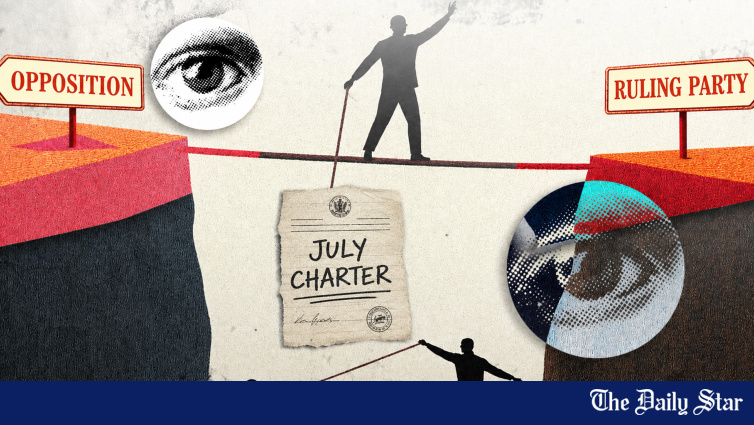
July charter implementation: Growing distance between BNP and the opposition is worrisome

Mahfuz Anam

1784850259192.webp

VISUAL: SALMAN SAKIB SHAHRYAR

After our Liberation War, we started off with the parliamentary system of government. Then Bangabandhu himself betrayed that vision and that of multiparty democracy by instituting BAKSAL, a one-party system, and introducing the presidential model of government.

After General Ziaur Rahman took over, he, thankfully, dismantled every aspect of the BAKSAL structure except the presidential system. The parliamentary system was restored during Khaleda Zia’s first tenure as prime minister. This particular episode can be termed the most illustrious example of cooperation between the ruling and opposition parties in parliament, as the demand for restoring the parliamentary system came from the then-opposition Awami League.

Both Bangabandhu, the unquestioned leader of our Liberation War, and General Ziaur Rahman, who declared independence on March 26, 1971, on behalf of Bangabandhu, inspiring Bangalees to join the war, were later assassinated by certain sections of the armed forces. Ironically, the commanders of both these groups had participated in the war of independence. Besides, the same group that killed Bangabandhu also killed the four national leaders who had led our government-in-exile—Acting President Syed Nazrul Islam, Prime Minister Tajuddin Ahmad, and senior ministers M Mansur Ali and AHM Qumruzzaman. Even Maj Gen Khaled Mosharraf, Maj Gen Abdul Manzur, Col Abu Taher, and many others who had played decisive roles during our Liberation War also met a brutal end.

Yet, we learnt nothing from these tragic and self-destructive experiences and kept on fighting each other. We seemed to be oblivious to the fact that with each such assassination, the sacred narrative of our Liberation War and the supreme sacrifices made by millions of ordinary citizens, especially the rural youth, were being belittled. This also gave a handle to those who did not believe in our Liberation War to distort the most glorious chapter of our history.

Then, in 1991, after a prolonged mass agitation, President Ershad’s autocratic government was toppled, and democracy, the parliamentary system, and elected governments were all restored. (Coincidentally, it was also when The Daily Star was born, on January 14, 1991.) We all thought then that, finally, we came back to the fundamental goal of our Liberation War: democracy. Since then, we have had regular elections in 1991, 1996, 2001, and 2008. The subsequent elections in 2014, 2018, and 2024 were doctored, eventually resulting in the ouster of Sheikh Hasina’s regime.

Bangladesh’s democratic experience from 1991 to 2008 produced several enduring strengths. Though we failed to properly institutionalise parliamentary democracy, people’s faith remained in that system. During this period, our economy moved forward, the private sector expanded, and press freedom began to see a ray of bright future. The most satisfying experience was that the transfers of power during this period were mostly peaceful. During this era of democracy, Bangladesh was able to prove that it was capable of sustained economic growth, despite failing to strengthen democracy.

Following the 2024 mass uprising and the February 12 election in 2026, we are again back on track with an elected government, elected parliament, an active opposition, the emergence of many political parties, and noticeable improvements in freedom of speech and of the media. However, it is political stability that we need most. Our economic development, foreign investment, and good governance all depend on it.

Against this backdrop, Jamaat-e-Islami chief Dr Shafiqur Rahman recently said that his party would resort to street agitation to bring the government down if the July National Charter is not implemented. We find such threats worrisome. Such rhetoric is deeply harmful to the future of democracy and, more importantly, to the future of the country.

While we criticise Jamaat for its bellicose tone, we also need to examine what BNP is doing in terms of implementing the July National Charter, which cannot, and must not, be ignored as it is the product of “public will”. During the long process of deliberation overseen by the National Consensus Commission, co-chaired by Ali Riaz of the interim government, about 30 political parties participated. Many of them were not widely known. But still, it was a positive process that brought most parties, with the notable exceptions of Awami League and Jatiya Party, to dialogue.

After months of discussion, the July charter was formulated and 26 parties signed it. On November 13, 2025, President Shahabuddin issued a July National Charter (Constitutional Reform) Implementation Order. This provided the legal framework to implement the charter and to hold a referendum on reform proposals that require constitutional changes. When the work of the consensus commission was completed, it delivered a document with 84 proposals, of which 48 needed constitutional changes. The rest could be put into effect by executive orders and amending laws. Of the 48 items that require changes to the Constitution of Bangladesh, BNP expressed its dissent on only nine.

So, the process can, by and large, be considered quite successful, as never before have we seen such convergence of views among so many political parties, marking a major achievement in a political culture where divisiveness has been a running thread.

To bring about constitutional changes, a referendum was held on the same day as the general elections on February 12. However, it also meant imposing an instrument on voters whose knowledge about the issues in question was superficial. Usually, referendums are held on specific, simple, and easily understandable topics that a voter can accept or reject. But this one had four separate questions that touched on all 48 constitution-related issues. Clustering so many constitutional amendments into one “yes or no” vote and not adequately educating the voters about their meaning and implications was a wrong move. Most voters did not know the full extent of what they were voting on.

The referendum also proposed that the elected parliament act not only as a legislature but also as a “Constitution Reform Commission” for a specific period. This was where the unity broke. BNP never accepted this formula and suggested that the relevant reforms could all be accommodated through a process of adopting amendments. This is a more formal and widely practised method, not only here but also globally.

But as of now, BNP’s handling of the July National Charter and the process of its implementation has started to raise some serious questions. BNP’s explanation for dragging its feet on issues that have been agreed upon by consensus is causing some concern. They claim that these issues need to be studied more thoroughly before amending the constitution. While this argument has some merit, the way the whole reform process, proposed by the July Charter, is being handled is perhaps not the best way to move forward.

Our constitution envisioned a system of checks and balances by distributing power among the executive, judiciary, and legislative branches. The idea was to prevent the concentration of all power in the hands of the executive branch, especially that of the prime minister. But over the years, the system of checks and balances was ignored and, in its place, came what some political scientists called an “elected dictatorship.” This, unfortunately, is what we experienced for a long time.

We need to ask why our parliamentary system did not succeed as it did in many other countries. The answer lies in the fact that our politics has always been leader-centric. Our governance process has always experienced the highest concentration of power in the hands of the prime minister. With the total lack of inner-party democracy, a central leader’s role has always been beyond scrutiny and accountability, and when such a party wins an electoral majority, all the power already concentrated in one individual gets combined with the executive power of the government when that leader becomes prime minister.

This then leads to the politicisation of many state institutions that often become extensions of the ruling party. Take, for example, the police. They were always used to suppress the opposition. The same is true for the bureaucracy, whose political loyalty, rather than efficiency and integrity, was mostly considered the main criterion for promotions and benefits. Turning these two vital institutions into extensions of the ruling party of the day did more harm to the country than many other factors put together.

Another important reason that often crippled our parliament over the decades is the highly confrontational relationship between the opposition and the ruling party. From 1991 to the present, we have never allowed the opposition to play its due role within parliament. Contrarily, the opposition also always thinks that it is its sacred duty to oppose the ruling party even when its policies are beneficial to the country.

At present, the future of constitutional changes seems to be stuck between two words: “amendment” or “reform.” BNP is offering dialogue on “amending” the constitution, whereas the opposition led by Jamaat is asking for “reforms” of the constitution. The real reason behind Jamaat’s intransigence is that it wants to rewrite the Constitution, which will most likely throw us into a chaotic and insoluble crisis. But doesn’t amending the constitution also amount to reforming it?

On April 29, BNP proposed the formation of a special parliamentary committee to amend the constitution. The proposed committee was to consist of 17 members, seven from BNP, five from other parties, and the remaining five seats were offered to the opposition, which Jamaat sought time to decide. On June 16, Jamaat chief declared in a press conference that they would not join. On July 13, the ruling party passed a resolution forming the special committee to amend the constitution in line with the July National Charter.

We think Jamaat should reconsider its stance and join the process of amending the constitution. Its presence will give it a chance to play a more effective role than being outside it. If the working of the special parliamentary committee for amending the constitution does not live up to Jamaat’s expectations, then it can always oppose and withdraw and then present its reasons for withdrawal to the citizens. The opposition’s decision not to join the committee, without even observing how it works, seems to be an attempt to impose Jamaat’s own will over that of others.

The time has come for a new collaborative approach between the ruling party and the opposition. Otherwise, the crisis may again lead to uncertainty and instability, which would negatively impact our country’s growth and prosperity.

Mahfuz Anam is editor and publisher of The Daily Star.​
 

Latest Posts

Back