[🇧🇩] Semiconductor Industry in Bangladesh

Afghanistan Albania Algeria Andorra Angola Antigua Austria Azerbaijan Bahamas Bahrain Bangladesh Barbados Canada China Egypt Finland Germany India Iran Israel Japan Lebanon North Macedonia Pakistan Palestine Qatar Russia Syria Turkey Ukraine United Kingdom United States Yemen
[🇧🇩] Semiconductor Industry in Bangladesh
50
4K
More threads by Saif

G Bangladesh Defense
Bangladesh has to formulate policy to stop brain drain. Big companies like BEXIMCO, Walton, Jamuna and Square must play positive role in arresting brain drain.

Pay has to go up - but above all, business atmosphere and stability has to improve, to stem the tide of brain drain.
 

Bangladesh steps up in global chip race

Tax incentives, policy support and global partnerships drive industry’s expansion plans

Mahmudul Hasan

1784850492145.webp


After more than a decade of steady growth, Bangladesh’s semiconductor sector is preparing for what industry leaders describe as its biggest push yet, backed by coordinated government policy, tax incentives and renewed efforts to expand globally.

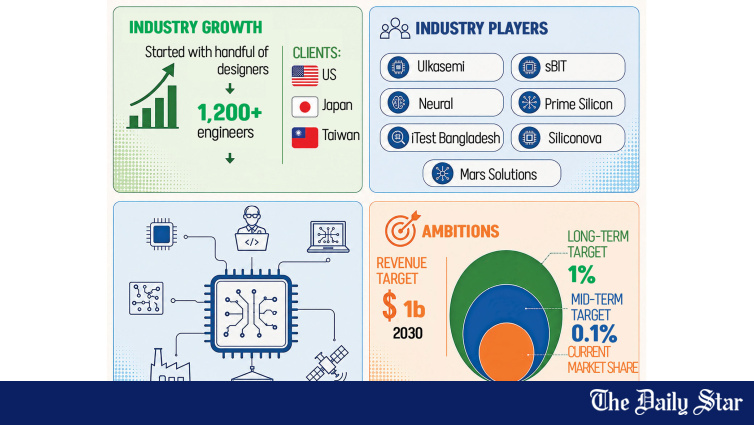
What began with a handful of chip designers has grown into an ecosystem of local companies serving clients in the United States, Japan, Taiwan and other countries.

Although still small, the sector is entering a new phase as policy support, international partnerships and talent development begin to converge, industry leaders say.

The government has announced a series of tax incentives for semiconductor and chip-related activities in the FY2026-27 budget, exempting regulatory duty, supplementary duty, VAT and advance tax on raw materials used in chip design, testing and packaging until June 30, 2031, while retaining a 1 percent import duty.

The incentives follow months of policy work and international roadshows led by the Bangladesh Semiconductor Industry Association (BSIA), which says global technology companies are increasingly viewing Bangladesh as a potential destination for semiconductor design and engineering services.

“The combination of fiscal incentives, policy support and growing engineering capacity could position Bangladesh to capture a larger share of the rapidly expanding global semiconductor market,” MA Jabbar, president of BSIA, told The Daily Star.

The momentum is expected to accelerate this week with the National Semiconductor Symposium & BEAR Summit 2026 at Novo Theatre, Dhaka, on July 25-26. The event will bring together government leaders, global semiconductor executives, researchers, investors, universities and members of the Bangladeshi diaspora.

Organised by the BSIA, in partnership with the Ministry of Science and Technology and the Silicon River Bangladesh programme, the summit will be inaugurated by Prime Minister Tarique Rahman.

It is expected to unveil eight strategic documents, including a national semiconductor talent roadmap, ecosystem roadmap and international partnership framework, to guide Bangladesh’s long-term semiconductor ambitions.

Roadshows in Malaysia, South Korea and the United States have also attracted global semiconductor companies interested in collaborating with local firms.

INSIDE BANGLADESH’S CHIP INDUSTRY

After graduating from Buet in 1977 and later working as a chip designer at AMD in the United States, Mohammed Enayetur Rahman returned to Bangladesh and founded Ulkasemi in Dhaka in 2007 with just four engineers.

Since then, Ulkasemi has grown into one of the country’s leading semiconductor firms. It became a Design Center Alliance partner of TSMC in 2021 and now operates design centres in four countries, employing more than 600 engineers with a senior management team that brings over 250 years of combined Silicon Valley experience.

The wider industry has also expanded. According to BSIA, around 1,200 engineers now work in semiconductor-related activities across companies including Ulkasemi, Neural Semiconductor, iTest Bangladesh, sBIT Inc, Mars Solutions, Prime Silicon, Siliconova, and others. Annual industry revenue is estimated at $12 million-$15 million, still modest by global standards but significantly higher than a few years ago.

The industry’s immediate focus is not advanced chip manufacturing.

“Manufacturing (foundries/fabs) is currently beyond our reach in Bangladesh,” said Munir Ahmed, founder of iTest Bangladesh Limited. “Our core focus for the country will be design, testing and assembly.”

Founded around 2021 with a small training-oriented team, iTest now employs 33 people and expects its workforce to exceed 50 by the end of this year while serving mainly American and Taiwanese clients.

Neural Semiconductor, launched by DBL Group in 2017, has grown from 20 engineers to more than 200 and plans to double its engineering workforce again.

“We primarily focus on physical design, analogue design, layout and RF design,” MA Jabbar, also managing director at Neural Semiconductor Limited.

Another early entrant, sBIT Inc, established in Silicon Valley in 2007 and in Bangladesh in 2010, works with international clients including Broadcom and AMD while providing chip design tools and training support to universities.

“We are two pioneer companies in Bangladesh: sBIT and Ulkasemi,” said Jahangir Dewan, CEO of sBIT.

Prof Muhammad Mustafa Hussain, a professor of electrical and computer engineering at Predue University, said several initiatives are under way, including a Semiconductor Training, Advances and Research (STAR) facility at BUET, efforts to revive cleanroom infrastructure at the Bangladesh Atomic Energy Commission and expanded research collaboration programmes.

Around 3,500 people are expected to receive training through current initiatives, while BSIA has set long-term targets of 10,000 skilled professionals and more than $1 billion in revenue by 2030.

Bangladesh’s push comes as semiconductors become increasingly strategic, powering artificial intelligence, data centres, electric vehicles, defence equipment and smartphones.

Industry leaders say the country’s neutral geopolitical position could work in its favour.

“Bangladesh is a neutral country. Neither side views us as a rival,” said Prof Hussain, referring to the ongoing US-China technology competition.

Bangladesh currently accounts for only about 0.01 percent of the global semiconductor market. Prof Hussain said the initial target was to raise that share to 0.1 percent before eventually reaching 1 percent.

“If you could capture 1 percent of the global market by 2035, it would be more than $100 billion-dollar earnings for Bangladesh,” he added.

INDUSTRY SEEKS POLICY BACKING

Despite recent policy initiatives, industry leaders say Bangladesh will need stronger long-term support to become a competitive player in the global semiconductor industry.

Ulkasemi’s Enayetur Rahman called for a dedicated semiconductor fund offering low-interest loans and grants, a 20-year tax holiday, a 25 percent export incentive for semiconductor design, testing and packaging services, and cash incentives for exports.

He also urged the government to revise customs rules for all import methods, simplify visa procedures, provide tax benefits for foreign experts, establish a public-private deep-tech investment fund, develop dedicated infrastructure in Hi-Tech Parks, and ensure political stability and a genuine one-stop approval system for investors.​
 

Semiconductor take-off envisaged with AI, partnerships
Staff Correspondent 26 July, 2026, 05:12

1785023797757.webp

Prime minister Tarique Rahman speaks as chief guest at the inauguration of two-day National Semiconductor Symposium and BEAR Summit 2026 in the capital on Saturday. | PID photo

International technology leaders and academics said Bangladesh has the ingredients needed to build a globally competitive semiconductor industry, stressing that success will depend on developing skilled human resources, embracing artificial intelligence, strengthening university-industry collaboration and forging global partnerships.

These observations came at the opening of the two-day National Semiconductor Symposium and BEAR Summit 2026, being held on July 25-26 in the capital on Saturday. The summit is jointly organised by the Ministry of Science and Technology, the Bangladesh Semiconductor Industry Association and the Silicon River Bangladesh programme.

Prime minister Tarique Rahman inaugurated the summit as chief guest.

Chief technology officer of Texas Instruments, Ahmed Bahai, said today’s artificial intelligence revolution rests on three pillars: massive computing power driven by Moore’s Law, massive volumes of data generated by billions of connected devices and generative AI enabled by the 2017 Transformer breakthrough that led to GPTs and modern large language models.

Bahai said the future of AI extends far beyond cloud computing, with Edge AI set to become equally important by enabling intelligence to run directly on laptops, smartphones, vehicles, robots and industrial equipment. Such systems will offer lower latency, greater privacy, stronger security and improved energy efficiency, while many devices will eventually be capable of training smaller AI models locally.

He said AI and semiconductors are reinforcing one another in a powerful cycle in which better chips create more capable AI systems while AI itself is transforming chip design, verification, packaging, manufacturing and material discovery.

According to Bahai, the semiconductor industry’s future will no longer depend solely on shrinking transistors. Breakthroughs will increasingly come from advanced packaging, heterogeneous integration, silicon photonics, power management, new materials, quantum technologies and application-specific chips for AI, healthcare, communications, automotive systems and sensing technologies.

Highlighting AI’s impact on scientific discovery, Bahai said researchers previously knew of only around 48,000 stable crystal structures, but AI has expanded that number to more than 2.2 million, dramatically accelerating the search for next-generation semiconductor materials.

He also described future vehicles as ‘data centres on wheels’ where real-time AI processes information without relying on cloud connectivity and pointed to semiconductors’ growing role in wearable healthcare devices, continuous glucose monitoring, gene sequencing, smart drug delivery and portable diagnostics. ‘AI will not simply replace engineers,’ Bahai said. ‘But engineers who use AI will outperform those who don’t.’

Professor Terry Lynn Alford of Arizona State University said Bangladesh has significant potential to build semiconductor packaging capabilities by leveraging its young workforce and learning from successful international models.

Drawing on more than two decades of experience in faculty development and workforce training across several countries, he said Bangladesh could avoid common pitfalls while building a sustainable talent pipeline.

Professor Muhammad Mustafa Hussain of Purdue University stressed that semiconductor development requires long-term investment in education, beginning from school-level programming and STEM education.

He urged students to become both thinkers and doers, arguing that innovation comes from asking the right questions and acting on ideas.

Hussain said that coordinated initiatives can rapidly build a skilled workforce. Professor Md Mamun Bin Ibne Reaz, vice-chancellor of the Islamic University of Technology, highlighted that Bangladesh has the essential elements for a semiconductor ecosystem but needs better integration.

He suggested updating university curricula for integrated circuit design, offering affordable access to Electronic Design Automation software through government support, partnering with global companies like TSMC and Texas Instruments, and establishing industry-led skill development centres.

Industry leaders also highlighted persistent workforce challenges. Md Shakhawat Hossain, CEO of Neural Semiconductor, highlighted the need for significant investment in semiconductor talent, noting that engineers require over a year of specialised training to be industry-ready.

Despite Bangladesh is producing over 20,000 graduates annually in related fields, the country should aim to train at least 1,000 semiconductor engineers each year, to reach 10,000 in the next four to five years, he said.

He emphasised the ongoing shortage of experienced engineers as a major challenge, as many international clients seek professionals with at least 10 years of experience.

He highlighted the semiconductor industry as Bangladesh’s next major economic growth driver after ready-made garments.

He emphasised the government’s commitment to creating a business-friendly environment for semiconductor investment, essential for AI, robotics, and renewable energy.

He said that to attract investment, the government has removed taxes on raw materials, introduced cash incentives for semiconductor service exports, and allocated Tk 5 crore annually for startup grants. Additional tax incentives and infrastructure support are planned, with a focus on collaboration among government, academia, and industry.

Prime minister’s adviser Mahdi Amin outlined efforts to establish a tripartite innovation ecosystem connecting universities, industry, and the Bangladeshi diaspora, encouraging stronger collaboration to bridge academic research with industrial needs.

He also emphasised transforming ‘brain drain’ into ‘brain circulation’ by connecting expatriate professionals with local institutions, supported by increased budget allocations for research infrastructure and skills development.​
 

Latest Posts

Back