Bangladesh Defense
Saif
Senior Member
- Joined
- Jan 24, 2024
- Messages
- 20,706
- Likes
- 9,684
- Nation

- Residence
- Axis Group

Non-leather footwear on course to half-billion export club
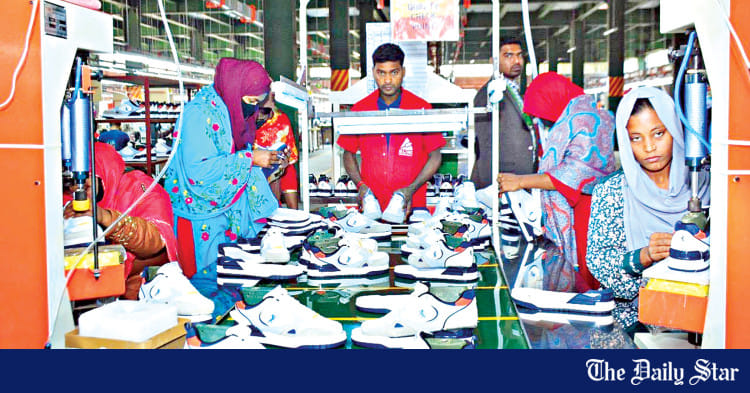
Bangladesh’s synthetic and athletic footwear exports have been growing rapidly, emerging as a bright spot in the country’s export basket, which is heavily dominated by readymade garments.
Non-leather footwear on course to half-billion export club

Bangladesh's synthetic and athletic footwear exports have been growing rapidly, emerging as a bright spot in the country's export basket, which is heavily dominated by readymade garments.
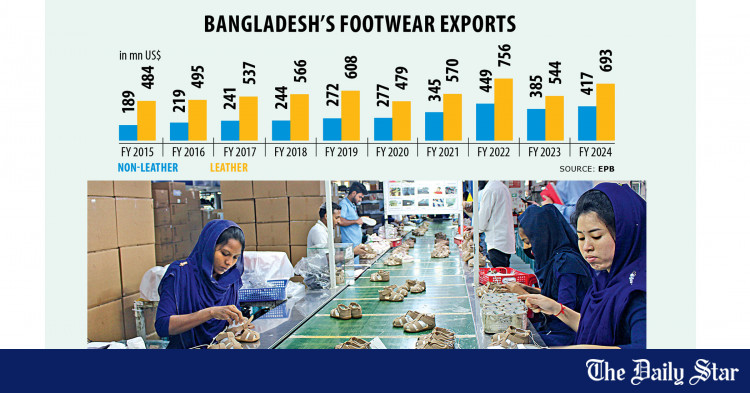
In the decade preceding the end of fiscal year 2023-24, non-leather footwear exports ballooned 120 percent, jumping from $189 million to $416 million.
Such robust growth has continued into the current fiscal year, according to the Export Promotion Bureau (EPB).
In the first five months of FY25, non-leather footwear exports grew 41 percent year-on-year to $217.81 million, EPB data shows.
Exporters anticipate that the sector is poised to enter the half-billion-dollar club by the end of this fiscal year, joining leather footwear, jute and jute goods, home textiles and agricultural products.
"Western buyers are turning away from global footwear giant China to diversify their sourcing basket and avert looming large tariffs on Beijing from the White House," Riad Mahmud, managing director of Shoeniverse Footwear, said as he outlined reasons for the segment's growth.
Mahmud's footwear factory in Mymensingh, which employs around 1,700 people, supplies products to global brands such as Inditex, Aldi, Matalan and RedTape.
Although Bangladesh has long been trying to diversify its export basket, readymade garments still account for over 80 percent of total exports.
Mahmud said global brands are well aware of Bangladesh's advantages, such as competitive labour pricing, and its strong track record in apparel products, which encourages them to place footwear orders.
"Bangladeshi manufacturers can offer competitive prices for synthetic shoes compared to Vietnam due to lower labour costs. This has attracted globally renowned brands and new buyers," he added.
He said big brands had booked Shoeniverse's factory until March next year and buyers are now approaching him for future slots due to the possibility of the US imposing higher tariffs on Chinese products.
According to a market assessment by the Bangladesh Investment Development Authority (Bida), the rise in non-leather shipments is a result of increased work orders from well-known global brands like H&M, Puma, Decathlon, FILA and Kappa.
The main export destinations for these products are Spain, France, the Netherlands, South Korea, India, Italy and Germany.
BETTER THAN LEATHER
EPB data shows that Bangladesh's non-leather footwear exports have grown at an average annual rate of 23 percent in the past 10 years while the leather footwear industry has seen average growth of only 6 percent.
Leather footwear exports grew to just over $544 million in FY24 from $483.81 million in FY15.
However, despite the segment's enormous potential, synthetic shoe exporters receive a cash incentive of only 4 percent, Mahmud said, adding that the leather footwear sector was afforded 15 percent.
Though dominated by small-scale factories, the synthetic footwear segment is rapidly growing due to the relatively low investment required to set up an export-oriented production unit.
"It doesn't matter who enters the Oval Office after Trump since Bangladeshi manufacturers of synthetic footwear are well-positioned to capitalise on any tariffs on China in the meanwhile," Mahmud said.
SYNTHETIC FOOTWEAR THE FUTURE OF EXPORT
Jakaria Shahid, managing director of Edison Footwear Limited, believes the synthetic footwear industry will hold the key to export diversification in the future due to its rapid growth.
However, he added that top global brands like Nike and Adidas have not ventured into Bangladesh because manufacturers fail to maintain lead times.
Mohammad Shahadat Ullah, executive director of Maf Shoes, which exports to France and Germany, said, "Our exports have increased compared to last year as buyers are placing more orders."
Maf Shoes, a sister concern of TK Group, has a daily production capacity of over 50,000 pairs of shoes.
Kamruzzaman Kamal, marketing director of industrial conglomerate PRAN-RFL Group, said RFL began exporting non-leather footwear products in 2021. Currently, RFL footwear products are shipped to 37 countries.
"Given the huge global demand and potential for rapid growth, this sector can quickly emerge as a major export earner," he added.
BOTTLENECKS NEED TO BE REMOVED
Nasir Khan, chairman and managing director of Jennys Shoes, said Chinese companies are now lining up to invest in Bangladesh to avoid high tariffs in the US market.
"However, we are confused about our ability to seize this business opportunity due to the non-cooperation of customs officials," Khan alleged.
He said local manufacturers must now spend at least three and a half months to negotiate and secure an export order.
Khan claimed that despite the bright future of both leather and non-leather footwear, exports have been limited to $1 billion over the past two decades due to the non-cooperation of customs officials.
"The customs authorities receive, at best, Tk 50 crore in import duty from leather product manufacturers annually. Manufacturers must bring raw materials into bonded warehouses," he said.
But, if the National Board of Revenue (NBR) reduces the duty to a minimum and allows the import of raw materials without the bonded warehouse condition, government revenue could increase manifold, he added.
MA Razzaque, chairman of Research and Policy Integration for Development (RAPID), said local leather footwear exports are struggling to grow due to the non-compliance of the tannery estate in Savar.
In contrast, he said, the synthetic footwear industry does not have such compliance requirements, leading to increased exports.
According to Maximize Market Research, a global market research and consultancy firm, the global athletic footwear market was valued at $68.26 billion in 2023.
The market is projected to grow at a compound annual growth rate of 7.11 percent from 2024 to 2030.
Bangladesh's synthetic and athletic footwear exports have been growing rapidly, emerging as a bright spot in the country's export basket, which is heavily dominated by readymade garments.
In the decade preceding the end of fiscal year 2023-24, non-leather footwear exports ballooned 120 percent, jumping from $189 million to $416 million.
Such robust growth has continued into the current fiscal year, according to the Export Promotion Bureau (EPB).
In the first five months of FY25, non-leather footwear exports grew 41 percent year-on-year to $217.81 million, EPB data shows.
Exporters anticipate that the sector is poised to enter the half-billion-dollar club by the end of this fiscal year, joining leather footwear, jute and jute goods, home textiles and agricultural products.
"Western buyers are turning away from global footwear giant China to diversify their sourcing basket and avert looming large tariffs on Beijing from the White House," Riad Mahmud, managing director of Shoeniverse Footwear, said as he outlined reasons for the segment's growth.
Mahmud's footwear factory in Mymensingh, which employs around 1,700 people, supplies products to global brands such as Inditex, Aldi, Matalan and RedTape.
Although Bangladesh has long been trying to diversify its export basket, readymade garments still account for over 80 percent of total exports.
Mahmud said global brands are well aware of Bangladesh's advantages, such as competitive labour pricing, and its strong track record in apparel products, which encourages them to place footwear orders.
"Bangladeshi manufacturers can offer competitive prices for synthetic shoes compared to Vietnam due to lower labour costs. This has attracted globally renowned brands and new buyers," he added.
He said big brands had booked Shoeniverse's factory until March next year and buyers are now approaching him for future slots due to the possibility of the US imposing higher tariffs on Chinese products.
According to a market assessment by the Bangladesh Investment Development Authority (Bida), the rise in non-leather shipments is a result of increased work orders from well-known global brands like H&M, Puma, Decathlon, FILA and Kappa.
The main export destinations for these products are Spain, France, the Netherlands, South Korea, India, Italy and Germany.
BETTER THAN LEATHER
EPB data shows that Bangladesh's non-leather footwear exports have grown at an average annual rate of 23 percent in the past 10 years while the leather footwear industry has seen average growth of only 6 percent.
Leather footwear exports grew to just over $544 million in FY24 from $483.81 million in FY15.
However, despite the segment's enormous potential, synthetic shoe exporters receive a cash incentive of only 4 percent, Mahmud said, adding that the leather footwear sector was afforded 15 percent.
Though dominated by small-scale factories, the synthetic footwear segment is rapidly growing due to the relatively low investment required to set up an export-oriented production unit.
"It doesn't matter who enters the Oval Office after Trump since Bangladeshi manufacturers of synthetic footwear are well-positioned to capitalise on any tariffs on China in the meanwhile," Mahmud said.
SYNTHETIC FOOTWEAR THE FUTURE OF EXPORT
Jakaria Shahid, managing director of Edison Footwear Limited, believes the synthetic footwear industry will hold the key to export diversification in the future due to its rapid growth.
However, he added that top global brands like Nike and Adidas have not ventured into Bangladesh because manufacturers fail to maintain lead times.
Mohammad Shahadat Ullah, executive director of Maf Shoes, which exports to France and Germany, said, "Our exports have increased compared to last year as buyers are placing more orders."
Maf Shoes, a sister concern of TK Group, has a daily production capacity of over 50,000 pairs of shoes.
Kamruzzaman Kamal, marketing director of industrial conglomerate PRAN-RFL Group, said RFL began exporting non-leather footwear products in 2021. Currently, RFL footwear products are shipped to 37 countries.
"Given the huge global demand and potential for rapid growth, this sector can quickly emerge as a major export earner," he added.
BOTTLENECKS NEED TO BE REMOVED
Nasir Khan, chairman and managing director of Jennys Shoes, said Chinese companies are now lining up to invest in Bangladesh to avoid high tariffs in the US market.
"However, we are confused about our ability to seize this business opportunity due to the non-cooperation of customs officials," Khan alleged.
He said local manufacturers must now spend at least three and a half months to negotiate and secure an export order.
Khan claimed that despite the bright future of both leather and non-leather footwear, exports have been limited to $1 billion over the past two decades due to the non-cooperation of customs officials.
"The customs authorities receive, at best, Tk 50 crore in import duty from leather product manufacturers annually. Manufacturers must bring raw materials into bonded warehouses," he said.
But, if the National Board of Revenue (NBR) reduces the duty to a minimum and allows the import of raw materials without the bonded warehouse condition, government revenue could increase manifold, he added.
MA Razzaque, chairman of Research and Policy Integration for Development (RAPID), said local leather footwear exports are struggling to grow due to the non-compliance of the tannery estate in Savar.
In contrast, he said, the synthetic footwear industry does not have such compliance requirements, leading to increased exports.
According to Maximize Market Research, a global market research and consultancy firm, the global athletic footwear market was valued at $68.26 billion in 2023.
The market is projected to grow at a compound annual growth rate of 7.11 percent from 2024 to 2030.