Bangladesh Defense
Saif
Senior Member
- Jan 24, 2024
- 21,500
- 9,744
- Nation

- Residence
- Axis Group


Urban healthcare to turn a corner
That health authorities have finally proposed building 170 city health centres across Dhaka and Chattogram is a piece of welcome news, though it speaks of how badly the urban poor have been let down for decades. The Directorate General of Health Services (DGHS) under a project estimated at Tk 11.57
Urban healthcare to turn a corner
FE
Published :
Apr 12, 2026 00:14
Updated :
Apr 12, 2026 00:14

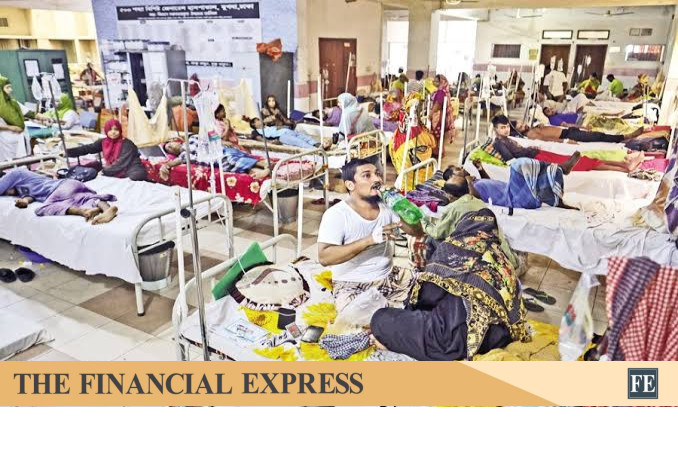
That health authorities have finally proposed building 170 city health centres across Dhaka and Chattogram is a piece of welcome news, though it speaks of how badly the urban poor have been let down for decades. The Directorate General of Health Services (DGHS) under a project estimated at Tk 11.57 billion and largely financed by the World Bank plans to establish these centres across Dhaka North, Dhaka South and Chattogram City Corporation over the next three years, with each ward receiving at least one primary healthcare facility operating in two shifts. The proposal, awaiting ECNEC approval after missing the last meeting's formal agenda, comes against a backdrop that is frankly embarrassing. Nearly 40 per cent of the country's population now lives in urban areas, up from 27 per cent in 2011, and Dhaka alone is projected to hold 28 million people by 2030. Yet across all urban areas under the health ministry, only 35 government dispensaries exist, 17 of them in Dhaka and nine in Chattogram and most of them are shut down by midday. The state has been, in effect, running a healthcare system designed to be left unused.
Most of Dhaka's working poor do not have the freedom to visit a government dispensary before noon, which is the only time one is open. A garment worker or a day labourer cannot afford to visit a facility at a fixed hour but a centre if it remains open for two shifts gives them the flexibility to choose when they can visit. The same is true for a woman in a conservative household who depends on a working husband to accompany her. Similar is the case of an elderly person who may have no one at home once family members leave for work. The predictable result is that they crowd into private clinics and spend money they cannot afford, self-medicate through pharmacies or simply suffer through illness until the condition worsens. The two-shift model built into the proposal addresses this directly, and the placement of at least one centre in every ward further reduces the problem of distance. There is also the matter of cost. Millions of people pushed into expensive private care are an economic drain on households. The project's own economic analysis puts the net present value of the investment at 316 million dollars, with a nine per cent internal rate of return. Primary healthcare is thus an economic imperative as much as a social one.
What also separates this proposal from previous efforts is the ambition of its design. Urban healthcare in Bangladesh has historically been a tangle of jurisdictions, with responsibilities fragmented across institutions that coordinate poorly and leave patients without any coherent pathway from a primary consultation to specialist care. The network linking the new centres with referral facilities attempts to address this tangle. The Planning Commission has rightly insisted on a memorandum of understanding with the Local Government Division before project approval, which makes coordination a formal requirement from the outset.
What remains is the question of execution. ECNEC approval should come at the next meeting without the proposal being tabled or deferred again, and implementation timelines must be treated as a firm commitment rather than a tentative projection. The monitoring mechanism promised within the project needs to be credible, independent and open to public scrutiny, with regular reporting that allows performance to be judged in real time. More importantly, those responsible for implementation cannot be allowed to bypass findings about understaffing, medicine shortages or absenteeism without consequence, as these are failures that have undone so many public facilities in this country before.
FE
Published :
Apr 12, 2026 00:14
Updated :
Apr 12, 2026 00:14
That health authorities have finally proposed building 170 city health centres across Dhaka and Chattogram is a piece of welcome news, though it speaks of how badly the urban poor have been let down for decades. The Directorate General of Health Services (DGHS) under a project estimated at Tk 11.57 billion and largely financed by the World Bank plans to establish these centres across Dhaka North, Dhaka South and Chattogram City Corporation over the next three years, with each ward receiving at least one primary healthcare facility operating in two shifts. The proposal, awaiting ECNEC approval after missing the last meeting's formal agenda, comes against a backdrop that is frankly embarrassing. Nearly 40 per cent of the country's population now lives in urban areas, up from 27 per cent in 2011, and Dhaka alone is projected to hold 28 million people by 2030. Yet across all urban areas under the health ministry, only 35 government dispensaries exist, 17 of them in Dhaka and nine in Chattogram and most of them are shut down by midday. The state has been, in effect, running a healthcare system designed to be left unused.
Most of Dhaka's working poor do not have the freedom to visit a government dispensary before noon, which is the only time one is open. A garment worker or a day labourer cannot afford to visit a facility at a fixed hour but a centre if it remains open for two shifts gives them the flexibility to choose when they can visit. The same is true for a woman in a conservative household who depends on a working husband to accompany her. Similar is the case of an elderly person who may have no one at home once family members leave for work. The predictable result is that they crowd into private clinics and spend money they cannot afford, self-medicate through pharmacies or simply suffer through illness until the condition worsens. The two-shift model built into the proposal addresses this directly, and the placement of at least one centre in every ward further reduces the problem of distance. There is also the matter of cost. Millions of people pushed into expensive private care are an economic drain on households. The project's own economic analysis puts the net present value of the investment at 316 million dollars, with a nine per cent internal rate of return. Primary healthcare is thus an economic imperative as much as a social one.
What also separates this proposal from previous efforts is the ambition of its design. Urban healthcare in Bangladesh has historically been a tangle of jurisdictions, with responsibilities fragmented across institutions that coordinate poorly and leave patients without any coherent pathway from a primary consultation to specialist care. The network linking the new centres with referral facilities attempts to address this tangle. The Planning Commission has rightly insisted on a memorandum of understanding with the Local Government Division before project approval, which makes coordination a formal requirement from the outset.
What remains is the question of execution. ECNEC approval should come at the next meeting without the proposal being tabled or deferred again, and implementation timelines must be treated as a firm commitment rather than a tentative projection. The monitoring mechanism promised within the project needs to be credible, independent and open to public scrutiny, with regular reporting that allows performance to be judged in real time. More importantly, those responsible for implementation cannot be allowed to bypass findings about understaffing, medicine shortages or absenteeism without consequence, as these are failures that have undone so many public facilities in this country before.