[🇮🇳] India---News & Views

[🇮🇳] India---News & Views
74
3K
More threads by Saif

G   Indian Defense

Modi urges limits on fuel use, travel and imports to save forex

REUTERS

Published :
May 11, 2026 22:42
Updated :
May 11, 2026 22:42
1778542834029.webp


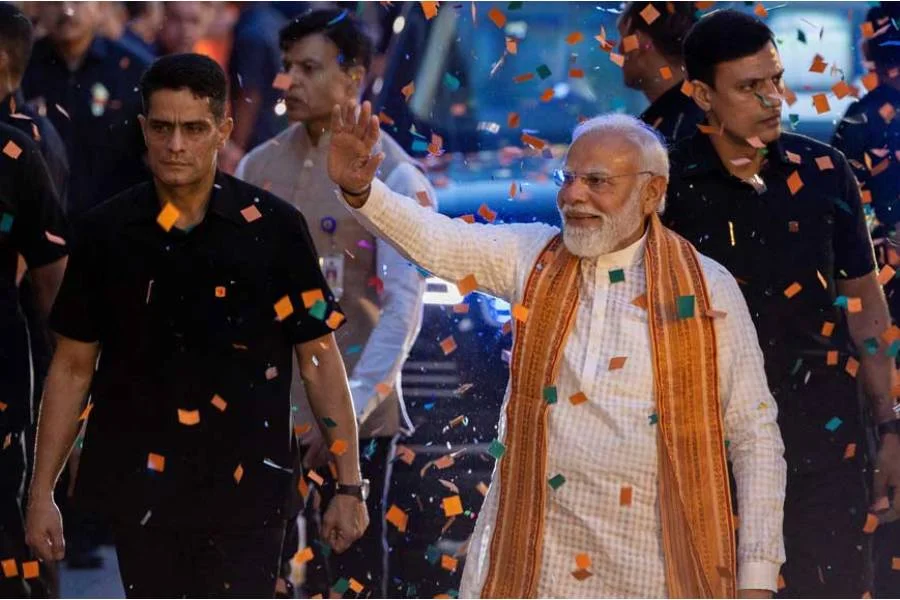
India's Prime Minister Narendra Modi greets his supporters as he arrives at the Bharatiya Janata Party (BJP) headquarters as BJP celebrates its win in the West Bengal and Assam states' assembly elections, in New Delhi, India, May 4, 2026. Photo : REUTERS

Indian Prime Minister Narendra Modi on Sunday urged a spate of measures including fuel conservation, work-from-home practices and limits on travel and imports, as a surge in global energy prices puts pressure on the country's foreign exchange reserves.

People should prioritise a return to work-from-home and online meetings, widely adopted during the COVID-19 pandemic, saying it would help India use less fuel, Modi said.

"In the current situation, we must place great emphasis on saving foreign exchange," he said.

Modi also asked people to use public transport such as the metro and to carpool where possible to conserve fuel.

India, the world's third-biggest oil importer and consumer, late last month said there was no proposal to raise pump prices for diesel and gasoline, leaving it among the countries yet to raise prices despite the global surge.

Modi urged people to avoid buying gold -- which India spends on heavily during weddings -- and to cut non-essential overseas travel for at least a year to save foreign exchange.

He called on families to reduce cooking oil consumption, describing that move as both healthy and patriotic.

Modi also asked farmers to cut fertiliser use by as much as half.​
 

India scrambles to steady rupee as oil shock bites

AFP, Mumbai

1779064145496.webp

A trader counts Indian currency notes at a market in Kochi. India’s central bank has already poured billions of dollars to stabilise the currency. Photo: REUTERS/FILE

India is scrambling to salvage a sinking rupee as surging oil prices linked to the Middle East conflict threaten to disrupt the world’s fastest-growing major economy.

The currency has dropped more than five percent since the crisis erupted in February, extending losses from 2025 and making it Asia’s worst-performing major currency in 2026 so far.

It hit a record low of over 96 to the dollar on Friday, prompting officials to signal that halting further depreciation is a key macroeconomic priority.

India’s central bank has already poured billions of dollars to stabilise the currency, curbed speculative trading and offered a special credit line to oil importers to ease dollar demand.

Prime Minister Narendra Modi has also urged voluntary austerity measures to rein in dollar-guzzling imports, including cutting down on gold buying and foreign travel for a year.

But the pressure persists.

“The whole system has been disturbed,” said Dilip Parmar of stockbroker HDFC Securities, citing heavy foreign investor outflows, weaker growth prospects and elevated crude prices.

“That is the basic problem which you’re seeing replicated in the fall of the rupee,” he said, noting that it was ultimately “a function of demand and supply” with dollar demand being higher.

The rupee’s slide comes as India faces a widening current account deficit driven by costly energy imports.


The gap is likely to be over two percent of GDP this fiscal year, more than double last year’s level and potentially the widest since 2012–13, according to Bank of America Securities estimates.

WIDENING DEFICIT

At the same time, foreign investors have dumped more than $20 billion in Indian stocks since the start of the Mideast conflict, the fastest pace on record, while dollar inflows have slowed, opening the possibility of a balance-of-payments gap as large as $67–88 billion.

The 2027 fiscal year “will be our third year of a balance-of-payment deficit, which is certainly unusual,” economist Dhiraj Nim of ANZ Research told AFP.

This strain has weighed on the rupee, prompting the central bank to defend it by burning through foreign exchange reserves -- now at around $697 billion, down from over $720 billion before the Middle East war.

While still covering about 11 months of imports, the decline underscores the strain.

A weaker rupee is rippling through the domestic economy.

Manufacturers and food processors, many dependent on imported raw materials priced in dollars, are seeing costs surge.

Smaller firms often lack the ability to hedge currency risks.

In Kerala’s cashew industry, which mostly imports raw nuts from Africa, the impact has been acute.

“Imports have become far more expensive for the local market,” said Rajmohan Pillai, who runs a cashew firm, adding buyers can now afford only about 90 percent of last year’s volumes.

He estimates more than 80 percent of processing units have shut in recent years, with rupee volatility a contributing factor.

‘LAST STRAW’

India’s currency decline has also hit students looking to study abroad.

Education consultants say studying in the United States now costs more than one million rupees ($10,450) extra compared with a year ago.

“This is the last straw,” said Meghna Sen, a 17-year-old aspiring psychology student.

“Now we have to track (the rupee) movement to check how much we need for our grocery budgets.”

The depreciation has punctured India’s ambition to become the world’s third-largest economy.

Modi, who once criticised his predecessors over currency weakness, has seen India’s global economic ranking dented because GDP comparisons are measured in dollars.

The country has slipped behind the United Kingdom to the sixth place according to IMF data, largely due to the rupee’s fall.

Nomura analysts warn more drastic measures may be on the anvil.

These include possible fuel price hikes, tighter controls on overseas remittances and steps to attract dollar deposits from non-resident Indians -- a playbook used in past crises.

Still, economists caution that intervention can only smooth volatility, not reverse underlying pressures.

“Fundamental factors” remain to be resolved, Nim said, adding “I would not even rule out an interest rate hike which squarely targets future inflation”.

The Reserve Bank of India knows what its options are, he said.

“All that remains is to see what it decides to choose.”​
 

The rise of CJP and its implications for mainstream politics

Neil Ray

Published :
May 24, 2026 23:29
Updated :
May 24, 2026 23:29

1779681363648.webp


The exponential proliferation of followers of the satirical "Cockroach Janata Party (CJP)" on social media sites is a clear sign that people, particularly the young generations, are not happy with the existing system of governance in India. This parodic imitation of the Bharatiya Janata Party (BJP) has caught the imagination of Indian youths like wildfire. By Saturday, it amassed 21 million followers on Instagram and hundreds of thousands of members. No mainstream political party in India is even remotely compared to this number in terms of followers. But it is not a formal political party. An online movement of political satire, it pronounces an indictment on the traditional arrangement of political system called 'democracy'.

A political communications strategist and student at the Boston University, Abhijeet Dipke is the creator of this humorous nomenclature CJP. The origin of this cockroach coinage goes to the credit of that country's Chief Justice Surya Kant who allegedly compared unemployed young people drifting towards journalism and activism with cockroaches and parasites. Although he later clarified that he referred to those with fake and bogus degrees.

But by this time the damage was done. No one was ready to listen to such explanations. Both young and elderly people joined the chorus against this apparently derisive comment on unemployed youths. Clearly, such a controversial comment on young people was not to the liking of any segment of Indian society. It was uncalled for. Unemployment or a lack of opportunities is a problem facing the world at large. It is the governments' responsibility to provide them with jobs and this cannot draw flak from people in high position.

Ironically, cockroach is an insect that dates back to over 300 million years, predating dinosaurs. This is one of the most resilient pests the world has ever known. It has survived multiple mass extinctions, including the raining down of asteroids that wiped out dinosaurs from the face of this planet. This creature's ability to adapt to every terrestrial environment is phenomenal. So the satirical name of this informal party has a truth ingrained in it. Although, the intention of its founder may not have considered this aspect of resilience but it has however happened coincidentally.

The government of India should not feel comfortable with this CJP that has gone viral on social sites and it now seeks to stamp it out. Already it has been removed from X handles but it is going from strength to strength on the Instagram. On the face of it, it may look like one of the sweeping fads that take social sites by storm but the ugly truth inherent in today's perverse politics cannot be missed. The angry young members of society observe that politics bypass them if they are not diehard supporters of the ruling party.

Generation Z or Gen Z in short, gives through this huge following a message most stark and disturbing. The old guards fail to appreciate the young people's attributes and often undermine their potential. But the members of Gen Z are a force to reckon with. What happened in Bangladesh and Sri Lanka can more than vouchsafe for their unlimited energy and fighting power. There is a need for governments everywhere to stay cautioned particularly when the two sides confront each other.

The way this generation sees the world through their digital telescope is clear enough and political manoeuvres political governments resort to may fall short of meeting the challenge. The president of the most powerful nation is behaving like a crazy guy and the inconsistency in his policies and actions should have by now prompted the generation to reject him. Even if it does not happen now, most likely the Gen Z will dump him in the dungeon of history. The Cockroach Janata Party may prove a point if it influences political parties in opposition to adopt the strategy it successfully applied. The established political order may go into pieces before the 'cockroaches' breathe fresh air into politics of the largest democracy in the world.​
 

Latest Posts

Back