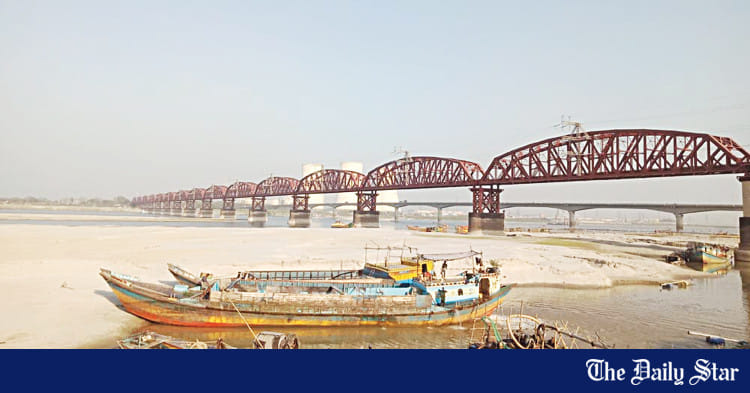
International Day of Action for Rivers: The shrinking Padma
Declining water levels fuel shoal expansion, threatening livelihoods
Rivers are the lifelines of Bangladesh, shaping its geography, economy, and culture. However, unchecked encroachment, pollution, and water withdrawal from upstream have left many rivers struggling to survive. Once-mighty rivers like the Padma, Bhairab, and countless others are drying up, forming vast shoals, disrupting agriculture, and forcing fishermen to abandon their livelihoods. The worsening crisis demands urgent attention and action. On this International Day of Action for Rivers, let's have a look at two of our rivers, which once used to flow gloriously, but are now being choked to death due to a lack of sustainable management, dredging, and pollution control.
School teacher Rakibul Islam used to cross the mighty Padma at the Shilaidah point in Kushtia every day to reach his school. But this year, his journey has become even more arduous due to the expanding shoals in the river.
"The 4-kilometre-wide river has narrowed to just 300 metres. Now, I have to cross over 3.5 kilometres of shoal, which is both costly and time-consuming. This year, I am forced to stay in Kushtia instead of commuting," said Rakibul, a teacher at Gangadhardiar Government Primary School in Pabna Sadar upazila.
A visit to different points of the river revealed excessive shoal areas developing across its course, severely affecting agriculture and fishing.
Farmer Abdul Malek from Mokarampur in Bheramara upazila of Kushtia, who used to cultivate paddy on the riverbank near Hardinge Bridge during the dry season, said this year the land has become uncultivable due to excessive sand accumulation.
"As the water recedes, the entire riverbank is getting covered in sand, making the land infertile for crops," he said.
Many farmers who prepared seedbeds in early winter lost their crops as vast sand fields developed along the riverbanks.
Apart from that, fishing communities are also facing challenges due to the shrinking water space.
"Five to six years ago, I could catch 5 to 10 kg of fish daily. Now, I barely get 2 to 3 kg," said Bodhon Kumar, a fisherman from Pakshey in Pabna's Ishwardi upazila.
Around 75 fishermen living near Hardinge Bridge are experiencing the same crisis, he claimed.
Meanwhile, despite concerns over water shortage, officials say the recorded flow at Hardinge Bridge has increased this year compared to last.
According to the Joint River Commission, the flow of water at Hardinge Bridge in January last year was 63,113 cusec, 48,518 cusec, and 48,359 cusec in three cycles.
This January, the recorded flow increased to 69,643 cusec, 64,186 cusec, and 64,672 cusec.
Similarly, in February last year, the flow was recorded at 43,926 cusec, 34,697 cusec, and 35,751 cusec, while this February, it rose to 59,202 cusec, 49,984 cusec, and 42,886 cusec.
"The flow of water has increased at the Harding Bridge due to more water discharge from upstream," said Zahedul Islam, executive engineer of Regional Hydrology Department.
However, asked about the formation of shoals, he said the water level still remains low, and due to a lack of proper dredging, silt is being accumulated, forming shoals in different points.
According to experts, the Ganges Water Sharing Treaty (1996) ensures that Bangladesh receives a fixed share of water from India's Farakka Barrage between January and May each year, but this allocation is not enough to sustain the Padma.
The 30-year Ganges Water Sharing Treaty is set to expire this year, prompting Bangladesh and India to begin discussions on its renewal.
However, experts emphasise the need for a fair water-sharing agreement based on international regulations.
"Since the construction of the Farakka Barrage, we have been deprived of our fair share of water, leading to the gradual destruction of the river," said Mizanur Rahman, a wetland activist and member of the Bangladesh Water Development Board.
Despite the increased flow at the Padma this year, the water level remains a lot less than ideal, and the level is still declining, leading to the expansion of shoals, he also said.
"We have been receiving an insufficient share of water for years, leading to the gradual destruction of the Padma," he said, adding that to save the river, Bangladesh must negotiate a fair share of water in accordance with international regulations.
Talking with the Daily Star, Abdul Hamid Khan, Secretary of Bangladesh Poribesh Andolon Pabna unit, emphasised the need for urgent action.
"Proper dredging is essential to keep the river flowing. Additionally, establishing reservoirs could help maintain water levels throughout the year," he said.
Meanwhile, encroachers and sand traders continue to exploit the river.
During a visit at Hardinge Bridge, dozens of trucks were seen moving across the vast shoal, carrying sand extracted from different points.
Experts warn that such unregulated sand mining is altering the river's natural course and further damaging its ecosystem.