Bangladesh Defense
Saif
Senior Member
- Joined
- Jan 24, 2024
- Messages
- 20,762
- Likes
- 9,684
- Nation

- Residence
- Axis Group


Padma turns into vast sandbars
The Padma River, once the lifeline of northwestern Bangladesh, is increasingly turning into a vast expanse of sandbars during the dry season, posing fears of ecological degradation, desertification, and growing economic hardship throughout the river basin.
 www.newagebd.net
Padma turns into vast sandbars
Suzon Ali . Rajshahi 20 May, 2026, 00:34
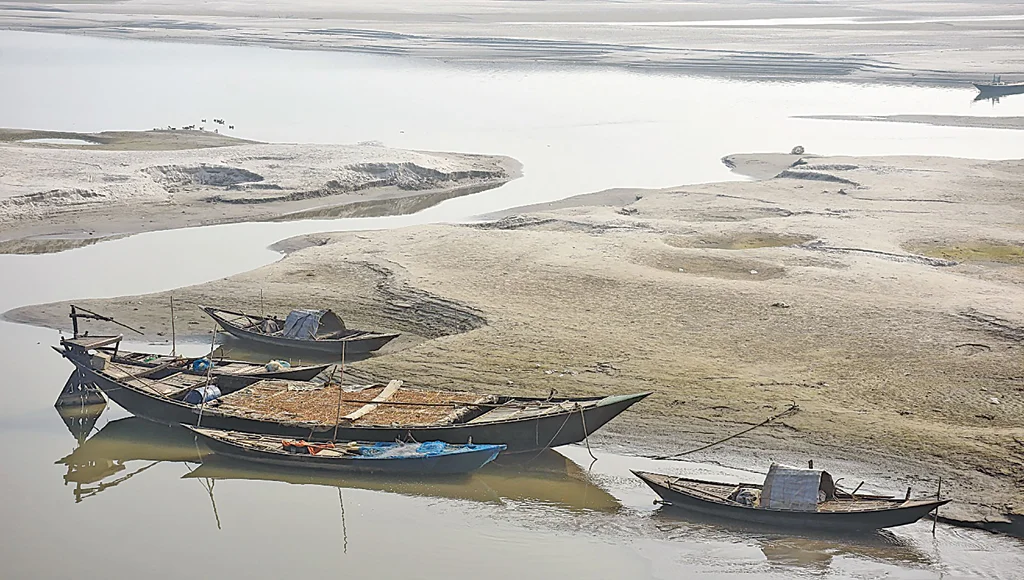
Boats stay tied at sandbars as the Padma River turns into a vast expanse of sandbars during the dry season. | New Age photo
The Padma River, once the lifeline of northwestern Bangladesh, is increasingly turning into a vast expanse of sandbars during the dry season, posing fears of ecological degradation, desertification, and growing economic hardship throughout the river basin.
Across large parts of Rajshahi, Chapainawabganj, and adjoining districts, the transboundary river that once sustained agriculture, fisheries, navigation, and river-oriented culture has now become fragmented into shallow channels surrounded by expanding char lands for much of the year.
According to scientists, environmentalists, and local people, the rapidly declining flow and excessive sedimentation over the years have shrunk the Padma, transforming large parts of the Barind region into drought-prone landscapes.Health & Wellness
A study published in the United Kingdom-based journal Geography and Environment this year found that the number of water bodies across the Padma floodplain had declined sharply from 1,706.97 square kilometres in 1990 to 1,072.74 square kilometres in 2023.
The study, carried out across Rajshahi, Chapainawabganj, Natore, Kushtia, Rajbari, and Pabna districts by researchers from Bangladesh Agricultural University, identified sediment accumulation and changing river behaviour as major reasons behind the shrinking water area.
Another study, published in the Netherlands-based journal Global and Earth Surface Processes Change this March, found that sandbar areas across the Padma River more than doubled to 768.029 square kilometres in 2020 from 311.45 square kilometres in 1976.
Using satellite images covering nearly 300 kilometres of the river system, researchers from Dhaka University observed extensive river widening, intensified erosion, and a sharp increase in sandbar formation over the decades.
The studies identified the Farakka Barrage upstream in India as one of the major reasons behind the crisis facing the Padma and the river system in Bangladesh stemming from it.Expat Community Forum
An analysis of hydrological data from the Bangladesh Water Development Board over the past five years shows that the average dry-season flow between January and May declined from 2,093 cubic metres per second in 2020 to 1,116 cubic metres per second in 2025.
Before the opening of the Farakka Barrage, located about 18 kilometres upstream of the Bangladesh border, the Padma carried an average flow of 3,685 cubic metres per second in 1974.
Along the Rajshahi riverfront, vast stretches of exposed sand land now dominate areas that were navigable even a decade ago.
Boatmen said that many channels had become too shallow for the movement of river vessels during the winter, while fishermen complained that native fish species were rapidly disappearing because of low water depth and the destruction of breeding grounds.
Abdul Majid, a fisherman from Rajshahi city’s T-Groyen area, said that the river had changed dramatically over the years.
‘There was a time when the Padma remained full of water throughout the year. We used to catch native species such as boal, pabda, and baghair in plenty. But now the river looks more like a sand field. The fish species have declined sharply as the river lost its depth and flow,’ he said.
Another study published in 2023 found that one-third of the native fish species recorded in the Padma in 1982 vanished as researchers found only 77 out of the 133 fish species during a survey covering the period from 2007 to 2017 due to the reduction in the river’s permanent area, water flow, and depth.
A group of seven researchers from Bangladesh, Australia, and the United Kingdom implemented the study titled ‘Fish diversity decline in the lower Gangetic plains: a victim of multiple stressors’ with support from Rajshahi University and the University Grants Commission of Bangladesh.
The study findings were published in the Netherlands-based journal ‘Biodiversity and Conservation’ in January 2023.
The researchers had investigated the response of the fish fauna to hydrological, climate, and anthropogenic factors in the lower Ganges River, Bangladesh.
The study covered a 70-kilometre area from Godagari in Rajshahi to Sarada in Charghat upazila. Fish species were collected at nine points in the area.
Environmental activists warned that the shrinking Padma was accelerating ecological stress across northwestern Bangladesh.
Rajshahi-based river and environment activist Enamul Haque said that many distributary rivers connected to the Padma had already died or become heavily silted.
‘Rajshahi is gradually moving towards desertification. The Padma is losing its natural character, while connected rivers are disappearing because of the reduced flow and sedimentation,’ he said.
The declining surface water in the Padma basin is also intensifying the groundwater crisis in the drought-prone Barind region.
In many villages across Rajshahi and Chapainawabganj, residents now depend heavily on deep tube wells while shallow tube wells have already become useless due to the declining water tables, forcing farmers to rely on costly deep irrigation systems for boro cultivation.
Mizanur Rahman, a professor of geography and environmental studies at Rajshahi University, said that groundwater conditions in the Barind region were becoming increasingly critical because of poor recharge, excessive irrigation, and declining river flow.
‘Huge amounts of groundwater are flowing from aquifers towards the river basin due to the poor river flow, while over-extraction of ground water for irrigation during the dry season is worsening the crisis,’ he said.
He warned that continued shrinking of the Padma would intensify the pressure on groundwater, biodiversity, and agriculture across the region.
Earlier, on November 6, 2025, the government prohibited groundwater extraction in 4,911 mouzas across Rajshahi, Naogaon, Chapainawabganj, and Natore districts except for drinking purposes.
Environmentalists said that wetlands, migratory birds and aquatic ecosystems dependent on the Padma were already under severe strain because of shrinking water bodies and habitat loss.
Anthropologist Shahidul Islam said that the broader ecological and cultural impacts on the Barind region were largely ignored.
He said that the Barind tract, known for its distinct geography and heritage, had gradually lost many of its traditional characteristics over the past five decades because of water scarcity and policy failures.
Experts stressed the need for integrated river management, restoration of the upstream flow, scientific dredging, and stronger regional cooperation over transboundary rivers to save the Padma and its dependent ecosystems before the damage becomes irreversible.
Suzon Ali . Rajshahi 20 May, 2026, 00:34
Boats stay tied at sandbars as the Padma River turns into a vast expanse of sandbars during the dry season. | New Age photo
The Padma River, once the lifeline of northwestern Bangladesh, is increasingly turning into a vast expanse of sandbars during the dry season, posing fears of ecological degradation, desertification, and growing economic hardship throughout the river basin.
Across large parts of Rajshahi, Chapainawabganj, and adjoining districts, the transboundary river that once sustained agriculture, fisheries, navigation, and river-oriented culture has now become fragmented into shallow channels surrounded by expanding char lands for much of the year.
According to scientists, environmentalists, and local people, the rapidly declining flow and excessive sedimentation over the years have shrunk the Padma, transforming large parts of the Barind region into drought-prone landscapes.Health & Wellness
A study published in the United Kingdom-based journal Geography and Environment this year found that the number of water bodies across the Padma floodplain had declined sharply from 1,706.97 square kilometres in 1990 to 1,072.74 square kilometres in 2023.
The study, carried out across Rajshahi, Chapainawabganj, Natore, Kushtia, Rajbari, and Pabna districts by researchers from Bangladesh Agricultural University, identified sediment accumulation and changing river behaviour as major reasons behind the shrinking water area.
Another study, published in the Netherlands-based journal Global and Earth Surface Processes Change this March, found that sandbar areas across the Padma River more than doubled to 768.029 square kilometres in 2020 from 311.45 square kilometres in 1976.
Using satellite images covering nearly 300 kilometres of the river system, researchers from Dhaka University observed extensive river widening, intensified erosion, and a sharp increase in sandbar formation over the decades.
The studies identified the Farakka Barrage upstream in India as one of the major reasons behind the crisis facing the Padma and the river system in Bangladesh stemming from it.Expat Community Forum
An analysis of hydrological data from the Bangladesh Water Development Board over the past five years shows that the average dry-season flow between January and May declined from 2,093 cubic metres per second in 2020 to 1,116 cubic metres per second in 2025.
Before the opening of the Farakka Barrage, located about 18 kilometres upstream of the Bangladesh border, the Padma carried an average flow of 3,685 cubic metres per second in 1974.
Along the Rajshahi riverfront, vast stretches of exposed sand land now dominate areas that were navigable even a decade ago.
Boatmen said that many channels had become too shallow for the movement of river vessels during the winter, while fishermen complained that native fish species were rapidly disappearing because of low water depth and the destruction of breeding grounds.
Abdul Majid, a fisherman from Rajshahi city’s T-Groyen area, said that the river had changed dramatically over the years.
‘There was a time when the Padma remained full of water throughout the year. We used to catch native species such as boal, pabda, and baghair in plenty. But now the river looks more like a sand field. The fish species have declined sharply as the river lost its depth and flow,’ he said.
Another study published in 2023 found that one-third of the native fish species recorded in the Padma in 1982 vanished as researchers found only 77 out of the 133 fish species during a survey covering the period from 2007 to 2017 due to the reduction in the river’s permanent area, water flow, and depth.
A group of seven researchers from Bangladesh, Australia, and the United Kingdom implemented the study titled ‘Fish diversity decline in the lower Gangetic plains: a victim of multiple stressors’ with support from Rajshahi University and the University Grants Commission of Bangladesh.
The study findings were published in the Netherlands-based journal ‘Biodiversity and Conservation’ in January 2023.
The researchers had investigated the response of the fish fauna to hydrological, climate, and anthropogenic factors in the lower Ganges River, Bangladesh.
The study covered a 70-kilometre area from Godagari in Rajshahi to Sarada in Charghat upazila. Fish species were collected at nine points in the area.
Environmental activists warned that the shrinking Padma was accelerating ecological stress across northwestern Bangladesh.
Rajshahi-based river and environment activist Enamul Haque said that many distributary rivers connected to the Padma had already died or become heavily silted.
‘Rajshahi is gradually moving towards desertification. The Padma is losing its natural character, while connected rivers are disappearing because of the reduced flow and sedimentation,’ he said.
The declining surface water in the Padma basin is also intensifying the groundwater crisis in the drought-prone Barind region.
In many villages across Rajshahi and Chapainawabganj, residents now depend heavily on deep tube wells while shallow tube wells have already become useless due to the declining water tables, forcing farmers to rely on costly deep irrigation systems for boro cultivation.
Mizanur Rahman, a professor of geography and environmental studies at Rajshahi University, said that groundwater conditions in the Barind region were becoming increasingly critical because of poor recharge, excessive irrigation, and declining river flow.
‘Huge amounts of groundwater are flowing from aquifers towards the river basin due to the poor river flow, while over-extraction of ground water for irrigation during the dry season is worsening the crisis,’ he said.
He warned that continued shrinking of the Padma would intensify the pressure on groundwater, biodiversity, and agriculture across the region.
Earlier, on November 6, 2025, the government prohibited groundwater extraction in 4,911 mouzas across Rajshahi, Naogaon, Chapainawabganj, and Natore districts except for drinking purposes.
Environmentalists said that wetlands, migratory birds and aquatic ecosystems dependent on the Padma were already under severe strain because of shrinking water bodies and habitat loss.
Anthropologist Shahidul Islam said that the broader ecological and cultural impacts on the Barind region were largely ignored.
He said that the Barind tract, known for its distinct geography and heritage, had gradually lost many of its traditional characteristics over the past five decades because of water scarcity and policy failures.
Experts stressed the need for integrated river management, restoration of the upstream flow, scientific dredging, and stronger regional cooperation over transboundary rivers to save the Padma and its dependent ecosystems before the damage becomes irreversible.