[🇧🇩] India's Water Terrorism Against Bangladesh

[🇧🇩] India's Water Terrorism Against Bangladesh
275
12K
More threads by Saif

G Bangladesh Defense

Padma turns into vast sandbars
Suzon Ali . Rajshahi 20 May, 2026, 00:34

1779237478821.webp

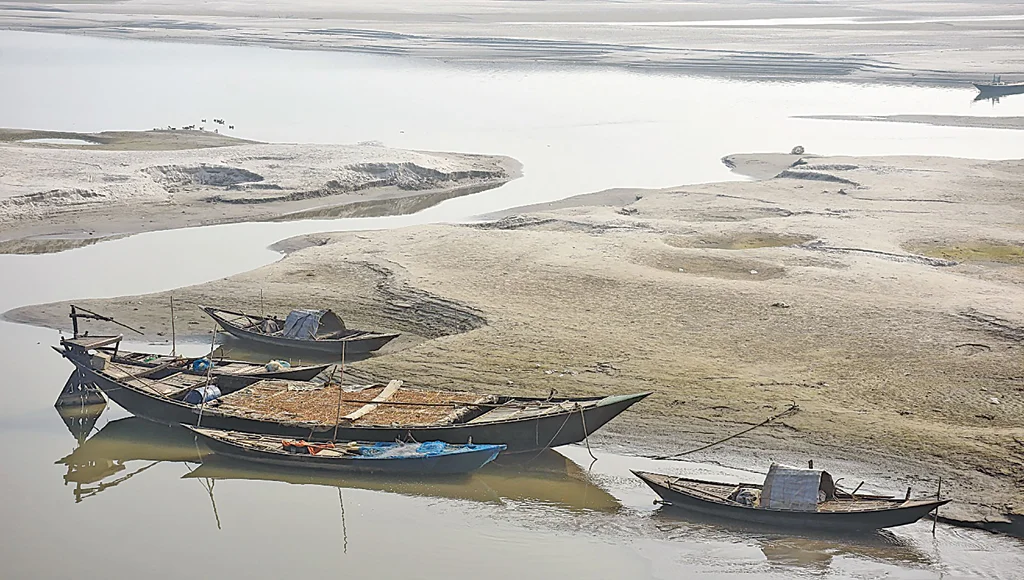
Boats stay tied at sandbars as the Padma River turns into a vast expanse of sandbars during the dry season. | New Age photo

The Padma River, once the lifeline of northwestern Bangladesh, is increasingly turning into a vast expanse of sandbars during the dry season, posing fears of ecological degradation, desertification, and growing economic hardship throughout the river basin.

Across large parts of Rajshahi, Chapainawabganj, and adjoining districts, the transboundary river that once sustained agriculture, fisheries, navigation, and river-oriented culture has now become fragmented into shallow channels surrounded by expanding char lands for much of the year.

According to scientists, environmentalists, and local people, the rapidly declining flow and excessive sedimentation over the years have shrunk the Padma, transforming large parts of the Barind region into drought-prone landscapes.Health & Wellness

A study published in the United Kingdom-based journal Geography and Environment this year found that the number of water bodies across the Padma floodplain had declined sharply from 1,706.97 square kilometres in 1990 to 1,072.74 square kilometres in 2023.

The study, carried out across Rajshahi, Chapainawabganj, Natore, Kushtia, Rajbari, and Pabna districts by researchers from Bangladesh Agricultural University, identified sediment accumulation and changing river behaviour as major reasons behind the shrinking water area.

Another study, published in the Netherlands-based journal Global and Earth Surface Processes Change this March, found that sandbar areas across the Padma River more than doubled to 768.029 square kilometres in 2020 from 311.45 square kilometres in 1976.

Using satellite images covering nearly 300 kilometres of the river system, researchers from Dhaka University observed extensive river widening, intensified erosion, and a sharp increase in sandbar formation over the decades.

The studies identified the Farakka Barrage upstream in India as one of the major reasons behind the crisis facing the Padma and the river system in Bangladesh stemming from it.Expat Community Forum

An analysis of hydrological data from the Bangladesh Water Development Board over the past five years shows that the average dry-season flow between January and May declined from 2,093 cubic metres per second in 2020 to 1,116 cubic metres per second in 2025.

Before the opening of the Farakka Barrage, located about 18 kilometres upstream of the Bangladesh border, the Padma carried an average flow of 3,685 cubic metres per second in 1974.

Along the Rajshahi riverfront, vast stretches of exposed sand land now dominate areas that were navigable even a decade ago.

Boatmen said that many channels had become too shallow for the movement of river vessels during the winter, while fishermen complained that native fish species were rapidly disappearing because of low water depth and the destruction of breeding grounds.

Abdul Majid, a fisherman from Rajshahi city’s T-Groyen area, said that the river had changed dramatically over the years.

‘There was a time when the Padma remained full of water throughout the year. We used to catch native species such as boal, pabda, and baghair in plenty. But now the river looks more like a sand field. The fish species have declined sharply as the river lost its depth and flow,’ he said.

Another study published in 2023 found that one-third of the native fish species recorded in the Padma in 1982 vanished as researchers found only 77 out of the 133 fish species during a survey covering the period from 2007 to 2017 due to the reduction in the river’s permanent area, water flow, and depth.

A group of seven researchers from Bangladesh, Australia, and the United Kingdom implemented the study titled ‘Fish diversity decline in the lower Gangetic plains: a victim of multiple stressors’ with support from Rajshahi University and the University Grants Commission of Bangladesh.

The study findings were published in the Netherlands-based journal ‘Biodiversity and Conservation’ in January 2023.

The researchers had investigated the response of the fish fauna to hydrological, climate, and anthropogenic factors in the lower Ganges River, Bangladesh.

The study covered a 70-kilometre area from Godagari in Rajshahi to Sarada in Charghat upazila. Fish species were collected at nine points in the area.

Environmental activists warned that the shrinking Padma was accelerating ecological stress across northwestern Bangladesh.

Rajshahi-based river and environment activist Enamul Haque said that many distributary rivers connected to the Padma had already died or become heavily silted.

‘Rajshahi is gradually moving towards desertification. The Padma is losing its natural character, while connected rivers are disappearing because of the reduced flow and sedimentation,’ he said.

The declining surface water in the Padma basin is also intensifying the groundwater crisis in the drought-prone Barind region.

In many villages across Rajshahi and Chapainawabganj, residents now depend heavily on deep tube wells while shallow tube wells have already become useless due to the declining water tables, forcing farmers to rely on costly deep irrigation systems for boro cultivation.

Mizanur Rahman, a professor of geography and environmental studies at Rajshahi University, said that groundwater conditions in the Barind region were becoming increasingly critical because of poor recharge, excessive irrigation, and declining river flow.

‘Huge amounts of groundwater are flowing from aquifers towards the river basin due to the poor river flow, while over-extraction of ground water for irrigation during the dry season is worsening the crisis,’ he said.

He warned that continued shrinking of the Padma would intensify the pressure on groundwater, biodiversity, and agriculture across the region.

Earlier, on November 6, 2025, the government prohibited groundwater extraction in 4,911 mouzas across Rajshahi, Naogaon, Chapainawabganj, and Natore districts except for drinking purposes.

Environmentalists said that wetlands, migratory birds and aquatic ecosystems dependent on the Padma were already under severe strain because of shrinking water bodies and habitat loss.

Anthropologist Shahidul Islam said that the broader ecological and cultural impacts on the Barind region were largely ignored.

He said that the Barind tract, known for its distinct geography and heritage, had gradually lost many of its traditional characteristics over the past five decades because of water scarcity and policy failures.

Experts stressed the need for integrated river management, restoration of the upstream flow, scientific dredging, and stronger regional cooperation over transboundary rivers to save the Padma and its dependent ecosystems before the damage becomes irreversible.​
 

Govt to build both Padma, Teesta barrages to tackle water crisis, climate risks: PM

Published :
May 20, 2026 18:33
Updated :
May 20, 2026 20:41

1779328472724.webp


Prime Minister Tarique Rahman on Wednesday announced that the government will implement both the Padma and Teesta barrage projects to address water shortages, protect agriculture and reduce climate-related risks.

“Today, before all of you, I want to make one thing clear – InshaAllah, this BNP government will begin work on the Padma Barrage and also on the Teesta Barrage,” he said, UNB reports.

Tarique Rahman, also the Chairman of the ruling BNP, made the announcement while speaking at a civic gathering after laying the foundation stone of the National Institute of Disaster Management Research and Training at Sataish Chowrasta in Gazipur city.

Referring to some political parties, which he did not name, the Prime Minister said BNP has taken practical steps over the Teesta issue, while others only made big statements and promises.

He said Disaster Management and Relief Minister Asadul Habib Dulu led BNP programmes on the Teesta issue in a way no other political party in Bangladesh has done.

“Others may have made strong speeches and big statements. But if anyone has done the work, delivered results and created the ground for action, it is BNP. InshaAllah, BNP will do it,” Tarique Rahman added.

Explaining why the Padma Barrage is necessary, he said the government recently decided to build a barrage on the mighty river, especially for the benefit of the northern and southern regions, including Rajshahi.

The Prime Minister said water flow in the Padma decreases during the dry season as India withdraws water upstream through barrages along the border, creating serious environmental and agricultural problems in Bangladesh.

“As a result, during the dry season, we are getting less water. The river flow is decreasing, and many problems are being created. Areas around the river are gradually drying up. When we were young, we saw the Padma full of water all around. Now the river has much less water. That is why we want to build the Padma Barrage,” he said.

Tarique Rahman said the barrage will help ensure water supply for farmers and people across the country during both the monsoon and dry seasons.

He also said reduced water flow caused by the Farakka Barrage is allowing saline sea water to move further into the southern region.

The Prime Minister voiced concern that trees are being damaged and different species of animals are disappearing in the Sundarbans and nearby areas because of rising salinity.

“So, if we want to tackle this situation, we have to build the barrage and store water there. We will be able to preserve excess monsoon water and use it later for people and for different purposes,” he said.

Speaking about climate change, Tarique Rahman said weather patterns in Bangladesh have changed noticeably over the years.

“It feels very hot these days, does not it? I clearly remember that when we were in school, especially in classes III, IV and V, we did not complain so much about the heat. It was not this hot at that time,” he said.

While living abroad for many years, the Prime Minister said, while speaking with people in Bangladesh during winter through online meetings, he noticed that many were not even wearing heavy winter clothes.

“Many people used to say there was hardly any winter even in December and January. I clearly remember that when we were in school and rehearsed for programmes on March 26, we used to wear sweaters because it was cold,” he said, recalling his childhood days.

Tarique Rahman said these changes show that the country’s climate and weather patterns are changing. “Today, we are here to discuss exactly this issue.”

On his way to the venue, the Prime Minister said he noticed a large boat lying on sand and felt that the area probably had a river or water body around 20 to 25 years ago.

He said Bangladesh must pay greater attention to environmental protection as population growth continues and land is shrinking.

Referring to the Rohingya camps in Cox’s Bazar, Tarique Rahman said thousands of trees were felled to build temporary shelters for displaced Myanmar nationals.

He also mentioned a proposed beach road from Cox’s Bazar to Ukhiya that would require cutting around 3,000 trees.

After reading a report on the issue, the Prime Minister said, he immediately contacted the minister concerned and asked whether the road design could be changed to save the trees.

“These trees cannot be cut. They can decide what steps to take, but the trees must not be cut,” he said, referring to his instructions to Road Transport and Bridges Minister Shaikh Rabiul Alam.

Tarique Rahman said natural disasters cannot be stopped or controlled by humans, but people can be made more aware and prepared to reduce damage and save lives.

“Bangladesh is both a disaster-prone and densely populated country. Even a small disaster causes damage to people, crops and livestock,” he said.

The Prime Minister said one of the main goals of the new institute in Gazipur will be to conduct research on climate change and find ways to deal with disasters such as earthquakes and tidal surges while protecting people and resources.

He also stressed the importance of canal excavation programmes for conserving water during the dry season.

“Canal excavation is closely linked to people’s lives and agriculture. We must continue these programmes in any way possible,” Tarique Rahman said.

Calling for greater public awareness, he urged people to protect the environment, plant trees, and reduce wasting of water.

“Since we cannot stop disasters, we must learn how to protect people and resources, how to reduce damage, and how to protect ourselves and others. Let that be our pledge today,” the Prime Minister said.

He said Bangladesh is still a poor country with limited resources, and those resources must be protected and properly used for the welfare of the people.

“If resources are destroyed because of our negligence or lack of awareness, people will suffer more,” he said.

Earlier, the Prime Minister laid the foundation stone of the National Institute of Disaster Management Research and Training building.

The programme was chaired by Disaster Management and Relief Minister Asadul Habib Dulu.

State Minister M Iqbal Hossain, Secretary Md Saidur Rahman Khan and Director General of the Department of Disaster Management Razwanur Rahman also spoke at the event.

Minister Dulu and Gazipur’s Deputy Commissioner Md Nurul Karim Bhuiyan separately presented commemorative gifts to the Prime Minister.

Defence Adviser to the Prime Minister Brig Gen (retd) AKM Shamsul Islam, Manjurul Karim Roni, MP, Gazipur City Corporation Administrator Md Shawkat Hossain Sarkar and senior government officials were also present.​
 

Padma Barrage could create another dry, exposed riverbed like the Teesta project

Khairul Hassan Jahin


1779935400347.webp


Eminent water expert Md. Khalequzzaman, PhD, professor of geology and oceanography at Commonwealth University of Pennsylvania, speaks to Khairul Hassan Jahin of The Daily Star about why the proposed Padma Barrage may deepen Bangladesh’s sediment, water, and ecological crises rather than resolve them.

How do you assess the proposed Padma Barrage project?

Its original name was the Ganges Barrage, which is more appropriate because the river is known as the Ganges up to Daulatdia. Calling it the Padma Barrage may create the impression that we are overlooking Bangladesh’s fair share of Ganges water under the Ganges Water Sharing Treaty.

For a delta to survive, maintain its landmass, and continue advancing towards the sea, sediment deposition in coastal areas is essential. If sediment deposition declines, the delta becomes more vulnerable, especially as sea levels continue to rise. In that sense, there is no alternative to sedimentation. In the 1960s, Bangladesh received roughly 200 crore tonnes of sediment annually through all its major rivers combined. Today, that figure has fallen to below 100 crore tonnes; or, as some studies suggest, 60-70 crore tonnes. The main reason is upstream intervention.

Studies suggest that a large share of sediment has been retained behind the Farakka Barrage since its construction. If another barrage is built on the Padma at Pangsha in Rajbari, a significant portion of the sediment that still enters Bangladesh during the monsoon could also be trapped.

At present, the Ganges brings an estimated 40-60 crore tonnes of sediment into Bangladesh each year. Much of it moves through the Meghna system towards the estuary; some is deposited on coastal floodplains, while the rest is carried into the sea. If another barrage is constructed, the downstream sediment supply will decline further, and more of that sediment will accumulate upstream and around the barrage itself.

The Farakka experience is instructive. Research by SANDRP and Kalyan Rudra, chairman of West Bengal Pollution Control Board, found that Farakka trapping 30-60 crore tonnes of sediment annually has reduced the river’s capacity to carry water and intensified waterlogging, flooding, and erosion. Around 40,000 families in Malda have reportedly been affected. Downstream, in Murshidabad, water scarcity is common, yet when large volumes are released, erosion intensifies. Roughly 100 square kilometres of land have been lost, and around 50,000 homes have reportedly been destroyed.

These may appear to be India’s problems, but they are highly relevant to us. Many Indian scientists, hydrologists, and environmentalists have concluded that Farakka was a fundamentally flawed decision. Movements in West Bengal and Bihar have demanded its removal for the damage within India. That experience should be taken seriously before Bangladesh considers another barrage on the same river system.

Given the uncertainty surrounding dry-season water availability from upstream and the upcoming expiry of the Ganges Water Sharing Treaty in 2026, how viable is the Padma Barrage project for Bangladesh?

I think this is a highly premature and poorly considered decision. Because of the Farakka Barrage, Bangladesh does not receive adequate water during the dry season. Even after the treaty was signed, we have not consistently received our rightful share. A study I was part of examined 20 years of data. Despite the treaty, Bangladesh did not receive its fair share of water 52 percent of the time. During the most critical period, Bangladesh failed to receive its rightful share nearly 65 percent of the time.

The central flaw of the current treaty is its lack of a minimum water guarantee. Under the agreement, if the flow at Farakka drops below 70,000 cusecs, the available water is simply split in half. For example, if the flow dwindles to 50,000 cusecs, Bangladesh receives only 25,000 cusecs instead of its anticipated 35,000, leaving the country to absorb the deficit caused by upstream shortages.

In my view, discussions on the Padma Barrage should be put on hold. Bangladesh’s priority should be to renew the Ganges Treaty in a stronger form, with a guarantee clause of the kind that existed in the 1977 agreement, but is absent from the current treaty. The next treaty should be more robust and, if possible, cover all 12 months rather than just the five dry-season months. Climate change is altering rainfall patterns, river flows, and water availability. We therefore need a basin-wide agreement that ensures an appropriate volume of dry-season flow at Farakka.

The Ganges Basin also includes Nepal. If we want a scientifically grounded agreement, it should be basin-based, year-round, include Nepal, and guarantee a minimum dry-season flow. It should also address sediment, not just water, and specify how sediment will be passed downstream. The treaty should further require India to notify Bangladesh about any new upstream diversionary structures beyond Farakka. Bangladesh should first see where the treaty negotiations are heading. Only then can we estimate how much water will actually be available and discuss how to manage it.

What lessons does the Teesta Barrage experience offer for the proposed Padma Barrage, and how realistic are its claims regarding irrigation, navigation, and water management?

If we take the Teesta Barrage as a lesson, then a Ganges or Padma Barrage is not a sound decision unless we first know exactly how much water will come from India in each season, and unless that flow is guaranteed.

The Ganges-dependent areas of Bangladesh are concentrated mainly in the southwest, which accounts for around 37 percent of the country’s land area and is already under severe stress. Salinity is increasing in the Sundarbans, in the Ganges-Kobadak Project area, and in waterlogged regions such as Bhabadah. Our concern is legitimate. But the Padma Barrage is not the right response.

The project plans to store roughly 3 billion cubic metres (BCM) of water. However, when you consider that the Padma River brings an enormous 350 to 525 BCM of water into Bangladesh every year, that 3 BCM storage capacity is basically a drop in the bucket. Additionally, a single day’s flood flow can be twice the amount of water the barrage is expected to store over three months.

One of the key claims is that the barrage will provide irrigation to 19 lakh hectares of land. But my calculations suggest that irrigating that area would require 9-26 BCM of water. Yet the project claims that irrigation water for the entire area can be provided by the barrage. That is misleading. Even partial irrigation would consume far more water than the proposed storage can realistically support. And if 100 percent of the stored water is used for irrigation, nothing would remain for environmental flow, fisheries, or navigation.

The proposal also claims that the barrage will increase navigability, expand irrigation, and reduce salinity. But there is no credible basis for claiming that enough water would remain to enhance navigability.

The Padma already receives inadequate water in the dry season, even under an existing treaty. In the Teesta, where there is no treaty at all, water barely arrives. Downstream of the proposed barrage at Pangsha, another 20-23 kilometres of river remain before Goalanda. If every available drop is retained behind the barrage, that stretch could fall under a kind of “double Farakka” condition. Without a strong treaty and a guarantee clause, a Padma Barrage could create another dry, exposed riverbed like the Teesta project. A barrage cannot create water.

Instead of pursuing megaprojects like the Padma Barrage, what kind of water management strategy should Bangladesh adopt to protect its long-term water and ecological security?

Bangladesh should accede to the UN Watercourses Convention and ratify it through parliament. That would strengthen our legal and diplomatic position regarding international rivers. Other basin countries—such as India, Nepal, and, in the case of the Brahmaputra, China—would also need to join and accept it as a framework for dispute resolution. India may not sign. Even so, Bangladesh should. By doing so, we can tell the international community that we adhere to the prevailing principles of international water law, and we expect support in protecting our rights. This would strengthen Bangladesh’s claims to all its international rivers. Even if others do not sign immediately, Bangladesh’s standing in international forums would improve. The convention should be used as a strategic tool.

As for the alternative to the Padma Barrage, we must treat the issue on a basin-wide scale. All countries in the Ganges-Brahmaputra-Meghna basin need to move towards integrated river basin management. What happens upstream directly affects downstream regions. This is why coordinated basin-level water governance is essential.

Hydro-diplomacy must become a central pillar of Bangladesh’s foreign policy. Bangladesh has strategic value to India in terms of security, regional stability, connectivity, and transit. Water and sediment are essential for Bangladesh. Our rights in international rivers are not charity or requests; they are rights.

We can also do a great deal domestically. The Padma Barrage proposal includes dredging components totalling about 381 kilometres—roughly 135 kilometres in the Gorai-Madhumati system and 246 kilometres in the Hisna-Mathabhanga system. This should be pursued seriously, alongside dredging in coastal rivers to increase water-carrying and water-holding capacity.

Abandoned canals, silted-up channels, and encroached waterways must also be restored. Dredged material should be treated as a resource for raising low-lying coastal land, reclaiming degraded areas, or producing construction materials.

Instead of retaining all available water behind a Padma Barrage, we should focus on the smaller distributaries and branch rivers in the southwest. Many have silted up, and many polders have caused persistent waterlogging. Some of those polders could be converted into eight-month embankments, allowing water and sediment to enter for part of the year while still providing seasonal protection.

At the same time, rivers, canals, and wetlands must be restored so that their flow, carrying, and storage capacities all improve. If we recover canals, rivers, and floodplains; dredge them properly; use sediment productively; and increase natural retention across the landscape, many of the underlying problems can be addressed far more sustainably.

We should also revisit basin-wide storage options in Nepal. In the Koshi basin, cooperative reservoir projects could store water for dry-season release, support irrigation in India and Nepal, and increase dry-season flows into the Ganges.

The Padma Barrage proposal also suggests generating around 76 megawatts of hydropower. I do not find that persuasive. Farakka is far upstream, where the gradient is much steeper, yet it has not produced meaningful hydropower. This electricity shortfall could be addressed far more safely through solar power, including in rural areas, and through wind energy.

Rivers should not be treated in fragmented, project-by-project terms. They must be understood within a broader framework of integrated development and basin-wide water governance. Bangladesh must improve internal river management, prevent encroachment and pollution, restore navigability, and expand natural water-storage capacity. If we address these issues together rather than through isolated megaprojects, many of the problems can be tackled far more effectively.​
 

Farakka Day: Will Bangladesh receive fair share of water this time after expiry of 30-year deal?

Subail Bin Alam
Published: 16 May 2026, 16: 59

View attachment 26676
How India withdraws water from the Ganges through the Farakka Barrage Collected

Every year on 16 May, a name inevitably comes to the forefront—Farakka. It is not just the name of a barrage; it is a symbol of the enduring crisis in Bangladesh concerning rivers, agriculture, economy, and geopolitics. On this day, some discussions happen, some memories are recalled, and then the issue goes into the shadows again. Yet, the dying rivers in the southwest, the increasing salinity in the Sundarbans, and the damage to agriculture are all somehow connected to Farakka.

This time the situation is more urgent. The 30-year-long Ganges Water Sharing Treaty of 1996 is set to expire in December. We stand at a historic juncture—a moment of opportunity, but there is no evidence of preparedness.

Bhasani’s Long March and an unfinished struggle
On 16 May 1976, 96-year-old Maulana Abdul Hamid Khan Bhasani left his hospital bed and marched from Rajshahi towards Farakka with millions of people, with just one message—to give Bangladesh its fair share of water.
He said, "If the Farakka Barrage is not dismantled, Bangladesh will turn into a desert. If I don't come, you will come; if you don’t, your children will. ”

Fifty years later, it must be acknowledged that this prediction has partially come true. It was not just a political protest; it was a historic public uprising to reclaim the life-or-death river rights. That movement remains unfinished today.

View attachment 26677
News of the Farakka Long March in the Daily Azad on 18 May 1976.Courtesy: Notebook of Sangram

Why was the barrage built, and who suffered?
Construction of the Farakka Barrage began in 1961 and was formally inaugurated on 21 April 1975. At that time, a short-term understanding took place between India and Bangladesh (from 21 April to 31 May 1975). After the political upheaval in August 1975, India unilaterally started withdrawing water, leading to a crisis in 1976.

The Indian government claimed that the barrage was built to maintain the navigability of Kolkata Port and to revive the Hooghly River. In reality, the Farakka project diverted 40,000 cusecs of water from the Ganges to the Bhagirathi-Hooghly through a feeder canal, most of which was due to Bangladesh.

However, the goal was not fully achieved. The Kolkata Port has not been entirely freed from sediment problems. Instead, sediment accumulation upstream in the Ganges is causing severe floods in Bihar and Uttar Pradesh every year. Riverbank erosion in Malda-Murshidabad is unending. That is, this barrage has become a ''death trap'' not only for Bangladesh but for India too.

50 years of loss: Data and reality
Before the barrage was operational, the average flow of the Ganges at the Hardinge Bridge point during the dry season was about 65,000 cusecs. After the barrage became operational, in some years, it reduced to just 10,000 to 15,000 cusecs.

In the dry season of 2015, the flow at Farakka was only 25,000 cusecs; as per the treaty, Bangladesh should have received 12,500 cusecs, but it received even less. Post the 1996 treaty, studies show the minimum flow in the dry season has reduced by up to 75 per cent. Today, the Padma River is a vast desert.

Various studies show that in five decades, the direct and indirect financial losses for Bangladesh exceed hundreds of billions of US dollars. The number of affected people is over sixty million. Sediment flow through the Padma has decreased by 20 per cent compared to 1960.

Agriculture has suffered the most. In the Ganges-Kobadak irrigation project, over 121,000 hectares of land depend on this flow. But the water level has dropped so much that the pumps are either shut or operating at much less capacity.

Farmers in Kushtia-Chuadanga have become owners of single-crop lands during the dry season. In Rajshahi-Chapainawabganj, the first layer of groundwater, previously found at 8 to 10 feet, is now unreachable even at 15 feet. In many places, it has dropped 60 to 100 feet below, which seasonal rain fails to replenish.

Over a hundred rivers and canals throughout the country are nearly dead. Rivers like Kobadak, Bhairab, Nabaganga, Chitra now sound like names from history. Where there once was the raging Padma, now there are shoals. Where boats once sailed, people now walk.

The encroachment of salinity continues unabated. With the decline in freshwater flow, saline water from the Bay of Bengal has intruded 100 to 150 kilometers inland. The sundari trees in the Sundarbans are on the verge of extinction due to diseases caused by high salinity. Everything from the Bengal tiger's habitat to fish breeding is affected. This crisis coupled with climate change has created a sort of double impact. During winter, water supply ceases, yet without warning, gates are opened during monsoon. Two different attacks across two seasons stem from one source.

View attachment 26678
Before the barrage, the average flow of the Ganges during the dry season at Hardinge Bridge Point was about 65,000 cusecs. After the barrage, in some years, it has dropped to just 10,000 to 15,000 cusecs. File photo

History of the treaty: The account of receivables and non-receivables

In 1972, the Bangladesh-India Joint River Commission was formed. In 1977, the first five-year water-sharing treaty was signed. However, from 1988 to 1996, for eight years, there was no effective treaty. During that time, India unilaterally managed Farakka, the severe impact of which was observed in Bangladesh.

The 30-year treaty signed on 12 December 1996, was a milestone.

According to the agreement, if the flow at Farakka is 70,000 cusecs or less, both countries will share the water equally; if the flow is between 70,000 and 75,000 cusecs, Bangladesh is assured of receiving 35,000 cusecs, and the rest will go to India. If the flow exceeds 75,000 cusecs, India is assured of receiving 40, 000 cusecs, with the remainder going to Bangladesh. However, there is a condition that from 1 April to 10 May, over three ten-day cycles, both countries are assured of receiving 35,000 cusecs alternately.

Nevertheless, despite this treaty, Bangladesh often did not receive its rightful share. Due to internal uses within India and other upstream infrastructure, the water due to Bangladesh has frequently been reduced.
The term of this treaty ends in December 2026. No visible discussions have started yet between the two countries on a new treaty. If this inactivity continues, from 2027, Bangladesh might again fall victim to unilateral water management.

What needs to be done next

Stepping out of emotional politics, we must now move towards information-based diplomacy. Action is needed on several fronts.

Firstly, the opportunity in December 2026 must not be squandered. The new treaty should not only share water equitably but also include accountability processes for violations. Water-sharing formulas should be determined based on the principle of "equitable and reasonable use" under international river law. Strengthening the Joint River Commission and bringing it under third-party observation could be considered.

Secondly, Bangladesh has not yet ratified the United Nations International Watercourses Convention 1997. While discussions have occurred on this matter, no formal progress has been made. This convention provides a legal basis for downstream countries to claim their rightful share in transboundary rivers. Ratifying it will legally strengthen our position in international discussions. It could be the most effective tool in exerting diplomatic pressure on India.

Thirdly, not just Farakka but Teesta, Manu, Mahananda, and all 54 shared rivers need to be brought under a comprehensive river basin management. Negotiating separately reduces leverage. The Ganges-Brahmaputra-Meghna Basin’s overall management should include all upstream countries like Nepal, Bhutan, and China. The Danube Commission in Europe, the Nile Basin Initiative in Africa, or the Mekong River Commission have shown that viewing water-sharing as part of political, economic, and environmental security can lead to solutions.

Fourthly, a real-time data system must be developed for the entire Ganges-Padma Basin. Information such as incoming water amounts, areas of depletion, increasing salinity should be published internationally. Political statements alone won't suffice; data must be presented. We've approved the UN Water Convention 1992, hence we have the right to demand fair compensation.

Fifthly, there are voices within India against Farakka. Bihar and Uttar Pradesh blame the barrage for floods, while Malda-Murshidabad for river erosion. Building a connection with these internal voices could provide a strategic opportunity for Bangladesh. The water issue should be brought to the table through economic realities, not emotion. India too is now dependent on Bangladesh for its northeast, transit, and regional economy. Not using that card would be foolish.

Sixthly, domestic work must be done at home. Constructing a Padma Barrage at appropriate locations through studies to capture excess monsoon water for release in the southwest rivers during the dry season is now timely, and has been approved by ECNEC. Regular and planned dredging of the Padma's tributaries, rainwater conservation, controlling excessive withdrawal of groundwater, and wider cultivation of salt-tolerant paddy varieties like BRRI-47 and BRRI-67 must be expanded. Establishing a separate climate and water resilience zone for the southwest could also be considered.

A reality check

Himalayan glaciers are shrinking, and rainfall patterns are changing. In the next two decades, water will be the biggest geopolitical issue in South Asia. India too is under water pressure. In this reality, conflict is not sustainable; joint management is the only way forward.

Diplomatic achievements may take five to ten years, but domestic adaptation work can start now. Steps like ratifying the UN Convention can be taken as early as tomorrow.

Farakka Day should not only be a day to remember past grievances. It should be a day for crafting future water security strategies. Losing a river means not only losing water but also losing economy, agriculture, and habitations, ultimately risking the state's stability.

Bhasani marched alone. Today, the state needs a collective march—uniting diplomacy, law, and science.

Farakka Day should not just be a day of remembrance; it should be a day for creating future water security strategies. If the rivers survive, Bangladesh will survive.

#Subail Bin Alam is a writer on sustainable development​

I doubt India will treat the renewal of Farakka accord fairly. Since they plan to screw us over any way, better take a harder stance than not. Problem is, our politicians seem to be mostly sold already.
 

Latest Posts

Back