New Tweets

[🇧🇩] Iran, US- Israel War: It's Impact On Bangladesh

G Bangladesh Defense
[🇧🇩] Iran, US- Israel War: It's Impact On Bangladesh
37
420
More threads by Saif


Iran war may impact growth, spur inflation in Asia and Pacific: ADB

UNB
Published :
Mar 26, 2026 18:49
Updated :
Mar 26, 2026 18:49

1774570055208.webp


The conflict in the Middle East (West Asia) could lower economic growth in developing Asia and the Pacific by up to 1.3 percentage points over 2026-2027 and raise inflation by 3.2 percentage points if energy market disruptions last more than a year, according to new research by the Asian Development Bank (ADB).

The conflict affects economies in Asia and the Pacific through higher energy prices, supply chain and trade disruptions, and tighter financial conditions. Tourism and remittances could also be impacted.

The ADB brief released on Thursday outlines three risk scenarios indicating that effects on the region’s developing economies will depend largely on the duration of disruptions.

Under a short-lived conflict, energy price pressures would ease relatively quickly. More prolonged disruptions would lead to larger and more persistent impacts on growth and inflation.

Adverse effects on growth will be most severe for economies in developing Southeast Asia and the Pacific, with inflation rising highest in South Asian economies.

The scenarios reflect the high degree of uncertainty around how the conflict and the associated disruptions will evolve, and should be treated with caution.

In addition to higher energy prices, they account for broader supply chain disruptions and a global tightening of financial conditions.

ADB Chief Economist Albert Park said that Prolonged energy disruptions could force economies in developing Asia and the Pacific to navigate a difficult trade-off between weaker growth and higher inflation.

“Governments should focus on containing market stress and protecting the most vulnerable, while adopting policies to improve longer-term resilience.”

The brief presents four key policy responses as follows:

Fistly, Policies should focus on stabilization rather than suppression of price signals. Allowing higher energy prices to pass through, at least in part, can encourage energy conservation, fuel switching, and investment in alternative energy sources.

Broad price controls or generalized subsidies risk distorting incentives, delaying adjustment, and misallocating resources.

Secondly, Fiscal support, where needed, should be targeted and time-bound. Priority should be given to supporting vulnerable households and the most affected industries.

Well-targeted measures can cushion the social impact of higher prices while containing fiscal costs and preserving incentives to adjust to the shock.

Thirdly, Central banks should focus on limiting excessive market volatility while keeping a close watch on inflation expectations.

The priority should be to provide targeted liquidity support to preserve orderly market functioning.

Tightening policy too aggressively risks amplifying growth headwinds and exacerbating financial volatility.

While some tightening may be warranted, anchoring inflation expectations with effective central bank communication will remain key.

Finally, Governments should curb energy demand where feasible. Practical measures include temperature mandates to limit air-conditioning, cuts to non-essential lighting, peak-hour electricity-saving campaigns, and work-from-home or staggered schedules.

Incentivizing public transport use and car-free days in urban areas on public holidays can also help reduce transport fuel use.​
 
Analyze

Analyze Post

Add your ideas here:
Highlight Cite Respond

Bangladesh receives no communication from Iran on access to Hormuz
Staff Correspondent 26 March, 2026, 19:59

Bangladesh has received no official communication from Iran on access to the Strait of Hormuz although media reports claim that Iran keeps the strategically vital shipping route open for India, Pakistan and several other ‘friendly countries’ amid US-Israeli war on Iran.

A senior foreign ministry official told New Age on Thursday that the Iranian ambassador in Dhaka Jalil Rahimi Jahanabadi in a recent meeting with state minister Shama Obaed Islam at her office assured that Bangladeshi oil tankers.

The official said that Dhaka could not reach Tehran directly over the matter amid joint attacks by the United States and Israel on Iran and Tehran’s retaliatory strikes on Israel and the US bases across the Arab states in the West Asia beginning from February 28.

The United News of Bangladesh reported on Thursday that Bangladesh was been named among several ‘friendly nations’ whose vessels might be allowed safe passage through the Strait of Hormuz, as Iran said the crucial maritime route remains partially open despite the ongoing war.

In a notable diplomatic development, Iran has indicated that ships linked to a number of countries, including Bangladesh can still transit the strategically vital Strait of Hormuz under coordinated arrangements.

The narrow waterway, which carries around one-fifth of the world’s oil shipments, has been under tight Iranian control since the United States and Israel launched attacks on Iran last month.

In an Interview with Iranian State TV, Iran’s foreign minister Abbas Araghchi rejected claimed that the strait was completely closed, saying controlled passage continued.

‘For some countries that we identified as our friends, we allowed passage through the Strait of Hormuz. We allowed China, Russia, India, Iraq, and Pakistan to pass,’ Tasnim News Agency of Iran quoted Aragchi to have said in the interview.

‘There is no reason for us to allow our enemy to pass through the Strait of Hormuz,’ he said.

UNB, however, reported that Bangladesh was included in the list of the countries to have access to the strait.City & Local Guides

‘Many of the shipowners, or the countries that own these vessels, have contacted us and requested that we ensure their safe passage through the strait. For some of these countries that we consider friendly, or in cases where we have decided to do so for other reasons, our armed forces have provided safe passage,’ Araghchi said, according to a report by Reuters.

‘You have seen on the news: China, Russia, Pakistan, Iraq, and India. Two of its ships passed through a few nights ago, and some other countries, and even Bangladesh, I believe. These are countries that spoke with us and coordinated with us, and this will continue in the future as well, even after the war,’ he added.

Araghchi also indicated that vessels linked to countries seen as adversaries or those involved in the ongoing conflict would not be allowed passage.

‘We are in a state of war. The region is a war zone, and there is no reason to allow the ships of our enemies and their allies to pass through. But it remains open to others,’ he said on Wednesday.

Shipping through the route has dropped sharply amid the conflict.

Following US and Israeli strikes on Iran and Tehran’s retaliatory actions, access to the strait has been significantly restricted.

The channel, which usually handles around 120 vessels daily, has seen traffic plunge by about 95 per cent in March, according to shipping data, with only a handful of crossings recorded in recent days.​
 
Analyze

Analyze Post

Add your ideas here:
Highlight Cite Respond

ME ENERGY BLOCKAGES
S&P predicts three-pronged onslaught on Bangladesh economy

Global ratings agency stresses energy diversification across Asia

Jasim Uddin Haroon
Published :
Mar 28, 2026 00:02
Updated :
Mar 28, 2026 00:02

1774656909577.webp


Bangladesh is increasingly exposed to global energy shocks as escalating conflict in the Middle East threatens to disrupt supply chains across Asia, S&P Global Ratings predicts and stresses fuel-sourcing diversification.

In its latest report released on March 26, the agency warns that Asia-Pacific economies-heavily reliant on Middle-Eastern fuels-could face a severe energy-availability crisis, with Bangladesh among the most vulnerable due to its import dependence.

The report says the potential closure of the Strait of Hormuz, a critical oil-shipping route, is turning a geopolitical conflict into a full-blown "energy shock and supply-chain crisis".

However, Iran Thursday said fuel ships meant for Bangladesh would be allowed to pass through.

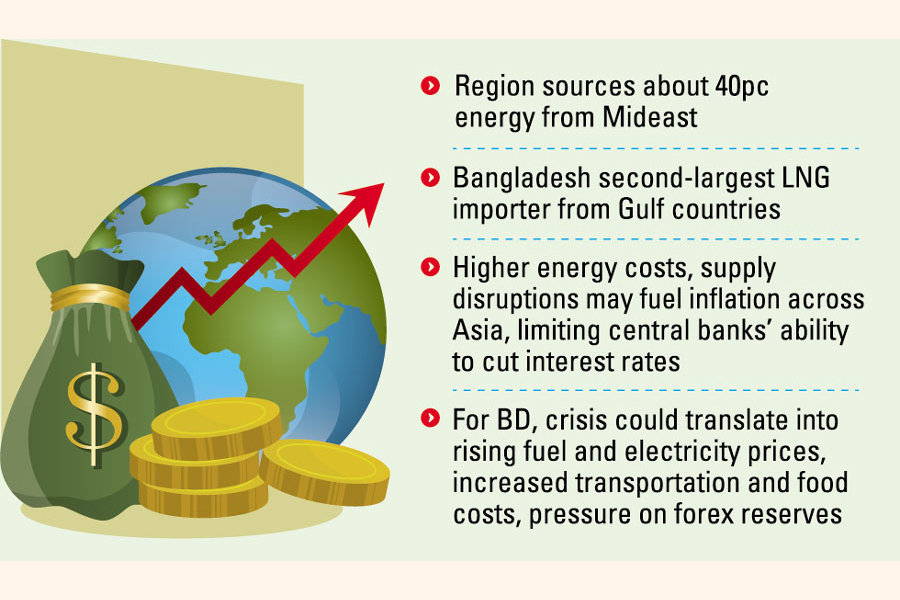
The region sources about 40 per cent of its energy imports from the Middle East, making alternatives difficult in the short term.

Bangladesh is the second-largest LNG importer having 72-percent dependence on the region after Pakistan.

The S&P report says energy supply, not price, is the biggest threat.

Unlike previous crises driven mainly by rising oil prices, the current risk lies in physical shortages of fuel, which could hit countries like Bangladesh harder.

"Energy availability-not prices-is the biggest threat," S&P notes, warning that disruptions could affect power generation, transport and industrial production.

For Bangladesh, which imports most of its oil, liquefied natural gas (LNG), and refined fuels, any prolonged disruption could strain electricity supply and industrial output-particularly in export-oriented sectors such as export-oriented garments and textiles.

It notes that inflation and growth pressure are mounting.

"Higher energy costs and supply disruptions are expected to fuel inflation across Asia, limiting central banks' ability to cut interest rates."

In Bangladesh, this could translate into: (a) rising fuel and electricity prices (b) increased transportation and food costs (c) pressure on foreign-exchange reserves

The US-based financial services company, Standards & Poor's or S&P, warns that stagflation-like conditions-slower growth combined with rising prices-could emerge if the conflict persists.

The report highlights another critical risk for Bangladesh: disruption in fertiliser supply.

Blockages in the Strait of Hormuz are already affecting shipment of urea and petrochemical products, key inputs for agriculture.

For a country where agriculture still plays a major economic and social role, delays in fertiliser import could reduce crop yields.

And food prices might jump.

For Bangladesh, this could mean higher import bills for fuels.

Such fiscal pressures could complicate macroeconomic management at a time when the country is already navigating inflation and reserve challenges.

Supply-chain disruptions are to hit export.

The report also flags broader supply-chain disruptions affecting industries from chemicals to pharmaceuticals.

Bangladesh's export sector may face indirect impacts too.

At the same time, uncertainty in US trade policy could further complicate export prospects for Asian economies.

The agency underscores the urgent need for energy diversification across Asia.

The S&P report delivers a clear warning: Bangladesh's heavy reliance on imported energy leaves it exposed to geopolitical shocks far beyond its borders.

If Mideast tensions persist, the impact could ripple across power supply, inflation, agriculture, and exports-testing the resilience of one of Asia's fastest-growing economies.​
 
Analyze

Analyze Post

Add your ideas here:
Highlight Cite Respond

Oil at $120 per barrel could add Tk 610b annual burden on Bangladesh

FE ONLINE REPORT
Published :
Mar 28, 2026 20:29
Updated :
Mar 28, 2026 20:29

1774741865516.webp


Bangladesh is facing a looming economic challenge as global oil prices are set to cross the critical threshold of US$120 per barrel amid escalating tensions in the Middle East.

Researchers at a press briefing on Saturday warned that such a surge could impose an additional annual burden of Tk 610 billion on the country’s economy, raising serious concerns about sustainability, industrial growth, and employment.

Change Initiative carried out the study, where the researchers revealed that every $10 increase in Brent crude oil prices per barrel translates into nearly $1 billion in extra annual expenditure for Bangladesh.

With the country importing about 95% of its energy needs, this dependency leaves the economy highly vulnerable to global market volatility, the study noted.

If prices remain above $120 for an extended period, the annual cost could balloon to $4–5 billion, creating unprecedented fiscal pressure.

The small and medium enterprise (SME) sector, which accounts for 70–80 per cent of national employment and contributes 25–30 per cent to gross domestic product (GDP), is expected to be hit hardest. Rising fuel costs would increase production expenses, reduce competitiveness, and potentially trigger widespread job losses.

Analysts caution that prolonged subsidies are not a viable solution, and the government may eventually be forced to adjust energy prices, risking de-industrialization.

Chief researcher M. Zakir Hossain Khan emphasized that while the situation is dire, it also presents a chance for Bangladesh to accelerate its transition toward renewable energy.

He noted that countries such as China, India, and Vietnam have successfully invested in renewables to stabilize their industries, and Bangladesh must follow suit to safeguard its future.

The study revealed that rooftop solar installations in industrial zones could reduce operating costs by 30–50 per cent while cutting carbon emissions significantly.

In fact, utilizing just 10 per cent of unused space in industrial parks could generate 57 megawatts (MW) of solar power, reducing emissions by over 51,000 tons of carbon dioxide annually.

Expanding this to 20 per cent could double the capacity, further strengthening energy independence.

Researchers also highlighted the potential for carbon credit revenues, estimating that Bangladesh could earn around $0.40 million annually by reducing emissions in SME clusters.

Sectors such as leather, plastics, packaging, and light engineering were identified as priority areas, with the potential to cut emissions by up to 49 per cent through targeted interventions.

The urgency is underscored by Bangladesh’s Nationally Determined Contribution (NDC) target, which aims to reduce 69.84 million tons of carbon dioxide emissions by 2035.

Achieving this goal will require immediate and decisive action to transform the energy landscape.

As global oil prices continue to climb, Bangladesh stands at a crossroads.

Failure to act could result in economic instability, job losses, and weakened industrial capacity.

But with bold investments in solar and other renewable sources, the country has the opportunity to not only mitigate the crisis but also position itself as a leader in sustainable industrial growth.​
 
Analyze

Analyze Post

Add your ideas here:
Highlight Cite Respond

Goodwill at the Strait runs dry

FE
Published :
Mar 29, 2026 00:04
Updated :
Mar 29, 2026 00:04

1774742244010.webp


The news that Iran had named Bangladesh among a handful of "friendly nations" whose vessels might be granted safe passage through the blockaded Strait of Hormuz had, for a brief moment, offered a significant relief. That prospect, however, has been swiftly overtaken by subsequent developments. Iranian authorities have since indicated that the route is closed to vessels travelling to and from ports belonging to allies and supporters of what it terms the Zionist-American bloc, and enforcement actions have already followed with ships reportedly turned back from the strait. This reversal effectively nullifies the earlier opening, as Bangladesh-bound cargo vessels remain dependent on Gulf loading terminals that now fall within the restricted category. What had briefly seemed like a critical pathway for both inbound cargo and outbound empty tankers has therefore narrowed once again, leaving Bangladesh exposed to the same acute uncertainties that defined the crisis from the outset. Given that the strait serves as a conduit for a significant share of global oil shipments and that traffic through it has plunged dramatically in recent weeks, the loss of even limited and conditional access compounds the strain on Bangladesh's energy supply chains.

Even though Bangladesh holds no strategic weight in the conflict and has little capacity to influence its course, its initial inclusion among nations Tehran considers friendly aligns with its long-standing policy of non-alignment and balanced diplomacy. The government has maintained a careful position condemning violation of sovereignty in several Middle Eastern countries while avoiding any explicit alignment. At the same time, the Bangladeshi populace maintains a perception of Iran as a brotherly Muslim nation, viewing the war as unfairly imposed in the middle of negotiations. Consistent with its long-standing policy, Bangladesh neither hunts with the hounds nor runs with the hare, instead emphasising diplomacy as the only viable means of resolving differences. Yet the latest restrictions revealed the hard truth that neutrality alone cannot insulate the country from the operational realities of conflict in which supply routes, ports and shipping lanes are subject to military and political calculations. The war in the Middle East has already created an extraordinary situation in the global energy market, and as an import-dependent country, Bangladesh continues to bear its consequences regardless of its diplomatic stance.

With the IRGC's latest announcement effectively nullifying the earlier assurance of safe passage, the central challenge is no longer confined to passage through the strait but extends decisively to the question of access itself. The ports of the GCC countries from which oil and LNG are sourced are now entangled in the matrix of restrictions, making both loading and transit subject to heightened uncertainty. This makes both the procurement of cargo and its subsequent transit through the strait equally formidable and compounding problems. Unless Iran lifts or substantially clarifies its restrictions in a manner that accommodates vessels loading from GCC terminals, Bangladesh's ability to move energy imports through the strait remains firmly closed.

The gravity of this moment demands that, alongside efforts to secure alternative supply arrangements, the government implement a comprehensive rationing regime for energy and electricity to stretch whatever reserves remain. Without appropriate measures, Bangladesh faces the very real possibility of severe energy shortages that could fundamentally alter daily life and economic activities. Ironically, if the oil shortage persists and starts grounding fuel-dependent vehicles, the country may soon come to rely heavily on battery-operated three-wheelers. The hope now rests on swift de-escalation that the blockade is lifted, that diplomacy prevails and that the war ends before the impending energy crisis hardens into an irreversible disaster.​
 
Analyze

Analyze Post

Add your ideas here:
Highlight Cite Respond

What are new risks to Bangladesh's economy from Iran war?
The Middle Eastern war, though thousands of miles away, has already reached Bangladesh with its economic impact in just a few days. What new risks this war will pose to Bangladesh's economy has been written by Golam Rasul.

Golam Rasul
Published: 28 Mar 2026, 18: 35

1774743635926.webp


The Middle East war, although far away, has already impacted Bangladesh’s markets, industries, and household kitchens. The United States and Israel's attack on Iran and Iran's subsequent decision to close the Strait of Hormuz has disrupted the global energy supply system. Approximately one-fifth of the world's oil supply and nearly 20 per cent of liquefied natural gas are transported through this strait. Consequently, as soon as disruptions occur on this route, the price of crude oil in the international market has exceeded $114 per barrel.

Its impact is quickly being felt on Asia's import-dependent economies—Bangladesh is no exception. Due to reliance on energy imports, the Gulf labour market, and global shipping routes, Middle East instability has swiftly pressured the country's economy. There is already uncertainty in the energy market, rising food prices, and increasing concern among businesses. For the new government, this is not a distant geopolitical event; rather, it is the first major test of economic management. In today's globalised economy, distant wars ultimately determine the prices in the nearest markets.

Energy shock and inflation

In the modern economy, energy is not just a commodity; it is a fundamental component in determining the price structure of the entire economic system. Bangladesh's energy sector is highly sensitive to international market volatility due to its dependence on imports. Approximately 65 per cent of the country's total electricity production comes from imported energy—oil, coal, and LNG. Consequently, when global energy prices rise, their impact is quickly reflected in the national economy.

Bangladesh's economy today stands at a reality where global geopolitics directly influences the cost of people’s daily lives. The increase in energy prices is quickly reflected in inflation. Transportation costs rise, food prices increase, and industrial production costs soar. In February of this year, the country's average inflation reached 9 per cent. If the war prolongs, this pressure could intensify further.

The cost of petroleum imports in December 2025 was approximately Tk 790 billion. With the price of crude oil exceeding $114 per barrel in the international market, there is a risk of this cost increasing further. As a result, policymakers are confronted with a tough policy dilemma—whether to raise domestic energy prices or increase subsidies, thereby exerting more pressure on the revenue deficit.

Bangladesh's economy today stands at a reality where global geopolitics directly influences the cost of people’s daily lives. The increase in energy prices is quickly reflected in inflation. Transportation costs rise, food prices increase, and industrial production costs soar. In February of this year, the country's average inflation reached 9 per cent. If the war prolongs, this pressure could intensify further.

In the modern economy, energy is not just a commodity; it is a fundamental component in determining the price structure of the entire economic system.

Bangladesh's economy today stands at a reality where global geopolitics directly influences the cost of people’s daily lives.

Its impact falls most heavily on low-income families. Urban poor households spend a large portion of their income on food. Thus, even a slight increase in food prices can bring significant changes to their dietary habits—relying more on minimal food instead of nutritious meals. In economic terms, this is a cost-push inflation situation, where increased production costs create inflationary pressure across the entire economy. In reality, rising energy prices mean not just higher electricity bills; it influences the entire economic cost structure.

The increase in the use of imported energy for electricity generation in Bangladesh makes energy supply more vulnerable to international market instability. Thus, energy security is no longer just a question of supply; it is deeply linked with price stability, industrial production, and macroeconomic stability.

Industry, trade, and food security

The most visible impact of the energy crisis falls on the industrial, trade, and agricultural sectors. The primary driving force of Bangladesh's export economy is the ready-made garment industry, which accounts for approximately 84 per cent of the country's total export income; but production is disrupted when gas supply is irregular, and production costs rapidly increase. Rising energy prices increase costs at every stage of industrial production—electricity, transportation, raw material imports, and supply chains—all come under pressure.

In the current global production system, industries are part of a complex supply chain. Thus, rising energy prices not only increase factory electricity costs but also raise international shipping, logistics, and raw material transportation costs. This could weaken Bangladesh's export competitiveness in the global market.

Energy-dependent industries such as cement, steel, and ceramics are also under similar pressure. Many small and medium-sized industries have already reduced production times or adopted cautious positions in taking new orders. Higher diesel prices in the transport sector increase transportation costs, which are reflected in product prices from the wholesale market to the retail market. Ultimately, this pressure falls on the common consumer.

This reality highlights a significant economic truth—rising energy prices do not mean just higher electricity bills; it means changing the entire production system's cost structure.

Similar types of risks are arising in the agriculture sector. About 80 per cent of Bangladesh's irrigation system relies on diesel-powered pumps. Due to the impact of the Middle East war, global oil prices have exceeded $114 per barrel, causing the average international price of diesel to reach $1.34 per liter in March. As a result, irrigation costs during the Boro season are feared to increase in the future.

Simultaneously, the cost of production and import of fertilizers is also rising. In December 2025, fertilizer import costs were nearly Tk 5.2483 billion. The global fertilizer price index increased by 6.5 per cent in February 2026. If the Middle East war prolongs, disruptions in natural gas supply could occur, which is the primary raw material for nitrogen-based fertilizers. Consequently, the risk of further price increases in fertilizers cannot be dismissed.

This situation can raise the production costs of staple crops like rice, wheat, and maize. If farmers are forced to cut back on using irrigation and fertilizers, production may decline. The long-term impact may affect the country's food security. In other words, even though production is not being disrupted immediately, the continuous increase in irrigation and fertilizer costs poses a serious risk to agricultural production stability in the future.

In reality, energy security and food security are deeply interconnected. During the global food crisis in 2008, it was observed that as energy prices rose, crops like maize and sugarcane were increasingly used for biofuel production, reducing food supply and rapidly raising food prices in the international market. If future biofuel production demand increases, competition for food crops may become more intense, creating long-term risks for food security.

This reality raises an important policy question—an energy crisis is not just a problem for power production or industry; it can also impact the foundation of food production. Although Bangladesh's ongoing canal re-excavation and irrigation infrastructure improvement initiatives are positive, it is essential to plan energy and food policies in an integrated manner in the long term.

Thus, the energy crisis is already putting pressure on the industrial, trade, and agricultural sectors. However, the biggest concern is its potential long-term impact. Increasing production costs, supply chain disruptions, and rising agricultural production costs—all together, these could become a significant risk for Bangladesh's economic stability in the future. Therefore, policymakers must prepare now to address this potential crisis before it materialises.

External pressures and policy challenges

Remittances have long been an important pillar of Bangladesh's economy. In the first seven months of the 2025–26 fiscal year, expatriates sent home nearly $18 billion, playing a vital role in funding the food, education, and healthcare expenses of millions of families. However, a large portion of this income depends on a few economies in the Middle East.

Consequently, regional instability or economic downturns could quickly make remittance flows uncertain. In reality, remittances are not just a source of family income; it is one of the main pillars for the stability of foreign currency in the country; but excessive reliance on a specific region's labour market could put the economy at risk in the long term.

Pressure is also gradually becoming evident in the external sector. Although Bangladesh's foreign exchange reserves are currently around $30 billion, rapidly rising fuel import costs could exert pressure on these reserves.

Additionally, the devaluation of the Taka increases the price of imported goods and exacerbates inflation. The country's external debt has already reached approximately $70 billion, so global interest rates and currency market volatility could create additional pressure on the economy. Here lies an important economic reality—when external sector stability is weak, its impact quickly falls on inflation, investment, and growth.

There are similar structural limitations in the revenue sector as well. Bangladesh's tax-to-GDP ratio is about 8 per cent, one of the lowest among emerging economies. As a result, the government's fiscal policy space to address economic crises is relatively limited. Subsidies for energy and fertilizer have already reached a huge amount; if the Middle East war continues, these costs may increase further, deepening the revenue deficit.

Therefore, policymakers face a challenging question of maintaining balance—controlling inflation on one hand, and maintaining fiscal stability on the other. To address this dual challenge, expanding the tax base, targeting subsidies, and increasing investment in renewable energy are essential in the long term.

Economic stability ultimately does not only depend on temporary policies; it rests on a strong revenue framework and long-term planning. At the same time, labour market diversity is also extremely important. If new employment opportunities can be created in emerging labour markets in Southeast Asia and Europe, remittance inflows could become more stable, reducing excessive reliance on a specific region.

While investing in renewable energy is important to address the energy crisis, regional electricity cooperation could be an effective strategy as well. In South Asia, a regional market for cross-border electricity trade is already emerging. India has expanded hydropower trade with Nepal and Bhutan, strengthening energy security in the region.

Bangladesh is gradually becoming a part of this initiative. From June 2025, it has started importing 40 MW of hydropower from Nepal through India's transmission lines and has decided to import an additional 20 MW in November of the same year. This initiative is a positive step for Bangladesh's energy source diversification and long-term energy security. In the future, there are opportunities to import electricity from Bhutan's hydropower projects as well, which could further strengthen regional cooperation.

Therefore, ensuring external sector stability and energy security is not only a question of economic policy now; it has become a strategic priority for long-term growth and stability in Bangladesh.

Conclusion

Though the Iran war is thousands of miles away, its economic shock reached Bangladesh within days. Oil prices, food costs, and remittances—these three indicators most clearly reflect the crisis. How the government responds now will determine whether this crisis increases economic weaknesses or creates opportunities for reform.

Increasing the tax base, targeting subsidies, investing in renewable energy, and diversifying labour markets—these steps are now necessary. Economic stability is never coincidental; it is the result of conscious policy and institutional capacity. History shows that economic crises sometimes create opportunities for reform. Today, Bangladesh has that opportunity.

#Dr. Golam Rasul is a professor at the Department of Economics, International University of Business Agriculture and Technology, Dhaka.​
 
Analyze

Analyze Post

Add your ideas here:
Highlight Cite Respond

Latest Posts

Back
PKDefense - Recommended Toggle