New Tweets

[🇧🇩] Israel and Hamas war in Gaza-----Can Bangladesh be a peace broker?

G Bangladesh Defense
[🇧🇩] Israel and Hamas war in Gaza-----Can Bangladesh be a peace broker?
966
28K
More threads by Saif


Hezbollah launches rockets at Israel
Agence France-Presse . Beirut 05 May, 2024, 22:48


1714951277339.webp

This picture taken from the northern Israeli kibbutz of Malkia along the border with southern Lebanon, shows smoke billowing above the Lebanese village of Mays al-Jabal during Israeli bombardment on Sunday, amid on-going cross-border tensions as fighting continues between Israel and Palestinian Hamas in the Gaza Strip. | AFP photo

A local official and state media in Lebanon said an Israeli strike on a southern village on Sunday killed several people from the same family, with Hezbollah announcing rocket fire in retaliation.

Israel and Lebanon's Iran-backed Hezbollah group have exchanged regular cross-border fire since Palestinian militant group Hamas's unprecedented October attack on southern Israel sparked the war in Gaza.

Fighting has intensified in recent weeks, with Israel striking deeper into Lebanese territory, while Hezbollah has stepped up its missile and drone attacks on military positions in northern Israel.

Lebanon's state-run National News Agency said the strike in Mais al-Jabal killed 'four people from a single family', updating an earlier reported toll of three dead in the raid it said was carried out by Israeli aircraft.

It identified them as a man, a woman and their children aged 12 and 21, and said two other people were wounded.

A Lebanese security source confirmed the strike killed 'four civilians'.

Mais al-Jabal municipality chief Abdelmoneim Shukair had earlier said that three people were killed, saying they were a couple and their son.

Hezbollah in a statement said it fired 'dozens of Katyusha and Falaq rockets' at Kiryat Shmona in northern Israel 'in response to the horrific crime that the Israeli enemy committed in Mais al-Jabal'.

The Lebanese movement has repeatedly declared that only a ceasefire in Gaza will put an end to its attacks on Israel, which it says are in support of Gazans and its ally Hamas.

Both the United States and France have made diplomatic efforts to calm tensions on the Lebanese-Israeli border.

In Lebanon, at least 390 people have been killed in nearly seven months of cross-border violence, mostly militants but also more than 70 civilians, according to an AFP tally.

Israel says 11 soldiers and nine civilians have been killed on its side of the border.

Tens of thousands of people have been displaced on both sides.​
 

Dhaka calls for holding Israel accountable for war crimes, crimes against humanity
UNB
Published :
May 05, 2024 21:03
Updated :
May 05, 2024 21:03


1714951579599.webp


Foreign Minister Hasan Mahmud has called for an immediate cessation of the conflict in Palestine, ensuring humanitarian access and holding Israel accountable for war crimes and crimes against humanity.

"We, the members of the OIC should be part of a multi-tracked international engagement to end the Gaza crisis," he said while speaking at the 15th Islamic Summit Conference titled "Strengthening Unity and Solidarity Through Dialogue For Sustainable Development" in Banjul, Republic of The Gambia.

Bangladesh, along with a few other countries, has requested the International Criminal Court for an investigation of 'the situation in the State of Palestine'.

"Accountability and punishment are mandatory so that once and for all the ongoing conflict in Gaza ends and people can start living peacefully in their own land," Hasan said while sharing six specific suggestions on behalf of Bangladesh on Saturday evening.

He sought a solution to the Rohingya crisis through international intervention and implementation of the judgement of the ICJ.

The Rohingya crisis has entered its 7th year, and Bangladesh is hosting the largest refugee camp in the world.

"It is our duty to assist in fulfilling the desire of these homeless people to return to their own country. As solution through the court is a long-term issue, we must keep the momentum going," said the foreign minister.

He appreciated the voluntary contribution and pledge of some countries and urged all Member States to commit to contribute generously to this cause.

The minister said OIC should continue initiating dialogue with the governments and inter-governmental bodies like the UN, EU, and other organisations to diffuse the elements that are instigating islamophobia and creating an environment of intolerance.

"Bangladesh is the largest contributor in force for peacekeeping, and we are ready to assist in this crucial area when the world is facing new conflicts and challenges," he said.

Hasan called for taking appropriate measures to implement the Trade Preferential system of OIC, which will create further trade and investment opportunities for the member states.

Through increased intra-OIC trade "we will be able to resist the unwarranted decision of the global blocs' which are at times detrimental for our interest, he mentioned.

"This is important for the LDCs and the Middle-Income countries, particularly after the Covid 19 pandemic and the ongoing global financial instability," he said.

Hasan laid emphasis on working together in realising the Sustainable Development Goals.

"We need to create a world free of hunger, poverty, and ensure climate resilient development," he said.

OIC is a platform where, as a member of the Muslim Ummah, we share our burdens and responsibilities.

Hasan said it is through their concerted effort that they will be able to build a Ummah of shared peace and stability.

President of the Republic of The Gambia Adama Barrow and OIC Secretary General

Hissein Brahim Taha, among others, were present.​
 

Israel plays down Hamas move on Gaza ceasefire, hits Rafah

1715037802605.webp

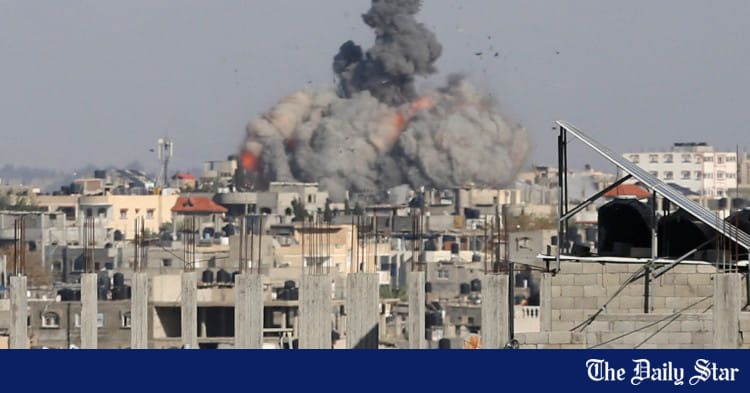
Smoke rises following Israeli strikes, amid the ongoing conflict between Israel and the Palestinian Islamist group Hamas, in Rafah in the southern Gaza Strip May 6, 2024. Photo: Reuters/Hatem Khaled

Israel played down the likelihood of a ceasefire in Gaza on Monday after Hamas said it had accepted a proposal from mediators, even as residents fled the city of Rafah in fear of an Israeli assault.

The last-minute moves towards a ceasefire came as Israeli forces struck Rafah on Gaza's southern edge and ordered residents out of parts of the city, which has served as the last refuge for more than a million displaced Gazans.

Hamas said in a brief statement that its chief, Ismail Haniyeh, had informed Qatari and Egyptian mediators that the group accepted their proposal for a ceasefire.

The Israeli military said all proposals that would release hostages held in Gaza would be considered, while for now its operations were continuing in parallel.

An Israeli official, speaking on condition of anonymity said the proposal that Hamas had accepted was a watered-down version of an Egyptian offer and included elements that Israel could not accept.

"This would appear to be a ruse intended to make Israel look like the side refusing a deal," said the Israeli official, who spoke on condition of anonymity.

An official briefed on the peace talks, also speaking on condition of anonymity, said however that the offer Hamas had accepted was effectively the same as one agreed at the end of April by Israel.

US State Department spokesman Matthew Miller said Washington would discuss the Hamas response with its allies in coming hours, and a deal was "absolutely achievable".

"We want to get these hostages out, we want to get a ceasefire in place for six weeks, we want to increase humanitarian assistance," White House national security spokesperson John Kirby said, adding that reaching an agreement would be the "absolute best outcome".

RAFAH HIT BY STRIKES

Any truce would be the first pause in fighting since a week-long ceasefire in November, during which Hamas freed around half of the hostages its fighters captured in the October 7 attack that precipitated the war.

Since then, all efforts to reach a new truce have foundered over Hamas's refusal to free more hostages without a promise of a permanent end to the conflict, and Israel's insistence that it would discuss only a temporary pause.

Taher Al-Nono, a Hamas official and adviser to Haniyeh, told Reuters the proposal had met the group's demands, including reconstruction efforts in Gaza, the return of displaced Palestinians and a swap of Israeli hostages for Palestinian prisoners held in Israeli jails.

The Hamas deputy chief in Gaza, Khalil Al-Hayya, told Al Jazeera television the proposal included three phases, each of six weeks, with Israel to pull its troops out of Gaza in the second phase.

Earlier on Monday, Israel ordered the evacuation of parts of Rafah, the city on Gaza's southern edge that has served as the last sanctuary for around half of Gaza's 2.3 million residents.

Asked during a media briefing whether Hamas saying it accepted a ceasefire proposal would impact a planned offensive in Rafah, Rear Admiral Daniel Hagari said: "We examine every answer and response in the most serious manner and are exhausting every possibility regarding negotiations and returning the hostages."

"In parallel, we are still operating in the Gaza Strip and will continue to do so," he said.

Israel's closest ally the United States has called on it not to assault Rafah, saying it must not do so without a full plan in place to protect civilians there, which has yet to be presented.

Israel said on Monday it was conducting limited operations on the eastern part of Rafah, following a rocket attack claimed by Hamas fighters that killed four Israeli soldiers at the main border crossing into Rafah the previous day.

"We've asked civilians to move out of harm's way. We've been extremely specific about the areas which we'll be targeting...", government spokesman David Mencer said.

Israeli bombardment of eastern Rafah areas continued throughout the day on Monday.

"They have been firing since last night and today after the evacuation orders the bombardment became more intense because they want to frighten us to leave," Jaber Abu Nazly, a 40-year old father of two told Reuters via a chat app.

"Some families already left, others are wondering whether there is any place safe in the whole of Gaza," he added.

Overnight, Israeli planes had hit 10 houses, killing 20 people, Palestinian medical officials said. The Israeli military said it had struck the site in Rafah from which the previous day's rocket had been launched at its troops.

Instructed by Arabic text messages, phone calls, and flyers to move to what the Israeli military called an "expanded humanitarian zone" around 20 km (12 miles) away, some Palestinian families began trundling away in chilly spring rain.

Some piled children and possessions onto donkey carts, while others left by pick-up or on foot through muddy streets.

Abdullah Al-Najar said this was the fourth time he had been displaced since the fighting began seven months ago, as families dismantled tents and folded belongings.

"God knows where we will go now. We have not decided yet."

Nick Maynard, a British surgeon trying to leave Gaza on Monday, said in a voice message from the Gaza side of the Rafah crossing into Egypt: "Two huge bombs have just gone off immediately outside the crossing. There's a lot of gunfire as well about 100 meters from us. We are very unclear whether we will get out."

"Driving through Rafah, the tension was palpable with people evacuating as rapidly as they could."​
 

US pauses ammunition shipment to Israel for first time since Oct 7: reports
'Concerned' Israeli officials say shipment was meant to include crucial weaponry for IDF'

The Biden administration paused a shipment of US-made ammunition to Israel last week amid the latter's ongoing attack on Gaza, but the reasons for doing so were not clear, according to media outlets in the US and Israel.

Axios broke the news yesterday citing two Israeli officials. According to its report, it is the first time since the October 7 attack on Israel by Hamas that the US has stopped a weapons shipment intended for the Israeli military.

The Jerusalem Post reported that the pause of the shipment sparked concerns and prompted Israeli officials to seek clarification from their American counterparts.

It also said that this was the first pause of shipment from the US to Israel since October 7.

Senior Israeli officials told the newspaper that the shipment was intended to include crucial weaponry for the Israel Defense Forces (IDF), which has killed over 34,000 people–most of them women and children–in Gaza since Hamas's October 7 attack.

Israel is poised to attack the Gaza's southern city of Rafah, where more than 1.5 million people have been driven following Israel's relentless bombing in the northern regions.

Quoting a source familiar with the shipment pause, CNN reported that it is not connected to the potential operation in Rafah and does not affect other shipments moving forward.

Asked about the paused shipment, a National Security Council spokesperson told CNN, "The United States has surged billions of dollars in security assistance to Israel since the October 7 attacks, passed the largest ever supplemental appropriation for emergency assistance to Israel, led an unprecedented coalition to defend Israel against Iranian attacks, and will continue to do what is necessary to ensure Israel can defend itself from the threats it faces."

The Biden administration is facing increasing pressure at home and abroad for its unstinting support to Israel in what has been termed by many rights groups as a genocidal campaign against Palestinians.​
 

US warns Israel that Rafah invasion will jeopardise weapons supply as assault continues

1715234792710.webp

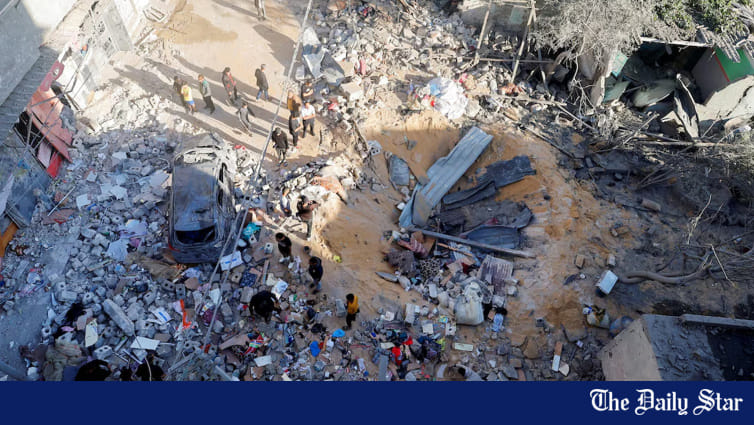
Palestinians inspect the site of an Israeli strike on a house, amid the ongoing conflict between Israel and the Palestinian Islamist group Hamas, in Rafah, in the southern Gaza Strip, May 8, 2024. Photo: Reuters

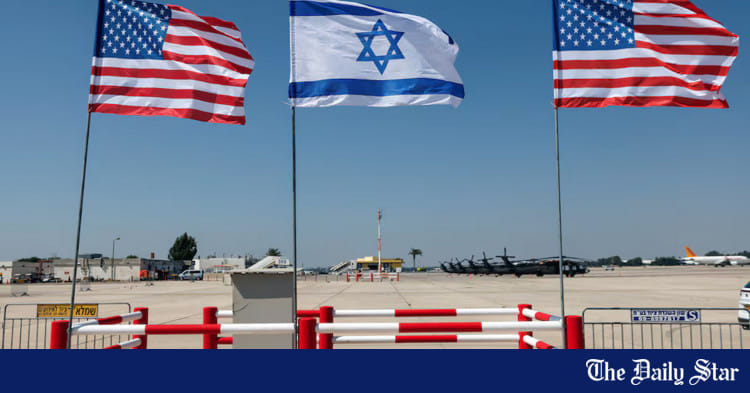
US President Joe Biden for the first time publicly vowed to withhold weapons from Israel if its forces make a major invasion of Rafah in southern Gaza while negotiations in Cairo on a ceasefire plan for the enclave were due to continue on Thursday.

"I made it clear that if they go into Rafah ..., I'm not supplying the weapons," Biden, whose administration has repeatedly asked Israel for its plan to protect civilians in Rafah, said on Wednesday in an interview with CNN.

Biden acknowledged that US bombs provided to Israel have killed Gaza civilians in the seven-month-old offensive aimed at annihilating Hamas.

Biden's comments, his starkest to date, increase the pressure on Israel to refrain from a full-scale assault on Rafah, where hundreds of thousands of Palestinians have sought refuge after fleeing combat farther north in Gaza.

There was no immediate comment from Israel on Biden's remarks, but Israeli Prime Minister Benjamin Netanyahu has said the Rafah operation would go ahead. Israel says it must hit Rafah to defeat thousands of Hamas fighters it says are there.

Israel, meanwhile, continued tank and aerial strikes on southern Gaza after moving in via the Rafah border crossing with Egypt on Tuesday, cutting off a vital aid route.

Biden has been under pressure from his fellow Democrats and growing campus protests to deter Israel from invading Rafah. His support of Israel has become a political liability as the president runs for re-election.

The United States is by far the biggest supplier of weapons to Israel, and it accelerated deliveries after the Hamas attacks on October 7 that triggered Israel's offensive in Gaza. Biden said US weapons for Israel's defense, such as for its Iron Dome anti-missile system, would continue.

US officials confirmed on Wednesday that Washington paused delivery of a shipment of bombs to Israel because of the risk to civilians in Gaza.

Israel's UN ambassador, Gilad Erdan, called that decision "very disappointing" but said he did not believe the US would stop supplying arms to Israel.

TALKS IN CAIRO

Palestinian militant group Hamas said late on Wednesday it would not make more concessions to Israel in the truce talks.

In Cairo, delegations from Hamas, Israel, the US, Egypt and Qatar have been meeting since Tuesday. Citing a source familiar with the matter, Egypt's state-affiliated Al Qahera TV reported early on Thursday that areas of disagreement were being resolved and there were signs that an agreement will be reached, without giving details.

But Izzat El-Reshiq, a member of Hamas' political office in Qatar, said in a statement late on Wednesday that the group would not go beyond a ceasefire proposal it accepted on Monday. It would also entail the release of some Israeli hostages in Gaza and Palestinian women and children detained in Israel.

"Israel isn't serious about reaching an agreement and it is using the negotiation as a cover to invade Rafah and occupy the crossing," said Reshiq.

Israel on Monday declared that the three-phase truce proposal approved by Hamas was unacceptable because terms had been watered down. It did not respond immediately to the Hamas statement.

The US said on Tuesday that Hamas had revised its ceasefire proposal and the revision could overcome an impasse in negotiations. Just a few hours before Hamas' latest statement, Washington continued to say the two sides were not far apart.

"We believe there is a pathway to a deal ... The two sides are close enough they should do what they can to get to a deal," US national security adviser Jake Sullivan told reporters.

The war began when Hamas militants attacked Israel on Oct. 7, killing about 1,200 people and abducting 252 others, of whom 128 remain hostage in Gaza and 36 have been declared dead, according to the latest Israeli figures.

'HUMANITARIAN CATASTROPHE' LOOMS

Hamas said its fighters on Wednesday were battling Israeli forces in Rafah's east and Islamic Jihad's fighters attacked Israeli soldiers and military vehicles with heavy artillery near the city's long abandoned airport.

Israeli tank shells landed in the middle of Rafah wounding at least 25 people on Wednesday, medics said. Residents said an Israeli air strike killed four people and wounded 16 others in western Rafah.

The Israeli military said it troops had discovered Hamas infrastructure in several places in eastern Rafah and were conducting targeted raids in Rafah and airstrikes across the Gaza Strip.

The UN, Gaza residents and humanitarian groups say further Israeli incursion into Rafah will result in a humanitarian catastrophe.

A UN official said no fuel or aid had entered the Gaza Strip due to the military operation, a situation "disastrous for the humanitarian response" in Gaza where more than half the population is suffering catastrophic hunger.

Palestinians have crammed into tented camps and makeshift shelters, suffering from shortages of food, water and medicine.

"The streets of the city echo with the cries of innocent lives lost, families torn apart, and homes reduced to rubble," Rafah Mayor Ahmed Al-Sofi said, appealing to the international community to intervene.​
 

Where do the weapons for the Gaza genocide come from?

1715235415762.webp

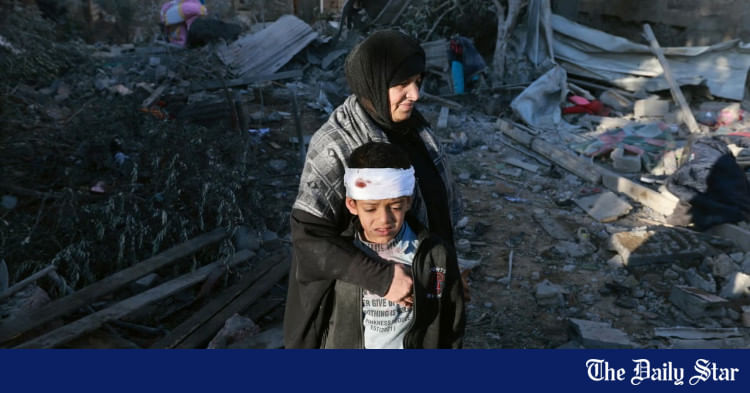
A Palestinian woman and boy check the rubble of a building following Israeli bombardment in Rafah on January 18. PHOTO: AFP

On May 7, Israeli newspaper Haaretz ran a news report on its website, titled "US Slow-rolling Weapons Sale to Israel, Sparking Questions of Policy Shift." What prompted the story was US President Joe Biden's decision to pause a shipment of weapons to Israel last week, apparently in opposition to Israel's decision to invade Rafah, the southern Gaza city where Palestinians have been forced to seek shelter as Israel's genocidal campaign continues to sweep down upon them from the north.

The Biden administration is clearly under some pressure due to Israel's open brutality and murderous campaign against the Palestinians, and because of the ongoing student protests in US universities urging different institutions to end their support for it. However, for experts to even question whether the US is shifting its policy in regard to the Palestine-Israel issue is completely disingenuous.

For starters, it was only two weeks ago that 12 US Republican senators issued a letter to the chief prosecutor of the International Criminal Court, warning that the institution would face "severe sanctions" if it issued arrest warrants against Israeli Prime Minister Benjamin Netanyahu and any other Israeli officials. And their threats were quite clear, "If you move forward with the measures indicated in the report, we will move to end all American support for the ICC, sanction your employees and associates, and bar you and your families from the United States. You have been warned," the letter read.

Secondly, as The Washington Post reported in March, the Biden administration has "quietly approved and delivered more than 100 separate foreign military sales to Israel since the Gaza war began" on October 7. And the military hardware provided to Israel includes "thousands of precision-guided munitions, small-diameter bombs, bunker busters, small arms and other lethal aid." These sales, of course, were separate to the ones the Biden administration already gave greenlight to by bypassing Congress as emergency weapons sales to Israel. And the way they were initiated is even more interesting.

According to The Guardian, the Biden administration managed to make these deliveries without Congressional oversight because each transaction was made so small that they did not require Congressional approval. Hence, most of these sales were made without Congress or the public knowing about them—at least up until a point. "This doesn't just seem like an attempt to avoid technical compliance with US arms export law; it's an extremely troubling way to avoid transparency and accountability on a high-profile issue," said Ari Tolany, director of the security assistance monitor at the Centre for International Policy.

It is a known fact that the US is by far the biggest supplier of arms to Israel. According to the Stockholm International Peace Research Institute, the US accounted for 69 percent of Israel's imports of major conventional arms between 2019 and 2023. Moreover, the US also provides Israel with $3.8 billion in annual military aid under a 10-year agreement so that Israel can "maintain" a "qualitative military edge" over its neighbours—or wipe out the rest of the Palestinian population. After the US comes Germany, which provides 30 percent of Israel's arms import, followed by other countries who provide the rest one percent. In other words, the US and Germany account for nearly all of Israel's weapons imports.

The fact that these are the same weapons that are being used to at least initiate an ethnic cleansing of the Palestinians is also well-known. In a recent report, the Human Rights Watch conclusively showed that US weapons were used by Israel on an emergency and relief centre in south Lebanon on March 27, 2024, to kill aid workers even.

So, for it to be asked whether the US is shifting its policy towards Israel because of the suspension of just one weapon shipment is a joke. The likely reason why the US has suspended this shipment is because of a highly anticipated report on whether Israel is using US military aid in compliance with international law, which the Biden administration is set to delay. Rights groups have been urging the US administration to make this report public. And given the sway in American public sentiment in sympathy for Palestinians—as apparent from the student movement—the Biden administration is probably reluctant to add more fuel to the fire.

Even if the report can be tampered with to downplay just how guilty Israel has been in its use of these weapons and the number of international laws that it has broken can be brought down, there is no way of showing Israel as fully innocent. So, the Biden administration is simply trying to appease some of the protesters and take the heat off of itself through its latest decision, which is nothing short of an attempt to deceive the public.

But ultimately, no matter the optics, the US can, in no way, wash its hands off Palestinian blood which continues to flow, by acting as Israel's primary arms factory that provides the weapons that is allowing Israel to wage its genocidal campaign against the Palestinians.

Eresh Omar Jamal is deputy editor of editorial and opinion at The Daily Star.​
 

OIC denounces Gaza genocide, urges sanctions against Israel
Agence France-Presse . Banjul, Gambia 06 May, 2024, 22:57

1715236530843.webp

Students are seen in their encampment outside the Helsinki University in Helsinki, Finland, as they demonstrate in solidarity with the Palestinian people and demand boycott against Israeli universities, on Monday. | AFP photo

The Organisation of Islamic Cooperation on Sunday denounced a 'genocide' in Gaza, urging its 57 member countries to impose sanctions on Israel in a resolution adopted at the end of its Gambia summit.

The organisation called on its members to impose 'sanctions on Israel, the occupying power, and halting the export of weapons and ammunition used by its army to perpetrate the crime of genocide in Gaza'.

Sunday's resolution, seen by AFP, urged members 'to exercise diplomatic, political and legal pressure and to take any deterrent measures to stop the crimes of the Israeli colonial occupation, and the genocidal war it is waging against the Palestinian people, including by imposing sanctions'.

It also called for 'an immediate, permanent and unconditional ceasefire'.

Founded in 1969 after the burning of the al-Aqsa mosque in Jerusalem, the OIC aims to increase Muslim solidarity, support the Palestinian struggle and defend Muslim holy sites.

In November 2023, it met with the Arab League in Riyadh for a joint summit, condemning the actions of Israeli forces in Gaza, but refraining from setting out punitive economic and political measures against Israel.

But in December 2023, the OIC welcomed the action brought by South Africa against Israel at the International Criminal Court in which it accused it of genocide against the Palestinians.

The 15th OIC summit, which started Saturday, focussed on Egypt's capital Cairo, where a meeting on a proposed truce, linked to the release of hostages in Gaza, was held this weekend without any concrete progress.

Only a handful of African leaders attended the OIC summit in person, most leaders of the 57 member countries sending representatives.

Gaza's bloodiest-ever war began following Hamas's unprecedented October 7 attack on Israel that resulted in the deaths of more than 1,170 people, mostly civilians, according to an AFP tally of Israeli official figures.

Vowing to destroy Hamas, Israel's retaliatory offensive has killed at least 34,683 people in Gaza, mostly women and children, according to the Hamas-run territory's health ministry.​
 

Members Online

No members online now.

Latest Posts

Back
PKDefense - Recommended Toggle