Home Watch Videos Wars Movies Login

[🇧🇩] Israel and Hamas war in Gaza-----Can Bangladesh be a peace broker?

Latest Posts Countries Wars Q&A

[🇧🇩] Israel and Hamas war in Gaza-----Can Bangladesh be a peace broker?
963
28K
More threads by Saif

G Bangladesh Defense

Gaza talks at critical moment, ceasefire not complete, Qatar's prime minister says

REUTERS

Published :
Dec 06, 2025 19:26
Updated :
Dec 06, 2025 19:26

1765069728995.webp

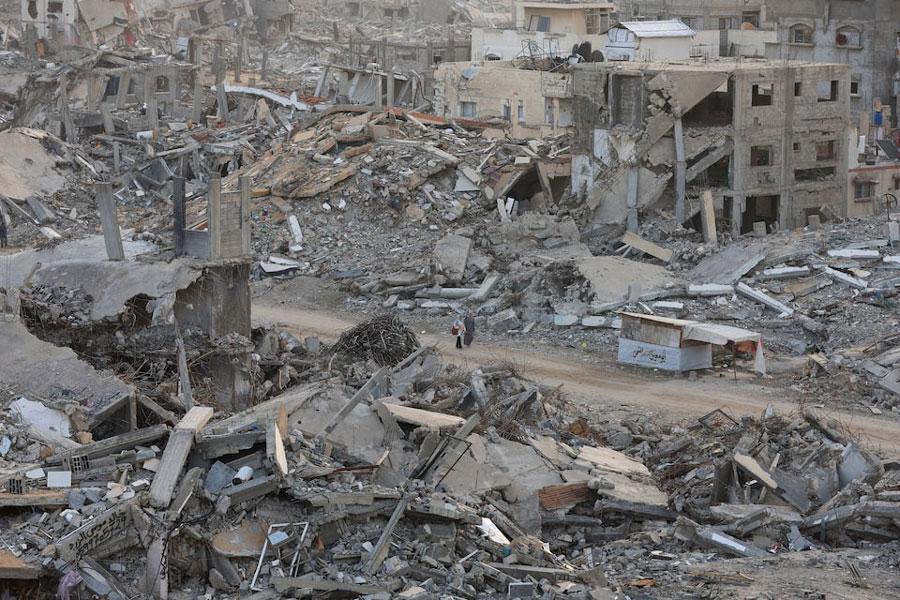
Palestinian women walk among piles of rubble and damaged buildings, in Gaza City, November 24, 2025. Photo : REUTERS/Dawoud Abu Alkas

Negotiations on consolidating the US-backed truce in the war in Gaza are at a "critical" moment, Qatari Prime Minister Sheikh Mohammed bin Abdulrahman al-Thani said on Saturday.

Mediators are working to force the next phase of the ceasefire forward, al-Thani, whose country has been a key mediator in the war, said during a panel discussion at the Doha Forum conference in Qatar.

Violence has subsided but not stopped since the Gaza truce took effect on October 10.

"We are at a critical moment. It's not yet there. So what we have just done is a pause," al-Thani said.

"We cannot consider it yet a ceasefire. A ceasefire cannot be completed unless there is a full withdrawal of the Israeli forces - (until) there is stability back in Gaza, people can go in and out - which is not the case today."

Talks on achieving the next stages of U.S. President Donald Trump's plan to end the two-year war in the Palestinian enclave have been continuing.

The plan calls for an interim technocratic Palestinian government in Gaza, overseen by an international "board of peace" and backed by an international security force. Agreeing on the makeup and mandate of that force has been particularly challenging.

On Thursday, an Israeli delegation held talks in Cairo with mediators on the return of the last hostage held in Gaza, which would complete an initial part of Trump's plan.

Since the truce started, Hamas has returned all 20 living hostages and 27 bodies in exchange for around 2,000 Palestinian detainees and convicted prisoners.

Although fighting has diminished, Israel has continued to attack Gaza and demolish what it says is Hamas infrastructure. Hamas and Israel have traded blame for violations.

On Saturday, the Israeli military said that its forces, deployed behind the so-called yellow line of withdrawal agreed in the ceasefire, had opened fire on Palestinian militants who had crossed the line, killing three.

There were no immediate details from Gaza health authorities on the incident or the identities of those killed.​
 
Analyze

Analyze Post

Add your ideas here:
Highlight Cite Respond

Qatar, Egypt call for next steps in Gaza truce
Agence France-Presse . Doha, Qatar 07 December, 2025, 00:26

1765072304897.webp

A Palestinian girl carries a bag of bread as others, many of whom are part of displaced families, gather in the yard of the UNRWA Deir al-Balah Joint School, west of Deir al-Balah, in the central Gaza on Saturday. | AFP photo

Qatar and Egypt, guarantors of the Gaza ceasefire, on Saturday called for the withdrawal of Israeli troops and the deployment of an international stabilisation force as the necessary next steps in fully implementing the fragile agreement.

The measures were spelt out in the US- and UN-backed peace plan that has largely halted the fighting in the Palestinian territory, though the warring parties have yet to agree on how to move forward from the deal’s first phase.

Its initial steps saw Israeli troops pull back behind a so-called ‘yellow line’ within Gaza’s borders, while Palestinian militant group Hamas released the living hostages it still held and handed over the remains of all but one of the deceased.

‘Now we are at the critical moment... A ceasefire cannot be completed unless there is a full withdrawal of the Israeli forces, [and] there is stability back in Gaza,’ Qatari PM Sheikh Mohammed bin Abdulrahman Al Thani told the Doha Forum, an annual diplomatic conference.

Qatar, alongside Egypt and the United States, helped secure the long-elusive truce in Gaza, which came into effect on October 10 and has mostly halted two years of fighting between Israel and Hamas.

Under a second phase of the deal, which has yet to begin, Israel is to withdraw from its positions in the territory, an interim authority is to take over governance, and an international stabilisation force is to be deployed.

‘We need to deploy this force as soon as possible on the ground because one party, which is Israel, is every day violating the ceasefire,’ said Egypt’s foreign minister Badr Abdelatty, also speaking at the Doha Forum.

Arab and Muslim nations, however, have been hesitant to participate in the new force, which could end up fighting Palestinian militants.

Turkey’s foreign minister Hakan Fidan told the forum that talks on the force were ongoing, with critical questions remaining as to its command structure and which countries would contribute.

But its first goal, Fidan said, ‘should be to separate Palestinians from the Israelis’.

‘This should be our main objective. Then we can address the other remaining issues,’ he added.

Abdelatty seconded the idea, calling for the force to be deployed along ‘the yellow line in order to verify and to monitor’ the truce.

There have been multiple deadly incidents of Israeli forces firing on Palestinians in the vicinity of the yellow line since the ceasefire went into effect.

Hamas is supposed to disarm under the 20-point plan first outlined by US President Donald Trump, with members who decommission their weapons allowed to leave Gaza. The militant group has repeatedly rejected the proposition.

Turkey, which is also a guarantor of the truce, has indicated it wants to take part in the stabilisation force, but its efforts are viewed unfavourably in Israel, which considers Ankara too close to Hamas.

Fidan later said at the Doha Forum that the disarmament of Hamas should not be the main priority in Gaza.

‘That cannot be the first thing to do in the process, the disarming. We need to put things in [their] proper order, we have to be realistic,’ he said.

He also urged the US to intervene with Israel’s Prime Minister Netanyahu to ensure the plan succeeds. ‘If they don’t intervene, I’m afraid there is a risk the plan can fail,’ Fidan said.

‘The amount of daily violations of the ceasefire by the Israelis is indescribable at the moment and all indicators are showing that there is a huge risk of stopping the process,’ he added.

Sheikh Mohammed said Qatar and the other truce guarantors were ‘getting together in order to force the way forward for the next phase’ of the deal.

‘And this next phase is just also temporary from our perspective,’ he said, calling for a ‘lasting solution that provides justice for both people’.

The ceasefire plan calls for Gaza’s vital Rafah crossing on the border with Egypt to be reopened to allow in aid—a goal shared by humanitarian actors.

Israel this week said it would open the checkpoint, but ‘exclusively for the exit of residents from the Gaza Strip to Egypt’.

Egypt swiftly denied that it had agreed to such a move, insisting the crossing be opened in both directions.

Israel’s announcement drew expressions of concern from several Muslim-majority nations, who said they opposed ‘any attempts to expel the Palestinian people from their land’.

Abdelatty insisted on Saturday that Rafah ‘is not going to be a gateway for displacement. It’s only for flooding Gaza with humanitarian and medical care’.​
 
Analyze

Analyze Post

Add your ideas here:
Highlight Cite Respond

Netanyahu says he will not quit politics if he receives a pardon

REUTERS
Published :
Dec 07, 2025 21:59
Updated :
Dec 07, 2025 21:59

1765154936647.webp


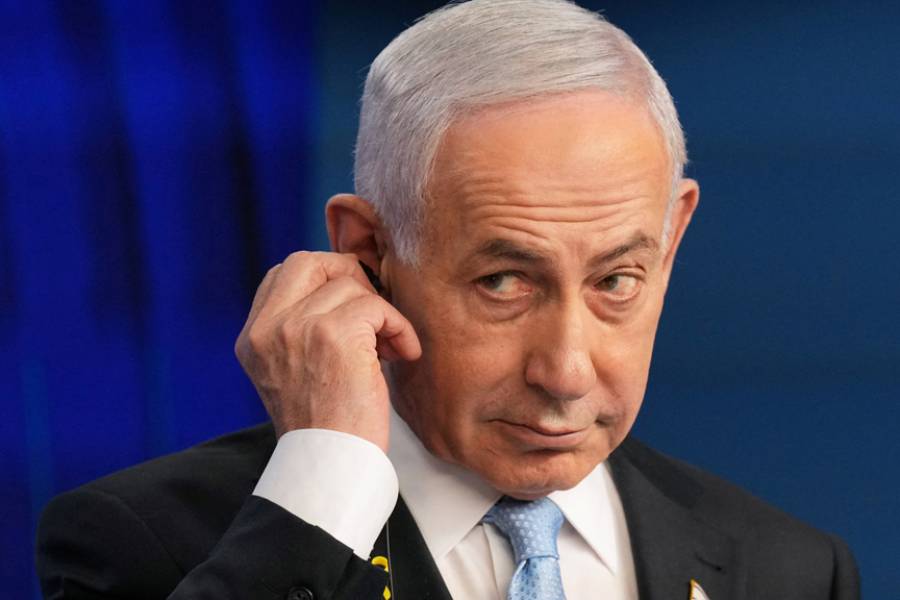
Israeli Prime Minister Benjamin Netanyahu adjusts the headphones during a joint press conference with German Chancellor Friedrich Merz (not pictured) in Jerusalem Sunday, Dec. 7, 2025. Photo : Ariel Schalit/Pool via REUTERS

Israeli Prime Minister Benjamin Netanyahu said on Sunday that he would not retire from politics if he receives a pardon from the country’s president in his years-long corruption trial.

Asked by a reporter if planned on retiring from political life if he receives a pardon, Netanyahu replied: “no”.

Netanyahu last month asked President Isaac Herzog for a pardon, with lawyers for the prime minister arguing that frequent court appearances were hindering Netanyahu’s ability to govern and that a pardon would be good for the country.

Pardons in Israel have typically been granted only after legal proceedings have concluded and the accused has been convicted. There is no precedent for issuing a pardon mid-trial.

Netanyahu has repeatedly denied wrongdoing in response to the charges of bribery, fraud and breach of trust, and his lawyers have said that the prime minister still believes the legal proceedings, if concluded, would result in a complete acquittal.

US President Donald Trump wrote to Herzog, before Netanyahu made his request, urging the Israeli president to consider granting the prime minister a pardon.

Some Israeli opposition politicians have argued that any pardon should be conditional on Netanyahu retiring from politics and admitting guilt. Others have said the prime minister must first call national elections, which are due by October 2026.​
 
Analyze

Analyze Post

Add your ideas here:
Highlight Cite Respond

Hamas says no Gaza truce second phase
Israel ‘continues violations’

1765329579249.webp

AFP photo

Hamas said on Tuesday that the Gaza ceasefire plan cannot proceed to its second phase as long as Israeli ‘violations’ persist and called on mediators to pressure Israel to respect the agreement.

The US-sponsored ceasefire, in effect since October 10, halted the war that began after Hamas’s deadly attack on Israel on October 7, 2023. But it remains fragile as Israel and Hamas accuse each other almost daily of breaches.

Meanwhile, an Israeli official said that authorities would allow the Allenby crossing on the Israeli-controlled border between Jordan and the occupied West Bank to reopen on Wednesday to aid trucks destined for Gaza for the first time since late September.

Hamas political bureau member Hossam Badran accused Israel of failing to respect the Gaza ceasefire deal, noting that under its terms, Israel should have reopened the Rafah crossing with Egypt and increased the volume of aid entering the territory.

He urged the mediators, who include Egypt, Qatar and the United States, to pressure Israel ‘to complete the implementation of the first phase of the ceasefire agreement’.

Under the terms of the deal, Palestinian militants committed to releasing the remaining 48 living and dead captives held in the territory. All of the hostages have so far been released except for one body.

In exchange, Israel has released nearly 2,000 Palestinian prisoners in its custody and returned the bodies of hundreds of dead Palestinians.

The first phase of the truce also stipulates that significantly more aid enter Gaza.

Israeli prime minister Benjamin Netanyahu has said he expects the second phase of the deal to begin soon but Badran said it could not start ‘as long as the occupation Israel continues its violations’.

In the announcement of the opening of Allenby crossing, the Israeli official said in a statement that ‘aid trucks destined for the Gaza Strip will proceed under escort and security, following a thorough security inspection’.

Israel closed the crossing in the Jordan Valley, also known as the King Hussein Bridge, after a Jordanian truck driver shot dead an Israeli soldier and a reserve officer at the border in September.

Israel mostly reopened the crossing to travellers a few days later, but not to humanitarian aid destined for the Gaza Strip, which has been left devastated by more than two years of war.

Under the initial steps of the ceasefire plan, Israeli troops withdrew to positions behind a so-called ‘Yellow Line’ in Gaza, though they remain in control of more than half of the territory.

Israel’s military chief, Lieutenant General Eyal Zamir, was quoted as saying on Sunday that the demarcation line was the ‘new border line’.

Badran on Tuesday slammed Zamir’s comments. ‘The statements clearly reveal the criminal occupation’s lack of commitment to the ceasefire agreement,’ he said.

The second stage of the truce plan concerns disarming Hamas, the further withdrawal of Israeli forces as a transitional authority is established, and the deployment of an international stabilisation force.

Israel has said the next phase cannot begin until the body of the last Gaza captive, the Israeli Ran Gvili, is handed over.

A final goal of the agreement is the withdrawal of Israeli forces from Gaza in phases if certain conditions are met.

Hamas has said it is ready to hand over its weapons to the government of a future Palestinian state on the condition that the Israeli occupation ends.

The Gaza war was sparked by Hamas’s October 7, 2023 attack on Israel, which resulted in the deaths of 1,221 people.

Israel’s retaliatory assault on Gaza has killed at least 70,366 people, according to figures from the territory’s health ministry that the United Nations considers reliable.

The ministry says since the ceasefire came into effect, 377 Palestinians have been killed by Israeli fire. Israel’s military has reported three soldiers killed during the same period.​
 
Analyze

Analyze Post

Add your ideas here:
Highlight Cite Respond

Desperate Gazans pull iron bars from rubble to construct tents and scratch out a living

REUTERS
Published :
Dec 12, 2025 00:15
Updated :
Dec 12, 2025 00:22

1765500266087.webp

Palestinian workers break concrete to extract steel bars from destroyed homes, relying only on simple hand tools amid a severe shortage of construction materials caused by long-standing restrictions on the entry of cement and iron, in Khan Younis in the southern Gaza Strip, Dec 9, 2025. Photo : REUTERS/Haseeb Alwazeer

As winter bites in Gaza, displaced Palestinians set out every day to homes destroyed by Israel. There they rip out iron rods from the walls and use them to prop up their flimsy tents or sell to scratch out a living in an enclave that will take years to recover from war.

The rods have become a hot item in Gaza, where they are twisted up in the wreckage left by an Israeli military campaign that spared few homes. Some residents spend days pounding away at thick cement to extract them, others do the back-breaking work for a week or more.

With only rudimentary tools such as shovels, pickaxes and hammers, work proceeds at a snail's pace.

UN SAYS WAR GENERATED 61 MILLION TONNES OF RUBBLE

Once the bars helped hold up cement walls in family homes, today they are destined for urgently-needed tents as temperatures at night fall. Heavy rainstorms have already submerged many Gazans' meagre belongings, adding to their misery.

Palestinian father-of-six Wael al-Jabra, 53, was putting together a makeshift tent, trying to hammer together two steel bars.

"I don’t have money to buy wood, of course. So, I had to extract this iron from the house. The house is made of five floors. We don’t have anything apart from God and this house that was sheltering us," he said.

In November, the UN Development Programme said that the war in Gaza had generated 61 million tonnes of rubble, citing estimates based on satellite imagery.

Most of it can be cleared within seven years under the right conditions, it said.

A ROD CAN COST $15

A 10-metre metal rod costs displaced families $15 - a steep amount because many barely have cash.

The Palestinian militant group Hamas triggered the conflict after attacking Israel on Oct 7, 2023, killing 1,200 people and taking 251 back to Gaza as hostages, according to Israeli calculations. Israel responded with a military campaign that killed over 70,000 people and laid waste to Gaza.

Carrying heavy buckets of rubble and pushing a wheelbarrow, Suleiman al-Arja, 19, described a typical day in the quest for iron rods.

"We pass by destroyed houses and agree with the house owner. He gives us a choice, whether to clean the house (clear the rubble) in exchange for iron or clean the house for money. We tell him that we want the iron and we start breaking the iron. As you can see, we spend a week, sometimes a week and a half," he said.

FOCUS IS ON DAILY STRUGGLE TO LIVE

US President Donald Trump promised to put together an international stabilisation force and an economic development plan to rebuild and energise Gaza, which was impoverished even before the war. Palestinians in Gaza can't look so far ahead even though a ceasefire was reached in October. Every day is a struggle for Palestinians who have seen peace plans come and go over many decades.

Their minds are focused on finding ways to survive, every single day.

"We do this work to get our food and drink, to cover our living expenses and not need anyone, so we earn a living through halal (legitimate) means and effort. These are my hands," said Haitham Arbiea, 29.

Palestinians accuse Israel of depriving Gaza of the iron bars.

An Israeli official told Reuters that construction materials are considered dual use items - items for civilian but also potential military use - and will not be allowed into Gaza until the second phase of the US-led peace plan. The official cited concerns that the materials could be used for the building of tunnels, which have been used by Hamas.​
 
Analyze

Analyze Post

Add your ideas here:
Highlight Cite Respond

Hamas proposes weapons ‘freeze’ in return for long-term truce
Agence France-Presse . Doha, Qatar 11 December, 2025, 23:10

A top Hamas leader told Qatari news channel Al Jazeera on Wednesday that the militant group is open to a weapons ‘freeze’, but rejects the demand for disarmament put forward in the US-sponsored peace plan for Gaza.

‘The idea of total disarmament is unacceptable to the resistance (Hamas). What is being proposed is a freeze, or storage (of weapons) to provide guarantees against any military escalation from Gaza with the Israeli occupation,’ said Khaled Mishaal in an interview aired Wednesday.

‘This is the idea we’re discussing with the mediators, and I believe that with pragmatic American thinking such a vision could be agreed upon with the US administration,’ he said.

The US-sponsored ceasefire deal, in effect since October 10, halted the war that began after Hamas’s deadly attack on Israel on October 7, 2023. But it remains fragile as Israel and Hamas accuse each other almost daily of breaches.

The agreement is composed of three phases. Israeli prime minister Benjamin Netanyahu recently indicated that it was about to enter the second phase.

Under that phase Israeli troops would further withdraw from their positions in Gaza and be replaced by an international stabilisation force, while Hamas would lay down its weapons.

Netanyahu is expected to meet with US president Donald Trump in the US later this month to discuss the steps forward in the truce.

But the Palestinian militant group has indicated it would not agree to giving up its arsenal.

‘Disarmament for a Palestinian means stripping away his very soul. Let’s achieve that goal another way,’ Meshaal added.

In the first phase of the deal Palestinian militants committed to releasing the remaining 48 living and dead captives held in the territory. All of the hostages have so far been released except for one body.

In exchange, Israel has released nearly 2,000 Palestinian prisoners in its custody and returned the bodies of hundreds of dead Palestinians.

As for the international peacekeeping force, Meshaal said the group was open to its deployment along Gaza’s border with Israel, but would not agree to it operating inside the Palestinian territory, calling such a plan an ‘occupation’.

‘We have no objection to international forces or international stabilisation forces being deployed along the border, like UNIFIL,’ he said, referring to the UN peacekeeping force deployed in southern Lebanon near the Israeli border.

‘They would separate Gaza from the occupation,’ he added, referring to Israel.

‘As for the presence of international forces inside Gaza, in Palestinian culture and consciousness that means an occupying force.’

Mediators as well as Arab and Islamic nations, he said, could act as ‘guarantors’ that there would be no escalation originating from inside Gaza.

‘The danger comes from the Zionist entity, not from Gaza,’ he added, referring to Israel.​
 
Analyze

Analyze Post

Add your ideas here:
Highlight Cite Respond

Tony Blair and the reduction of Gaza to a political laboratory

1765674966181.webp

The first and most important conclusion from Blair being dropped is improvisation and haste policies, as if the Gaza Strip is a field of experiments in which formulas, initiatives and even players change from day to day. FILE PHOTO: AFP

For months, former UK Prime Minister Tony Blair's role has been lobbying US President Donald Trump's son-in-law, Jared Kushner, to head a "temporary transitional authority in Gaza." The former UK PM's intense interest in taking the leadership role of a "governor of Gaza" was a red flag from the start. The Tony Blair Institute for Global Change (TBI) drew up a plan behind the scenes with Jared Kushner, who publicly stated that Gaza's "waterfront property could be very valuable." Tony Blair amassed an empire of wealth unlike any other former UK PM since leaving office, through an overlapping web of charities, advisory positions, firms, and foundations, and thus became one of the wealthiest people in the UK.

Many Western political leaders have had shady careers, but Blair has proven to be a self-serving opportunist who injects himself wherever there is a shot to become relevant in the global political scene. His involvement in the "Gaza peace plan" was in the least interest of the Palestinian people, who are being killed mercilessly in the Gaza Strip. Blair's plan revealed a hierarchy in which an international board of billionaires and businesspeople sit at the top, a long-known tactic of his to mix private enrichment with so-called "public service" for the Palestinians. Blair sees business opportunities beneath the rubble of Gaza.

In the many periods in which he held the positions of power, Blair turned British politics into a follower of US imperialist politics to serve his own interests and position himself as a loyal lobbyist for US foreign policies. Even as PM, Blair unwaveringly supported George W Bush's plan to invade Iraq. It is even documented that Blair wrote a private note to Bush in 2002, saying, "I will be with you, whatever." The chair of Blair's own intelligence committee at the time had questioned the evidence of "weapons of mass destruction" in Iraq. However, Blair admitted that he wanted to ensure he was the US's first partner of choice. He subordinated his own government to the goals of the Bush administration. Prominent British politicians such as Jeremy Corbyn had long accused Blair of war crimes. Tony Blair's involvement must be blocked immediately because his history of corruption and failure poses a risk to the Trump administration's political timeline as it tries to manage the crisis in Gaza for its own benefit.

Right after he left office as PM, Blair's impulses behind the US invasion of Iraq led to his appointment as representative of the Quartet to salvage the peace process between Israel and Palestine, which had begun to show signs of dying and had reached the brink of inevitable collapse. The Quartet committee consisted of the US, Russia, the European Union, and the United Nations.

During his job as Middle East envoy, Blair lobbied for the development of an oil field off the Gaza Strip, which would be owned and operated by British Gas. He proposed economic policies that would benefit JP Morgan, where Blair was also serving as an adviser, and drew a salary of two million pounds per year. He intrepidly used his position to make financial gains for himself, his initiatives and those of his family's as well. In 2010, Blair used his access to Middle Eastern people of power to help his wife, Cherie Blair, raise funds for her charitable initiatives worldwide, including in Bangladesh, showing further conflict of interest.

When Israel launched a brutal war against Palestinians in Gaza in 2009, Blair, the Middle East envoy to negotiate peace for "Palestinian statehood", was silent and was said to be on holiday. It was later revealed that he was, at the time, meeting the Israeli defence minister. All that Blair did, unsurprisingly, benefited Israel's interests. While Gaza was in rubble, he received $1 million from Tel Aviv University for his "exceptional leadership." Later in 2011, Blair created a proposal, which championed dropping Palestinians' calls for an end to illegal occupation and instead demanded that Palestinians recognise Israel as a "Jewish state." Two years later, Blair hired Netanyahu's former aide as his own private consultant, ruining his credibility that he could undertake any neutral position in the peace process. Blair's career in the Middle East went hand-in-hand with US-Israeli policies, demonstrating a fusion of his business dealings and diplomatic dealings to profit off the backs of Palestinians.

Blair's history made many in the Middle East reserved about the US administration's choice of him as a front for their effort regarding Gaza, which finally led to his recent removal from the main executive position. The first and most important conclusion from Blair being dropped is improvisation and haste policies, as if the Gaza Strip is a field of experiments in which formulas, initiatives and even players change from day to day. Improvisation and haste positioned Blair as the CEO of the most important political project on the basis of which the future of the Middle East will be determined. The lack of sufficient consultation with those concerned, such as the partners of the US administration's project, is reflected in what happened to Blair being dropped as a major figure from the "peace council" before he began his work in Gaza. Blair's supposed appointment and quiet dismissal point to a fragile and bleak plan of field testing politics in Gaza, the result of which can lead to further uncertainty about what will happen to the region, and most importantly, the self-determination of Palestinians.

Yousef SY Ramadan is the ambassador of Palestine to Bangladesh.​
 
Analyze

Analyze Post

Add your ideas here:
Highlight Cite Respond

Hamas says weapons are ‘legitimate right’
Agence France-Presse . Doha, Qatar 14 December, 2025, 22:29

1765763093943.webp

Palestinian Ahmed Al-Mabhuh collects breeze blocks salvaged from the rubble of his destroyed home to build a shelter for his family ahead of winter in the Bureij refugee camp in the central Gaza Strip on Sunday. | AFP photo

Hamas’s Gaza chief Khalil al-Hayya said on Sunday that the militant group had a ‘legitimate right’ to hold weapons and that any proposal for the next phases of the Gaza ceasefire must uphold that right.

‘Resistance and its weapons are a legitimate right guaranteed by international law and are linked to the establishment of a Palestinian state,’ Hayya said in a televised address on Hamas-run Al-Aqsa TV.

‘We are open to studying any proposals that preserve this right while guaranteeing the establishment of a Palestinian state.’

The US-sponsored ceasefire, in effect since October 10, halted the war that began after Hamas’s deadly attack on Israel on October 7, 2023. But it remains fragile as Israel and Hamas accuse each other almost daily of violations.

The agreement is composed of three phases. In the first phase of the deal, Palestinian militants committed to releasing the remaining 48 living and dead captives held in the territory.

So far they have released all of the hostages except for one body.

Under the second phase Israeli troops would further withdraw from their positions in Gaza and be replaced by an international stabilisation force, while Hamas would lay down its weapons.

The third phase includes the reconstruction of the vast areas of Gaza levelled by Israel’s retaliatory military campaign.

Hayya also confirmed the head of the group’s weapons production was killed in an Israeli strike in the Gaza Strip the day before.

‘The Palestinian people are currently going through difficult times and suffering greatly with the martyrdom of more than 70,000 people, the latest of whom was the mujahid commander Raed Saad and his companions.’

Israel announced on Saturday that it had killed Saad, describing him as ‘one of the architects’ of the October 2023 attack.​
 
Analyze

Analyze Post

Add your ideas here:
Highlight Cite Respond

Members Online

Latest Posts

Back
 
G
O
 
H
O
M
E