Wars 2023 10/08 Monitoring the Israel and Lebanon War

Wars 2023 10/08 Monitoring the Israel and Lebanon War
237
11K
More threads by Saif

G War Archive

Lebanon president vows to stop war with Israel
Agence France-Presse . Beirut, Lebanon 19 May, 2026, 01:24

Lebanese president Joseph Aoun said Monday that he would do the ‘impossible’ in order to stop the war with Israel, after a ceasefire and direct talks between the countries failed to end the fighting.

Aoun’s comments came as the Israeli army carried out a series of strikes in south Lebanon, while Hezbollah said it had struck a military target in northern Israel.

Since the start of the ceasefire on April 17, Israel has continued to launch strikes, carry out demolitions and issue evacuation orders in south Lebanon, saying it is targeting Iran-backed armed group Hezbollah.

Hezbollah has also maintained its operations against Israeli forces in south Lebanon and northern Israel.

‘The framework that Lebanon has set for the negotiations consists of an Israeli withdrawal, a ceasefire, the deployment of the army along the border, the return of the displaced, and economic aid,’ Aoun said in a statement Monday.

‘My duty, based on my position and my responsibility, is to do the impossible, and to choose what is least costly, in order to stop the war against Lebanon and its people,’ he added.

Last week the truce was extended for 45 days following a third round of talks between Lebanese and Israeli representatives in Washington, discussions which Hezbollah is opposed to.

But the ceasefire has failed to stop the violence, with Hezbollah on Monday saying it had fired a drone at a military target in northern Israel.

The target was ‘an Iron Dome platform belonging to the Israeli enemy army’ based in a military encampment in northern Israel, Hezbollah said, referring to Israel’s air defence system.

The attack was a response to Israeli ‘violations’ of the ceasefire, it added.

Lebanon’s state-run National News Agency reported a series of Israeli strikes across the south.

The Israeli military also issued an evacuation warning for three southern Lebanese towns.

The attacks came a day after Israeli strikes killed seven people in Lebanon, including a member of the group Palestinian Islamic Jihad in the country’s northeast, far from the Israel-Lebanon border.

Israeli soldiers have invaded and occupied a swathe of south Lebanon, operating inside an Israeli-declared ‘yellow line’ that runs around 10 kilometres north of the border. They have carried out large-scale demolitions in the area.

Israeli prime minister Benjamin Netanyahu said on Sunday his country was ‘facing the challenge of neutralising first-person view drones’, as Hezbollah has increasingly made use of the tech to strike Israeli forces.

Israeli attacks have killed more than 2,900 people in Lebanon since the start of the war, including more than 400 since the ceasefire took effect on April 17, according to Lebanese authorities.​
 

Israeli strike damages hospital in south Lebanon
Agence France-Presse . Beirut, Lebanon 22 May, 2026, 01:26

Lebanon said an Israeli strike on Thursday damaged a hospital in the country’s south, where Israel and Hezbollah have been trading fire despite a ceasefire.

The state-run National News Agency reported that Israeli aircraft ‘launched two strikes on the town of Tibnin near the public hospital, where significant damage was recorded’.

The health ministry circulated a video showing part of the hospital with shattered glass on the floor, blown-out ceiling panels and window panes, and other damage to what appeared to be offices.

According to the ministry, 16 hospitals have been damaged since the war erupted on March 2, while 116 emergency and health workers have been killed.

The NNA also reported Israeli airstrikes on other south Lebanon locations on Thursday, while an AFP photographer saw smoke rising after a raid on the village of Hanniyeh.

Hezbollah claimed a series of attacks including with rockets and drones on Israeli troops in south Lebanon, saying they came in retaliation for Israeli ceasefire violations.

Since the truce began on April 17, Israel has continued to launch strikes, carry out demolitions and issue evacuation orders in south Lebanon, saying it is targeting Hezbollah, which has also kept up attacks.

Last week the truce was extended for 45 days following a third round of direct talks between Lebanese and Israeli representatives in Washington, discussions which the Iran-backed Hezbollah staunchly opposes.

Under the terms of the ceasefire published by Washington, Israel reserves the right to act against ‘planned, imminent or on-going attacks’.

Lebanon’s health ministry said Thursday that Israeli attacks have killed at least 3,089 people in Lebanon since March 2.

The ministry said Wednesday that a strike on the town of Deir Qanun al-Nahr this week killed 14 people, including three women and four children, one of them Syrian, updating a preliminary toll of 10 dead.

Hezbollah drew Lebanon into the Middle East war with rocket fire at Israel in retaliation for the killing of Iran’s supreme leader in US-Israeli strikes.

Israeli responded with massive airstrikes and a ground invasion in the country’s south, where its troops are operating inside an Israeli-declared ‘yellow line’ running around 10 kilometres inside Lebanon along the border.​
 

Israel hits Lebanon despite ceasefire
Agence France-Presse . Beirut, Lebanon 24 May, 2026, 01:09

Israel struck south Lebanon on Saturday despite a ceasefire as Hezbollah said its backer Tehran had pledged not to abandon the militant group.

Hezbollah said its chief Naim Qassem had received a message from Iran’s foreign minister Abbas Araghchi, saying the latest proposal through Pakistani mediators aimed ending the regional war emphasised ‘the demand to include Lebanon’ in the broader ceasefire.

Lebanese authorities, however, have insisted the country’s on-going talks with Israel under US auspices must be independent from the Iran-US negotiations.

Israel’s military has been pounding Lebanon despite an April 17 ceasefire in the country announced by US president Donald Trump, and which was recently extended for several weeks.

Hezbollah has also kept up attacks on Israeli targets in south Lebanon and in northern Israel, including targeting Israeli air defence platforms across the border on Saturday.

The group said Araghchi’s message indicated Iran ‘will not give up its support’ for Hezbollah.

Lebanon’s state-run National News Agency reported Israeli airstrikes on multiple south Lebanon locations, some after Israel issued evacuation warnings to around 15 villages.

Lebanon’s military said one strike targeted an army barracks in the city of Nabatieh, wounding a soldier.

The military stressed this week that its soldiers were loyal to the institution after Washington announced sanctions that included an officer accused of sharing information with Hezbollah.

The sanctions came after the United States hosted three rounds of landmark direct talks between Lebanon and Israel aimed at ending the latest conflict.

Hezbollah drew Lebanon into the Middle East war on March 2 with rocket fire at Israel in retaliation for the killing of Iran’s supreme leader in US-Israeli strikes.

Security talks with Israel are scheduled at the Pentagon for May 29, while a fourth round of negotiations is planned for June.

Hezbollah has vehemently rejected the direct talks.

On Saturday, Lebanon’s health ministry said Israeli attacks had killed 3,123 people since March 2, decrying an overnight strike that damaged a hospital in the southern city of Tyre as ‘further proof of the Israeli enemy’s violation of humanitarian law’.

Israel had issued overnight evacuation warnings for two sites in Tyre.

An AFP correspondent saw shattered glass, ceiling panels blown out and damaged medical equipment at the Hiram hospital, near one of the locations.

The hospital’s CEO, Dr Salman Aydibi, said that around 40 patients were in the facility when the warning came.

‘We took the patients to a safer location’ elsewhere inside the hospital, he said, adding that no patients were harmed but some 30 staff sustained minor injuries.

He said the hospital was still operational.

Israel’s army said it had targeted ‘Hezbollah infrastructure sites in Tyre’, adding that ‘prior to the strike, steps were taken to mitigate harm to civilians’.

Another AFP correspondent saw heavy damage at the targeted sites in the city.

‘I don’t know what happened, it felt like doomsday,’ said Wisam Baroud, who lives near one site.

‘We quickly got dressed, rushed outside, and started running,’ said Baroud, showing her damaged home.

Israel’s army also targeted a Hezbollah compound in east Lebanon overnight.

Lebanon’s Hamas-aligned Islamist group Jamaa Islamiya and its armed wing the Al-Fajr Forces said one of its members was killed in a strike in the east.

Under the terms of the ceasefire published by Washington, Israel reserves the right to act against ‘planned, imminent or on-going attacks’.

Israeli troops who invaded Lebanon are also operating inside an Israeli-announced ‘yellow line’ running around 10 kilometres deep along Lebanon’s southern border.​
 

Israel issues new evacuation warning for 10 Lebanon villages
Agence France-Presse . Jerusalem 25 May, 2026, 22:07

1779765521105.webp

Rescue workers extinguish a fire following an Israeli airstrike on the southern Lebanese town of Kfar Roummane on Monday. | AFP photo

Israel’s military warned residents of 10 villages, most of them in southern Lebanon, on Monday to evacuate their homes ahead of expected strikes against alleged Hezbollah targets.

‘In light of Hezbollah’s violation of the ceasefire agreement, the Israel Defence Forces are compelled to operate against it with force,’ the military’s Arabic-language spokesman, Colonel Avichay Adraee, said in a social media post, listing the names of the villages.

‘For your safety, you must evacuate your homes immediately and move at least 1,000 metres away from these towns and villages to open areas.’

Later on Monday, Adraee issued another evacuation warning directed at residents of a building in Rashidiyeh and two buildings in Burj al-Shamali, near the city of Tyre.

‘We urge residents of the building marked in red on the attached map, as well as nearby buildings: you are located near a facility used by the Hezbollah terrorist organisation,’ he wrote on X.

‘For your safety, you must evacuate immediately and move at least 300 metres away.’

Israel has repeatedly targeted what it says are Hezbollah-linked sites in Tyre, causing extensive damage in several areas and prompting many residents to flee the city.

Despite a ceasefire that came into effect on April 17, Israel and Hezbollah have continued to exchange fire on a near-daily basis.

According to Lebanese authorities, Israeli strikes since early March have killed more than 3,100 people.

The Israeli military also announced on Monday that a soldier had been killed the previous day in southern Lebanon.

That brings the number of Israeli soldiers killed since the outbreak of hostilities with Hezbollah to 23. One civilian contractor has also been killed.

Lebanese president Joseph Aoun on Monday said Israel’s withdrawal from the country’s south was a ‘non-negotiable’ demand that authorities would pursue through negotiations, days ahead of a new round of talks in Washington.

In a statement commemorating Israel’s previous withdrawal from south Lebanon in 2000 after some two decades of occupation, Aoun said that ‘this year, the anniversary of the liberation comes as Lebanon is weighed down by a painful reality.’

‘Israeli attacks have not stopped and our dear southern villages are still suffering under a renewed occupation,’ he said.

Israeli troops who invaded Lebanon during the latest war with Hezbollah began on March 2 are operating inside a self-declared ‘yellow line’ running around 10 kilometres deep inside Lebanese territory.

Israel’s military has also been conducting heavy strikes well beyond that area despite a ceasefire supposed to be in force since April 17.

‘Lebanon will not accept this reality,’ Aoun said.

‘The path to a full Israeli withdrawal will remain an uncompromised, constant national demand that the Lebanese state works to achieve through the option of negotiations,’ he added.

Lebanon and Israel began landmark US-brokered talks last month and are preparing for a fourth round in early June, preceded by a meeting between military delegations at the Pentagon on May 29.

Hezbollah chief Naim Qassem on Sunday reiterated his opposition to the direct talks with Israel and his group’s refusal to disarm, as it keeps up attacks on Israeli targets in south Lebanon and across the border.

‘If this government is incapable of guaranteeing sovereignty, it should go,’ Qassem said, adding: ‘Where is the sovereignty if America runs the cogs of the Lebanese state?’

Aoun said that negotiations were ‘neither a concession nor a surrender’.

‘The liberation of the south is a duty borne by the state with the support of its people,’ the president added.

Lebanese authorities have committed to disarming Hezbollah and they prohibited its military activities after it drew Lebanon into the Middle East war with rocket fire at Israel, in retaliation for strikes that killed Iran’s supreme leader.

On Sunday, US secretary of state Marco Rubio condemned what he called Hezbollah’s ‘reckless call to overthrow Lebanon’s democratically elected government’, accusing it of ‘actively trying to drag Lebanon back into chaos and destruction.’

Qassem had said that ‘the people have the right to go down onto the streets and to bring down the government’ in response to Israeli attacks and US sanctions on the Hezbollah-linked Al-Qard Al-Hassan financial institution, which Washington wants Beirut to shut down.​
 

Israel expands south Lebanon ground operations
Agence France-Presse . Jerusalem 26 May, 2026, 21:35

1779842062104.webp

This picture taken in the Marjeyoun area of southern Lebanon shows smoke trails resulting from the Israeli bombing that targeted the southern Lebanese village of Kfar Tibnit on Tuesday, May 26, 2026. —AFP photo

Israel has begun operating beyond its so-called ‘Yellow Line’ in south Lebanon, which runs around 10 kilometres deep inside Lebanese territory, a military official confirmed to AFP on Tuesday.

‘The IDF is operating in a targeted manner beyond the Forward Defence Line in order to remove direct threats to the citizens of the State of Israel and IDF troops, in accordance with the directives of the political echelon,’ the military official said.

He was asked about reports that the military had begun ground operations beyond its demarcation line.

‘Specific details regarding soldiers’ locations cannot be provided,’ the official added.

Israeli troops have until now been operating inside the self-declared ‘Yellow Line’, where they have carried out large-scale demolitions despite a ceasefire in effect since April 17.

Israel’s left-leaning Haaretz newspaper and news site Ynet reported that troops had begun ground operations north of the Yellow Line in order to reduce the threat posed by Hezbollah’s explosive drones.

Israel and Iran-backed Hezbollah have continued to exchange fire on a near-daily basis despite the ceasefire.

Several strikes hit the southern Lebanese city of Nabatieh on Tuesday after an unprecedented Israeli evacuation warning, an AFP correspondent said, a day after at least 11 were killed in a strike in the country’s east.

Hezbollah meanwhile said it confronted Israeli troops trying to advance into a town that overlooks the city.​
 

Israeli forces cross key Lebanon river in expanded ground offensive

REUTERS

Published :
May 29, 2026 23:49
Updated :
May 29, 2026 23:49

1780107858114.webp

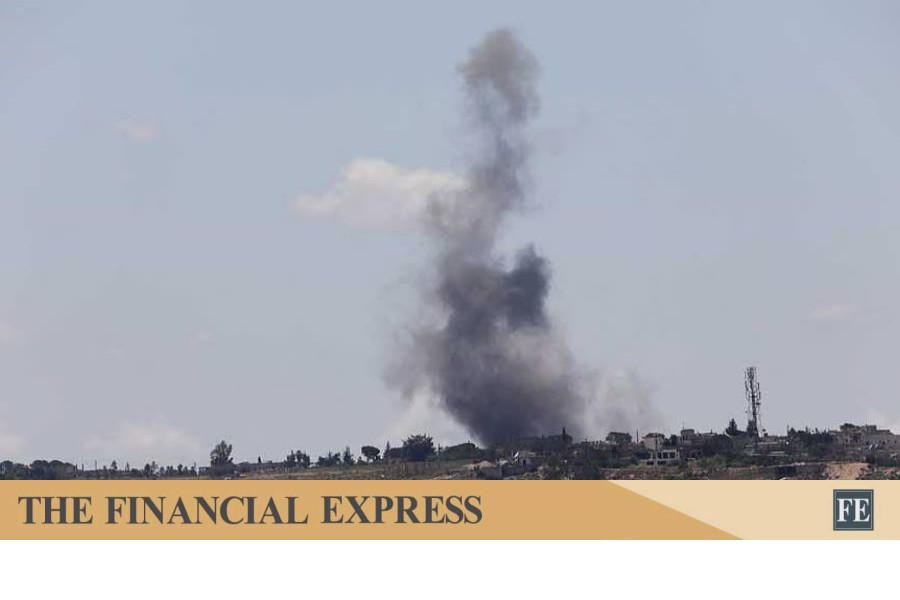
Smoke billows from southern Lebanon following strikes, as seen from Marjayoun, southern Lebanon, May 29, 2026. Photo : REUTERS/Stringer

Israeli forces have advanced to positions north of Lebanon's Litani River, Prime Minister Benjamin Netanyahu said on Friday, as Israel escalates attacks against Hezbollah militants after warning thousands more Lebanese to flee their villages.

The Israeli advance came as the US military hosted Israeli and Lebanese defence representatives in Washington on Friday to pursue a US-brokered plan to forge peace between the two countries and disarm Iran-backed Hezbollah.

The Washington talks also aim to reinforce an Apr 16 ceasefire that has failed to halt cross-border fighting, with Israeli warplanes pounding Lebanon's south and east and Hezbollah firing drones and rockets into Israel.

The military said this week it had expanded ground operations beyond a security zone its troops have occupied since Apr 16. During a visit to the Israel-Lebanon border on Friday, Netanyahu said troops had pushed even further, past the Litani River that cuts east-west around 30 km (19 miles) into southern Lebanon.

"Our forces have crossed the Litani and advanced to controlling positions," Netanyahu said in remarks to military personnel, according to excerpts released by his office.

"We are operating in Beirut, in the Bekaa (Valley), across the entire width of the front, and are dealing Hezbollah a crushing blow."

Lebanese Security Sources Say Israeli Troops Crossed Litani Then Retreated

The Israeli conflict in Lebanon has been the most deadly spillover of the Iran war, with more than 1.2 million Lebanese displaced by Israeli strikes and evacuation orders since Mar 2, when Hezbollah fired at Israel in support of ally Tehran.

Since then, Israeli strikes have pummelled Lebanon's south, east and its capital Beirut, killing more than 3,200 people, according to Lebanon's health ministry. Israel says 23 of its soldiers and four civilians have been killed over the same period.

Early in the fighting, Israel ordered people south of the Litani River to flee. On Thursday, the military ordered people south of the Zahrani River -- which lies around 10 km north of the Litani -- to flee as well, declaring the area a combat zone.

Commenting on advances by Israeli ground forces, Lebanese security sources said Israeli troops had crossed the Litani near the village of Zawtar al-Sharqiyah on Thursday but retreated to the southern bank of the river later in the day.

Ground forces crossed back over the Litani again on Friday, the sources said, saying it wasn't a major advance and that it took place at an eastern point on the Litani that sits close to the Israeli border.

Speaking with troops in Israel's northern command on Friday, Israeli military chief Eyal Zamir said troops would continue pursuing what he described as Hezbollah "launch squads" and their operators and commanders at every level.

"Wherever we identify a threat, we will strike it," he said, according to remarks released by the military.

Israel, Lebanon Hold Security Talks at Pentagon

In Washington, Israeli and Lebanese military officials were meeting at the Pentagon to discuss implementation of the ceasefire, which the two sides agreed on May 15 to extend by 45 days. The talks were expected to have begun at 8am (1200 GMT).

An Israeli source briefed on the talks said Israel and Lebanon were not expected to discuss the question of Beirut's southern suburbs, a Hezbollah stronghold where Israel says it has largely held off attacks due to US pressure.

A US official said the talks at the Pentagon were moving ahead as scheduled, adding: "The only path to lasting peace is through direct negotiations between the two sovereign governments."

Israel and Lebanon agreed to split their US-mediated talks into diplomatic and security tracks. Diplomatic meetings are expected to be held next week at the State Department.​
 

Latest Posts

Back