
[🇧🇩] Israel and Hamas war in Gaza-----Can Bangladesh be a peace broker?

[🇧🇩] Israel and Hamas war in Gaza-----Can Bangladesh be a peace broker?
985
33K
More threads by Saif

G Bangladesh Defense

Israeli strike kills top Hamas official’s son in Gaza
Agence France-Presse . Gaza City, Palestinian Territories 07 May, 2026, 22:17
1778201064739.webp

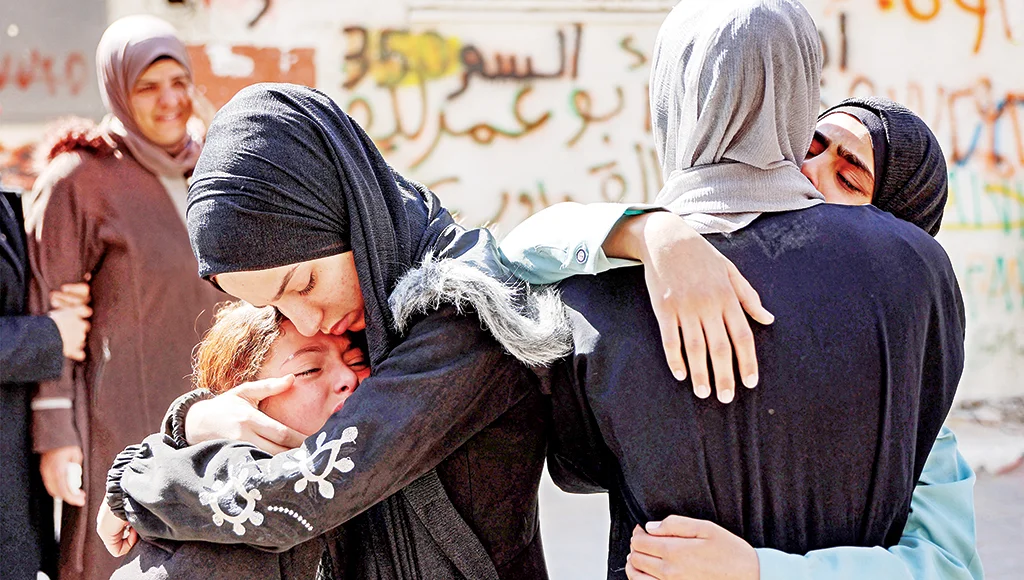
Mourners grieve the victims killed by Israeli bombardment the previous day during the funeral at Shifa Hospital in Gaza City on Thursday. | AFP photo

A Gaza hospital and Hamas on Thursday said the son of the Palestinian Islamist movement’s chief negotiator had died from wounds sustained in an Israeli strike a day earlier.

Azzam Khalil al-Hayya, 23, the son of top Hamas official Khalil al-Hayya, ‘was martyred after succumbing to wounds sustained in an Israeli airstrike targeting him yesterday,’ Gaza City’s Al-Shifa hospital said in a statement.

The city’s Al-Ahli hospital and a security source said on Wednesday that a strike on the Al-Daraj neighbourhood of Gaza City in the evening killed one person and wounded 10 others, including Azzam Khalil al-Hayya.

The Israeli military did not immediately respond to AFP’s request for comment on the incident.

Azzam Khalil al-Hayya is the fourth of Khalil al-Hayya’s seven sons to be killed in Israeli attacks, according to a Hamas source. Two of those were killed before the Gaza war erupted in October 2023.

The third, Hammam, was killed in an Israeli strike targeting Hamas leaders in Doha in September, which killed six people.

Khalil al-Hayya is the head of Hamas in Gaza despite living in exile in Qatar. He is currently vying for the leadership of the movement.

He survived the strike on Doha.

In a statement, Hamas said that the killing of Azzam Khalil al-Hayya ‘came within the framework of attempts to exert pressure on the resistance leadership and its negotiating delegation, after the occupation’s failure to impose its conditions or achieve its declared objectives.’

The US-brokered ceasefire which came into effect in October has largely halted the Gaza war that began after Hamas’s October 7, 2023 attack on Israel.

But Gaza remains gripped by daily violence as Israeli strikes continue, with both the military and Hamas accusing one another of violating the truce.

At least 846 Palestinians have been killed since the truce began, according to Gaza’s health ministry, which operates under Hamas authority and whose figures are considered reliable by the United Nations.

Over the same period, the Israeli military said five soldiers have been killed in Gaza.​
 

Revisiting Bangladesh’s Palestine solidarity

1778989654572.webp

United News of Bangladesh

NAKBA, commonly translated as ‘the catastrophe,’ was not the first major incident of Zionist expansionism in historic Palestine — the first Jewish settlements preceded the event by decades— but it was the episode of mass ethnic cleansing that split the history of Palestine and its inhabitants into one of dispossessed subjects. Every year, May 15 is observed as Nakba Day by Palestinians, for half (major sources estimate 750,000 people) of the Arab population of Palestine was driven out of their homes in 1948 by first paramilitary and later military forces by the new Jewish settlers. The areas were later occupied by creating new Jewish settlements in Palestinian villages and replacing the erstwhile names of Palestinian towns and villages with Hebrew names.

Nakba is not a singular event that uprooted Palestinians from their homes, but it is a continuous wound, a collective generational trauma that has not ceased. Israel’s expansionist and genocidal atrocities in the West Bank and the siege of Gaza have made Palestinians, and the lack of actions to stop it has exhibited the facade of international law and global failure to act against genocide. Today Gaza is being starved due to the siege, and new settlements are displacing Palestinian families in the West Bank. The Nakba never ended.Bangladeshi Culture Course

Historically, Bangladesh has remained steadfast in its recognition of the Palestinian state and in question of its national liberation and shown more than symbolic solidarity with Palestine in the past. Over a thousand Bangladeshi volunteers joined the Palestine Liberation Organisation against the second Israeli invasion of Lebanon in the 1982 Lebanon war. While there have been claims of eight thousand Bangladeshi youths volunteering to join the war efforts, researchers doubt such a high number. Fatah’s secretary of PLO factions in Lebanon previously relayed to the Lebanese newspaper Al-Akhbar that around 1,000 to 1,500 Bangladeshis were fighting for the PLO in the war. Some battalions were said to be fully formed of only Bangladeshis. A number of Bangladeshis also fought with the Palestinian Front for the Liberation of Palestine – General Command, a left-wing party. Four hundred and seventy-six of them were captured by the Israeli occupation forces and later were tortured in prison. Kamal Mustafa Ali, the sole well-known Bangladeshi martyr, was buried in the Palestinian Martyr Cemetery in the Shatila Palestinian refugee camp in Lebanon.

The Bangladeshi youths who fought alongside the PLO and Syrian Arab Army joined the war on the belief of a shared struggle against occupying and oppressive forces, having gone through brutal military regimes for two decades. Many of them had previously fought in the Bangladesh war of independence. However, a number of them went with the motive to free Al-Aqsa, the third holiest site for Muslims. This undercurrent of Islamic solidarity has captured the ‘free Palestine’ movement, especially in the last few decades. Despite Israel’s repeated recognition of Bangladesh as a democratic state, Bangladesh has never made any diplomatic relations with Israel, so much so that Bangladeshi passports used to have ‘Valid for all countries except Israel’ stamped on them. As of now, Bangladesh has no official trade relations with Israel. Bangladesh has hosted an embassy for the state of Palestine since 1988, after the Palestinian declaration of independence, and sent aid in food for Eid to Gaza in 2024 amidst Israel’s genocidal campaign. Bangladesh supports the pre-1967 border claims, i.e., the two-state solution, and supported South Africa’s genocidal case against Israel in the International Court of Justice.

Remarkable as Bangladesh’s diplomatic stances are in regards to Palestinian statehood, the revolutionary and material solidarity shown by the previous generation of freedom fighters and statesmen is waning in today’s solidarity actions. Since the genocidal campaign in Gaza began on October 7, 2023, all political groups have rallied against Israeli aggression. Leftist student groups and Islamic political groups alike have erupted into protests and marches against the bombardment of Gaza. Centering Palestinian national liberation within the lens of a shared anti-imperialist struggle, leftist coalitions saw the genocide of Gaza waged by and for US imperialism. On the other hand, Islamic political groups saw it as an attack on the global ummah, their outrage deriving from a sense of pan-Islamic solidarity. Last year in April, organised by the Palestine Solidarity Movement Bangladesh, around 1 million people gathered in the capital for a protest rally in solidarity with Palestine. They pledged to boycott all Israeli-manufactured products and called on the Muslim country leaders to stop economic, diplomatic and cultural relationships with the entity. They also demanded the government of Bangladesh reissue ‘Valid for all countries except Israel’ on passports again.

The demands and declaration made in the rally gives us a major look into the pitfalls of Bangladeshi solidarity with Palestine. Calls for a boycott of Israeli products and companies having billions of investments in the Israeli military have been a major part of Palestinian activism. As Bangladesh does not have any bilateral relations with the occupying, settler entity, Bangladeshis found boycotting the easiest way to showcase their support for Palestine. Much confusion arose, though, on the matter of which products to boycott and what the replacement could be. While the Boycott, Divestment, and Sanctions movement outlines the primary companies that should be targeted for consumer boycott, Bangladeshis largely remain ignorant of it. In many cases, the false sense of morality of people has resulted in vandalism of restaurants having no ties with Israel. The Palestine solidarity movement also failed to make demands to the government to implement BDS in trade deals. Many of these companies that countries are called to divest from are based in the US and UK, a policy that Bangladesh might not afford given our national economic policy is largely dependent on garment exports to the USA and Europe.Politics

The recent Bangladesh-USA trade deal has imposed a lot of restrictions on Bangladesh in regard to energy and military equipment purchases. The publicly released text of the 2026 Bangladesh–US reciprocal trade agreement, in Section 5: Commercial Considerations under the sub-clause on defence procurement, states: ‘Bangladesh shall endeavour to increase purchases of US military equipment and limit military equipment purchases from certain countries.’ The Bangladeshi military is now likely to buy weapons from the US weapon manufacturing companies, the same weapon industry supplying weapons to Israel to maim and kill the children in Gaza. The opposition to this unequal deal has been limited to the meagre left parties, and the masses remain unaware of the stipulations. The foreign minister, along with a number of advisers to the interim government, stated that such a disastrous deal was signed with the consent of both the Bangladesh Nationalist Party and Bangladesh Jamaat-e-Islami. However, this is not the first betrayal to the Palestine solidarity movement by Bangladesh. The fallen Awami League government, was found secretly buying mass surveillance systems worth $33, 000 from Israeli companies by Aljazeera. (Aljazeera, February 2, 2021). The report also said that Bangladeshi military officers received training from Israeli Intelligence in Budapest.

Furthermore, what is perhaps the most important part of transnational anti-imperialist solidarity — or the lack thereof — is evidenced in the treatment and perception of minoritised ethnic communities in the Chittagong Hill Tracts by Bengali Muslims, the largest ethnolinguistic group in the country. Historically, this hilly region has been the ancestral land of the Paharis. Beginning before the independence of Bangladesh, the Pakistani government amended the 1900 CHT Act, introduced by the British colonial administration, and allowed Bengalis to settle in the hill tracts. An artificial lake and a hydroelectric dam were built in Rangamati, displacing around 100,000 people and submerging 40 per cent of arable land. However, it was not until 1979, during the government of Ziaur Rahman, that a politicised effort to settle Bengalis in the hill tracts began. An amendment to Rule 34 of the CHT Manual was made, and 30,000 landless Bengali peasants were allocated khas land. Multiple waves of Bengali settlement in the subsequent years in the hill tracts, in order to change the demographic makeup, paved the way for sectarian violence.Bangladeshi Culture Course

The CHT, as reported by many international human rights organisations, remains one of the largest militarised regions across the world. Despite occupying only 9 per cent of the total territory of Bangladesh and 1 per cent of its population, around one-third of the Bangladesh army is deployed in the Chittagong Hill Tracts, said a report of the International Work Group for Indigenous Affairs. In the name of border security and combating terrorist groups, the Adibashi population in CHT lives under unspoken militarised rule, unlike the rest of the country. Perception among Bangladeshis regarding the militarisation of CHT seems to be a positive one, and the larger Bengali population denies their ‘settler’ status or refuses to look at the recent history of government policy that brought the landless population to the CHT. The Bengali settler–Pahari relationship in the region follows an atypical settler-colonial framework. Several scholars, including Mark Levene, Hana Shams Ahmed, and Bhumitra Chakma, have characterised the situation in the CHT and the associated settler violence as a form of internal colonisation. As such, on matters of solidarity, it becomes quite difficult to reconcile the cognitive and moral dissonance of Bengali Muslims rallying in support of Palestinian liberation yet turning a blind eye to the settler-colonial policies and militarisation practised against their fellow Pahari citizens and, worse, participating in the violence perpetuated against them.

‘Bangladesh has always supported Palestine’ has been a matter of pride for many Bangladeshis, but the lack of material action exposes its vacuousness. Our solidarity must go beyond ‘Free Palestine’ slogans and move in the direction of economic pressure on Israel. When we speak of the Nakba, we must first take a look at our own backyard and grapple with our complicity in the displacement and dehumanisation of ethnic communities in Bangladesh. As of now, the solidarity shown towards Palestinians remains fractured at best and hypocritical at worst.

Nawshin Flora is a researcher based in Dhaka.​
 

Latest Posts

Back