
[🇧🇩] Israel and Hamas war in Gaza-----Can Bangladesh be a peace broker?

[🇧🇩] Israel and Hamas war in Gaza-----Can Bangladesh be a peace broker?
1K
42K
More threads by Saif

G Bangladesh Defense

Gaza suffers world’s worst ever economic crisis: UN
Agence France-Presse . Geneva 26 September, 2026, 00:10
1790383940906.webp

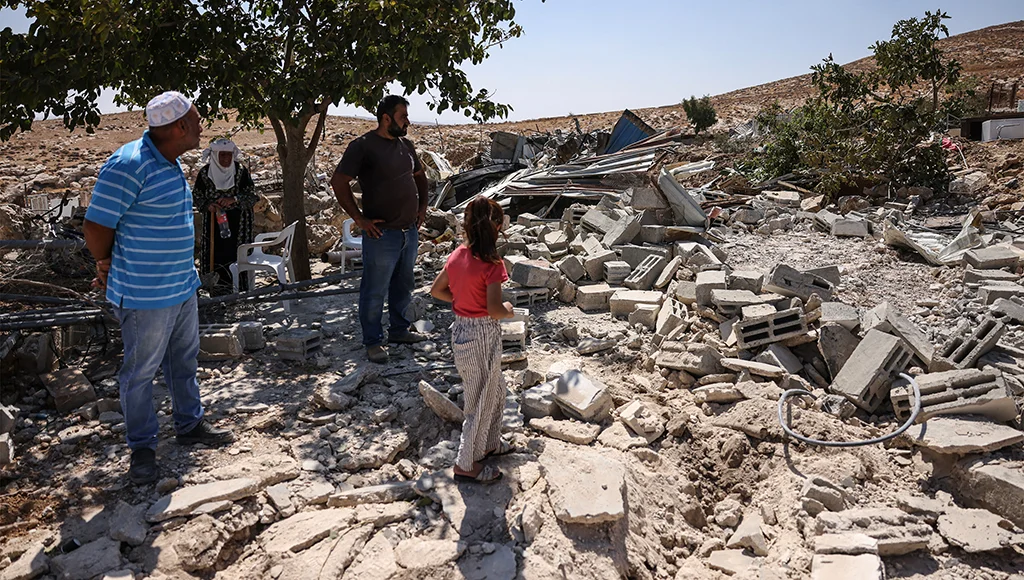
A Palestinian family inspects the remains of their home and livestock pen after they were demolished along with more than 20 other structures that Israeli authorities said had been built without permits, in the Palestinian village of Jinba, south of Yatta in the Israeli-occupied West Bank, on Wednesday. | AFP photo

Gaza is suffering the world’s worst economic crisis ever recorded, with nine in 10 businesses destroyed and hundreds of thousands of people unemployed, a top UN development agency warned on Thursday.

Israel’s military offensive sparked by Hamas militants’ attack in October 2023 devastated the territory of two million people before a patchy ceasefire was announced in October 2025.

‘The collapse of the economy of Gaza is the world’s most severe economic crisis on record,’ said Pedro Manuel Moreno, acting secretary-general of the UN Conference on Trade and Development.

‘It has wiped out decades of development and generated an acute economic crisis for its people,’ he told reporters in Geneva as the organisation released a new report.

It said 92 per cent of Gaza’s ‘economic establishments have been damaged or destroyed’.

The territory’s daily per capita GDP is $0.58 a day, the report said. Prices are 274 per cent higher than in 2022.

Israel’s military offensive killed more than 73,000 people, according to the territory’s health ministry under Hamas authority, whose figures are regarded as reliable by the United Nations.

It displaced virtually the entire population and damaged or destroyed most of its buildings.

Before October 2023, ‘two out of three Gazans were poor. Today, everyone in Gaza is multidimensionally poor,’ said Mutasim Elagraa, UNCTAD’s coordinator for assistance to the Palestinians.

Industrial activity and agricultural production have fallen by 94 per cent, with only 1.5 per cent of arable land accessible, forcing ‘total dependence on humanitarian food aid’, Elagraa said.

According to the report, the conflict has destroyed hundreds of thousands of jobs, leaving more than 90 per cent of Gaza’s working-age population unemployed.

The report also detailed an economic and financial crisis in the occupied West Bank, citing ‘reduced access to land and natural resources linked to (Israeli) settlement expansion’.

The Palestinian government has borrowed heavily from local banks, drawn on the Palestinian pension fund and owes money to private contractors, Elagraa said.

The Palestinian territories risk a ‘banking collapse’, he warned. The ‘political and social and humanitarian consequences will be immense’.​
 

Israeli strike kills five in Gaza City
Agence Frqance-Presse . Gaza City, Palestinian Territories 01 October, 2026, 00:00

1790813693950.webp

Palestinians inspect the damage following an Israeli airstrike that targeted a minibus and killed five people in Gaza City’s Tel al-Hawa neighbourhood on Wednesday, according to Gaza’s civil defence agency and a hospital. | AFP photo.

Gaza’s civil defence agency and a hospital said an Israeli airstrike targeting a minibus killed five people on Wednesday in a neighbourhood southwest of the city.

Mahmoud Bassal, the spokesperson for the civil defence which operates as a rescue force under Hamas authority, said there were ‘five martyrs and 20 wounded, including a number of children and women... as a result of an Israeli airstrike that targeted a passenger bus in Tel al-Hawa’.

Bassal said the bus was carrying civilians between Gaza City and the central and southern parts of the Palestinian territory.

He said it was hit ‘by two missiles fired by Israeli drones, which led to the destruction of its front and completely burned it’.

AFP has contacted the Israeli military for a response.

Gaza City’s Al-Shifa hospital confirmed that five bodies and several wounded people had arrived at the medical facility ‘following an Israeli airstrike that targeted a vehicle near the destroyed cabinet headquarters in the Tel al-Hawa neighbourhood’.

The Gaza war was sparked by Hamas’s unprecedented 2023 attack against Israel, which resulted in the deaths of 1,221 people, according to an AFP tally based on official Israeli figures.

The massive Israeli offensive in response has left most of Gaza in ruins and killed more than 74,000 people, according to Gaza’s health ministry, which is under Hamas authority and whose figures are considered reliable by the United Nations.

Israeli forces have killed more than 1,400 people since a ceasefire was announced last October, according to Gaza’s health ministry.

The Israeli military has identified five deaths in its ranks over the same period, as well as the death of one civilian contractor.​
 

Israeli strike kills 5 in Gaza
Agence France-Presse 04 October, 2026, 01:24

Gaza’s civil defence agency and a hospital said on Saturday that an overnight Israeli airstrike on an apartment in Gaza City killed five Palestinians, including four women.

Israeli media reported that the military was targeting Ali al-Amoudi, a senior Hamas official. The army has yet to comment on the incident.

Gaza City’s Al-Shifa hospital told AFP it had ‘received at dawn five martyrs and a number of injured... following the Israeli airstrike on an apartment’ in the Rimal neighbourhood.

It said the dead were two women and their daughters, as well as a young man.

Mahmoud Bassal, the spokesperson for the civil defence which operates as a rescue force under Hamas authority, told AFP that his team took ‘five bodies and several wounded’ to the hospital after the strike.

He said two missiles directly hit the apartment, causing a fire to break out and damaging the building.

Meanwhile, the World Health Organization on Friday said getting humanitarian aid through Israel into Gaza is layered with ‘delay after delay’ as it decried ‘chronic shortages’ of mdical supplies.

Reinhilde Van de Weerdt, the WHO’s representative in the Palestinian territories, said the health situation in the Gaza Strip ‘remains utterly dire’, with none of its hospitals fully functional.

‘Not enough humanitarian aid is entering Gaza, and definitely not enough to allow for a meaningful expansion and restoration of health services,’ she told reporters in Geneva, speaking from Jerusalem.

She said Israel’s approval system for medical and other humanitarian supplies was proving a major bottleneck.

‘It is laborious, time-consuming, with no guaranteed results,’ she said.

Based on the WHO’s latest analysis, large volumes of medical supplies wait for clearance for a median of 74 days, said Van de Weerdt, adding that if it is not, ‘than we start that lengthy, cumbersome process all over again’.

She added that the approval system kept changing, with new regulations introduced.

Van de Weerdt said standard health kits used worldwide had the lowest approval rate, while X-ray machines, sterilisation equipment and spare parts for CT scans and other essential machinery ‘get rejected regularly’.

‘In just the last six months alone, one shipment of prosthetics and assistive devices was rejected four separate times,’ she said.

However, medicines move ‘relatively well’, with almost 87 per cent approved and one per cent rejected, she added.

‘It’s not one single blockage. It’s a system, layered with delay after delay... and on the other side of every one of these delays is a patient who is waiting,’ she said.

‘We need the unimpeded and predicable entry of humanitarian and health supplies into Gaza, at scale.

‘We hope that Israel will at least release the pressure on medical supplies.’

Van de Weerdt called for more crossings into the territory to be opened, and for ‘clear, published guidance’ on processes and requirements.

She added that success should not be measured in terms of numbers of trucks crossing the border, insisting that it says ‘almost nothing about whether people’s actual health needs are being met’.

‘A truck full of non-priority supplies, or the right supplies arriving too late, doesn’t save lives.’​
 

Palestine is more than a humanitarian cause
Isaac Namoura 07 October, 2026, 00:00


1791332929374.webp

Isaac Namoura in his hometown in the West Bank in 2020. | Author’s courtesy


A TICKING bomb and a matter of time. These words summarise what’s currently going on now in Palestine. But you, the person who’s reading this, might ask how, and I will answer.

Let’s start by talking about the Gaza Strip. Currently more than 50 per cent of the land has already been taken by the Israeli occupation. And the people and their resistance are boiled down into thinking about how to survive every day on its own. Water to drink and to wash yourself, sanitation and sanitary products, access to medical care and critical care.

Nevertheless, people are very aware of the current political situation of the world, especially with American foreign politics about the genocide and the recent Trump plans, and they’re aware that this is a sugar-coated way of saying, ‘We are going to take your land and turn it into anything we want, and you have no right to complain. If you don’t like it, leave.’

Most of the news that comes out from the Gaza Strip right now is completely shadowed, and no one is seeing anything coming out from there except for the people who are searching for it.


The West Bank has been divided into small cantonments that people somehow scrape by and somehow move around through numerous checkpoints, which has increased in number by twofold. Some people can’t reach their workplaces, and others can’t visit their family members and loved ones, all while everyday there’s new legislation to make more illegal settlements; the most recent has been a settlement they’re building one kilometre away from my own house.

The incidence of settler violence has increased at least threefold from three years ago. Full of unhinged audacity, they come armed with way more weapons than before, and they destroy everything. They attack houses, burn them down while people are inside, steal and kill cattle, and cut down and burn trees. Basically, whatever helps people to exist other than the fact that they shoot people on sight if they show any form of resistance, or if they see them in a secluded area, it depends on how much ‘fun’ they want to have — sadistic blood thirst at its best.

As for finances, there are two types of workers in the West Bank, the majority (60-65 per cent) of which are workers inside the Israeli-occupied land, and for the past three years their work has been cut off, and they haven’t made any form of financial progression since then, and the other half, which are government and private sector workers inside the West Bank, have been receiving half and most of the time less than that of their salaries, with some who haven’t even got any salary for the past few months, all while the price of basic groceries and oil has increased heavily. Not even factoring the problem of availability, this is already a dire situation.

And how can we forget about the nearly 12,000 Palestinian hostages in Israeli jails, who were taken without any trial, who have been tortured, starved, and even raped, including women and children, and every household has a beloved one that’s rotting in their injustice, waiting for the day they see the light of freedom.

So as I said in the beginning, a ticking bomb is the West Bank, and a matter of time is the Gaza Strip.

As a Palestinian in Bangladesh, I have witnessed the kindest, warmest treatment by people, be they friends, teachers and colleagues, or even street vendors. Once they hear where I am from, they never waste a chance to show kindness. People here made Bangladesh a second home for me. In all honesty, I don’t know how I will be able to say goodbye to all of this once I leave after I am done with my internship.

There are definitely certain things that changed my perspective on life: how much the concept of comfort is relative and how much we can get easily used to a new life, and how my life back at home is a form of suffering. For example, I have water 24/7, and I use as much as I want. Back at home, we used to stay days and weeks without water because it used to be cut off, or when the electricity didn’t go away randomly for days or even weeks. Like back at home, I realised I can travel between two cities without needing to be worried about the army threatening or shooting me, that I can travel wherever I want. In Palestine, the sea is only 40 kilometres away from me, yet if I never came to Bangladesh, I probably would have never been able to visit a beach in my life. I can walk around at night without being worried about a settler shooting me or running over me with his car, and most importantly, for me, is how open and free Bangladesh can be for me to express my genuine opinion on politics or anything else I wish to talk about.

Witnessing all of this while being in Bangladesh has been an experience of mixed feelings. On one hand, I feel proud to represent my cause and even more proud of my Bangladeshi friends for being on the right side of history, but on the other, I wish I was there with my family. Being devastated is an understatement. I have seen my Palestinian friends here lose family members and how they lived through it while being away from home. No matter how much in touch with my family I am, every time we speak about the current situation, it hits me that it’s way worse than I even thought.

What we want from the world is simple: we recognise that our struggle has been familiar to most people around the world, but now we are waiting for action, don’t stop boycotting, sharing, talking, rallying, lobbying, and always remember, this is not just a humanitarian cause, we are people who are fighting for freedom and self-determination, against the coalition of evil and vile.

Isaac Namoura is a Palestinian medical student who has been living in Bangladesh since 2020 and is currently an intern physician at Shaheed Suhrawardy Medical College Hospital.​
 

Latest Posts

Back