[🇧🇩] Israel and Hamas war in Gaza-----Can Bangladesh be a peace broker?

[🇧🇩] Israel and Hamas war in Gaza-----Can Bangladesh be a peace broker?
1K
38K
More threads by Saif

G Bangladesh Defense

Israeli strikes in Gaza kill 2

Agence France-Presse . Gaza City, Palestinian Territories 13 August, 2026, 22:33
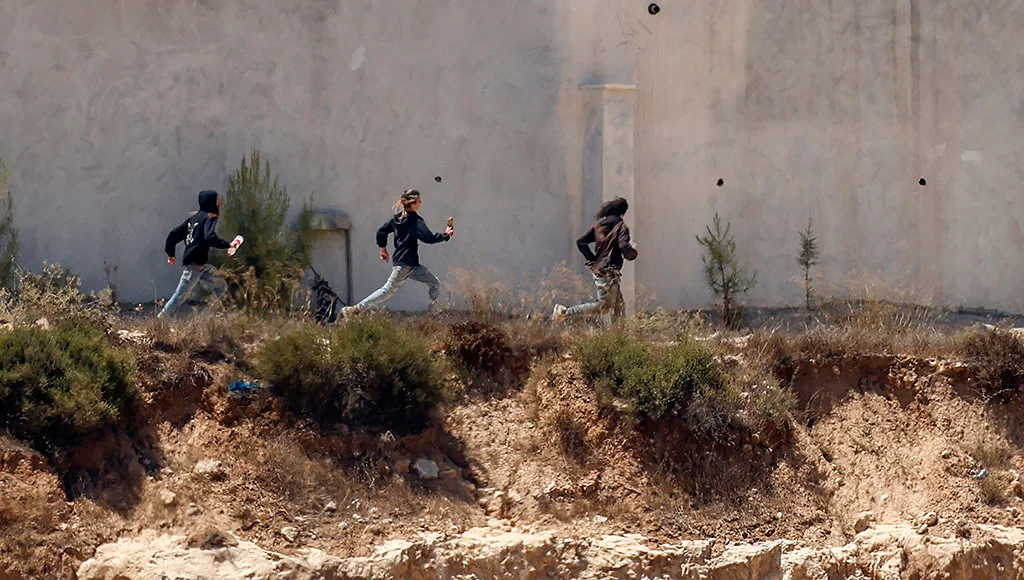
1786665417200.webp

Israeli settlers run as being chased by an Israeli military vehicle around Palestinian houses in the village of Qusra, south of Nablus, in the occupied West Bank, on August 13, 2026. | AFP photo.

Israeli strikes in Gaza killed two people including a senior police officer on Thursday, health officials said, the second straight day of bombardment after a lull due to a US peace push.

The Israeli military said it struck a Hamas commander in the Khan Yunis area who it said had been planning attacks against troops, in the second such targeting in as many days.

‘The terrorist was struck in an aerial strike in order to remove the threat to IDF troops,’ the military said, adding that ‘steps were taken to mitigate harm to civilians.’

Gaza’s civil defence agency, which operates as a rescue service under Hamas, said an airstrike west of Khan Yunis killed one person, with the city’s Nasser Hospital confirming the arrival of a body following the attack.

In a separate incident in Gaza City, the civil defence said one person was killed and several others injured in an Israeli strike on a vehicle in the Sheikh Ajlin neighbourhood.

Al-Shifa Hospital said it had received the body of Gaza City’s police governor Jamal Abu Kamil.

Gaza’s interior ministry confirmed Abu Kamil ‘was assassinated in an Israeli airstrike targeting his vehicle on Al-Rashid Street, southwest of Gaza City’.

When contacted by AFP, the Israeli military said it was checking the reports.

Israel on Wednesday carried out its first airstrike in Gaza since August 3.

The hiatus in airstrikes came after US president Donald Trump’s announcement of a ‘major milestone’ in his plan to end the war.

Hamas had announced that it would disarm by giving its weapons to a nascent Palestinian governing committee.

Trump’s ‘Board of Peace’, in charge of implementing the ceasefire deal, had initially announced that Israel in turn would start a phased withdrawal from much of the Gaza Strip.

But prime minister Benjamin Netanyahu on Sunday publicly rejected the deal and vowed no Israeli pullout, even after the Board of Peace reassured him that Israel would not have to withdraw until complete Hamas disarmament.

Israeli operations in Gaza have killed 1,260 Palestinians since the ceasefire, according to the territory’s health ministry, which operates under Hamas authority and whose figures are considered reliable by the United Nations.

The Israeli army has reported five deaths in its ranks during the same period.​
 

Israel blocks activists from reaching besieged Palestinian families
New Age Desk 14 August, 2026, 23:11

1786753553225.webp

Activists hold flags next to Israeli soldiers as they accompany Palestinian landowners to their property, which is at risk of being confiscated by Israeli settlers, in Beit Sahur, south of Bethlehem, in the occupied West Bank on Friday. | AFP photo

Israeli forces have prevented Israeli and foreign activists from reaching Palestinian families whose homes have been surrounded by settlers for nearly a week in the occupied West Bank town of Qusra, south of Nablus, reports Al Jazeera.

The activists were trying to deliver food and water to three homes in the Ras al-Ain area on Friday, according to the Palestinian news agency Wafa.

Al Jazeera’s Laith Jaar, reporting from Qusra, said that Israeli forces brought in reinforcements and stopped members of the Israeli group Peace Now from reaching the families after declaring the area a closed military zone.

Qusra mayor Abdel Azim Wadi told Wafa that Israeli forces had also forced Italian activists who managed to reach the homes earlier in the week to leave.

ads
Settlers began surrounding the homes earlier this week, blocking roads with stones, erecting a tent nearby, and preventing residents from entering or leaving freely.

Water and electricity supplies to the homes have also been cut. About 15 Palestinians, including two children, are living in the three homes and have struggled to obtain basic supplies, according to the United Nations.

The UN said they were ‘trapped inside their homes in a state of terror, unable to attend to their basic needs and without access to water or electricity’.

Israeli forces entered the area a day earlier and ordered the families to temporarily leave their homes. The residents refused to leave the area and instead gathered in one of the three houses, fearing their homes could be taken over if abandoned.

Jaar reported that settlers again attempted on Friday to erect a tent and establish an outpost near the homes before Israeli forces removed it.

Qusra has emerged as a flashpoint for settler violence in the northern occupied West Bank, with the UN saying earlier this year that it had recorded more settler attacks there than in any other occupied West Bank community.

The developments come as Israeli defence minister Israel Katz has ordered preparations for transferring responsibility for enforcing civilian law involving settlers in the occupied West Bank from the military to the Israeli police.

Political scientist Ibrahim Rabaia told Al Jazeera that the proposed move appeared to be driven by political considerations and questioned how broadly it could be implemented.

He said the military remains responsible for the occupied West Bank under the existing system, while coordination between the army and police already takes place.

Rabaia argued that transferring responsibilities would be unlikely to result in police preventing settlers from attacking Palestinian homes.

‘The police are controlled by national security minister Itamar Ben-Gvir, who arms these settlers and supports them in the West Bank,’ he said.

Rabaia, an academic in political science and former managing editor of the journal Palestinian Affairs, said settlement expansion had reached an advanced stage, with infrastructure, funding and planning being put in place to create what he described as ‘a reality that cannot be reversed,’ including new areas capable of accommodating larger numbers of settlers in the future.​
 

Israel’s Gaza war expenditure hits $136 billion, Haaretz reports


1786922823050.webp

A view shows houses and buildings destroyed in Israeli strikes, in Jabalia in the northern Gaza Strip, October 11, 2023.
Source: REUTERS/Anas al-Shareef/Files

Israel’s genocidal war on Gaza, which began on October 7, 2023, has become the longest and most expensive war in Israel’s history, with costs reaching about 420 billion shekels ($136bn) and national debt rising by roughly 400 billion shekels, Haaretz newspaper reports.

The report said Israel entered its ground offensive in Gaza in late October 2023, expecting at least three months of fighting, despite ammunition stockpiles having been prepared for shorter wars.​

A former Israeli military officer told Haaretz that stocks of some types of ammunition were insufficient even for a short war, while actual consumption in some categories reached twice the levels originally planned.
 

Hamas says committed to Gaza deal
Agence France-Presse . Gaza City, Palestinian Territories 18 August, 2026, 23:16

1787098158224.webp

A boy walks carrying a table on his back past salvage workers scrapping the rubble of a building that was destroyed during Israel’s war against Hamas in Gaza, to use the recycled remains in the future, in Gaza City on Sunday. | AFP photo

Hamas said on Tuesday it remained committed to the US-backed Gaza peace deal after White House envoy Jared Kushner spoke to Israel about steps towards the group’s disarmament.

‘Hamas is committed to this agreed-upon process. It is clear that, so far, the Israeli side has not given the mediators clear approval of the roadmap,’ Hamas spokesman Hazem Qassem said.

‘There are timelines and procedural steps that need to be worked out in detail, but there must first be Israeli approval of the roadmap,’ he said.

Kushner, president Donald Trump’s son-in-law, held a rare meeting with Hamas on Sunday in Egypt before meeting the following day in Jerusalem with Israeli prime minister Benjamin Netanyahu, who has publicly rejected the latest phase of the deal.

Kushner, in a Fox News interview after the talks, said that Hamas’s disarmament could begin in about 30 days and that reconstruction of Gaza would not begin until that happens.

Kushner also said that the United States is ‘not going to restrict Israel’s right to defend itself if there are any imminent threats’ in Gaza.

Netanyahu has demanded that Hamas fully disarm. In his talks with Kushner, the two sides agreed that a US general would oversee the surrender of weapons, according to an Israeli official.

Trump’s ‘Board of Peace’ implementing the deal has also told Netanyahu that Israel does not need to start withdrawing from Gaza until full disarmament, walking back an earlier call for Israel to start a phased pullout.

Israel has kept up airstrikes in Gaza despite the peace push.

The Israeli military said Tuesday that a strike two days earlier had killed a commander of the Islamic Jihad group who was responsible for abducting an Israeli during the October 7, 2023 attack that triggered the war.

Israeli operations have killed at least 1,265 Palestinians since a ceasefire came into effect on October 10, according to figures from Gaza’s health ministry, which operates under Hamas authority and whose figures are considered reliable by the United Nations.

The Israeli army has reported five deaths in its ranks from Gaza operations over the same period.​
 

Is Trump’s Gaza peace plan falling apart?

Maleeha Lodhi

The Israeli prime minister’s public rejection of the US-backed Gaza roadmap came as little surprise. Last month, the Board of Peace (BoP) announced a 15-point plan to implement the next phases of President Donald Trump’s peace initiative. Brokered by the US, agreement on the plan was announced by Trump on July 30. He called this a “major milestone”. The 15-point document’s aim was to move the peace process forward by reaffirming and fleshing out specific commitments for implementation by the parties to the conflict.

The second of the 15 points required Israel to abide by all “remaining obligations” under the Sharm el-Sheikh Memorandum especially an end to its military operations. It called on Hamas and other Palestinian factions to cease their military actions under the peace plan. The 15 points also detailed the framework for Gaza’s governance including the National Committee for the Administration of Gaza’s (NCAG) responsibilities for running the Strip. Composed of Palestinian technocrats, the transitional body was established by the BoP in January. But it was prevented by Israel from entering Gaza. It has since remained stuck in Cairo. The 15-point framework makes it clear that in the specified timetable NCAG must enter the Strip and start to assume day-to-day governance.

The roadmap involves reciprocal steps. It mandates a link between decommissioning of armed militias including Hamas and “an Israeli withdrawal, in phases, from areas under its control in Gaza”. Point 13 commits Israeliforces “to complete their phased withdrawal from Gaza Strip according to an agreed upon timetable”. The plan provides for the inventorying and storage of Hamas’s heavy weapons under NCAG’s supervision. Hamas would disarm in exchange for a gradual Israeli military withdrawal and establishment of governance by the technocratic Palestinian committee.

Rejecting the plan, Benjamin Netanyahu declared his country’s troops will not withdraw until Hamas is “genuinely disarmed”. The Israeli leader’s wholesale rejection of the 15-point plan threatens to derail the peace process altogether. It makes the ceasefire’s fate uncertain and pushes it to the brink of collapse.

Rejecting the plan, Benjamin Netanyahu declared his country’s troops will not withdraw until Hamas is “genuinely disarmed”. The Israeli leader’s wholesale rejection of the 15-point plan threatens to derail the peace process altogether. It makes the ceasefire’s fate uncertain and pushes it to the brink of collapse. For its part, Hamas agreed to the plan, with the BOP announcing on July 31 that the resistance group had consented to disarm. Hamas said it would surrender its weapons in stages. After Israel’s rejection of the plan, Hamas reiterated its commitment to it while urging the BoP and mediators to prevent ceasefire violations.

Several Western analysts attribute Netanyahu’s opposition to the plan to electoral politics with general elections due in two months. The Oct 27 poll poses a major challenge for Israel’s longest-serving prime minister, whose declining public support places his political future in jeopardy. But elections alone do not explain Netanyahu’s rejection. Israel was never really committed to the Trump plan, despite signing on to the Sharm el-Sheikh agreement. Netanyahu has since done everything to block its implementation.

Several of Israel’s actions testify to that. It has conducted almost daily military strikes on Gaza defying the ceasefire brokered by the US last October. Over 1,000 Palestinians have been killed since the ceasefire came into effect. Israel also intensified its bombings of Gaza after announcement of the 15-point plan. It has seized control of over 70 per cent of the Strip and deepened its occupation. Israeli defence officials vowed their forces would indefinitely remain in so-called “security zones” in Gaza, with no timetable for withdrawal. Netanyahu also did not allow the 13-member Palestinian NCAG to enter Gaza.

Israel has carried out deadly military raids into the West Bank, along with its de facto annexation and engaged in ethnic cleansing of the Bedouin and herding communities. A senior UN official warned the West Bank was at “breaking point”. But Washington had nothing to say on these actions. Only a single incident of Israeli settler violence prompted a rare rebuke from the US envoy. Israel’s military assaults on Lebanon and occupation of its southern areas also showed Tel Aviv’s aggressive designs and lack of interest in a truce.

1787181921555.webp

Benjamin Netanyahu has rejected Donald Trump's 15-point plan for Gaza. Photo: Reuters

So far, there is silence from Washington over Netanyahu’s rejection of the Gaza plan. Trump claimed he would give his reaction on social media. He never did. The US may be distracted by its conflict with Iran. But that doesn’t explain why it hasn’t said anything about Israel’s abandonment of the Gaza plan. Trump administration officials privately tell journalists they are willing to give “leeway” to Netanyahu to navigate the looming elections. Jared Kushner, Trump’s son-in-law and envoy, is however set to visit Israel next week accompanied by Nickolay Mladenov, BoP’s high representative, for talks on the Gaza plan.

Following Netanyahu’s Washington visit in July, the BoP contradicted its own 15-point plan by announcingIsrael will only be obligated to withdraw after “complete” disarmament. But after Netanyahu’s rejection, a Board member told a Middle Eastern media outlet that the peace process will still be based on the original plan for “phased, reciprocal commitments”.

From the very inception of Trump’s Gaza plan, the US never committed to an even-handed approach. Instead, it adopted a pronounced pro-Israel stance. It did nothing to stop Israel from violating the ceasefire and cease the killings of Palestinians in Gaza. It turned a blind eye to Israeli expansion of areas under its control. Washington frequently demanded Hamas should disarm but said nothing about the reciprocal obligation for Israel to withdraw from the enclave.

Future prospects for peace in Gaza hinge on how much pressure, if any, the US is prepared to mount on Israel to compel it to drop its opposition to the Trump plan. If it is unable or unwilling to do this, and the tail wags the dog, then it won’t just be Israel that will sabotage the plan. The US will end up defeating its own peace initiative.

Vice President J.D. Vance occasionally criticised Israel for its stance. But this did not change the heavy influence of the Israeli lobby on the Trump administration’s Middle East decisions. This continues to be the case despite Israel’s plummeting standing among the majority of Americans. A new book Israel’s Lobby describes it as the most powerful foreign policy lobby that has for decades held America in its grip.

Future prospects for peace in Gaza hinge on how much pressure, if any, the US is prepared to mount on Israel to compel it to drop its opposition to the Trump plan. If it is unable or unwilling to do this, and the tail wags the dog, then it won’t just be Israel that will sabotage the plan. The US will end up defeating its own peace initiative.

This article was first published under the title “Gaza plan at risk, again" in Dawn, an ANN partner of The Daily Star, on August 17, 2026.​
 

Israeli strike kills nine in Gaza
Agence France-Presse . Gaza City 19 August, 2026, 22:38

1787182968614.webp

Women mourn during the funeral of Palestinians killed in an Israeli army strike on Gaza City’s port the previous day, in Gaza City on Wednesday. | AFP photo

Gaza health officials said an Israeli strike on the municipal police headquarters in Gaza City killed nine people on Wednesday, with the Israeli military saying it targeted a Hamas commander in that strike and another further south.

Attacks in the Palestinian territory have continued in recent days, despite a renewed push by the United States to advance a long-term Gaza peace plan.

Gaza City’s Al-Shifa Hospital reported the arrival of nine bodies, including a woman and a girl, and at least 20 wounded following the strike in Gaza City.

The territory’s civil defence agency, which operates as a rescue service under Hamas, confirmed the toll.

The Israeli military said the strike on the police headquarters targeted a Hamas commander who it said had planned to carry out attacks against troops in the territory.

‘Prior to the strike, steps were taken to mitigate harm to civilians, including the use of precise munitions and aerial surveillance,’ it added.

It said it had also struck a commander in Hamas’s military wing in the Nuseirat area in the central Gaza Strip.

Hamas spokesman Hazem Qassem condemned what he called Israel’s ‘complete disregard for all calls for a ceasefire’.

He said US president Donald Trump’s Board of Peace, which is tasked with implementing the ceasefire plan agreed last October, ‘bears responsibility for this escalation due to its failure to fulfil its obligations by pressuring the occupation’ to abide by its commitments.

Trump’s envoy Jared Kushner had said on Monday that progress towards disarming Hamas and moving forward with the Gaza peace plan could begin within a month following a meeting with Israeli prime minister Benjamin Netanyahu.

The sit-down came two weeks after Hamas endorsed the latest stage of Trump’s Gaza plan.

Netanyahu, however, has refused to support the roadmap, vowing not to withdraw troops until the Palestinian Islamist movement is ‘genuinely disarmed’.

Gaza health officials said Tuesday that an Israeli airstrike killed six people in the port of Gaza City, with the Israeli army saying it had targeted several Hamas commanders.​
 

Latest Posts

Back