โ˜• Support Us โ˜•
[๐Ÿ‡ง๐Ÿ‡ฉ] - LDC Graduation For Bangladesh | Page 6 | PKDefense

[๐Ÿ‡ง๐Ÿ‡ฉ] LDC Graduation For Bangladesh

Reply (Scroll)
Press space to scroll through posts
G Bangladesh Defense
[๐Ÿ‡ง๐Ÿ‡ฉ] LDC Graduation For Bangladesh
56
1K
More threads by Saif


Setbacks LDCs are up against in global trade
Asjadul Kibria
Published :
Nov 15, 2025 22:50

1763256343437.webp


For more than a decade, the global community has been working towards the goal of doubling the share of global exports from the Least Developed Countries (LDCs) to two per cent by 2020, up from one per cent a decade ago. There has been the United Nations (UN) Sustainable Development Goals (SDGs') call to 'significantly increase the exports of developing countries, in particular with a view to doubling the least developed countries' share of global exports by 2020.' When the UN formally launched the SDGs a decade ago, in 2015, the share of LDCs in global trade was only one per cent in terms of exports. In this connection, two per cent of global exports in 2020 is determined as the indicator.

Nevertheless, a decade after setting the target and five years after the deadline, the LDCs' combined share in global trade remains below two per cent of global exports, reflecting disappointing progress. In 2024, LDCs accounted for just 1.03 per cent of global exports, up only marginally from 0.96 per cent in 2012. "These figures highlight the persistent structural barriers -- limited diversification, weak infrastructure and small productive bases -- that continue to constrain export growth in LDCs," observed the UN Trade and Development (UNCTAD) in a recent note.

A note prepared by the Secretariat of the World Trade Organisation (WTO) and submitted to the Sub-Committee on LDCs in the last month showed that between 2019 and 2024 LDCs' exports of goods and services grew at an average annual rate of 6.7 per cent. In 2024, the goods exports of LDCs increased by 5.0 per cent year-on-year. Exports of commercial services, however, registered a strong growth of 12.6 per cent. The note also mentioned that in 2024, the share of LDCs in world exports of goods and commercial services increased to 1.03 per cent, up from 1.01 per cent in 2023. LDCs' share in world imports increased to 1.41 per cent in 2024 from 1.37 per cent in 2023. Thus, the share of LDCs in total world trade of goods and commercial services increased from 1.19 per cent in 2023 to 1.22 per cent in 2024.

The target of doubling the LDCs' share in global exports in five years was ambitious. Earlier, the LDCs' share in global merchandise exports almost doubled in 15 years, from 0.6 per cent in 2000 to one per cent in 2015. The LDCs' share in global exports of commercial services also doubled within a decade, from 0.50 per cent in 2005 to 0.90 per cent in 2015.

Several factors drove the global community to set the ambitious non-binding target of doubling the LDCs' share in exports in five years. Initially, it was a commendable gesture of global cooperation under the UN SDGs framework for the five Ps: people, planet, prosperity, peace, and partnership. Second, it was presumed that the poorest nations of the world could significantly improve their socio-economic conditions by enhancing trade, especially exports. Therefore, supporting the exports of LDCs through multilateral trade benefits under the WTO umbrella will be beneficial in increasing their share in global exports. This increase in share could potentially lead to improved socio-economic conditions and a brighter future for the LDCs. Third, a persistent rise in global trade during the first two decades following the WTO's inception also widened expectations. Despite a significant drop in 2008 due to the global financial crisis, global trade surged by around fourfold between 1995 and 2014. UNCTAD-WTO estimates showed that global trade in goods and commercial services increased to $23.50 trillion in 2014 from $6 trillion in 2005 when the WTO formally came into effect.

At present, there are 44 LDCs on the United Nations (UN) list, 37 of which to date have become WTO members and six are in the process of joining the WTO as members. And 15 LDCs, both WTO members and non-members, are at the different stage of graduation.

Over the decades, developed and developing countries have offered preferential market accesses to the LDCs in various forms like duty-free quota-free access and relaxed rules of origins. The offers are made under bilateral, regional and multilateral arrangements to enhance the LDCs' exports. Australia, New Zealand, Norway and Switzerland offer 100 per cent duty-free market access to LDCs whereas Chile, the European Union (EU) and the United Kingdom (UK) offer over 99 per cent duty-free market access to LDCs. The WTO secretariat note also mentioned that duty-free coverage is 98.5 per cent for Canada and 97.8 per cent for Japan. Some other WTO members grant duty-free access to around 90 per cent or more of their tariff lines, including India, the Republic of Korea and Montenegro. In addition, Hong Kong, Macao, and Singapore grant duty-free market access to all or almost all of their tariff lines under their respective most-favoured-nation (MFN) scheme.

So far, the market access benefits have not been optimal for the LDCs mainly due to discriminatory treatment by the preference giving countries to a number of LDCs. For instance, the United States (US) offers Generalised System of Preference (GSP) for least-developed beneficiary developing countries (LDBDC) covering 82.7 per cent of tariff line as duty-free. The preferential benefit excludes apparel and clothing, cotton, fibres, footwear, dairy and other animal products. That means critical and major exportable items of LDCs are subject to higher tariff. The US also scraped the GSP for Bangladesh more than a decade ago.

The tariff blitz by the United States (US) President Donald Trump is the latest blow to the LDCs' trade. UNCTAD, in an analytical note released last month, said: "Tariffs on LDCs' exports to the US market have recently tripled -- and they are twice as high as those faced by developed countries." UNCTAD also estimated that the competitiveness of the 44 LDCs would be eroded in the market, which represents nearly 10 per cent of their exports.

Just before Trump formally took office as the President of the US in January this year, LDCs on average faced less than 10 per cent tariff in the US market. In October, the rate stood at 28.30 per cent. The average rate of applied US tariff on developed countries stood at 14.20 per cent and on developing countries (excluding China), 19.20 per cent.

In 2024, Bangladesh was the top merchandise exporter among the LDCs, covering 17 per cent of all LDCs' exports, followed by Angola, the Democratic Republic of the Congo, Cambodia, and Myanmar. Ethiopia was the largest exporter of LDCs' commercial services (17 per cent), followed by Tanzania (15 per cent), and Bangladesh (11 per cent) in the last year.

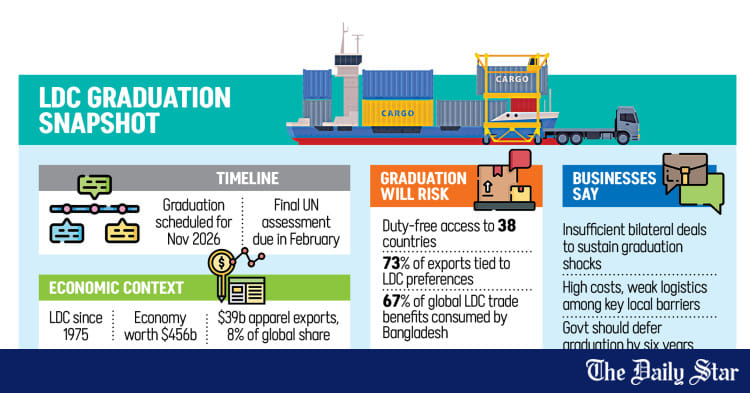
What is most alarming is that the graduating LDCs, especially in Asia, face steep surges in US tariffs. At present, four Asian countries, namely Bangladesh, Cambodia, Lao PDR, and Nepal, are on the path of graduation from the LDC category by 2030. Of these, Bangladesh, Lao and Nepal are scheduled to strip off the LDC tag in November next year. The high US tariffs have definitely made the smooth graduation difficult for these countries, posing a significant challenge to their development.​
 

LDC graduation an opportunity to match growth with dignity: Lutfey Siddiqi

UNB
Published :
Nov 18, 2025 19:05

1763514726124.webp


Special Envoy for International Affairs Lutfey Siddiqi on Tuesday said Bangladeshโ€™s graduation from LDC status is a chance to build a new kind of competitiveness, one based on value, skills, quality and fairness.

โ€œThis platform connects government, private sector and partners to shape the next chapter of our economic development, matching growth with dignity and sustainability,โ€ he said while speaking as the chief guest at a programme.

The Ministry of Commerce, Bangladesh Investment Development Authority (BIDA), International Labour Organisation (ILO) and United Nations Development Programme (UNDP) launched the Resilient Supply Chains for Sustainable Trade and Investments Platform at the BIDA auditorium.

The platform aims to strengthen Bangladeshโ€™s trade and investment ecosystem, ensuring sustainable, inclusive growth as the country prepares for graduation from Least Developed Country (LDC) status.

BIDA Executive Chairman Chowdhury Ashik Mahmud Bin Harun said, โ€œLetโ€™s set a clear roadmap and hold ourselves accountable, so by the end of 2026, we know exactly where we stand. This platform is about real progress, not just conversation.โ€

Commerce Secretary Mahbubur Rahman as Bangladesh prepares for LDC graduation; they are advancing regulatory reforms and aligning the trade and investment policies with global best practices.

โ€œOur goal is to create a stronger, more competitive environment for both domestic and cross-border investment, ensuring sustainable growth and decent work for all,โ€ he said.

Country Director, ILO Bangladesh Max Tuรฑรณn said supply chains are ultimately about people, the workers and entrepreneurs who drive Bangladeshโ€™s economy forward. โ€œThis platform is our opportunity to build joint solutions that put dignity and opportunity at the centre, making a real difference in everyday lives as Bangladesh transitions beyond LDC status.โ€

Resident Representative UNDP Bangladesh Stefan Liller said they are now poised to formally launch a platform for pooling their efforts to make the future growth of Bangladesh greener and more inclusive. โ€œThis platform will serve as a hub for collaboration and knowledge sharing. It will help in aligning investments, production and trade to environmental sustainability and social safeguards.โ€

Both UN agencies emphasised their appreciation for the close partnership with BIDA and the Ministry of Commerce, and called for more actors, including other UN agencies to join the platform network.

The UN agencies acknowledged the major support received from the countryโ€™s development partners, including Team Europe and Global Affairs Canada.

The platform will act as a hub for policy dialogue, capacity building, and knowledge sharing, driving policy coherence, supply chain development, and public-private partnerships.

This initiative supports Bangladeshโ€™s LDC graduation by promoting international labour standards, inclusive growth and decent work.​
 

Industries adviser leads delegation to LDCs ministerial conference
Bangladesh Sangbad Sangstha . Dhaka 23 November, 2025, 23:17

Industries adviser Adilur Rahman Khan led a four member Bangladesh delegation to the 11th Ministerial Conference of the Least Developed Countries (LDCs).

The United Nations Industrial Development Organization (UNIDO) organized the conference hosted by the Government of the Kingdom of Saudi Arabia on 22 November 2025 in Riyadh.

This yearโ€™s ministerial conference took place under the theme โ€˜Driving inclusive industrialization in LDCs: Investment, Innovation and Partnershipsโ€™ which featured two high-level thematic panels addressing key issues, including the mobilization of investment and financing for sustainable industrial development, and the formulation of transformative industrial policies to achieve irreversible graduation from LDC status.

The 11th ministerial conference was well attended by the ministers of LDCs, ambassadors and Permanent Representatives and representatives and partners from private sector, said a press release here.

The adviser participated as one of the panelists in the High-Level Ministerial Dialogue titled โ€˜Shaping LDCs Industrialization Agenda: Ministerial Dialogue on Investment, Innovation and Partnership.โ€™

While sharing Bangladeshโ€™s journey towards graduation from LDC category, he underscored the three zeros- zero carbon emission, zero employment and zero poverty, prioritized by the chief adviser of the Interim Government of Bangladesh Professor Muhammad Yunus.

Adilur also highlighted how Bangladesh is shifting towards smart manufacturing and value chain integration in line with the National Industrial Policy 2022.

However, he emphasized on investment, innovation and partnerships that are essential drivers for sustainable industrialization to attain inclusive growth for the LDCs.

He also highlighted the important role of the SMEs as the backbone of the industrial development as well as a strategic priority for the sustainable development of the LDCs

He also moderated the informal session on the Ministerial Declaration for LDC Member States as Vice Chairman.

The Ministerial Declaration is an outcome document of the conference which will be adopted during the 21st Session of the General Conference (GC) of UNIDO to be held on 23-27 November 2025 in Riyadh.

Overall, the conference created an important opportunity for the Industries Adviser to engage with counterparts of the LDCs including developed countries, and partners on vital issues and to contribute directly to the deliberations in Riyadh.

Ambassador and PR of Bangladesh to UNIDO in Vienna Toufique Hasan also attended the event as a delegate.​
 

Tarique warns against unchecked push for Bangladeshโ€™s LDC graduation

UNB
Published :
Nov 24, 2025 23:55
Updated :
Nov 24, 2025 23:55

1764034659115.webp


BNP Acting Chairman Tarique Rahman has warned that Bangladeshโ€™s planned graduation from Least Developed Country (LDC) status in 2026 should not proceed without open debate, warning that such a major decision carries long-term economic consequences

In a detailed Facebook post from London on Monday, he said the impact of losing tariff benefits will fall hardest on ordinary families, small factory owners and workersโ€”people who were never consulted but will bear the real cost.

Using examples of a garment factory owner in Gazipur and a young woman in Narayanganj whose family depends on overtime income, Tarique said these โ€œsilent crises inside ordinary homesโ€ show why the timeline needs reconsideration.

โ€œPicture a small garment factory owner in Gazipur. He has spent more than a decade building his business, employing over a hundred workers, managing tight margins, and competing in an unforgiving global market. One day, without any visible ceremony, the tariff advantages that once kept his prices competitive quietly disappear. It leads to his orders slowing down and the pressure rises to keep his factory open, his employees paid, and his family safe,โ€ he said.

โ€œNow picture a young graduate in Narayanganj, watching her family disappear into uncertainty. Her father works in a factory. He depends on overtime to make ends meet. When export pressure builds, overtime disappears first. Then shifts are cut. Then jobs. These are not headlines. These are silent crises inside ordinary homes.They never voted on that decision. They were never asked. They were never shown the real numbers,โ€ Tarique added.

He said that is why the debate around Bangladeshโ€™s LDC graduation matteres far more than official statements make it seem.

Tarique said the BNP has stated this before that moving ahead with the 2026 graduation timeline without keeping the option of deferral alive is purely a political decision, being taken by an interim government that does not carry an electoral mandate.

โ€œAnd yet, is making long-term commitments that will shape the countryโ€™s economic future for decades. We are told that delay is โ€˜impossible', that even asking for it to be deferred would be a โ€˜humiliationโ€™ which the United Nations (UN) would not even consider. But if we all look closer, history tells a more complex story,โ€ he observed.

The BNP leader said countries such as Angola and Samoa have had their graduation timelines adjusted.

He said the UN rules themselves allow flexibility when countries face economic shocks and asking for time on country shaping consequences is just responsible governance by an interim government.

โ€œBut why are we pretending that there is no choice? Why are we limiting our future? By publicly removing the option of deferral, we weaken our own negotiating power. We enter international discussions with our hands already exposed, giving away leverage before we even sit at the table,โ€ the BNP leader said.

Even, he said the governmentโ€™s own documents acknowledge the business community in Bangladesh already feeling the pressure on the banking sector, stress on foreign exchange, rising debt risk, slowing exports.

Tarique said it is not an argument against graduation, as Bangladesh has earned the right to move forward, but having the โ€œrightโ€ to graduate is not the same as being โ€œreadyโ€ to graduate.

He added that, in his view, real national strength does not lie in the absence of doubt in decision-making, but in the discipline to ask hard questions before the cost became irreversible.

โ€œNow look at Chattogram Port, the gateway to Bangladeshโ€™s economy. What happens there shapes the lives of millions more than any political speech ever will,โ€ the BNP leader said.

He said recent long-term decisions about the port are not routine but strategic commitments involving a national asset, being pushed forward by an interim government without a democratic mandate to make decisions that bind future generations.

Tarique said what is happening at Chattogram Port mirrors the same pattern seen in the LDC graduation process, where strategic options are being closed, public debate is treated as an inconvenience, and legitimate concerns are brushed aside in the name of speed and โ€œinevitability.โ€

โ€œLet me be very clear: this is not about personalities or attacking individuals. It is about protecting institutions and the principle that decisions which shape decades of national life should be made by governments that are accountable to the people,โ€ he said.

The BNP leader said no one is arguing against LDC graduation or port reforms.

โ€œThe argument is simpler, and more fundamental: the future of a nation should not be locked in by a government that the nation did not elect. Strategic patience is not weakness. Public consultation is not obstruction. Democratic legitimacy is not delay. And in my opinion, perhaps this is the most important truth beneath all of this,โ€ he said.

Tarique said the people of Bangladesh have never been passive about their future as they have endured hardship and sacrifice because they believe in dignity, voice, and choice.

โ€œTheir ask is simple: to be heard, to participate, to be respected. That is why so many of us look ahead to the national elections scheduled for February 2026, a chance for the people of Bangladesh to speak, to choose, and to reaffirm a simple truth: The future of this country must be shaped by those who live in it, believing in Shobar age Bangladesh,โ€ he concluded.​
 

UN panel queries Bangladeshโ€™s economic readiness for LDC exit

The United Nations Committee for Development Policy (UN CDP) has asked Bangladesh to provide clarification on its economic situation ahead of the country's scheduled graduation from least developed country (LDC) status.

During a virtual meeting with senior government officials Tuesday, the panel inquired about Bangladesh's readiness for graduation and its progress in implementing the Smooth Transition Strategy (STS), a guideline designed to ensure a sustainable transition from the LDC category.

The meeting followed Bangladesh's submission of its 2025 annual country report to the UN panel, which evaluates LDC graduation against established thresholds. The report was submitted on November 10. Bangladesh is scheduled to graduate from LDC status in November 2026.

Anisuzzaman Chowdhury, special assistant to the chief adviser, led the Bangladesh delegation, while senior UN CDP officials and representatives from other UN bodies participated.

"The UN CDP team and other UN officials focused mainly on the government's report," said a meeting participant, speaking on condition of anonymity.

"They sought information on macroeconomic stability, foreign currency reserves with the central bank, balance of payments, private sector investment, and the tax-to-GDP ratio. The officials also discussed various other economic issues highlighted in the report," the participant added.

"The committee has been reviewing Bangladesh's economic position to provide feedback in February, ahead of the country's scheduled graduation to a developing nation on November 24 next year," the participant said.

"They also requested updates on Bangladesh's preparations to obtain EU Generalised System of Preferences Plus (GSP+) status," they added.

Another participant, speaking anonymously, said the UN CDP team also sought information on Bangladesh's current economic situation, including employment, exports, and imports. "The meeting also covered the private sector's recent performance in trade, business, and the economy," they added.

Earlier, on November 10, a team led by Roland Mollerus, acting director of the United Nations Office of the High Representative for the Least Developed Countries, Landlocked Developing Countries, and Small Island Developing States, met with business leaders, independent economists, senior government officials, and labour union representatives.

They discussed the country's macroeconomic stability, while business leaders urged a deferment of graduation by at least six years, citing insufficient readiness.

Despite these calls, the interim government has repeatedly affirmed its intention to maintain the graduation timeline. The independent UN commission is preparing a report on the visit, which will be submitted to the UN CDP soon.

The UN panel is scheduled to review both Bangladesh's 2025 annual report and the commission's findings in February before finalising decisions on the country's LDC graduation or any possible deferment.​
 

Why we need to revisit the LDC paradigm

1764812640635.webp


It has been more than five decades since the UN established the Least Developed Countries (LDC) category, in 1971, identifying these countries as facing the most severe roadblocks to sustainable development.

LDC status unlocks international support measures (ISMs) including trade preferences, concessional finance, technical assistance, and prioritisation in aid allocation. Buffering against shocks and creating openings for investment, trade, and institutional strengthening, these measures are a lifeline for countries facing vulnerabilities due to geography, climate exposure, fragility, or conflict. The ultimate goal is "graduation" from LDC status, which triggers a transition period during which countries prepare to phase out ISMs.

This framework was designed to help countries move out of extreme structural disadvantage. But has it worked? The picture is mixed: today, some LDCs have advanced toward graduation, but many remain stuck. LDCs host about 12 percent of the world's population, including 27 percent of its refugees, but generate less than 2 percent of global GDP and 1 percent of world trade.

These imbalances reveal the limits of the current graduation model, which overlooks the structural realities keeping many trapped in underdevelopment. To be truly fit for purpose, the LDC paradigm must be updated to better reflect these vulnerabilities, recognise diverse trajectories, and align support with today's challenges.

THE UNEVEN PATH OF GRADUATION PROGRESS

To determine whether countries should retain LDC status or be considered for graduation, the UN Committee for Development Policy (CDP) reviews the list of LDCs every three years, using three criteria: income level, measured by gross national income per capita; human assets, assessed through health, nutrition, and education indicators; and environmental and economic vulnerability, captured through the Environmental Vulnerability Index (EVI). Countries qualify for graduation after meeting thresholds in two of the three categories in two consecutive reviews. As of late 2025, only eight countries have managed to exit the group of LDCs; 44 remain.

Six countries, Bangladesh, Lao PDR, Nepal, Solomon Islands, Cambodia and Senegal, have confirmed exit years and are preparing transition plans.

Comoros, Myanmar, Djibouti, Kiribati and Tuvalu have met the graduation criteria but deferred their exit due to political or structural challenges. Kiribati and Tuvalu, both Small Island Developing States (SIDS), have remained in the graduation pipeline for nearly two decades, reflecting the compound effects of remoteness, small size and exposure to climate risks.

Despite meeting thresholds in all three categories since 2018, Myanmar's graduation has been held back by protracted political instability. The graduations of Comoros and Djibouti, which became eligible in 2024, were deferred due to political uncertainty and weak institutions.

Rwanda, Uganda and Tanzania are the newest additions to the graduation pipeline, having met the thresholds for the first time in 2024.

Thirty LDCs (the "holdover" LDCs) have never qualified for graduation. Of these, 26 are in Africa. The remaining four, Afghanistan, Timor-Leste, Yemen and Haiti, face instability and isolation. About 40 percent of holdover LDCs are landlocked, limiting opportunities for connectivity and integration into global markets. Around 60 percent are conflict-affected or institutionally weak; nearly 93 percent fail to meet the EVI threshold. They are also home to 17 percent of the world's refugees. These pressures deepen fiscal strain and weaken state capacity, making progress toward graduation even more challenging.

THE LIMITS OF THE LDC PARADIGM

The slow pace of graduation is not a function of inadequate effort on the part of LDCs. Rather, it reflects the weaknesses of the model itself.

Specifically, the graduation criteria reward relatively short-term gains in economic and social indicators and downplay the impact of conflict exposure, remoteness, climate and peace-and-security risk โ€” all realities many LDCs face. The EVI threshold, while helpful, does not necessarily fully capture these dimensions, either. ISMs likewise fall short, focusing heavily on trade preferences and concessional finance rather than addressing the challenges that impede sustainable progress. By penalising countries for conditions they cannot easily change, the LDC paradigm keeps them at the bottom of the development ladder.

TOWARD A NEW LDC FRAMEWORK

Graduation must reflect a country's capacity to absorb shocks, recover and sustain progress despite conflict, climate exposure or geographic disadvantage. Here are some elements that policymakers at national, regional and global levels should prioritise to create a more responsive and equitable framework.

Modernise how vulnerability is measured. A more comprehensive risk and resilience index would better identify structural weaknesses and guide targeted ISMs that strengthen long-term preparedness and adaptive capacity. The UN-CDP along with UNCTAD should revisit how the EVI captures risk, ensuring that conflict, fragility, climate exposure and refugee inflows are adequately reflected.

Promote a cross-pillar approach to resilience. The LDC agenda must move beyond economic metrics to integrate climate action, governance, peace and security, and social inclusion as equal pillars of progress. This would better capture the links between economic performance, environmental stability and institutional strength, aligning international support with the ambitions of the 2030 Agenda.

Strengthen international support measures and link them to resilience-building. ISMs must go beyond trade preferences and concessional finance to address structurally weak and conflict-ridden economies. Climate funds, debt relief, governance support and peacebuilding should be strategically linked.

Domestic reforms such as stronger institutions, fiscal discipline and diversification are also vital to ensure lasting gains.

This reimagined framework cannot be one-size-fits-all: the experience of many LDCs makes clear that the graduation trajectories of landlocked developing countries, SIDS, conflict-affected or climate-vulnerable economies must be considered separately.

There are some positive signs that support for this approach is growing. The UN-CDP has introduced supplementary graduation indicators (SGIs) to allow greater flexibility in evaluating country progress. The Doha Programme of Action (2022, 2031) recognises the diversity of LDCs and calls for tailored support that reflects distinct vulnerabilities.

These are welcome steps, but more work is needed to ensure that global frameworks evolve to match the complex realities of the countries left behind. It is time to rethink the LDC paradigm, aligning measures of progress and support with today's structural, climate, governance and peace-security challenges.

Debapriya Bhattacharya is a distinguished fellow at Centre for Policy Dialogue, and Mamtajul Jannat is a senior research associate at Centre for Policy Dialogue​
 

Bangladesh needs strong diplomatic engagement to delay LDC graduation, says RAPID chief

FE ONLINE REPORT
Published :
Dec 15, 2025 14:29
Updated :
Dec 15, 2025 14:32

1765846339580.webp

File photo of Dr Mohammad Abdur Razzaque

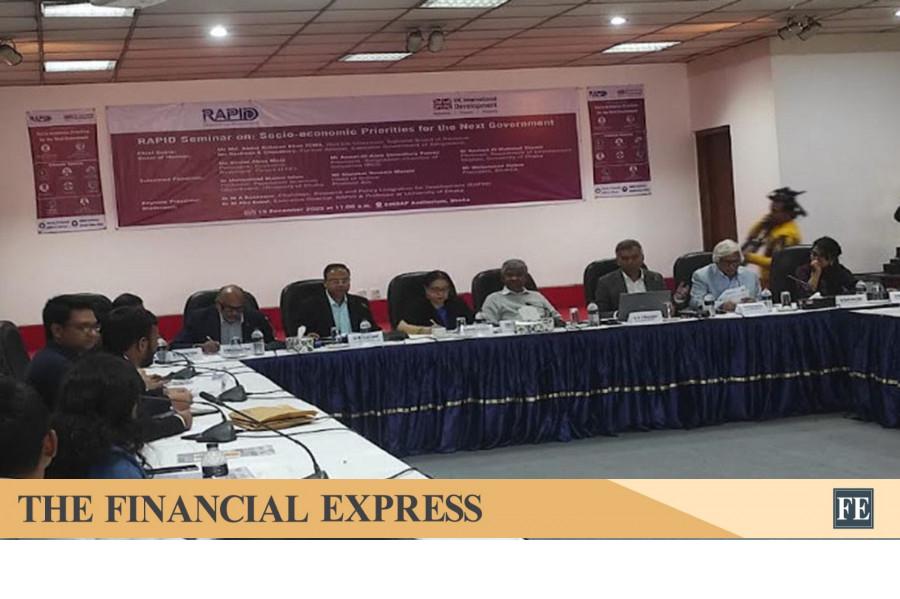
Bangladesh needs strong diplomatic engagement to delay its graduation from the Least Developed Country (LDC) category, as the country is likely to face multiple post-graduation challenges without adequate preparation, said Dr Mohammad Abdur Razzaque, chairman of the Research and Policy Integration for Development (RAPID), on Monday.

He made the remarks at a seminar titled โ€˜Socio-economic Priorities for the Next Governmentโ€™, held at the CIRDAP Auditorium in Dhaka.

Dr Razzaque noted that the next governmentโ€™s first major test would be crisis management, leaving limited scope for articulating long-term vision statements in the early phase of its tenure.

โ€œImmediate challenges related to inflation, banking sector stability, foreign exchange reserves, and LDC graduation will shape the entire term of the next government,โ€ the economist said.

He stressed that the incoming administration must prioritise securing the EUโ€™s GSP+ facility, implementing the ninth five-year plan with a strong focus on job creation, ensuring energy security to support urban development and manufacturing industries, enhancing export competitiveness, attracting greater foreign direct investment (FDI), and strengthening human resource development.

Dr Razzaque warned that failure to act promptly would narrow the policy space and lead to more costly adjustments later, adding that while structural reforms are crucial, they can only succeed if short-term macroeconomic stability is ensured.

โ€œCredible actions taken within the first year can help restore confidence among households, investors, and development partners,โ€ he said.

The seminar was attended by National Board of Revenue (NBR) Chairman Md Abdur Rahman as the chief guest. Other speakers included former caretaker government adviser Rasheda K Chowdhury, RAPID Executive Director Dr M Abu Eusuf, Bangladesh Chamber of Industries President Anwar Ul Alam Parvez, among others.​
 

Members Online

Latest Posts

Latest Posts