[🇧🇩] LDC Graduation For Bangladesh

Afghanistan Albania Algeria Andorra Angola Antigua Austria Azerbaijan Bahamas Bahrain Bangladesh Barbados Canada China Egypt Finland Germany India Iran Israel Japan Lebanon North Macedonia Pakistan Palestine Qatar Russia Syria Turkey Ukraine United Kingdom United States Yemen
[🇧🇩] LDC Graduation For Bangladesh
123
3K
More threads by Saif

G Bangladesh Defense

EU, G77 back country's bid for smooth LDC graduation
1784329744717.webp


A big backing comes from the European Union (EU) and the Group of 77 and China (G77) to Bangladesh in its try for smooth, sustainable and irreversible graduation from the least- developed country (LDC) category with extended time.

According to a government news release issued Friday, the assurances came during separate meetings at the United Nations Headquarters between Commerce Minister Khandakar Abdul Muktadir and Head of the European Union Delegation to the United Nations Ambassador Stavros Lambrinidis, and Chair of the Group of 77 and China and Permanent Representative of Uruguay to the United Nations Ambassador Laura Dupuy Lasserre.

The minister was accompanied by State Minister for Planning Zonayed Saki, Economic Relations Division (ERD) Secretary Md Shahriar Kader Siddiky, Bangladesh Permanent Representative to the United Nations Ambassador Salahuddin Noman Chowdhury, Footwear, Leathergoods and Accessories Exporters' Association of Bangladesh (LFMEAB) President Syed Nasim Manzur and Bangladesh Garment Manufacturers and Exporters Association (BGMEA) President Mahmud Hasan Khan.

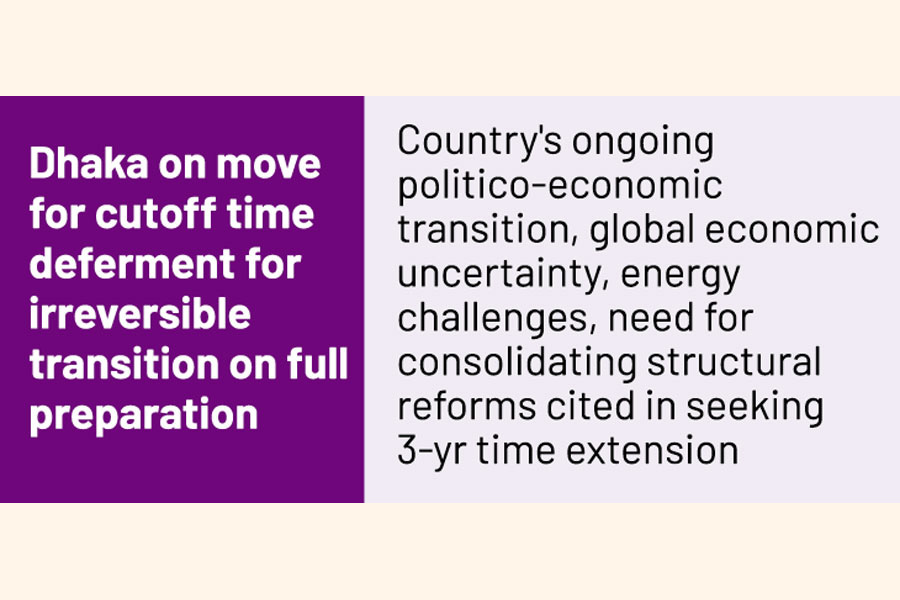
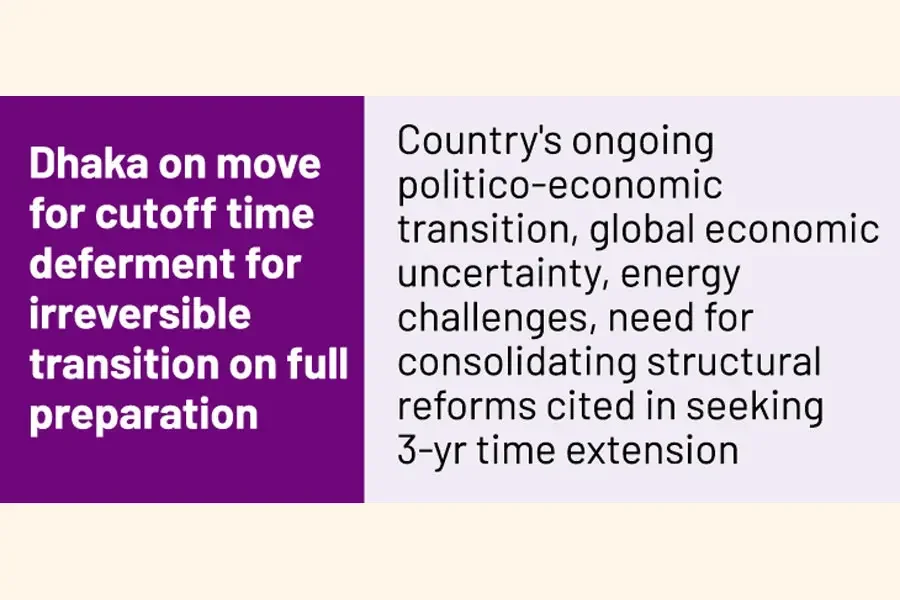
During the meetings, the commerce minister explained the rationale behind Bangladesh's request for a three-year extension of the LDC-graduation-preparatory period, citing the country's ongoing economic and political transition, global economic uncertainty, energy challenges and the need to consolidate structural reforms.

He reiterated the government's commitment to strengthening governance, reforming the financial sector, improving infrastructure, enhancing domestic resource mobilisation and creating a more investment-friendly business environment.

"The additional time would help consolidate reforms, remove infrastructure bottlenecks, strengthen industrial competitiveness and ensure that Bangladesh's graduation remains smooth, sustainable and irreversible," the minister was quoted as saying.

Ambassador Lambrinidis has welcomed the government's commitment to good governance and sustainable development and expressed the EU's continued support for Bangladesh's graduation process.

He also welcomed the launch of discussions on a Bangladesh-European Union Free-Trade Agreement (FTA) and stressed the importance of stronger public-private cooperation to facilitate the transition, according to the press release.

Meanwhile, Ambassador Lasserre acknowledged the strength of Bangladesh's case for extending the preparatory period and praised the government's pragmatic reform agenda.

She reaffirmed the G77's support for Bangladesh and proposed a dedicated briefing for G77 member- states on the country's graduation strategy, a proposal welcomed by the Bangladesh delegation.

Following the meetings, the ERD Secretary, Shahriar Kader Siddiky, described the discussions with the EU delegation as "productive", saying that the bloc reiterated its continued support for Bangladesh's smooth, sustainable and irreversible graduation from the world's poor-country club.​
 

Bangladesh takes 5-year plan to get ready for post-LDC challenges

The commerce ministry today organised a validation workshop on the programme

Star Business Report

1784504201992.webp

File visual: Anwar Sohel/Star

The government has adopted a new five-year plan to improve the country's investment climate and business competitiveness and prepare for the challenges it will face after graduating from the least developed country (LDC) category in November this year.

The new programme has been undertaken under the third phase of the Enhanced Integrated Framework (EIF) of the World Trade Organisation, according to a statement from the commerce ministry.

The commerce ministry today organised a validation workshop on the new EIF programme at the ministry to make its officials aware of the plan.

At the workshop, Commerce Secretary Ataur Rahman Khan said the economy has been passing through an important period as, on the one hand, the country has to prepare for LDC graduation and, on the other hand, it is facing non-tariff barriers to exports and challenges in improving the investment climate.

The 12 key recommendations made by the EIF in its earlier programme have been incorporated into the newly formulated country document, which will help improve business competitiveness and support the ongoing reform initiatives, the secretary also said.

The document gives importance to improving the business environment by enhancing the ease of doing business, liberalising the tariff regime, and relaxing related rules in collaboration with the ministries concerned.

1784504244146.webp


Additional Commerce Secretary Khadiza Nazneen said the WTO provides assistance to LDCs and graduating LDCs to improve business competitiveness through its arm, the EIF, while the UK, the European Union, and Sweden support the programme.

Bangladesh has already implemented different recommendations under EIF-funded projects in two phases from 2009 to 2024.

The five-year third phase of the EIF-funded project may begin this year as the country is eligible for the fund, Nazneen also said.

EIF-funded Project Consultant Md Hafizur Rahman said 52 projects were initially identified, but later 12 were prioritised, considering implementation capacity and assurances of funding from foreign donors.

Bangladesh has been preparing to face the challenges of LDC graduation and retain preferential trade benefits, as the country may lose $17.5 billion worth of exports annually because of the graduation.

Currently, 73 percent of Bangladesh's trade enjoys LDC-specific preferences, and Bangladesh is the largest beneficiary of LDC-specific trade benefits, accounting for 67 percent of the preferences provided to all 44 LDCs by developing and developed countries.​
 

Bicycle exporters look beyond recovery to post-LDC challenges

Jagaran Chakma

1784763978364.webp


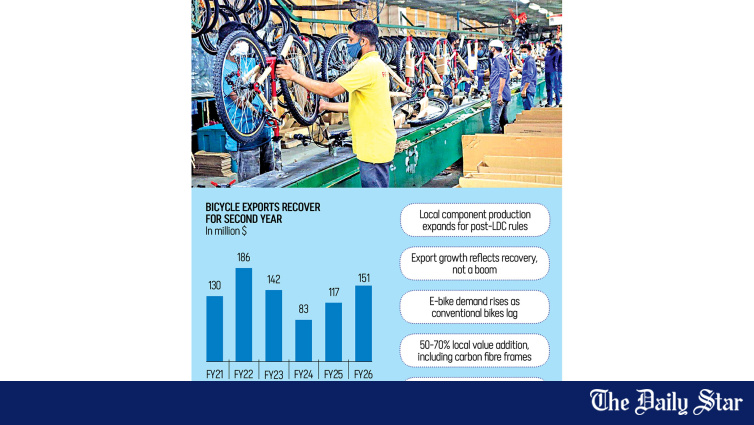
Bangladesh’s bicycle industry is moving beyond simple assembly towards deeper manufacturing, with exporters increasingly producing components locally to strengthen competitiveness in global markets.

But industry leaders say substantially higher local value addition will be essential to retain preferential market access after the country’s graduation from the least developed country (LDC) category.

Manufacturers are now investing in local component production to reduce their import dependence and meet stricter rules of origin that will apply after LDC graduation.

The shift comes as bicycle exports continue to recover. According to the Export Promotion Bureau (EPB), bicycle exports earned $151 million in FY2025-26, up around 30 percent from $116 million a year earlier.

Industry executives say the recovery reflects Bangladesh’s improving manufacturing capability, competitive production costs and established relationships with European buyers.

However, RN Paul, managing director of RFL Group, noted that the rise in bicycle exports reflects a recovery from last year’s unusually weak base rather than a full-fledged market rebound.

“Exports have bounced back, but the market is still well below where it was three or four years ago, including 2022,” he said. “It’s a case of things getting better from a very bad situation, not a boom.”

He attributed the recent improvement to some overseas buyers resuming orders after a prolonged slowdown rather than the emergence of new export destinations.

Paul said global demand for conventional bicycles remains subdued as consumers gradually shift towards electric bicycles, which typically cost about 30 percent more. At the same time, economic uncertainty caused by ongoing geopolitical conflicts has made consumers more cautious about spending.

“The transition to e-bikes is happening, but volumes are not growing at the pace we expected,” he said.

RFL has introduced e-bikes in both the domestic and export markets, although demand remains limited, he added.

While RFL is navigating a gradual recovery in demand, other manufacturers are focusing on expanding local production to strengthen their long-term competitiveness.

Md Luthful Bari, chief operating officer of the Tyre Division of Meghna Group of Companies, said the company manufactures most bicycle components locally, including frames, forks, rims, tyres, tubes, pedals, saddles, handlebars and grips. Only a few specialised inputs, such as paint and Shimano gear systems for multi-gear bicycles, are imported.

He said specialised bicycle paint is not produced in Bangladesh and attracts an import duty of about 60 percent, increasing production costs.

Multi-gear components are also imported because overseas buyers prefer internationally recognised brands such as Shimano, while steel sheets and rods are brought in as raw materials.

Bari said local value addition ranges between 50 percent and 70 percent, depending on the type and specifications of the bicycle.

Meghna’s exports are gradually gaining momentum after a prolonged slowdown, with Germany remaining its largest market, followed by Denmark.

The company is also expanding into new European markets, although exports to Italy have declined.

“Export orders are improving gradually,” Bari said, expressing optimism that overseas demand will continue to recover.

He added that Meghna began manufacturing high-end carbon fibre frames and forks a few years ago, claiming it was the first company in South Asia to do so.

Google News LinkFor all latest news, follow The Daily Star's Google News channel.
The company plans to start producing fully carbon fibre bicycles soon, targeting the premium segment of the global market.

Newer manufacturers are also making significant investments with the post-LDC trade regime in mind.

Among the new entrants, Akij Bicycle Industries is building its strategy around increasing domestic value addition.

Sayed Joynul Abedin, chief executive officer of Akij Bicycle Industries Ltd, said the company began exporting bicycles in March after spending the previous two years establishing its manufacturing facilities.

“So far, we have exported to three European countries -- the Netherlands, Poland and Germany. The response has been encouraging, and we already have several export orders in hand,” he said.

The company expects to export around 100,000 bicycles this year.

Abedin said Akij has invested about Tk 250 crore, including land acquisition and factory development, in its bicycle manufacturing project in Mirzapur, Tangail.

He said increasing local value addition has become a strategic priority as Bangladesh prepares to graduate from LDC status.

“At present, we can qualify for export preferences with around 30 percent value addition. After LDC graduation, the requirement will rise to about 50 percent. Keeping that in mind, we are investing in tyre manufacturing, which we expect to begin commercial production next year and help raise local value addition,” he said.

The factory currently employs around 800 workers, with the workforce expected to exceed 1,000 by the end of the year, he added.​
 

UN body backs Bangladesh’s LDC extension request
Staff Correspondent 22 July, 2026, 12:47

1784764742893.webp


Bangladesh permanent representative to the United Nations ambassador Salahuddin Noman Chowdhury. | UNB photo

The United Nations Economic and Social Council on Tuesday recommended that the United Nations General Assembly make a final decision on requests by Bangladesh and Nepal for a three-year extension of the preparatory period before their graduation from the least developed country category.

The recommendation was adopted by consensus by ECOSOC member states at a council meeting, according to a press release issued by Bangladesh’s permanent mission to the United Nations in New York.

Bangladesh’s permanent representative to the UN, ambassador Salahuddin Noman Chowdhury, introduced the draft decision on behalf of Bangladesh and Nepal, outlining the reasons for their requests for extending the preparatory period.

Bangladesh has requested a three-year extension of the preparatory period until November 24, 2029.

The ECOSOC decision followed assessments by the Committee for Development Policy, which concluded that it would be appropriate for the General Assembly to consider granting extensions for both countries.

Under the recommendation, the General Assembly has been asked to make a final decision on the matter before November 24, when Bangladesh and Nepal are currently scheduled to graduate from the LDC category.

Following the adoption of the decision, ambassador Salahuddin Noman reaffirmed Bangladesh’s commitment to graduating from the LDC category in a sustainable manner.

He also reiterated Bangladesh’s commitment to implementing necessary policy measures and reforms to strengthen its readiness for graduation if the General Assembly approves the deferral request.

Addressing the ECOSOC meeting, the ambassador said that Bangladesh remained firmly committed to LDC graduation, describing it as a national aspiration built on decades of hard work by its people rather than a luxury.

He said that the graduation process must be smooth, sustainable and irreversible, ensuring that it does not disrupt or reverse the country’s development gains.​
 

Latest Posts

Back