Home Watch Videos Wars Login

[🇧🇩] Monitoring Bangladesh's Economy

[🇧🇩] Monitoring Bangladesh's Economy
955
25K
More threads by Saif

G Bangladesh Defense

State of the Bangladesh Economy in H1 of FY2024-25
Persistent headwinds and concerns in external sector

Fahmida Khatun, Mustafizur Rahman, Khondaker Golam Moazzem, Muntaseer Kamal and Syed Yusuf Saadat
Published :
Jan 31, 2025 21:33
Updated :
Jan 31, 2025 21:33

1738367826532.webp


Amid the prevailing bleak macroeconomic scenario and the pressure on several fronts, the external sector performance during the first half of FY25 offers some much needed and welcome relief to the Bangladesh economy. The positive changes are underpinned by the robust performance of most of the attendant correlates that inform the country’s external sector outcomes. Exports posted robust growth during the first half (July-Dec) of FY25 as did the earnings from remittance inflows. The slide experienced by the foreign exchange reserves was halted, and the exchange rate of Bangladeshi Taka (BDT) against major currencies stabilised, although some volatility in the reserve position continues to persist. Improved trade and current account balance, as also the overall balance of payments situation, allowed going for some de-restriction of import activities. To what extent the positive trends will continue over the second half of FY25 is, however, uncertain, particularly because some of the headwinds are becoming gradually discernible. The following sections elaborate on some of the pertinent issues in view of the above.

Robust Export Performance, But Mostly Volume-Driven: Against the backdrop of muted performance of the corresponding period of the previous year, Bangladesh’s export sector experienced an impressive growth rate of 12.8 per cent during the first half of FY25. However, the double-digit growth needs to be taken with a grain of salt since it was achieved on the relatively lower base of (-) 9.5 per cent over the first half of FY24.

One distinctive feature of the export performance in the first half of FY2025 was that both RMG (13.3 per cent) and non-RMG (11.0 per cent) sectors recorded impressive growth. Within the RMG, while knitwear continued to exhibit robust performance (13.0 per cent growth), the wovenwear was also able to catch up with similarly high growth (13.6 per cent). As noted, the non-RMG sector also performed well, overall, with some of the non-RMG traditional export sectors registering impressive growth.

What is encouraging to note is that, in spite of the significant disruptions in production in the first quarter (July-September) of the FY25, consequent to the student-citizens uprising and workers’ unrest, export sector was able to demonstrate remarkable resilience and to pick up quickly, and major brands and buyers continued to stay with, and procure from, Bangladesh.


1738367855814.webp


Estimating value addition is important from the perspective of arriving at an understanding about net domestic forex retention from export activities and capturing the possible implications for the country’s forex reserves situation. Our estimates indicate that domestic value addition from export was about US$15.0 billion during the first half of FY25 as against US$13.2 billion for the corresponding period of FY24, posting a high growth of 12.6 per cent. This robust performance owed to the high growth of knitwear exports (for which the value addition is considered to be about 60 per cent of corresponding global exports, as against the wovenwear where this is taken to be about 50 per cent), and also of non-RMG exports (for which the average value addition is estimated to be about 85 per cent). The fall in the cotton price was to the advantage of exporters (this was US$ 1.79/ kg in July-December of FY25, compared to US$ 2.07/kg in FY24 and US$2.48/kg in FY23 for corresponding periods). However, as would be seen below, exporters did not benefit in the form of higher apparels prices.

With regard to the drivers of the export growth in the key markets of the European Union (EU) and the United States of America (USA), as Table 4.1 indicates, this was primarily on account of the high growth in volume (10.6 per cent in the EU and 16.2 per cent in the USA), rather than that of price which witnessed negative growth rate (-.05 per cent and -4.0 per cent respectively). This, however, depicts the overall trend as regards the imports by both the EU and the USA since the performance pattern was the same for all major sourcing countries such as Vietnam, and, to some extent, China as well. The significant fall in cotton price, by 13.3 per cent between July-December period of FY24 and FY25, noted above, could be one reason for the above. On the other hand, this also underscores the stranglehold the brands and buyers have on the buy-driven global value chain of apparels whereby they are strongly positioned to pass on the lower price of inputs and intermediates in the form of lower prices to producers and exporters of apparels in Bangladesh and other countries.

While exports of jute and jute goods, and leather continued to struggle (-8.1 per cent and -11.6 per cent growth respectively), exports of leather and sports footwear posted very high growth of 30-45 per cent.

An analysis of export composition evinces that intra-RMG diversification continues to remain limited. Structural changes favouring the growing segment of the global RMG market- man-made and synthetic fibre-based apparels items- are yet not visible. To note, three-fourths of Bangladesh’s RMG exports are cotton-based, while more than three-fourths (and growing) of the global apparel market is non-cotton-based. There is a need to restructure export incentives in place to encourage investment in, and export of, man-made fibre-based apparel items. This would also help to raise the share of domestic value retention in total exports of Bangladesh which at present hovers around 60.0 per cent.

Indeed, both export concentration and market concentration persist. For example, the country’s export share in the growing markets of South Asia, East Asia, and ASEAN came down in the first half of FY2025 compared to the matched figure for FY24 (the share came down to 11.8 per cent from 12.7 per cent). Addressing the attendant challenges is particularly important also in anticipation of Bangladesh’s upcoming graduation from the Least Developed Country (LDC) status. Taking a cue from Vietnam, Bangladesh should aggressively pursue Free Trade Agreements (FTAs) and Comprehensive Economic Partnership Agreements (CEPAs) with countries of the region. A dedicated Trade Negotiating Cell needs to be set up, and the country’s offensive and defensive interests identified. Forward-looking trade strategies will need to be formulated and proactively pursued. Domestic tariff rates and regulatory policies will have to be adjusted in view of this in anticipation of Bangladesh’s future as a non-LDC developing country. Initiatives targeting the various trade-related measures, at the border and behind the border, must be put into action, and adequate preparation must be taken in anticipation of changing market access regime beyond the border.

Recent initiatives of the Bangladesh Investment Development Authority (BIDA) to attract export-oriented Foreign Direct Investment (FDI) to targeted sectors are timely, and need to be vigorously pursued. The proposed measures by BIDA include prioritising the setting up of selected Special Economic Zones (initially five SEZs and in ten years an additional ten) and identification of sectors that will be prioritised (19 sectors) in policies. The policies will need to be implemented by making available all the investment-related services as stipulated in the One Stop Service Act of 2018.

Proactive implementation of the Smooth Transition Strategy in view of LDC graduation is critically important if the current robust export performance is to be sustained in future, and the challenges of LDC graduation are to be adequately addressed. The discourse and proposal as regards deferment of LDC graduation (beyond 2026) and the possibility of availing of the Generalised System of Preferences (GSP) plus facility should not dissuade Bangladesh from doing the needful towards sustainable graduation. This is for a number of reasons. Firstly, as the CDP report (2021) indicates that Bangladesh is comfortably situated in view of all the three graduation thresholds and, as such, it will be a hard sell to argue for any deferment. Secondly, accessing the GSP plus preferential market access will be difficult (Bangladesh’s export share of RMG to the EU at present is above the ceiling proposed in the GSP Plus Scheme). Thirdly, the rules of origin for RMG in the GSP Plus proposed are onerous: two-stage conversion instead of one stage under the existing Everything But Arms (EBA) scheme. Fourthly, compliance requirements as regards labour, environment, CO2 emission and other standards are expected to become much more stringent once the new EU-GSP Scheme comes into effect in 2027. The task before Bangladesh will be to take all necessary initiatives and measures in view of the country’s graduation timeline of November 26, 2026.

Better and more efficient trade facilitation measures will be critically important in raising the export and trade competitiveness of Bangladesh. These included implementation of the recently formulated National Logistics Policy (2024), Paperless Trade Policy, Single Window System and cross-border Digital Commerce Policy (2024), and introduction of green trade facilitation measures. Putting in place the above will raise Bangladesh’s trade competitiveness and bring down trade-related costs and improve the business environment significantly.

Imports Gain from Price Effect: The encouraging growth of exports, together with the robust inflow of remittances helped to stall the fall in the forex reserves experienced since June 2024, and stabilise it at about US$26.0 billion in more recent months. This facilitated the withdrawal of some of the restrictions on imports put in place earlier. This led to a rise of 2.0 per cent in imports during the July-October of FY25 period compared to the corresponding period of FY24 (when imports were -20.6 per cent lower when compared to the matched period of FY2023). However, the import structure indicates that the growth was mainly because of the growth of imports of raw cotton (15.4 per cent) and textiles and articles thereof (26.8 per cent), while import of key production-related intermediaries (e.g., crude petroleum; -46.7 per cent) and capital goods (e.g., capital machinery: -25.1 per cent) remained in the negative. L/C opening (-0.5 per cent) and L/C settlement (-1.0 per cent) were in negative terrain for the period between July-November, FY25. However, to note, the two indicators were deep in the negative during the previous two corresponding periods (-12.3 per cent and -26.8 per cent for the same period of FY24 against FY23). The slide downward, thus, has been arrested. In view of the fall in prices of major commodities in the global market (e.g., fuel cotton, etc.), imports in terms of volume were able to post a positive trend. Accordingly, the data on import L/C opening, and L/C settlement should be treated with some caution, and leave room for interpretation.

Encouraging Remittance Inflow but Composition Merits Closer Look: As was noted, the high growth of remittance inflow has contributed to restraining the slide in the availability of foreign exchange in Bangladesh. The year 2024 saw the highest amount of remittance flow to the country US$26.89 billion, which was 22.7 per cent higher than 2023. If the period under review (July-December of FY25) is considered, the growth in remittance flow was 27.6 per cent against the matched period of FY2024.

Over the past four years (between 2021 and 2024), about 4 million people have left Bangladesh for overseas jobs, mostly in the Middle-East countries. It was pointed out in the previous IRBDs that this was not reflected in the amount and origins of remittance inflows to Bangladesh. Remittance inflow figures for 2021, 2022, and 2023 were US$22.0 billion, US$21.3 billion, and US$21.9 billion respectively despite the fact that about three million people had left the country for overseas jobs over the corresponding period. The other disquieting development was the structure of the inflow- there was a significant shift from Saudi Arabia to the UAE, for example. This is clearly discernible from Figure 4.2.

The fall in remittances from Saudi Arabia (more than 50 per cent of migrant workers left for the country), and the parallel rise in the remittances from the UAE, allude to the suspicion about a shift towards informal channels in recent past years. This calls for more in-depth investigation. In this connection, one may recall the report of the White Paper Committee 2024 which was set up by the Interim Government. The report noted that Dubai has emerged as a major hub of the money laundered from Bangladesh in the recent past. A number of underlying factors were identified in this connection: Dubai real-estate regulations (dedicated areas earmarked for foreign buyers and not asking about the source of money); investment policies (attracting foreign investors without undertaking due diligence); easy ways for people to set up shell companies and aggregators purchasing foreign currency from remitters by paying a premium; distribution of ill-gotten money among remittance-receiving households in Bangladesh by using various mobile financial platforms; employing firms and agents specialised in handling laundered money; hiding the sources through multilayered transactions and setting up shell companies in tax havens.

It is hoped that the Task Force set up by the Bangladesh Bank for Recovery of Stolen Assets, with support from the re-energised Bangladesh Financial Intelligence Unit (BFIU) and a rejuvenated Anti-Corruption Commission (ACC), will go deeper into the attendant issues, undertake forensic investigation and identify the key players involved in the laundering of money and will lodge criminal cases to bring the perpetrators to justice. Efforts must be pursued in all earnest to bring back the stolen money to where it truly belongs (filing cases in Bangladesh; establishing paper trail to the ultimate beneficiary abroad; filing cases in overseas jurisdiction; getting court verdicts to sequester, freeze and seize assets and return the recovered money to Bangladesh). To facilitate this process, Bangladesh should become a full member of the Financial Action Task Force (FATF), and Global Forum (GF) on Transparency and Exchange of Information for Tax Purposes.

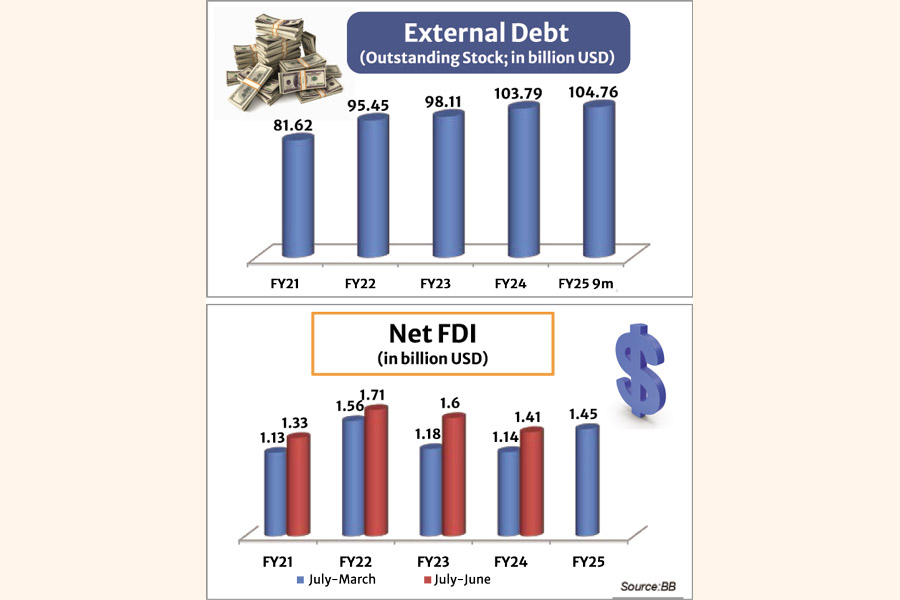
Balance of Payment Scenario: The robust performance of exports and remittances contributed to an overall improvement in the balance of payments situation towards the end of December 2024. While this is still not comfortable, the trend is, however, encouraging when compared with the corresponding period of FY24. As was noted, large inflow of export and remittance earnings have helped to stall the slide downwards in the forex reserves situation, and contributed to stabilisation of, to a certain degree, the exchange rate of BDT. The improvement is primarily on account of the significant reduction in the trade account deficit, and to a larger extent, to the declining current account deficit. The improvement in Bop is not primarily because of the debt-creating financial account balance (to note, in the July-November period of FY2022, this was US$4,599 million; underpinned by medium- and long-term loans worth US$3,013 million). This compositional shift is a positive trend. However, the dismal performance in terms of FDI and portfolio flows remains a nagging concern.

There are a number of issues which, however, will need to be kept in the perspective in view of the likely BoP scenario over the near-term future: (a) with increasing de-restriction of imports, import payments are expected to go up; consequently, the trade balance could come under further pressure. Sustaining current robust export performance will be critically important in view of this; (b) maintaining the ongoing high growth of remittances will not be easy. It could be that the rise in remittance flow is because of the evident disruption of hundi/hawala and other informal channels of illicit financial flows in the aftermath of the August uprising. This could as well be a one-time phenomenon; (c) while the fall in reserves has been halted, the demands of higher imports and growing debt servicing liabilities could accentuate the pressure on forex reserves (the grace periods- when only interests have to be made- as regards a number of megaprojects are coming to an end; when the repayment period will commence, both interest and principal amount will need to be paid). Fourthly, true, the BDT, in view of the higher availability of the foreign currency in the country, has somewhat stabilised (for example, at about BDT 120-121 vis-a-vis USD). However, if forex demand on account of import and debt servicing payments goes up, BDT could slide further under an open market regime. This would then likely have implications in the form of imported inflation.

Exchange Rate Movement and Stabilisation of BDT: After the sharp decline of almost 40 per cent over the last three years, the value of the BDT appears to be stabilising in recent months. The BDT exchange rate against USD appears to be at the equilibrium level, as of now. As is known, at present the Bangladesh Bank is pursuing a crawling peg policy (within a limited range). However, a move towards a fully market-based exchange rate regime is anticipated over the near-term future. The exchange rate movement will need to be closely monitored. At the same time, the Bangladesh Bank may consider gradually phasing out (or withdrawing) the additional money being given to remitters to incentivise remittance flow and discourage sending money through informal channels (at 2.5 per cent). In 2024, against the remittance flow of US$26.88 billion, about US$0.67 billion was paid to remitters as incentives (equivalent to more than 80 billion taka at the current exchange rate of US$1=BDT 120). Given the revenue situation, the prevailing policy in this regard ought to be carefully weighed, and if justified, changed. Maintaining the exchange rate stability and holding comfortable forex reserves are the twin challenges that the central bank will have to deal with in the near-term future.

Concluding Remarks: The performance of the external sector during the July-December 2024 period transmits some hopeful messages. However, headwinds in the form of the global trading environment (likely US trade policy changes under the Trump administration), demand-side pressure on forex against the backdrop of import and investment pick-up, the growing pressure of Public and Publicly Guaranteed (PPG) debt servicing, and the challenges of implementing the smooth and sustainable LDC graduation strategy should keep policymakers alert and on their toes. The external sector situation and BoP scenario in June 2025 will hinge on how policymakers are able to deal with these emergent challenges, and take advantage of the drivers and accelerators of external sector performance. How the key external sector correlates evolve in the coming months of FY25 will hinge critically on this. In the context of LDC graduation, the smart way to go forward would be to implement the Smooth Transition Strategy in all earnest and take the needed initiatives to transform the economy from one of preference-driven competitiveness to skills and productivity-driven competitiveness.

The discourse about deferment of graduation should not dissuade Bangladesh from taking the needed measures. It is also to be noted that, in the end, the issue of requesting a deferment of Bangladesh’s LDC graduation is a political call. Whether Bangladesh will be comfortable to remain an LDC beyond 2026, with the war-torn Afghanistan, being the only other LDC in the region, demands careful strategic and political consideration.

Efforts to bring back the laundered money from abroad must be pursued in all earnest. Measures need to be geared to undertaking energetic initiatives concerning prosecution, investigation, collaboration with relevant global initiatives and platforms, and filing of criminal/ civil cases in foreign jurisdictions to recover the stolen assets and the evaded taxes.

Dr Fahmida Khatun, Executive Director, Centre for Policy Dialogue (CPD); Professor Mustafizur Rahman, Distinguished Fellow, CPD; Dr Khondaker Golam Moazzem, Research Director, CPD; Mr Muntaseer Kamal and Mr Syed Yusuf Saadat, Research Fellows, CPD. moazzem@cpd.org.bd; avra@cpd.org.bd

[Abu Saleh Md Shamim Alam Shibly, Tamim Ahmed and Helen Mashiyat Preoty, Senior Research Associates; M Tanjim Hasan Khan, Resource Mobilisation Associate; Afrin Mahbub, Preetilata Khondaker Huq, Anika Tasnim Arpita, Jannath Sharmin Chowdhury, Anindita Islam, Abrar Ahammed Bhuiyan, Nuzaira Zareen, Ayesha Suhaima Rab, and Safrina Kamal, Programme Associates of CPD provide research assistance.]​
 
Analyze

Analyze Post

Add your ideas here:
Highlight Cite Fact Check Respond
  • Like (+1)
Reactions: Bilal9

A struggling economy needs greater attention
The government lacks urgency and focus in crisis response

1738452345220.webp

VISUAL: STAR

The bleak economic outlook for Bangladesh, as recently highlighted by the Centre for Policy Dialogue (CPD), is concerning. In a paper titled "Navigating Expectations in Turbulent Times," the think tank revealed that the interim government's economic measures have yet to bring substantive improvements in people's lives and to support businesses. Despite reform initiatives across various sectors, including the economy, any noticeable recovery or dynamism remains absent.

As many have pointed out, Bangladesh has a real opportunity to implement substantive changes in its taxation system during this transition period. Over the years, the country's development activities have become increasingly dependent on debt due to its low tax-GDP ratio. To address this, Bangladesh must increase direct taxes and curb tax evasion. However, instead of prioritising these measures, the interim government has disappointingly adhered to an outdated approach by raising VAT—a regressive policy that disproportionately affects low-income groups. This move also contradicts the pro-people spirit of the historic July uprising.

Investment, or lack thereof, is another major concern highlighted by the CPD. While the presence of an elected government can positively influence investment, the interim administration has failed to significantly improve other critical factors that drive investment. As a result, a conducive environment has yet to be established, which is alarming. To attract investment, the government must urgently implement measures, such as setting up a one-stop service for businesses and developing adequate infrastructure. Engaging with relevant stakeholders to address bottlenecks in business operations is also essential.

Inflation is another pressing issue that the government has struggled to tackle. Despite repeated calls for stronger monitoring to prevent hoarding and market distortions, little progress has been made in that regard. Given the hardships faced by ordinary people due to sustained inflationary pressures, addressing this issue should have been a top priority.

The CPD has rightly emphasised that political and economic reforms must progress hand in hand, requiring a degree of political consensus. Achieving this will undoubtedly be challenging. Additionally, it must be acknowledged that the ousted Awami League government inflicted significant damage on the economy, which may take years to repair. However, the fact remains that the interim government has underperformed in addressing economic challenges and badly lacked the urgency and focus necessary to tackle these issues. It is high time it recognised the desperate need for an economic turnaround and took decisive action to deliver it.​
 
Analyze

Analyze Post

Add your ideas here:
Highlight Cite Fact Check Respond
  • Like (+1)
Reactions: Bilal9

Shifting poverty map a wake-up call for policymakers
Greater efforts needed to level up poorer regions like Barishal and Rangpur

1738452539624.webp

VISUAL: STAR

That economic and climate vulnerabilities are inextricably linked has once again been underscored by the latest Bangladesh Bureau of Statistics (BBS) survey, which ranked Barishal as the poorest division in the country. For long, that spot had been reserved for Rangpur, which was—and still is, to a large extent—synonymous with crippling poverty mostly due to seasonal famines or Monga. However, according to a report based on the Poverty Map 2022, things have turned around for Rangpur where the poverty rate dropped from 47.23 percent in 2016 to 25 percent in 2022. In contrast, Barishal's poverty rate slightly increased from 26.49 percent to 26.6 percent.

The shifting poverty map reflects the changing reality of our policy and geographical landscapes. Rangpur's relative improvement, according to an expert at the BBS event, has been partly driven by the efforts of the government and NGOs in addressing seasonal food insecurity. On the contrary, Barishal's relative deterioration underscores the growing impact of climate change on coastal regions. The division, once known as a food basket, is now struggling with climate vulnerability and its resultant effects, including rising salinity and declining agricultural yields. As a result, many are losing their traditional livelihoods and slipping further into poverty.

Such disparities could only have emerged due to inequitable distribution of budgets, development projects, and economic opportunities. This highlights the need for a more balanced approach to resource allocation, infrastructure development, and economic diversification. Poorer regions also need targeted investments in education, healthcare, and industry to achieve parity with more developed areas.

Another factor contributing to the shift is how wealth and opportunities are being distributed. For example, districts like Noakhali, which now has the lowest poverty rate at 6.1 percent, provide a stark contrast to districts like Madaripur, where poverty stands at 54.4 percent—nearly three times the national average of 18.7 percent. Such disparities could only have emerged due to inequitable distribution of budgets, development projects, and economic opportunities. This highlights the need for a more balanced approach to resource allocation, infrastructure development, and economic diversification. Poorer regions also need targeted investments in education, healthcare, and industry to achieve parity with more developed areas.

That said, we cannot ignore the role likely played by Bangladesh's flawed data governance in shaping or redrawing poverty maps. One can rightly question how Rangpur's poverty rate could have declined so dramatically in just seven years between 2016 and 2022. As it is now abundantly clear, the state data ecosystem was severely compromised during Sheikh Hasina's rule, which often presented flawed and overly optimistic economic indicators, including poverty rates, GDP growth figures, etc. Since data guides policy efforts, flawed statistics likely distorted decision-making, denying crucial interventions to regions that needed them most.

The newly unveiled poverty map seems more grounded in reality and, as such, should serve as a wake-up call for all involved. As one of the poorest and most climate-vulnerable countries, Bangladesh's policymakers must ensure that climate resilience is embedded in poverty alleviation strategies. Similarly, there must be greater efforts to bridge wealth and opportunity gaps among regions to insulate poorer divisions and districts from harsher economic shocks and climate-induced hardships.​
 
Analyze

Analyze Post

Add your ideas here:
Highlight Cite Fact Check Respond
  • Sad (0)
Reactions: Bilal9

Safety net schemes fall short in the fight against poverty
Finds government taskforce

1738453007642.webp


Social safety net programmes, such as Open Market Sales (OMS) and Vulnerable Group Feeding (VGF), provided less help to the actual poor, despite the government boasting about the impact of those schemes on reducing moderate and extreme poverty, according to a taskforce report.

The impact of those programmes was low because of an unclear focus, low benefits, and persistent targeting errors, the report, submitted to the interim government last week, said.

Using the 2022 Household Income and Expenditure Survey (HIES), the report estimated that social protection programmes contributed to reducing extreme poverty by only 0.6 percentage points and moderate poverty by 0.8 percentage points between 2010 and 2022.

"Most schemes fail to align with the core objective of addressing poverty, and the absence of robust income support measures leaves a critical gap in tackling both moderate and extreme poverty," it said.

Between 2010 and 2022, the poverty rate declined from 31.5 percent in 2010 to 18.7 percent in 2022, an average annual decline of 1.07 percentage points, according to the Bangladesh Bureau of Statistics (BBS).

Over the same period, extreme poverty followed a similar trajectory, dropping from 17.6 percent to 5.6 percent, an average annual decline of 1 percentage point.

The number of people in poverty declined from 4.54 crore in 2010 to 3.09 crore in 2022, while the corresponding fall in extreme poverty is estimated to have been from 2.53 crore to only 93 lakh, BBS data showed.

These outcomes could improve significantly if inclusion errors were corrected and resources reallocated to poor households, said the taskforce, which was formed on September 10 last year.

It was established to develop strategies to boost the economy and mobilise resources for equitable and sustainable development.

Those adjustments to poverty alleviation schemes, the report said, could increase the reduction in extreme poverty to 1.3 percentage points and moderate poverty to 2.5 percentage points.

Data from the 2022 HIES show that 53.9 percent of poor and vulnerable families are excluded from social protection programmes, mainly because of exclusion errors, while 62 percent of non-poor and non-vulnerable households receive some form of benefit because of inclusion errors.

CORRECTION EFFORTS ALSO FALL FLAT

To address the shortcomings of safety net programmes, the National Social Security Strategy (NSSS) was adopted in 2015, signalling a shift towards a structured framework grounded in the lifecycle approach.

The lifecycle approach means designing poverty alleviation policies and programmes that address the different vulnerabilities and needs people face at various stages of their lives, from childhood to old age.

The NSSS, which has seemingly well-defined reform objectives and time-bound action plans, is set to expire in June next year.

However, progress towards realising the NSSS vision has fallen significantly short of expectations, the taskforce report said.

Persistent issues, including structural inefficiencies, inadequate resource allocation, weak institutional capacities, and limited inclusivity, have hindered progress and undermined the system's effectiveness, the taskforce mentioned.

These shortcomings prevent vulnerable groups from escaping the cycle of poverty, thereby diminishing the overall impact of social protection programmes.

With the NSSS set to expire in June 2026 and many key reforms still unimplemented, its transformative potential remains unrealised.

For instance, programme fragmentation is still frequent, while progress in consolidating and harmonising poverty alleviation programmes is limited. Similarly, targeting errors in beneficiary selection continue to be pervasive.

Resource constraints exclude a substantial number of potential beneficiaries in all programmes, the small benefits provided without adjustments for inflation render the impact negligible, and a comprehensive and integrated database on social protection beneficiaries remains elusive, according to the report.

It said there has been virtually no progress in introducing interventions based on social insurance principles (such as unemployment insurance), while the capacities of different ministries and departments remain grossly inadequate, with persistent dependence on development partners.

"More strikingly, despite its emphasis, the system has evolved without a clear focus on addressing poverty effectively, and—given its current state of limited resources and meagre benefits—its role in dealing with inequality is highly questionable," the report mentioned.

SOCIAL PROTECTION GROSSLY OVERSTATED

The inclusion of numerous unrelated and irrelevant schemes in social protection allocations not only inflates the budget but also obscures the limited political commitment to addressing poverty and vulnerability, redirecting attention to the broader resource constraints faced by the country, the report said.

It said that social protection is grossly overstated because of the inclusion of schemes such as pensions for government employees, subsidies, interest payments on national savings certificates, and infrastructure development programmes.

Of the six largest schemes by budget allocation, only one—the old-age allowance—can be considered a genuine social protection measure.

Quoting government sources, it said social protection spending in fiscal year (FY) 2024–25 accounts for 2.5 percent of the gross domestic product (GDP) and 17 percent of the national budget.

However, when the programmes linked with pensions and subsidies are excluded, the allocation drops to only 1.2 percent of GDP and 7 percent of the budget.

The World Social Protection Report 2024–26, published by the International Labour Organization (ILO), estimated that Bangladesh spends just 0.9 percent of its GDP on social protection. This figure is markedly below the South Asian regional average of 3.8 percent.

On the other hand, social protection benefits in Bangladesh are low and are rarely adjusted for inflation, resulting in a steady erosion of their real value over time.

Estimates suggest that monthly benefits from key programmes, such as the old-age allowance (OAA) and widow allowance (WA), amount to just 14 percent of the national poverty line income per person, while the allowance for persons with disabilities is slightly higher at 22 percent.

This issue is further compounded by the lack of annual inflation adjustments for most regular benefit payments, which exacerbates the decline in their purchasing power, leaving them increasingly inadequate to address poverty and vulnerability effectively.

COVID EXPOSED FLAWS IN POVERTY FIGHT

Regarding the vulnerabilities in the safety net programmes, the report said their impact was starkly evident during the Covid-19 pandemic in 2020, when the resulting economic shocks pushed many individuals and families into poverty, giving rise to a group widely termed the "new poor".

It is estimated that the richest 5 percent of households in 2022 held 30 percent of the national income, while the poorest 5 percent were left with less than 0.4 percent.

Regularly adjusting transfer values for social protection programmes to account for inflation is crucial to ensuring their effectiveness in alleviating poverty. Many programmes in Bangladesh have failed to provide adequate benefits as allowances are not consistently reviewed in line with economic development and inflation.

Consequently, the real value of benefits has significantly declined over time, eroding their purchasing power. The NSSS has recommended inflation adjustments for all cash transfers under lifecycle-based core schemes to address this issue.

However, even with inflation adjustments, the real value of benefits for most programmes will remain insufficient, as initial benefit levels were too low to begin with.

To address this, it is critical that revised benefit levels are aligned with the minimum expenditure basket, enabling transfers to meaningfully alleviate poverty, said the taskforce.

A systematic review of transfer values should be conducted for all cash-based programmes, taking into account inflation, the expenditure basket, and the country's socio-economic progress.

Based on these reviews, adjustments should be implemented at regular intervals of two to three years to maintain the relevance and impact of social protection interventions, the report noted.​
 
Analyze

Analyze Post

Add your ideas here:
Highlight Cite Fact Check Respond
  • Sad (0)
Reactions: Bilal9

Remittances grow 3% in January
Migrants sent home $2.18 billion in the first month of 2025

1738536308424.webp


Remittances grew 3 percent year-on-year to $2.18 billion in January 2025 and this happened at a time when Bangladesh Bank imposed a ceiling on banks for remittance collection.

Bangladesh Receives $26.9B in Remittance in 2024

As a result, total remittances in the July-January period of the 2024-25 fiscal year rose 24 percent year-on-year to $15.96 billion, according to data released by the Bangladesh Bank today.

In January last year, remittance inflows had increased 7 percent year-on-year.​
 
Analyze

Analyze Post

Add your ideas here:
Highlight Cite Fact Check Respond
  • Like (+1)
Reactions: Bilal9

Members Online

Latest Posts

Back
 
G
O
 
H
O
M
E