New Tweets

[๐Ÿ‡ง๐Ÿ‡ฉ] Monitoring Bangladesh's Economy

G Bangladesh Defense
[๐Ÿ‡ง๐Ÿ‡ฉ] Monitoring Bangladesh's Economy
1K
28K
More threads by Saif

How was she a dictator? Had she toppled and elected government to come to power? In a rogue nation like BD, you need to control radical elements like Jamatis with heavy hands to save nation.
She staged fake elections. It is well documented by the UN and organizations like HRW.

No use discussing this with you since you refuse to believe facts.

Every time someone mentions Jamaat - Indians start wetting their pants.

They were a non-entity in Hasina's time, because she banned them from participating in elections.

Even during BNP times, they hardly commanded 12-15% of all votes. A lot less than the allegiance Hindu radical parties like BJP, VHP and RSS command in India.

Jamaat is only relevant as a vote-getter propaganda tool in India by the BJP, RSS and Shivsena.

Bangladeshis aren't radical, Indian are - and that too, to a higher degree. Proof is in the pudding, how minorities are treated in India.

Heck, even Christmas and Valentine's day is the target of radical Hindu nutcases.
 
Last edited:
Analyze

Analyze Post

Add your ideas here:
Highlight Cite Respond

Creating jobs and driving growth-where should the focus be?

M Rokonuzzaman
Published :
Mar 03, 2026 22:49
Updated :
Mar 03, 2026 22:50

1772584272034.webp

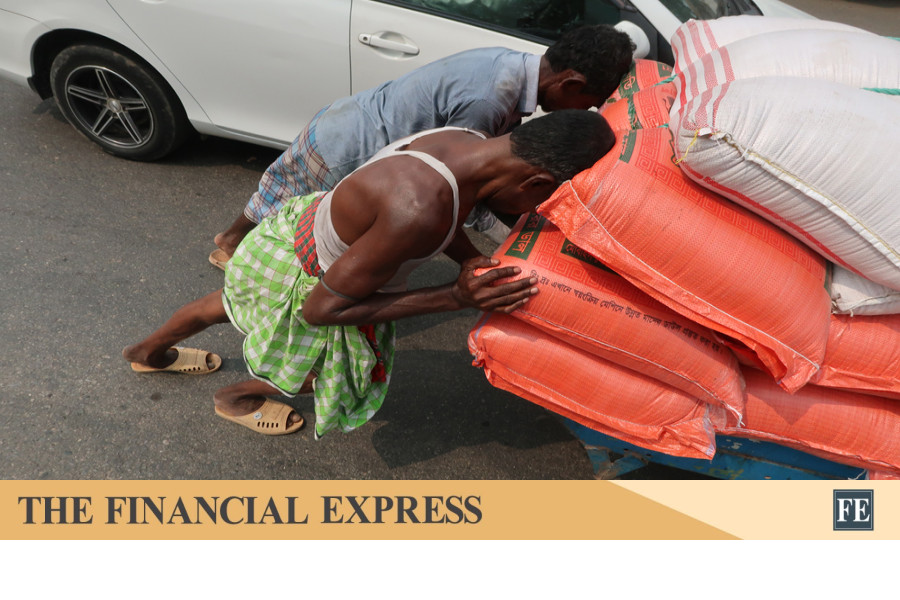
Two carters are pushing a loaded cart at a street in Dhaka. Millions of people in the country still rely on low-paid hard-working Jobs โ€”FE File Photo.

Despite notable improvements in macroeconomic indicators in recent years, Bangladesh now faces an urgent challenge: creating sufficient jobs and stimulating economic growth. The slowdown in new investment, combined with the closure of existing factories, has left many workers unemployed and weakened industrial momentum. At the same time, gross domestic product (GDP) growth has declined significantly. Provisional estimates for FY25 suggest growth between 3.49 percent and 3.97 percent, marking the lowest rate since the pandemic and continuing a three-year downward trend. This signals not merely a temporary fluctuation, but a deeper structural concern.

In this context, the government must confront a critical strategic choice. One option is to replicate past growth models that delivered short-term expansion but created long-term vulnerabilities, including financial fragility, inefficient capital allocation, and weak industrial competitiveness. While such measures may produce immediate statistical improvements, they risk undermining future stability and growth.

The alternative-and more sustainable-approach is to diagnose and address the root causes of declining investment and factory closures. These may include governance weaknesses, financial sector inefficiencies, policy uncertainty, inappropriate strategy and inadequate support for productivity-enhancing innovation through local value addition. By focusing on structural reforms that improve investor confidence, strengthen institutions, and enhance competitiveness, Bangladesh can create durable employment opportunities and achieve resilient, long-term economic growth rather than temporary, fragile gains.

According to media reports, although foreign currency reserves have recovered and panic in the financial sector has eased, private investment in Bangladesh remains subdued. Foreign exchange reserves, which fell sharply from $48 billion in 2021 to $25.90 billion in August 2024, rebounded to $34.3 billion by February 2026. The exchange rate also stabilised at around Tk 123 per US dollar after depreciating nearly 40 percent over the previous three years. Meanwhile, the balance of payments returned to a surplus of $0.76 billion in February 2026, a notable improvement from the $4.3 billion deficit recorded in August 2024. These trends suggest visible progress in restoring macroeconomic stability.

Despite these improvements, both domestic and foreign investment have declined sharply over the past two years. Registered domestic investment fell by 58 percent in the 2024-2025 fiscal year compared to the previous year, while foreign direct investment showed a similar downward trend. At the same time, factories closed. For example, more than 350 BGMEA member garment factories closed between 2024 and late 2025, particularly in Savar, Gazipur, and Narayanganj, leaving nearly 120,000 workers unemployed.

Despite the restoration of fiscal discipline, non-performing loans in Bangladesh have reached alarming levels, with actual bad loans estimated at35 percent of total lending.Corruption, weak governance, poor monitoring, and political influence are widely cited causes. However, structural economic factors also deserve attention. Declining labour-based local value addition, increasing technology import and rising input costs are eroding profitability, making it increasingly difficult for firms to repay loans sustainably.

These alarming developments raise fundamental questions. Why has investment failed to respond positively and non-performing loans skyrocketed despite improving financial indicators and restored stability? The answer likely lies beyond macroeconomic recovery, pointing toward deeper structural barriers affecting local value addition, profitability, and long-term industrial sustainability.

Among the reasons behind widespread factory closures in Bangladesh, rising production costs, energy prices, and raw material expenses are frequently cited. Yet a deeper, more structural issue has emerged: a significant decline in labour-based value addition. A recent study shows that despite a decade of robust manufacturing expansion, employment in productive sector has fallen by 1.4 million. This suggests that factors beyond financial distress, lack of orders, labour unrest, or political changes are driving the problem.

The readymade garment (RMG) industry, which forms the backbone of Bangladesh's exports, exemplifies this erosion of value addition and competitiveness. In 2013, producing and exporting $1 million worth of garments required 220 workers. By 2024, the same output needed only 94 workers, largely due to automation and adoption of advanced technologies. While technology can boost efficiency, Bangladesh's technology-import-centric low-cost labour model is undermining its core competitive advantage: labour-driven value creation in replication. Imported technologies are effectively replacing the very workforce that has historically powered the country's manufacturing success.

If this trend continues unchecked, relying on past approaches to revive investment and create jobs-without addressing declining labour value-may fail. Bangladesh faces a critical choice: either restructure its industrial strategy to substitute labour-driven competitiveness or risk repeating cycles of growth followed by jobless industrialisation.

Declining labour-based value addition has pushed many industries in Bangladesh into unprofitable territory. In electronics assembly, for example, labour contributes just 2 percent of production cost, while in furniture making it accounts for only 6 percent. With firms still obliged to repay loans and other dues, generating profits becomes increasingly difficult. Combined with rising input costs, these structural challenges make natural closures inevitable for existing firms. Under such conditions, expecting new investment to flourish is unrealistic. Sustainable industrial growth requires addressing the erosion of local value addition and restoring the economic viability of labor-driven production.

It appears that Bangladesh's technology-import-centric,labour-based value addition through replication has lost its ability to generate profitable industrial growth, whether for domestic consumption or export markets. Despite this, there is little evidence that the issue is being addressed at a structural level. Instead, reports indicate that defaulted loans of closed factories are being rescheduled, with fresh loans offered to resume production. While such measures may temporarily create jobs and support economic activity, they raise serious questions about long-term viability. Can firms with low labour-based value addition truly achieve profitability and repay their loans? If the underlying value addition is insufficient and production costs remain high, how can oversight ensure profitable operations and loan recovery? Policymakers must consider this core challenge to determine where investment and job-creation efforts should focus. Without addressing the structural limitations of labour-based value addition, temporary interventions risk perpetuating cycles of unprofitable industrial activity and increasing non-performing loans.

M. Rokonuzzaman, Ph.D is academic, and researcher on technology, innovation and policy.​
 
Analyze

Analyze Post

Add your ideas here:
Highlight Cite Respond

Resilience defines economic outlook
Says HSBC economist Frederic Neumann about Bangladesh

FE REPORT
Published :
Mar 03, 2026 09:22
Updated :
Mar 03, 2026 09:22

1772584419328.webp


Bangladesh has demonstrated notable resilience in navigating recent economic headwinds, with growth expected to strengthen gradually over the next few years, according to Frederic Neumann, chief Asia economist and co-head of Global Research Asia at HSBC Global Research.

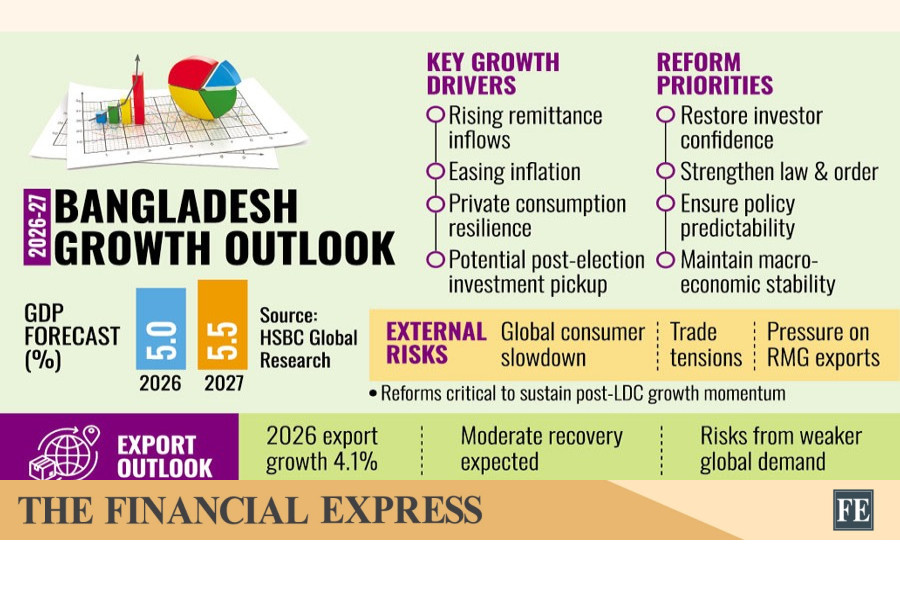
Speaking at an event organised by the Hongkong and Shanghai Banking Corporation Limited (HSBC) in Bangladesh on Monday, Neumann said the bank projects Bangladesh's gross domestic product (GDP) growth at 5.0 per cent in 2026, rising to 5.5 per cent in 2027.

Export value growth is forecast at 4.1 per cent for the 2026 calendar year, reflecting a moderate recovery amid a challenging global environment, he said.

The event, titled "Bangladesh and the World: Economic Prospects for 2026 and Beyond", brought together senior finance professionals, corporate leaders and policymakers to discuss global and regional economic trends and their implications for Bangladesh.

In his keynote address, delivered via Zoom, Neumann observed that Bangladesh has emerged with resilience from the shocks of recent years, including global inflationary pressures, tighter financial conditions and volatility in external demand.

He noted that remittance inflows continue to increase year on year, reflecting growing trust in formal transfer channels. Combined with easing inflation, these trends are expected to support private consumption, which remains a key driver of economic activity.

However, he cautioned that while domestic and foreign investment could pick up modestly following the recent general election, any meaningful acceleration would depend heavily on the new government's ability to restore and sustain investor confidence.

Strengthening law and order, ensuring policy predictability and maintaining macroeconomic stability would be critical in this regard, he said.

Looking ahead, Neumann highlighted Bangladesh's impending graduation from least developed country (LDC) status in November 2026 as a major milestone that also brings fresh challenges.

He stressed that the transition would require renewed efforts to enhance export competitiveness through expanded market access, improved governance and stronger infrastructure.

"LDC graduation underscores the urgency of reforms," he said, adding that Bangladesh would need to move swiftly to secure favourable trade arrangements and diversify its export base beyond traditional products.

He identified a slowdown in global consumer demand as the principal external risk facing the economy, noting that this has been partly driven by tariff measures imposed by the United States.

Such developments, he warned, could weigh on export-oriented sectors, particularly readymade garments.

Against this backdrop, Neumann emphasised the need for Bangladesh to accelerate trade negotiations with the European Union, its largest garment export market.

Ensuring continued preferential or near-preferential market access after LDC graduation would be crucial to sustaining export growth and employment, he said.

With the formation of a new government following what he described as a largely peaceful election, Neumann said the administration now holds a clear political mandate to pursue reforms and deliver the stability sought by citizens and investors alike.

"Facing an extensive reform agenda, the government must demonstrate its commitment to promises made and address the aspirations of the country's young generation," he remarked.

The keynote session was followed by an interactive question-and-answer segment, during which participants raised issues ranging from exchange rate management to investment climate reforms and global financial market trends.

At the event, Jignesh Ruparel, chief financial officer of HSBC Bangladesh, delivered a presentation outlining the HSBC Group's latest global financial results and its international capabilities.

He noted that the group's 161-year history is rooted in its founding mission to facilitate local and international trade.

With a presence in 56 countries and territories, including Bangladesh, HSBC continues to connect customers to opportunities worldwide, Ruparel said.

Kausar Alam, president of the Institute of Cost and Management Accountants of Bangladesh, described the CFO connect event as a timely initiative that offered valuable insights into Bangladesh's evolving macroeconomic landscape within a global context.

He said the economy holds significant latent potential, supported by favourable demographic trends and a resilient private sector.

He added that the private sector remains a key driver in Bangladesh's ambition to become a trillion-dollar economy by 2040, provided that structural bottlenecks are addressed and reforms are implemented effectively.

Speaking at the gathering, Md Mahbub ur Rahman, chief executive officer of HSBC Bangladesh, said the bank's strong performance in 2025 reflects the strength of its global network and the trust placed in it by clients.

As Bangladesh enters a pivotal phase of reform and growth, he said, HSBC's role is to connect local ambition with global opportunity.

Through initiatives such as CFO connect, Rahman added, the bank aims to provide a platform for senior finance professionals in Bangladesh to exchange insights, deepen engagement with global trends and strengthen their preparedness for an increasingly dynamic and uncertain economic environment.

The event was attended by chief financial officers, senior executives and stakeholders from both local and multinational companies operating in Bangladesh.​
 
Analyze

Analyze Post

Add your ideas here:
Highlight Cite Respond

Members Online

No members online now.

Latest Posts

Back
PKDefense - Recommended Toggle