Home Watch Videos Wars Movies Login

[🇧🇩] Monitoring Bangladesh's Economy

Latest Posts Countries Wars Q&A

[🇧🇩] Monitoring Bangladesh's Economy
976
26K
More threads by Saif

G Bangladesh Defense

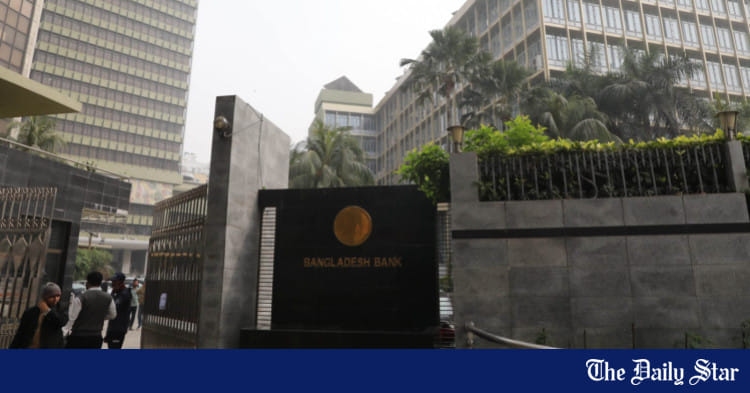
BB rolls out generous exit policy to borrowers

1720485735016.webp

Photo: Star/File

The Bangladesh Bank today unveiled the latest iteration of its exit policy that offers borrowers the option to close off their loan account within three years by paying only 10 percent as down payment and no interest.

The move, which comes at a time when interest waiver facilities are being widely criticised in the parliament, is aimed at window-dressing the country's bad loan scenario.

At the end of March, defaulted loans soared to a record Tk 182,000 crore -- which is 11.11 percent of total outstanding credit -- much to the displeasure of the International Monetary Fund. The exit policy is expected to make the situation more palatable.

"The financial condition of clients has been adversely affected by various uncontrollable factors -- that's why an exit policy is needed to recover the loans from them," the BB said in a notice yesterday.

The exit policy applies to defaulted loans, loans with a low probability of recovery and loans taken by defunct companies.

Borrowers will have to provide a minimum of 10 percent down payment in cash by the borrowers and in return, they will get an interest waiver under the policy.

However, the interest waiver facility cannot be extended to loans created by forgery and wilful defaulters, as per BB's notice.

Clients can repay the loans in one instalment or more than one instalment but the maximum repayment tenure will be two years. However, banks can extend the tenure by another year, read BB notice.

Under the facility, borrowers will not be eligible to get new loans until they have adjusted the full loan amount.

The central bank said that this facility would not be considered as rescheduling or restructuring of loans.

BB asked banks for proper provisioning against the loans and taking security before adjustment of the loans, it added.

Banks will have to take legal action to recover the loans if the borrowers fail to repay the loans after getting the facility.

Earlier in May 2019, the central bank introduced a one-time exit policy for defaulters to bring down the high bad loans in the country's banking sector. The bad loans then amounted to Tk 110,873 crore.

"The exit policy should have been left to the banks' discretion," said Monzur Hossain, research director of the Bangladesh Institute of Development Studies (BIDS).

This policy will affect the banks' profitability, while the loan defaulters will be tempted by the facility, he said.

Mohammad Nurul Amin, former chairman of the Association of Bankers of Bangladesh, echoed the same. "Defaulters are likely to be encouraged to not repay loans due to the facility."​
 
Analyze

Analyze Post

Add your ideas here:
Highlight Cite Respond

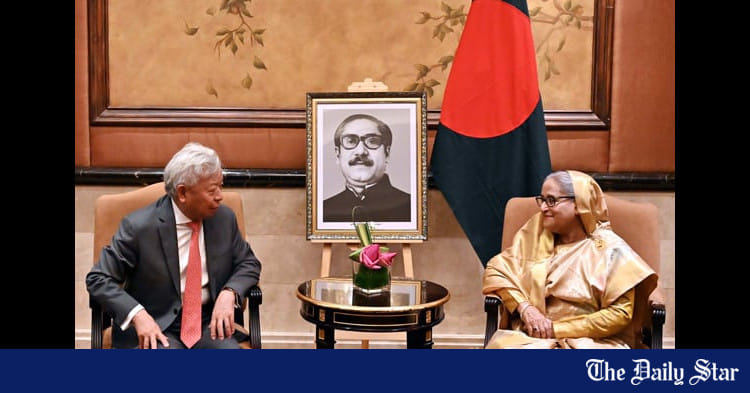
PM asks AIIB to lower interest rates of loan
1720571762520.webp

Photo: BSS

Prime Minister Sheikh Hasina today asked the Asian Infrastructure Investment Bank (AIIB) to further cut the interest rates on its loan for Bangladesh.

She made the request when the Beijing-based bank's President Jin Liqun, along with its high officials, paid a courtesy call on her at her place of residence in Beijing.

During the meeting, the financing for infrastructure building, river dredging and the climate sector of Bangladesh, particularly building climate resilient houses in the country's coastal areas came up for discussion.

Foreign Minister Hasan Mahmud briefed reporters about the outcome of the meeting on the second day of the prime minister's official visit to China.

The PM said AIIB played a very important role for Bangladesh in the past.

She said the multilateral development bank and lender can also play a significant role in the future in the development journey of Bangladesh and help fulfil the dream to transform it as a developed and prosperous country by 2041.

"The PM requested the AIIB to reduce its loan interest further for Bangladesh," said the foreign minister.

In response, the AIIB officials said Bangladesh is one of the biggest borrowers from AIIB. The bank has given Bangladesh a special concession in case of the interest rate.

The issue of giving a special concession for Bangladesh in future was discussed with importance, according to the foreign minister.

Finance Minister AH Mahmood Ali and PM's Press Secretary M Nayeemul Islam Khan were present at the briefing.​
 
Analyze

Analyze Post

Add your ideas here:
Highlight Cite Respond

No relief for consumers as inflation hits 12-year high
Lack of proper government actions is costing citizens dearly

1720572200062.webp

VISUAL: STAR

The government's inability to keep annual inflation anywhere near its target of 7.5 percent is deeply concerning. As reported by this daily, the annual average inflation has surged to 9.73 percent in the just-concluded fiscal year, according to Bangladesh Bureau of Statistics (BBS). This is the highest inflation experienced in 12 years since 2011-2012, when annual inflation was 10.62 percent. What is even more concerning is that this is the second consecutive year that the Consumer Prices Index has stood at more than 9 percent. This means that the tremendous inflationary pressure experienced by citizens has actually persisted for two straight years.

The resulting erosion of people's real income and the deterioration of their living standards—particularly of low-income groups—are there for all to see. According to an earlier survey by the South Asian Network on Economic Modelling (SANEM), as many as 70 percent of the households in Bangladesh had to change their food habits involuntarily to cope with rising prices. It further discovered that food insecurity among the poor had increased drastically, meaning that the prospect of malnutrition and various health concerns has also risen considerably. Despite such warnings, the fact that the government has failed to bring inflation down by now is completely unacceptable. True, there have been some measures to address it, but those were taken too late, and because of the "time lag effect," we are yet to see them really kick in.

The good news is that some of those measures may eventually pay dividends down the line. However, as experts have said, the government needs to do more. For starters, perhaps it should increase the interest rate further to tame inflation. Moreover, its failure to properly regulate the market means that a section of business groups is continuing to artificially prop up prices. These businesses, unfortunately, are either politically connected, or have acquired monopoly powers due to failed government policies, which makes holding them accountable difficult. But that is exactly what the government must do, without exception.

So, while its focus—although late—has so far been on demand containment, now it must also shift to addressing the distortions in the market and the problems in supply chain. And these issues have persisted in our country for years and have somewhat become entrenched. Despite that, the government needs to take a holistic approach to finally fix them. Parallel to that, it must ramp up its support for lower-income groups. That should include its rice distribution programme, as well as selling essential food items at subsidised rates to low-income earners.​
 
Analyze

Analyze Post

Add your ideas here:
Highlight Cite Respond
  • Sad (0)
Reactions: Bilal9

Cashless economy: a tech leap with inclusion hurdles

1720572754312.webp


Cashless payments are driven by innovations like online banking, cryptocurrencies, and mobile payments, delivering enhanced convenience, security, and efficiency. Countries like Norway, Sweden, and China lead with minimal cash usage and robust digital infrastructures.

In Bangladesh, rapid strides towards a cashless future through digital finance, mobile financial service (MFS), and e-commerce align with the SMART Bangladesh framework 2041, targeting 100 percent cashless transactions by 2031. With 1.77 million agents and 223 million registered clients in the MFS sector, Bangladesh aims to accelerate financial inclusion and economic efficiency.

Bangladesh's path to financial inclusion began with branch banking and microcredit. The introduction of MFS and agent banking in the 2010s was pivotal, particularly during the Covid-19 pandemic, enhancing transparency, introducing new financial products, and fostering inclusion.

The digital ecosystem also saw a surge with 36 million debit cards, 2.4 million credit cards, and 5.8 million prepaid cards. Internet banking engages 8.5 million users with monthly transactions totaling Tk 1 lakh crore.

Hindrances to a cashless Bangladesh

Insufficient digital infrastructure, limited internet access, lack of service points, and inadequate public education on digital transactions hinder the move towards a cashless economy. The lack of seamless integration among diverse payment systems impedes efficient cashless transactions and a smooth user experience.

Weak cybersecurity measures, encryption protocols, and insufficient monitoring leave digital payment systems vulnerable to cyber risks. Frequent technical glitches and power outages, coupled with inadequate backup systems and infrastructure resilience, undermine service continuity and user trust.

The significant urban-rural digital gap also limits equitable access to smartphones, and digital literacy, restricting inclusive participation in the cashless economy. Furthermore, insufficient regulations, monitoring, and authentication processes increase the risk of fraud and money laundering, eroding trust in digital transactions.

Building bridges: approaches for inclusion

Bangladesh's 8th Five-Year Plan emphasises ICT-driven financial inclusion while achieving a cashless economy requires collaborative efforts across the government, financial institutions, civil society, and the private sector to bridge the digital gap effectively. The BASIS has made some recommendations:

The Finance Bill 2024 mandates that software and IT-enabled service providers conduct transactions via bank transfers from July 1, 2024, to qualify for tax exemption until June 30, 2027. Although it aims at promoting cashless transactions, this requirement conflicts with SMART Bangladesh's goal for a cashless vision by 2031, presenting infrastructure scalability challenges and reliance on cash for daily expenses unsupported by current banking systems.

According to the Finance Bill 2024, thriving services like cloud computing and IT outsourcing could face adverse impacts if taxed, potentially displacing local businesses and deterring new entrants. Government investments in rural internet infrastructure and partnerships with telecom operators for fibre optic cables and Wi-Fi hotspots are crucial for enhancing accessibility.

Essential financial literacy programmes in local languages through radio broadcasts, mobile tutorials, and community outreach are vital for rural citizens to adopt safe digital practices. Cybersecurity awareness campaigns are essential to educate citizens about online threats, complemented by robust security measures and data encryption technologies in financial institutions to protect user information.

Bangladesh's path to a cashless economy requires meticulous planning and collaboration among policymakers, financial institutions, and technology providers. Despite high expectations, numerous challenges must be effectively tackled. Addressing these issues is pivotal for realising Bangladesh's vision of a comprehensive cashless economy, paving the way for a more inclusive and efficient financial landscape.

The author is senior vice-president of the Bangladesh Association of Software and Information Services.​
 
Analyze

Analyze Post

Add your ideas here:
Highlight Cite Respond
  • Like (+1)
Reactions: Bilal9

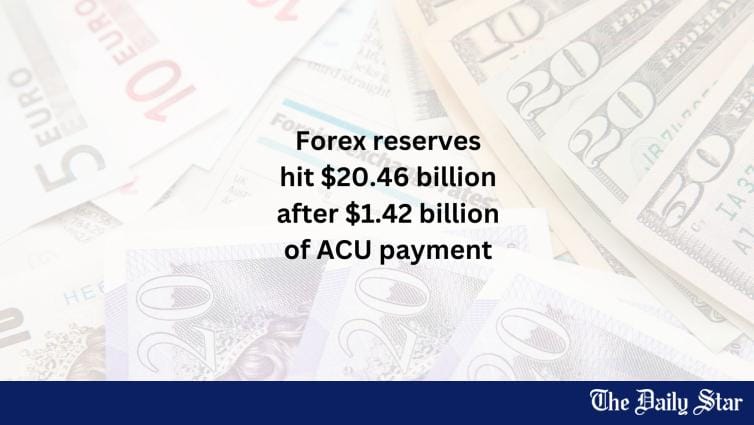
Reserves come down to $20.46 billion after ACU payment
$1.42 billion of import bills for May and June were paid through Asian Clearing Union (ACU)

1720658229874.webp


Bangladesh's foreign exchange reserves fell below $21 billion after the payment of $1.42 billion in import bills through the Asian Clearing Union (ACU).

The ACU payments for May and June were cleared this week, said a senior official of the Bangladesh Bank.

After the payment, reserves stood at $20.46 billion.

The forex reserves were at $21.78 billion as on June 30 this year, BB data showed.

The ACU is an arrangement for settling payments for intraregional transactions among eight countries: Bangladesh, Bhutan, India, Iran, Maldives, Myanmar, Nepal, Pakistan, and Sri Lanka.

The reserves data was calculated based on the formula of the International Monetary Fund (IMF).​
 
Analyze

Analyze Post

Add your ideas here:
Highlight Cite Respond

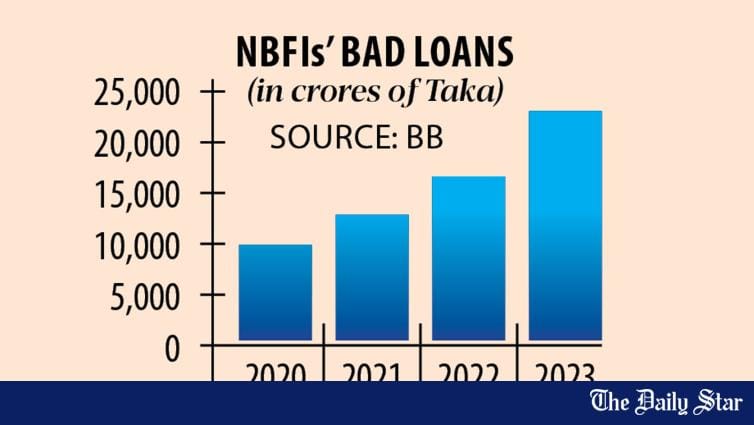
NBFIs' bad loans surge to a record Tk 23,208 crore

1720743867719.webp


Defaulted loans at non-bank financial institutions (NBFIs) soared 38 percent to a record Tk 23,208.7 crore at the end of 2023, raising concerns over the sector's deteriorating health.

The toxic assets accounted for a record 32 percent of the total disbursed loans of Tk 73,560.5 crore in the sector, up from 31.55 percent a year earlier, according to data from the Bangladesh Bank.

The data on 35 NBFIs' bad loans comes when economists have raised concerns over vulnerabilities in Bangladesh's financial sector due to rising defaulted loans and a lack of corporate governance.

Industry insiders said the central bank is largely responsible for the state of the NBFI sector as its supervision was not strict.

The toxic assets are legacy loans from the large scams and irregularities seen in the sector a few years ago, said Kanti Kumar Saha, chief executive officer of Alliance Finance.

For instance, PK Halder, former managing director of NRB Global Bank, which was later renamed Global Islami Bank, swindled at least Tk 3,500 crore from four NBFIs: People's Leasing, International Leasing, FAS Finance and BIFC, according to a BB probe report.

As a result, the four NBFIs have become ailing institutions with more than 90 percent of their loans going bad.

Saha, also vice-chairman of Bangladesh Leasing and Finance Companies Association (BLFCA), said the loans that were disbursed in the last one or two years are regular.

"Now, most of the NBFIs are trying to do better," he said, adding that the industry is looking to upgrade its manpower for improved performance.

Md Golam Sarwar Bhuiyan, chairman of the BLFCA, said that not only the NBFIs, but the overall economy is now facing multiple challenges, and that is why the bad loans in the sector have increased.

Bad loans jumped after the central bank in 2022 withdrew the deferral facility extended during the pandemic for paying back loans, said Bhuiyan.

Due to the confidence crisis in the sector, deposits in NBFIs fell to Tk 44,304 crore in the January-March quarter from Tk 44,830 crore in the previous quarter.​
 
Analyze

Analyze Post

Add your ideas here:
Highlight Cite Respond

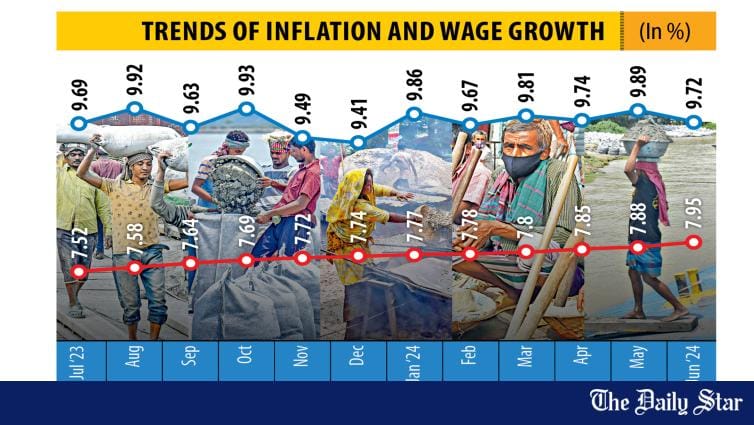
Inflation outpaces wage growth for 29th month straight
1720828357439.webp


Although wage growth in Bangladesh has been slowly climbing since July 2021, it has remained below the inflation rate for the past two and a half years, government data shows.

Wages of low-paid and unskilled workers grew 7.95 percent in June, which was 1.77 percentage points below the inflation rate of 9.72 percent in the same month, showed the Wage Rate Index (WRI) of the Bangladesh Bureau of Statistics (BBS).

This trend has been continuing for the past 29 months, as per data from the BBS.

This widening gap is forcing low-income and unskilled workers to cut consumption amid falling real incomes, according to analysts.

The nominal wage rate growth stood at 7.88 percent in May while the inflation rate was 9.89 percent, it added.

"When high inflation persists for a long time, it will definitely impact the poverty rate and create many new poor," said MM Akash, a former chairman of the economics department at the University of Dhaka.

People who are now struggling to keep their heads above water may be dragged below the poverty line, he added.

Rizwanul Islam, an economist and former special adviser for employment at the International Labour Office in Geneva, said high inflation, especially high food inflation, has been affecting the purchasing power of low-income people.

This also reduces coping strategies and gradually narrows opportunities for low-income and low-skilled people.

"More than 40 percent of the population of Bangladesh is in real difficulty because of continuously elevated inflation, especially food inflation," Islam said, adding that it has been affecting low-skilled, self-employed and middle-income individuals.

In June, food inflation slipped to 10.42 percent from 10.76 percent a month ago. However, food inflation has hovered above 9 percent since May 2023. It crossed 9.5 percent every month of fiscal year 2023-24 except February.

In FY24, the highest rate of food inflation was witnessed in October, when it hit 12.56 percent. If effective trade unions existed, there would have been an uproar regarding the situation, according to Islam.

"But we don't see such issues. Rather, everyone is more focused on how to cope with the situation," he said.

The WRI takes into account the wages of informal workers, who get their payments on a daily basis, across 63 occupations in the agriculture, industry and services sectors.

Asked about the impact on the labour market due to the persistently higher inflation, Islam said there is an inverse relationship between inflation and unemployment as illustrated by the Phillips curve.

"However, in Bangladesh, it's not clear if such a relationship will work because there are other factors such as import compression working that are simultaneously having an adverse effect on growth."

So, one cannot expect employment to grow, he said.

"Employment was not growing even when output growth was normal. That's why the informal sector continues to be the major source of employment," Islam said.

He added that inflation may also adversely affect the labour market situation through the consumption and demand route. Elevated levels of inflation have an adverse effect on demand, which in turn affects output growth in various sectors.

Prof Akash added: "It should be mandatory to provide rations or adjust their wages in line with inflation to give a cushion to the workers."

The economist suggested providing cash incentives to low-income people, similar to initiatives during Covid-19, and expanding social safety net programmes.

He also urged the government to extend support to the urban poor, who usually remain out of safety net, by providing essential commodities and cash support for house rent.

"The nominal wage rate climbed from 7.39 percent in June 2023 to 7.7 percent in December 2023. In April 2024, it was 7.85 percent. Despite being less than inflation, the pay index increase significantly represented the current inflationary wave," the Bangladesh Bank said in its monetary policy review yesterday.​
 
Analyze

Analyze Post

Add your ideas here:
Highlight Cite Respond
  • Like (+1)
Reactions: Bilal9

BB signals further monetary tightening as inflation rages
1720828509658.webp


The central bank has signalled that it would go for more tightening of the monetary policy since inflationary pressure shows no signs of cooling.

The Bangladesh Bank gave the hints about its upcoming measures in its monetary policy review for the just-concluded fiscal year. The report was released yesterday.

"Monetary policy would need to be restrictive for sufficiently long to return inflation to around the 7.5 percent target sustainably in the medium term, and further tightening would be required if there were evidence of more persistent inflationary pressures," it said.

Annual inflation rose to 9.73 percent in 2023-24, the highest since 2011-12 when it was 10.62 percent, overshooting the government's target of containing it to 7.5 percent, according to the Bangladesh Bureau of Statistics (BBS).

This is the second year in a row that the Consumer Price Index (CPI), a measure of the increase in the prices of a basket of products and services, crossed 9 percent. This means the monetary policy of the central bank could do little to bring it down although it initiated several measures, albeit belatedly.

With global components of inflation turning down, most countries have experienced a significant fall in inflation relative to its peak, said Lisa DeNell Cook, a member of the Federal Reserve Board of Governors of the US, at the Australian Conference of Economists in Adelaide of Australia, on Wednesday.

Even cash-strapped Sri Lanka succeeded in controlling inflation. On the other hand, consumer prices have kept rising in Bangladesh. The government aims to contain it to 6.5 percent in the fiscal year of 2024-25, which begins on July 1.

In the review, the central bank said the lag effect of marked global commodity price hikes, partly exacerbated by the weaker exchange rate of the taka against US dollars, has prolonged the persistently high inflation.

"Inflationary pressures have also broadened within the core basket, reflecting spillover and second-round effects as well as the pass-through of costs associated with electricity generation."

It said despite decreasing trend of global commodity prices, Bangladesh's economy could not benefit due to the significant domestic currency depreciation, which subsequently raised import prices, thereby contributing to inflationary pressures.

The taka has lost its value by about 35 percent against the US dollar in the past two years.

In FY24, the central bank adopted a tight monetary policy stance and raised the policy rate -- at which it lends to commercial banks -- on several occasions to lift it to 8.5 percent. The rate was hiked by 400 basis points since the middle of 2022.

The International Monetary Fund (IMF) has suggested the central bank raise the policy rate by 50 basis points by December this year since its monetary tightening is yet to rein in inflation.

However, most central banks stopped raising their policy rates over the past year. Some are considering how long to keep rates at restrictive levels or, if inflation picks up again, whether to raise rates further, according to Lisa DeNell Cook.

The BB said over the past year, fluctuations in fuel, food, and energy prices have been the predominant drivers of headline inflation, with food and fuel costs largely mirroring global commodity price trends.

It blamed higher food prices for the spike in demand ahead of Ramadan and Eid-ul-Fitr celebrations.

Among the components of non-food inflation, the highest rate was recorded in the health sector at 13.69 percent. followed by 11.34 percent in furnishings, household equipment, and routine maintenance of the house, according to the report.

In the review, BB Governor Abdur Rouf Talukder said Bangladesh economy was not immune to the impact of global issues, though it performed fairly well a couple of years after the Covid-19 recovery.

However, since 2023, the economy began feeling the pressures of persistently high inflation and the exchange rate depreciation, particularly through geopolitical tension and trade uncertainties, he added.

Despite the challenges, provisional estimates from the BBS indicate that gross domestic product (GDP) grew 5.82 percent in FY24, up from 5.78 percent in FY23, reflecting a modest improvement in the country's economic performance.

"To mitigate inflationary pressure and restore the stability of the exchange rate, BB upheld a hawkish approach to monetary policy throughout last year and continued the contractionary stance for the second half of the last fiscal year," he said.

The BB has not gained much success in curbing higher inflation because of the lack of a market-based interest rate system. In April 2020, the BB first introduced a 9 percent interest rate ceiling.

Although it was withdrawn in the first month of the last fiscal year, the banking regulator introduced a new interest rate system based on the six-month moving average rate of treasury bills known as SMART, which was still considered as another cap.

Finally, in May this year, the BB allowed banks to determine a market-driven interest rate in line with the IMF's prescription.

At a webinar recently, Birupaksha Paul, a professor of economics at the State University of New York, said the interest rate cap was largely responsible for the current inflationary pressure.

He explained when interest rates were increased all over the world to tackle inflation, the central bank walked in the opposite direction. The lending cap was withdrawn following the advice of the IMF.

In May, the BB also rolled out a more flexible exchange rate policy, moving away from its practices where banks would determine the price of the dollar in line with the verbal instructions of the central bank.

The governor hoped that the crawling peg will help to tackle the present challenges.

Amid the persisting macroeconomic challenge, the BB is going to announce the monetary policy for the first half of FY25 in the third week of July. The main objective will be to control inflation and achieve the GDP growth target set by the government.

Ahsan H Mansur, executive director of the Policy Research Institute of Bangladesh, recently said the policy rate would have to be hiked to control inflation.

"If the central bank and the government maintain strict policy measures, it will help reduce inflation."

The government has also set high bank borrowing targets for FY25, but banks are facing liquidity shortages. This prompts the economist to suggest the central bank be strict about refraining from granting loans to the government.​
 
Analyze

Analyze Post

Add your ideas here:
Highlight Cite Respond
  • Like (+1)
Reactions: Bilal9

Members Online

Back
 
G
O
 
H
O
M
E