Home Watch Videos Wars Login

[🇧🇩] Monitoring Bangladesh's Economy

[🇧🇩] Monitoring Bangladesh's Economy
955
25K
More threads by Saif

G Bangladesh Defense

Improving economic Management
FE
Published :
Jan 20, 2025 22:00
Updated :
Jan 20, 2025 22:00

1737420471701.webp


If the purpose behind preparation of the white paper on the state of the country's economy was to identify the economic malaises and find some ways out of the current imbroglio, the follow-up by the interim government has been conspicuous by its absence. This has prompted the white paper committee and other reputed economists to gather at a symposium titled "White Paper and Thereafter: Economic Management, Reforms, and National Budget" one and a half months after the submission of that important factual and analytical document. Clearly, the head of the 12-member committee, Debapriya Bhattacharya was highly disappointed with the interim government's inaction. Other economists present at the symposium could not agree more with the observations made by him. Additionally they made their own critical observations on the slowdown of the economy in the absence of any effective and innovative policy shift or action aimed at reviving the economy. The recommendations made in the white paper have remained largely ignored until now.

This is for the first time that the country's leading economists have criticised the interim government and expressed their disappointment with its inaction. True, the economic doldrums have been a legacy of the past despotic government marked by crony capitalism and those cannot be overcome overnight. Yet this sounds like a cliché or even an excuse if there is no sign of any positive action that might at least set the tone of an economic recovery slowly but surely. The task is proving all the more daunting because of the culture of overdependence on borrowed money from multilateral agencies and the bureaucracy for expenditure of the funds received from those multilateral organisations on annual development programmes (ADP). Such dependence on Bretton Woods institutions for funds and on an outdated bureaucracy for expenditure of the allocations for ADP is contradictory to the principle of an equalitarian and discrimination-free socio-economic system. When economic recipes made a precondition for receiving loans from those multilateral institutions are accepted and complied with, nations lose their ways in the woods.

Now that the country finds enmeshed in the web of financial prescriptions from those agencies, the government should take a deep breath and be mindful of creating the nation's internal wealth. The white paper wanted the government to chart a roadmap of augmenting wealth through the optimal use of internal resources. When industries are sluggish, inflation remains untamed with that of food surpassing other commodities, the interim government's option for value-added tax and supplementary duty, considered an easy-way-out at the cost of the general public, has made 'ease of doing business' a highly daunting proposition. Confidence of investors in the economy is at rock bottom.

Accepted that the human resources development requires a long-term plan but there was ample opportunity to set the process into motion. Surprisingly, the government did not feel the need for forming a reform commission on education although it went for 10 such commissions. For sometime now, the country's diaspora and migrant workers have been sending an increasing amount of remittance to the relief of the government. Job creation in the private sector was a priority but with industries and businesses encountering a hostile environment due, on the one hand, to sharp deterioration of law and order and, on the other, a crisis of energy and a lack of policy support, employment opportunities are rather shrinking. Home-grown bold and innovative policies are needed to make good use of the country's human resources, decidedly the number one, to obviate the crises.​
 
Analyze

Analyze Post

Add your ideas here:
Highlight Cite Fact Check Respond

We must break free from our economic captivity

1737613913807.webp

File Visual: Salman Sakib Shahryar

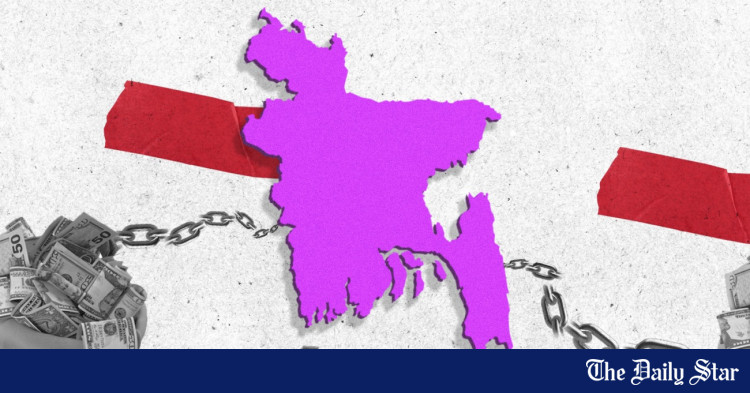
Once, long ago, the poet Nazrul sang of revolution, of freedom from oppression, but were he alive today, he might lament a nation enthralled—not to foreign invaders, but to a domestic oligarchy.

Bangladesh, a country of immense potential, now finds itself shackled by the iron grip of family-owned conglomerates. These corporate behemoths, shadowy leviathans cloaked in cronyism, have seized the state, becoming the financial sinew of Sheikh Hasina's authoritarian regime. Their stranglehold threatens not only our economy but also our democracy, suffocating the very ideals for which this nation was born.

In Japan's pre-war years, the zaibatsu—vast industrial and financial conglomerates—dominated the economy, leveraging their might to entrench authoritarianism. A striking parallel can be drawn with the past Awami regime in Bangladesh, where conglomerates like S Alam, Beximco and Bashundhara entrenched themselves across critical sectors, including energy, finance, real estate and media.

These conglomerates have become the faceless architects of a regime sustained by repression and corruption, extracting billions from an impoverished populace to line their pockets and bankroll autocracy. The modus operandi is insidious: monopolistic practices that stifle competition, inflate prices and hollow out public coffers.

Banks have been looted with impunity, state contracts distributed like party favours and regulatory bodies rendered impotent. Foreign investors, sensing the rot, flee; the economy's lifeblood haemorrhages. Yet the perpetrators remain untouchable, shielded by their proximity to power.

History offers a clarion call: economic monopolies and democratic governance cannot coexist.

The Allied dismantling of Japan's zaibatsu after World War II stands as a model. By decentralising economic power, breaking conglomerates into smaller entities, and instituting strict anti-trust laws, Japan laid the groundwork for a competitive, transparent economy. Similarly, South Korea's chaebol reforms curbed the dominance of family-owned conglomerates, injecting accountability into the veins of its economic system.

Bangladesh, too, must summon the courage to confront its oligarchs. Reforms must begin with an unflinching examination of financial records, exposing the labyrinthine networks of collusion between conglomerates and state actors. Here, examples abound: Brazil's Operation Car Wash dismantled an empire of corruption, revealing the pernicious ties between politicians and business magnates. The Zondo Commission in South Africa meticulously mapped out state capture by corporate elites. These efforts were not mere exercises in forensic accounting but acts of reclamation—nations reclaiming their dignity, their future.

The task before us is Herculean but not insurmountable.

First, we must establish a powerful, independent task force, armed with the tools of forensic accounting, data analytics and legal expertise. By dissecting financial flows, tracing cross-ownership structures and auditing procurement records, this body can expose the mechanisms of economic enslavement.

In South Korea, the Anti-Corruption and Civil Rights Commission worked in tandem with whistleblowers to unveil the rot within chaebols. Bangladesh must do the same, empowering civil society to join this battle.

Temporary nationalisation offers another pathway. Inspired by Japan's post-war reforms, key conglomerates could be placed under professional management for a limited period. This is not an invitation to chaos but an orderly transition: stabilising operations, removing corrupt actors and creating the conditions for fair re-privatisation.

The aim is not to destroy but to transform, to extract these entities from the toxic embrace of cronyism and return them to the people as competitive, transparent enterprises. Some will cry foul, invoking the spectre of economic disruption or accusing reformers of vendetta. Let them cry. The moral imperative is clear: the wealth of a nation cannot be the preserve of a few.

The lives of 170 million citizens—their hopes, their dreams, their right to dignity—are at stake. We must remember that these conglomerates do not merely control industries; they control futures.

Every inflated price, every siphoned dollar, every monopolised sector represents a child denied an education, a farmer deprived of fair markets, a citizen silenced by poverty. The battle is not just economic; it is existential. It is a battle for the soul of Bangladesh, a battle to reclaim our sovereignty from those who would sell it piecemeal for private gain.

Imagine a Bangladesh unshackled. Imagine industries where competition thrives, where entrepreneurs dare to dream without fear of predation by monopolies. Imagine a government no longer beholden to the oligarchs but answerable to its people. This vision is not utopian; it is attainable. It requires political will, legal reform, and, above all, a collective awakening.

Let us remember that history is a relentless tide. The zaibatsu fell. The chaebols were humbled. Even the most entrenched powers can be dismantled when a nation decides that enough is enough.

Bangladesh stands at such a crossroads. The choice is stark: capitulation or courage, stagnation or progress.

In the end, this is not merely an economic question but a moral one. Will we, as a people, continue to watch as our nation's wealth is siphoned away, our democracy eroded, our dreams deferred? Or will we rise, as we did in 1971, and declare that this land, this future, belongs to us all? The time for equivocation is over. The time for action is now.

For Bangladesh, the stakes could not be higher. For the oligarchs, the message could not be clearer: your time is up.

Bobby Hajjaj is a faculty member at North South University.​
 
Analyze

Analyze Post

Add your ideas here:
Highlight Cite Fact Check Respond

Impact of rising debt on our socio-economic future

1737614067902.webp

FILE VISUAL: SHAIKH SULTANA JAHAN BADHON

At the end of June 2024, the total debt burden—both domestic and external—of Bangladesh was Tk 18,000 billion. Since the population of Bangladesh is about 180 million, this implies that the debt burden on each Bangladeshi citizen is Tk 100,000. No, this is not our personal debt, but it represents our liability as citizens of Bangladesh. If we cannot repay this debt, it will become a liability for future generations. Looking at it from a different perspective, every child born in Bangladesh today is born with a debt.

Truly speaking, the amount of Tk 18,000 billion is enormous. However, the current situation was not created in a day or two. About four years ago, the country's debt burden was around Tk 11,000 billion, roughly equal to the national budgets over the past three years. Of the total debt, domestic debt amounts to about Tk 10,000 billion, representing 56 percent of the total debt, while foreign debt was approximately Tk 8,000 billion, or 44 percent of the total debt. Three observations are pertinent. First, this is the first time that domestic debt has exceeded Tk 10,000 billion. Second, over the last four years, the amount of foreign debt has doubled. Third, the current debt-to-GDP ratio in Bangladesh is about 36 percent, compared to 32 percent four years ago.

These trends call for some comments. First, the debt-to-GDP situation undoubtedly needs consistent monitoring. It is true that Bangladesh's debt-to-GDP ratio has not reached a dangerous level. According to the yardstick set by the International Monetary Fund (IMF), the acceptable level of the debt-to-GDP ratio is 55 percent. With a ratio of 36 percent, Bangladesh is in the safe zone. Second, every year, the government has to borrow from domestic and foreign sources to meet budget deficits. Since domestic loans are easier to obtain, previous governments have often opted for this route. In fact, due to inefficiencies in loan management, the majority of loans in the past were taken from domestic sources.

Third, most foreign loans were taken without proper scrutiny, necessary negotiations, or objective evaluations. Significant amounts of foreign loans were used to finance prestige projects. This occurred during a time when international organisations reduced the grace period for loan repayments and increased interest rates. The grace period for repaying loans for prestige projects is now ending, increasing the pressure to meet loan repayment liabilities.

Fourth, one aspect of debt is debt servicing. During the 2023-24 financial year, the Bangladesh government spent Tk 1,000 billion on debt repayment, amounting to one-sixth of the national budget. In the previous financial year, the debt-servicing ratio was 17 percent. Foreign loans have another dimension: interest on foreign loans must be paid in foreign currencies, leading to a depletion of foreign exchange reserves. For instance, as debt servicing on foreign loans has increased, Bangladesh's foreign exchange reserves have fallen below $20 billion.

Fifth, the increasing debt burden of Bangladesh will have adverse impacts on the socio-economic sectors of the country. In the 2023-24 financial year, debt servicing amounted to about Tk 1,000 billion, surpassing the country's education budget. If more funds are allocated for debt servicing, fewer resources will be available for crucial areas like health, education, and nutrition. This would negatively affect human development in Bangladesh.

In light of these issues, the relevant question is: what needs to be done to address them? The first action is to establish justifications for taking loans. The relevance of loans, their intended purposes, and their usage must be justified. Every loan proposal should undergo rigorous scrutiny. Second, large prestige projects with unclear economic contributions must be avoided. Similarly, loans should not be approved due to political considerations or pressures. Third, clear guidelines are needed for determining the sources of loans. In this context, the pros and cons of both domestic and foreign loans must be objectively assessed. Loan objectives, project evaluations, loan negotiations, and efficient management should guide decisions on loan sources.

Fourth, the government must mobilise resources for debt repayment and servicing. Currently, the government relies heavily on indirect taxes to generate revenue. This dependence must decrease, and Bangladesh's direct tax base must be expanded. The tax-to-GDP ratio in Bangladesh is only about 8 percent, compared to 12 percent in India and 17 percent in Nepal. Bangladesh's ratio is far below the 19 percent average in the Asia-Pacific region and 25 percent in developing countries. Increasing the tax-to-GDP ratio must involve expanding the coverage and amount of direct taxes. Approximately 68 percent of the population does not pay income tax; these individuals must be brought into the tax net.

Fifth, there is another important dimension to direct taxation. Historically, revenue has been mobilised through indirect taxes and duties on poor people rather than income taxes on the rich. This has exacerbated economic disparities in society. As Bangladesh aspires to build an equitable society, it is essential to reform this tax structure, which is unfavourable to common people. For example, while nearly 60 percent of tax revenue in India comes from direct taxes, nearly 65 percent of taxes in Bangladesh come from duties on essential commodities, disproportionately affecting poorer people. Revenue can also be increased by addressing tax evasion and improving tax administration. Due to tax evasion in various sectors, the Bangladesh government loses tax revenue ranging from Tk 560 billion to Tk 3,000 billion. Such evasion can be curbed through the use of information and communication technologies.

In conclusion, I once believed I had no economic debt—that I was a free bird. However, I now understand that, while I do not have personal debt, I bear a liability of Tk 100,000 as a citizen of Bangladesh. I realise that the country's indebtedness has increased, and I am a part of this debt too.

Selim Jahan is director of the Human Development Report Office and lead author of the Human Development Report.​
 
Analyze

Analyze Post

Add your ideas here:
Highlight Cite Fact Check Respond

Bangladesh loses over 2,500 hectares of cultivable land every year: DAE
The DAE has undertaken a new plan to produce safe food

1737673620427.webp


Around 2,500 to 3,000 hectares of cultivable land are converted and used for non-agricultural purposes every year in Bangladesh, raising serious concerns about future food security, according to experts and stakeholders.

The population is increasing day by day while the amount of land under cultivation is decreasing, Md Sawkat Osman, director for the crops wing at the Department of Agricultural Extension, said at a seminar today.

"Many people are constructing houses, brick kilns and other structures on cultivable land. This could have a significant impact on the nation's ability to meet its growing food demand."

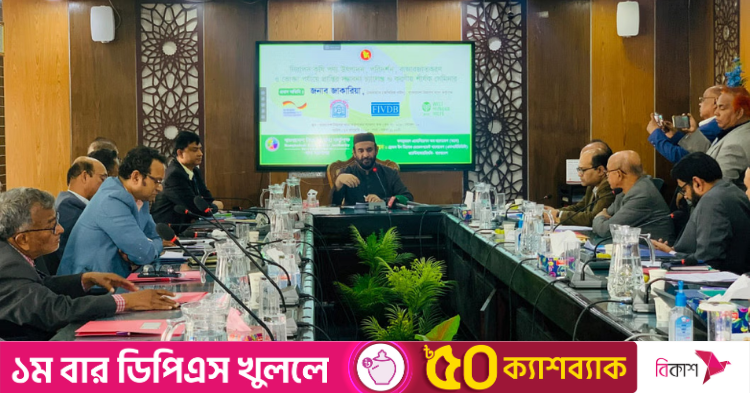
The seminar was jointly organised by the Consumers Association of Bangladesh and Friends in Village Development Bangladesh at the Bangladesh Food Safety Authority office.

Osman said the DAE has undertaken a new plan to produce safe food.

In the first phase, 2 crore farmers will be given smart cards, which will be used to organise agricultural production by region. The initial phase targets the production of eight specific crops, with a focus on increasing agricultural output through the use of organic fertilisers, he added.

Muhummad Nazim Uddin, senior scientific officer of the Horticulture Research Center at the Bangladesh Agricultural Research Institute, said: "The organic nature or fertility of our soil has drastically decreased.

"There is no guarantee that the food being consumed is completely safe. Although these issues have been discussed for a long time and some initiatives have been taken, there has not been any significant development so far," he added.

Uddin added that adopting sustainable and environmentally friendly agricultural technologies at the production level in Bangladesh is crucial to ensuring food security and combating the challenges of climate change.

He also said the formulation and implementation of policies to ensure a balance between demand and supply for the consumers in the country were essential.

Fakir Muhammad Munawar Hossain, director for the operations and laboratories department of the Directorate of National Consumers' Right Protection, said proper enforcement of laws must be ensured alongside social awareness to ensure safe food for consumers.

Raising social awareness requires creating a social movement, which in turn necessitates political commitment, he added.

Zakaria, chairman of the BFSA, said it was essential for people involved in food production to have proper knowledge and training. Online training programmes alongside training centres need to be established for restaurant staff and owners, he added.

He also cited the need to increase manpower at the BFSA, pointing out that there is only one official designated for the whole Mymensingh region, which has a population of 60 lakh.

As of 2023, there were 88.29 lakh hectares of cultivable land in the country, according to data from the Ministry of Agriculture.​
 
Analyze

Analyze Post

Add your ideas here:
Highlight Cite Fact Check Respond

Economy slowing, negative revenue growth shows the sign

1737675071860.webp


For Bangladesh, it is no longer the question of whether the economy is destined for a hard landing or a glide to a flat state; rather the question now is how deep the descent will be.

To fathom the crisis, let's take a look at the country's tax collection.

Roughly speaking, the collection turned negative in the first half of the current fiscal year (FY) 2024-25, which is a first since at least the pandemic era -- when markets shuttered, manufacturing units came to a grinding halt, supply chains collapsed, and life and livelihood endured unprecedented shockwaves.

But those days were long over.

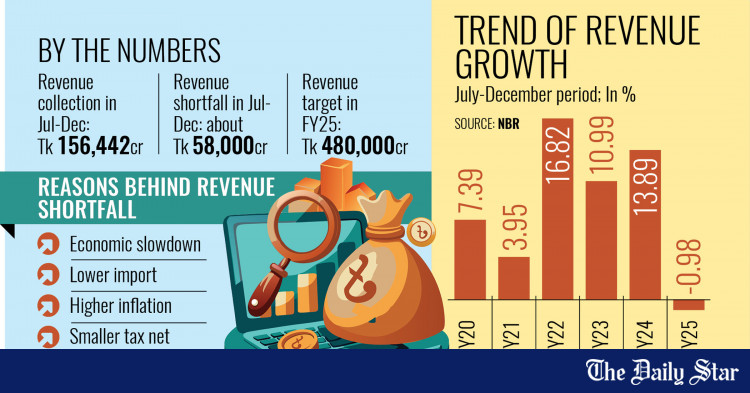
Yet, in the July-December period of FY25, taxmen collected Tk 156,442 crore -- 0.98 percent down year-on-year, according to National Board of Revenue (NBR) data.

This negative growth in revenue collection itself is not the disease, according to economists and businesspeople. Rather, it is a symptom of a slowing economy and growing cracks on the macro frontier.

In FY25, major macro indicators like the growth of the gross domestic product (GDP) tumbled, high inflation continued its rampage without showing signs of stopping anytime soon, the exchange rate remained volatile, and development spending hit a four-year low.

All these fairly indicate a single message: the economy is slowing down, it is hurting and will continue to do so due to a lot of factors, including revenue mobilisation, according to economists.

They said NBR's struggle to mobilise revenue and meet targets is nothing new, but these newly emerged economic cracks have added to the collection inefficiency.

In the last 13 years, the revenue board has been consistent in failing to meet its collection targets.

Despite a 6.66 percent collection growth in December, the revenue administration's collection still fell short of its target by Tk 58,000 crore or 25 percent in the first half of FY25, with its end goal set at Tk 480,000 crore for the year.

Taxmen and policy analysts point the finger at the political and economic shakeup stemming from the ouster of the Awami League government following a mass uprising on August 5 last year.

"The lower revenue growth is closely linked to the current economic slowdown, which also expedites the NBR's inefficiencies," said MA Razzaque, research director of the Policy Research Institute (PRI) of Bangladesh, a local think tank.

Prolonged inefficiencies, reduced imports, higher exemptions and inflationary pressure also contributed to the overall shortfall, the economist added.

The World Bank slashed its forecast for Bangladesh's economic growth by 1.7 percentage points to 4 percent for FY25 due to "significant uncertainties following recent political turmoil" and "data unavailability".

But Razzaque said the country's actual GDP growth this year could be lower than the World Bank projection.

The country's US dollar stocks have been depleting fast since 2022, prompting the authorities to tighten the belt and restrict imports.

As per the BPM-6 method by the International Monetary Fund (IMF), Bangladesh forex reserves now hover around $20 billion, according to the latest Bangladesh Bank data.

Furthermore, the country's total imports decreased from $90 billion in 2021 to $70 billion in 2023.

"So, the NBR is not going to get enough tariffs from imports," Razzaque added.

Besides, inflationary pressure is also hurting revenue growth as people have been slashing their consumption for a couple of years.

Echoing similar views, Anwar-ul Alam Chowdhury (Parvez), president of the Bangladesh Chamber of Industries (BCI), said lower imports contributed to lower revenue collection.

"The reduction of the overall import volume has contributed to the lower revenue growth and lack of business expansion," he said.

Besides, sluggish implementation of the development budget, officially known as the annual development programme (ADP), is another reason for the lacklustre revenue collection.

The NBR is not getting value-added tax (VAT) and supplementary duties (SDs) from construction works, according to the business leader.

"The projects automatically generate revenue for the NBR," he said.

The implementation of the Annual Development Programme (ADP) in the first six months of fiscal year 2024-25 was down 19 percent year-on-year.

Development spending in the July-December period amounted to Tk 50,002 crore, according to the Implementation Monitoring and Evaluation Division (IMED) under the planning ministry.

"There is an interrelation between the reduction of development spending and lower manufacturing growth," said Parvez.

For example, he said, if there is an ongoing project, there would be demand for construction items and services.

When government spending slows, it badly hits production, including cement, rod and brick manufacturing, causing lower revenue collection, explained Parvez, also a former president of the Bangladesh Garment Manufacturers and Exporters Association.

He also criticised NBR for failing to expand the tax net.

"We don't see any major progress in expanding the tax net. Rather, the NBR is burdening existing taxpayers," he said.

Seeking anonymity, an NBR official acknowledged that the negative collection growth occurred due to the economic slowdown.

"We are facing hurdles in collecting revenue amid the government's lower public spending, higher inflation and slow private sector credit growth," the official said.

Prof Selim Raihan, executive director of the South Asian Network on Economic Modeling (Sanem), suggested exploring more diversified sectors for revenue generation, properly implementing the wealth tax, and expanding the tax net.

"The NBR should not take any ad-hoc decisions for tax hikes without consultation stakeholders," he said, referring to the revenue board's recent withdrawal of hiked VAT and SD on nine goods and services.

"It should be well researched and meticulously planned," he said.​
 
Analyze

Analyze Post

Add your ideas here:
Highlight Cite Fact Check Respond

Members Online

No members online now.

Latest Posts

Back
 
G
O
 
H
O
M
E