[🇧🇩] Monitoring Bangladesh's Economy

[🇧🇩] Monitoring Bangladesh's Economy
1K
31K
More threads by Saif

G Bangladesh Defense

Remittances all-time high of $3.75b

Expats sent more before Eid in March, offering relief amid concerns over war fallout on economy

Star Business Report

1775103123254.webp


Remittance hit $3.75 billion in March, the highest on record, giving a respite amid deepening worries over the ripple effect on Bangladesh’s struggling economy due to the US-Israel war on Iran.

The inflow in March was 14 percent higher than $3.29 billion in March 2025 as Bangladeshis working abroad sent increased amounts to their loved ones ahead of the Eid-ul-Fitr festival on March 21.

Overall remittance, which acts as a major source for Bangladesh to clear its external payments, rose 20 percent to $26.20 billion in the July-March period compared to a year ago, according to Bangladesh Bank (BB) data released yesterday.

The surge comes against the backdrop of heightening concern over the possible impact of the war on remittances in the coming months as the conflict spreads across the Gulf -- key employment destinations for Bangladeshi migrant workers.

Nearly 800 Middle East-bound flights from Bangladesh have been cancelled since the war with Iran on February 28, mostly affecting migrant workers.

Last week, the Asian Development Bank (ADB), in a report, said Bangladesh and other South Asian countries could face lower remittances from the Middle East as the ongoing conflict in the region weakens labour demand and squeezes migrant worker incomes.

Nearly half of Bangladesh’s more than $30 billion in annual remittances comes from the Middle East. Saudi Arabia, Oman, Qatar, the UAE, and Kuwait together accounted for 86 percent of Bangladeshi migrant workers who secured jobs abroad in FY25, according to the Bangladesh Economic Review 2025.

Bankers and analysts said the spike in the inflow was largely because of the Eid festival, political stability and an increased rate of the US dollar following a slight depreciation of the taka.

Md Shaheen Iqbal, additional managing director & head of wholesale banking at BRAC Bank, said another factor is that migrants try to send home more during any crisis period. “We have seen this trend during the initial days of the Russia-Ukraine war. A similar thing may happen this time.”

He said the inflow may fall this month but recover in the next month ahead of Eid-ul-Azha. However, the remittance inflows in the later months will depend on the war, he said.

Deen Islam, professor of economics at Dhaka University, said the recent surge in remittance inflows provides meaningful short-term relief to Bangladesh’s external sector, but its sustainability remains uncertain in the current global context.

“Much of Bangladesh’s remittance originates from migrant workers in Gulf Cooperation Council (GCC) economies, making flows sensitive to oil price cycles, fiscal conditions in host countries, and evolving labour nationalisation policies,” he said.

“Additionally, tighter immigration regimes in advanced economies and global economic slowdown risks could constrain future migration and earnings growth.”

During the July-February period of the fiscal year 2025-26, over 10 lakh migrant workers left for jobs abroad, up 15 percent YoY, according to official data.

Birupaksha Paul, a professor of economics at the State University of New York, USA, said imports may increase following the return of political stability in the country after the election.

“There is a concern that pressure is likely to build on Bangladesh’s foreign exchange reserves to pay higher import bills,” he said. “Foreign exchange reserves will not increase in that case.”

In this context, he said, the foreign exchange rate should be re-evaluated. “Some people doubt that it is not yet fully market-based and not reflecting the market price,” he said, adding that any depreciation will fuel import-induced inflation.

“But reserve management is a crucial thing,” said Paul, former chief economist at the BB.

Prof Islam said while the increase in remittance strengthens the balance of payments, supports exchange rate stability, and boosts domestic consumption, it also reinforces a structural dependence on external labour income rather than productivity-driven export growth.

“Therefore, although remittances will likely remain a vital pillar of macroeconomic stability in the near term, their long-run sustainability and developmental impact depend on diversification of migration destinations, skill upgrading of workers, and complementary policies to channel inflows into productive investment rather than predominantly consumption.”​
 

Boosting govt’s tax revenue earnings

FE
Published :
Apr 04, 2026 00:06
Updated :
Apr 04, 2026 00:06

1775261633885.webp


The economy that the incumbent BNP government has inherited from the past bears the legacy of rampant corruption and politicization that distorted all vital state institutions. The tax authority, the National Board of Revenue (NBR), was no exception. Small wonder that the past regime was marked by high tax evasion, political patronage and unrealistic budgetary process causing the NBR to miss its revenue collection targets over the years. Against this backdrop, the incumbent government is planning to introduce a series of tax measures so higher revenue earnings targets could be achieved. It is worthwhile to note at this point that the country's tax-to-GDP ratio now at approximately 7 per cent is among the lowest in the world. So, the country's very low domestic revenue collection profile poses a significant challenge before the economy.

To get around the predicament, the NBR is reportedly considering introducing a slew of measures to strengthen revenue collection for the upcoming fiscal year (FY 2026-27). Those include reintroduction of wealth tax, a new inheritance tax, higher rates for the ultra-rich, and rationalizing the prevailing tax exemption regime. Such measures to boost revenue earning are now the imperative seeing that the country is faced with mounting pressure on public finances, with the government struggling to meet revenue targets amid a widening fiscal deficit and rising debt servicing costs. In this connection, the issue of wealth tax is being reconsidered as it is not quite new in this part of the world. In fact, it was in place since 1963 until it was abolished in 1999. The reasons behind abolishing the provision at that time include high administrative costs, low revenue generation and a shift towards taxing incomes and capital gains rather than accumulated assets. At that time, the factors leading to low tax generation (from wealth tax) included broad exemptions resulting in taxpayers often shifting their assets into exempt categories which reduced effective tax base. In that case, acknowledging that challenges remain regarding asset valuation and availability of the necessary data, a committee was learnt to have been formed to examine the issues in more detail.

Apart from establishing a standard procedure of asset evaluation and ensuring availability of adequate data, exercising of necessary caution would also be advisable on the part of the tax authority (while levying inheritance tax) to avoid triggering capital flight. In a similar vein, gradual phasing out of the existing system of tax exemption regime needs to be given serious consideration. That is for the simple reason that the prevailing tax system is characterized by a complex and distortionary multiple tax rates and large and regressive exemptions on VAT and income taxes. True, tax exemptions are necessary, to attract investment and generate employment. But the arrangement cannot be continued indefinitely.

It is time the beneficiaries of tax exemptions were brought under the tax net. To this end, the tax regulator, as reported, plans to raise the top marginal income tax from 30 to 35 per cent tentatively by FY2028. Notably, marginal taxation is the percentage of tax paid on each additional taka earned within a specific tax bracket rather than on total income. However, for the next fiscal year (FY2026-27), the tax regulator's focus is on raising the tax rate on individuals who earn more than Tk10 million annually by five percentage points. This is undoubtedly a welcome move. In fine, successful implementation of the steps to boost the government's revenue income through measures as envisaged by NBR would depend on expeditious automation of the tax administration. Hopefully, the tax authority would give the necessary go-ahead to the issue.​
 

BD eyes an Islamic capital market
Integrate first, then elevate

Mohammad Kabir Hassan and Zobayer Ahmed

Published :
Apr 04, 2026 00:00
Updated :
Apr 04, 2026 00:00

1775262502789.webp


The economic future of any developing nation depends on broadening its financial base beyond bank-dominated, debt-driven growth. In a welcome signal of strategic intent, Professor Dr Rashed Al Mahmud Titumir, Adviser to the Prime Minister on Economic Affairs and Planning, recently called for the establishment of an Islamic stock exchange in Bangladesh — designed to attract capital from Malaysia, Indonesia, and the Gulf, and to create an investment gateway for non-resident Bangladeshis (NRBs). The proposal is timely and ambitious, and it deserves a rigorous answer to a question that policymakers have not yet fully confronted: should Bangladesh integrate Islamic financial instruments into its existing exchanges, or build a separate Islamic capital market from the ground up?

Our answer, grounded in Bangladesh’s own data, international precedent, and academic research, is clear: integrate first and, over a five-to-ten-year horizon, and evaluate the case for a dedicated Islamic exchange. Attempting to build a standalone institution before the necessary instruments, regulations, and investor base are in place would risk repeating the fragmentation and governance failures that have already hurt the country’s banking sector.

A Shallow Market in Need of Depth: Bangladesh’s capital market remains conspicuously underdeveloped relative to its economic size and ambition. As of 2024, the market capitalisation of the Dhaka Stock Exchange (DSE) stood at approximately Tk 6.62 trillion — down from Tk 7.70 trillion in 2023 — equivalent to roughly 19.5 per cent of gross domestic product (GDP), compared with a global average exceeding 69 per cent. No new companies were approved for IPOs on the DSE in 2024, an indicator of regulatory paralysis and weak listing incentives. The Chittagong Stock Exchange (CSE) remains marginal in terms of volume. The two exchanges together host around 625 listed companies, a figure modest for an economy of Bangladesh’s scale.

The market’s structural problems are well-documented. Well-performing family-owned enterprises resist listing, fearing governance scrutiny. Retail investor behaviour is often speculative rather than fundamental, a pattern captured in research by Hassan, Basher and Islam (2007), which found persistent serial correlation and negative risk-return dynamics in DSE equity returns — consistent with market inefficiency and thin trading. Circuit breakers, introduced to manage volatility, were found to increase realized volatility rather than reduce it. Decades later, many of these structural weaknesses persist.

Against this backdrop, the Islamic capital market segment is essentially absent. There is no dedicated Shariah-compliant equity index on exchange, no regular corporate sukuk market, and only a nascent government sukuk program through the Bangladesh Government Islamic Investment Bond (BGIIB). The country’s BGIIB sukuk issuance, launched in 2020 to raise Tk 80 billion for water infrastructure, demonstrated proof of concept — but the pipeline of subsequent issuances remains thin.

A Strong Banking Base, a Missing Capital Market: The irony is that Bangladesh has quietly built one of the world’s most significant Islamic banking sectors, yet its capital market has not followed suit. As of early 2024, ten full-fledged Islamic banks, alongside 23 Islamic banking branches and over 500 Islamic banking windows of conventional banks, collectively held approximately 23.65 per cent of total banking assets, 26.23 percent of deposits, and 28.24 per cent of investments in the national banking system — figures that place Bangladesh among the leading Islamic banking jurisdictions in South and Southeast Asia.

This is a crucial foundation. A large Islamic banking sector means there is domestic institutional demand for Shariah-compliant capital market instruments — sukuk for liquidity management, Islamic equities for portfolio diversification, and Islamic mutual funds for retail investors. Bangladesh Bank has itself acknowledged the urgent need to deepen the Islamic capital market and scale up sukuk issuance to reduce Islamic banks’ reliance on debt-like instruments. The capital market gap is not a demand problem. It is a supply-and-regulatory problem.

What Malaysia, Indonesia, and the Gulf Did Right: Malaysia is the global benchmark. The Kuala Lumpur Stock Exchange did not build a parallel Islamic bourse — it integrated Shariah-compliant indices and instruments into the existing exchange, supported by a dedicated Securities Commission Shariah Advisory Council, robust disclosure standards, and a pipeline of corporate and sovereign sukuk. Today, Malaysia accounts for a disproportionate share of global sukuk issuance and consistently tops the Islamic Finance Country Index.

Indonesia followed a similar path. The Jakarta Islamic Index (JII), launched in 2000, operates as a Shariah-compliant sub-index of the Indonesia Stock Exchange — not a separate institution. Supported by a national Shariah board and progressive regulation, it has grown into a credible benchmark for domestic and foreign Islamic investors.

The Gulf states, where Islamic finance is embedded in the financial culture, offer a different lesson: even in their most mature markets — Dubai Financial Market, Saudi Arabia’s Tadawul — Islamic and conventional instruments coexist on the same exchange infrastructure. A bifurcated architecture did not require two separate exchange buildings; it required dual-window compliance frameworks within a unified market structure.

Academic research reinforces these lessons. Hassan and Yu (2007), examining stock exchange alliances across OIC countries, found that despite a shared Islamic culture, local capital market conditions were too heterogeneous in terms of legal frameworks, income levels, and market maturity to support a single unified Islamic exchange. Their recommendation was a bifurcated, or two-tier, system: small, locally operating firms listed on domestic exchanges, while larger, more established companies access regional Islamic financial centres in Asia, Europe, or MENA — eventually linking into a pan-OIC exchange architecture. Bangladesh’s current market development places it firmly in the first tier of that framework: it needs to build domestic Islamic capital market capacity before aspiring to regional integration.

The Policy Prescription: The policy case for integrating Islamic instruments into the DSE and CSE first — rather than creating a standalone exchange — rests on five arguments.

Cost and institutional capacity. Building a separate exchange from scratch requires regulatory infrastructure, a Shariah board, trading technology, clearing systems, investor education, and a critical mass of listings. Bangladesh’s capital market regulator, the Bangladesh Securities and Exchange Commission (BSEC), already struggles to govern two existing exchanges. A premature third institution risks becoming a shell — credential in name but thin in activity, as has occurred in several OIC countries that established Islamic markets before their investor bases were ready.

Market liquidity. Liquidity is the lifeblood of any exchange. Splitting an already thin market between a conventional exchange and a new Islamic exchange would reduce liquidity on both, widening bid-ask spreads and increasing price volatility — the very conditions that have historically undermined DSE efficiency. Shariah-compliant indices embedded within the DSE, by contrast, share the existing order book and liquidity pool.

Derivative and hedging gap. While a group of Shariah scholars supports instruments such as Islamic Forex forwards under the concept of wa’d, the majority remain cautious, reflecting heterogeneous jurisprudential positions. Without an agreed-upon framework for Islamic hedging instruments, a standalone Islamic exchange would lack the risk-management tools that institutional investors — particularly those from the Gulf and Malaysia — require before committing capital. Developing these instruments requires gradual Shariah consensus-building, which is more feasible in an integrated regulatory environment than in a parallel institution operating under separate oversight.

Investor confidence and governance. Bangladesh’s Islamic banking sector is currently navigating a governance and non-performing-loan crisis so severe that Bangladesh Bank has proposed merging five Islamic banks into a single entity to prevent systemic failure. Launching a standalone Islamic stock exchange in this environment, before trust in Islamic financial institutions has been restored, risks contaminating the new institution with reputational spillover. Integration into the existing exchange — which has its own credibility and Nasdaq technology partnership — offers a lower-risk launch pad.

The NRB opportunity is reachable through integration. Non-resident Bangladeshis remit billions of dollars annually. Making Shariah-compliant equities, sukuk, and Islamic mutual funds accessible on the DSE — with digital platforms and clear foreign investment rules — can capture NRB capital without requiring a new exchange. Malaysia and Indonesia attracted faith-based foreign investment through their existing exchanges’ Islamic windows, not through separate institutions.

A Five-Point Action Plan: An integration-first strategy requires the following concrete steps, which BSEC, Bangladesh Bank, and the Ministry of Finance should pursue in parallel.

Launch a DSE Shariah Index. BSEC should establish a formal Shariah Supervisory Board for the capital market, distinct from the banking sector’s boards, to screen listed equities and publish a DSE Islamic Index. This would provide the benchmark that Islamic mutual funds, pension funds, and foreign investors need. [Currently, investors and stakeholders have no free access to the DSE Shariah index (DSES) as the Dhaka bourse has been managing it for the purpose of business.]

Scale up sukuk issuance. The government should deepen and regularize sovereign sukuk through the BGIIB program and actively encourage corporate sukuk for infrastructure financing. Sukuk can reduce reliance on budgetary allocations and bank loans — directly addressing Adviser Titumir’s vision of a bond-based economy.

Build Shariah-compliant mutual fund regulation. Islamic mutual funds are the most accessible on-ramp for retail investors. BSEC should fast-track a regulatory framework for Islamic unit trusts, modelled on the Securities Commission of Malaysia’s guidelines.

Develop Islamic derivatives prudently. Bangladesh Bank and BSEC should convene a joint working group with Shariah scholars to develop a national standard for Islamic hedging instruments. The wa’d-based FX forward structure, as identified in the academic literature on Bangladesh, offers a viable starting point.

Plan for a dedicated Islamic exchange. A separate Islamic capital market — whether as a dedicated board within DSE/CSE or eventually as a standalone exchange — should be the five-to-ten-year horizon goal, contingent on achieving sufficient market depth, Shariah product diversity, and regulatory maturity. The two-tier OIC framework offers a useful architectural template: domestic Islamic listings on a Shariah board of DSE, with larger Bangladeshi companies eventually accessing regional Islamic financial centers in Kuala Lumpur, Dubai, or Riyadh.

Conclusion: Bangladesh has the foundational conditions for a genuinely transformative Islamic capital market: a Muslim-majority population of 170 million, a proven Islamic banking sector holding nearly a quarter of national banking assets, a large diaspora eager for faith-based investment options, and growing government recognition of the opportunity. What it currently lacks is the sequenced institutional architecture to make it real.

The establishment of an Islamic stock exchange should not be dismissed — it should be pursued on the right timeline. That means integrating Shariah-compliant instruments into the DSE and CSE first, building liquidity, regulatory credibility, and investor trust over the next five years, and then evaluating the conditions for a dedicated Islamic exchange or board. Moving from a debt-dependent society to an ownership-based society requires foundations built carefully — not institutions launched prematurely and subsequently hollowed out.

The global experience is unambiguous: the countries that lead in Islamic capital markets today built depth before they built separation. Bangladesh should do the same.

Dr Mohammad Kabir Hassan, Professor of Finance, University of New Orleans; mhassan@uno.edu; and Dr Zobayer Ahmed, Associate Professor, Bangladesh Institute of Governance and Management (BIGM)​
 

Export earnings ring alarm bells

FE
Published :
Apr 05, 2026 00:25
Updated :
Apr 05, 2026 00:25

1775347544013.webp


The latest figures on Bangladesh's export earnings make for grim reading. For each of eight consecutive months since August last, export earnings recorded a fall year-on-year, and the performance of March 2026 was the worst, registering an 18.07 per cent decline. The country received $3.48 billion in export earnings in March 2026, down from $4.28 billion in March 2025, a contraction that shows just how severe this downward spiral has become. The cumulative damage over the first nine months of fiscal year 2025 to 2026 is just as concerning. Total export earnings stood at $35.38 billion against $37.19 billion in the corresponding period of the previous fiscal year, marking a 4.85 per cent decline. The readymade garment sector which accounts for more than 80 per cent of total merchandise export earnings has been the principal casualty, registering a 5.51 per cent contraction during the same nine months. The damage is not confined to one corner of the industry either. Knitwear exports fell by 6.42 per cent while woven garments declined by 4.48 per cent, meaning the rot has spread across the sector leaving little room for one sub-sector to compensate for the weakness of another.

Fluctuations in export earnings are normal for any trading nation, but what Bangladesh is experiencing right now goes far beyond the usual ups and downs. The causes of this sustained decline are multiple and they feed into one another which make the prospect of a quick recovery considerably harder. On the one hand, the imposition of reciprocal tariffs by the US directly reduced demand from one of Bangladesh's key markets, as American buyers scaled back orders in an increasingly uncertain trade environment. On the other hand, China, facing heavier tariffs on its own exports to America, turned its attention aggressively toward European markets and offered prices that Bangladeshi manufacturers find difficult to match. This has created pressure from both sides, with weaker demand in the US and intensified competition in Europe, two markets that together account for a large share of Bangladesh's garment exports. Geopolitical turmoil has added further weight to this burden. The conflict involving the United States, Israel and Iran has introduced volatility into energy markets and disrupted shipping lanes, raising freight costs to levels that render exports of agricultural and processed food products to the Middle East financially unviable. Shipping companies have reportedly demanded risk surcharges of $3500 per container for Gulf destinations, charges that entirely wipe out the commercial logic of many export transactions.

Bangladesh's export basket remains dangerously concentrated, with readymade garments constituting more than four fifths of total earnings. This concentration means that any disruption to global clothing demand, whether driven by recession, changing consumer habits or competitive pressure from rival producers, transmits almost instantly into a national export crisis. The sectors that managed positive growth during the July to March period, including frozen fish, leather goods and engineering products, are instructive because they are more insulated from the factors battering the garment sector, and their modest gains point toward the diversification that Bangladesh needs but has been slow to achieve.

The outlook, as things stand, is not reassuring. Industry leaders from both the BGMEA and BKMEA have warned of further deterioration in the months ahead, a prognosis that deserves to be taken seriously. The grim figures of March 2026 are a warning, and the cost of ignoring that will be measured in lost earnings, lost livelihoods and a lost opportunity to consolidate the economic gains of recent decades.​
 

Time to cut tax rates, widen base

1775351499765.webp


ALTHOUGH Bangladesh is progressing towards becoming a middle-income country, it has not yet achieved the expected success in domestic revenue mobilisation. The tax-to-GDP ratio remains below 7 per cent, which is extremely low by global standards and a matter of serious concern for a developing economy. This reality indicates that the current tax system fails to bring a large number of potential taxpayers into the formal economy. Even after extending the deadline multiple times for the 2026 financial year, the number of income tax return filers has still not crossed five million. As a result, the government’s reliance on deficit financing to meet its expenditure needs continues to grow.

Over the few decades, Bangladesh’s budget deficit has increased steadily. As expenditure has risen much faster than revenue, the government has had to depend heavily on domestic sources to finance the deficit, primarily through borrowing via national savings certificates and from the banking sector. Although the overall deficit-to-gross domestic product ratio has been kept around 5 per cent, the absolute size of the deficit is exerting long-term pressure on the economy. At the same time, dependence on external borrowing is also gradually increasing, especially for the implementation of large infrastructure projects.

In this situation, excessive borrowing from the banking sector is creating a ‘crowding out’ risk, where the availability of credit for the private sector declines. This may lead to reduced investment and hinder the overall economic growth. If global shocks are added to this scenario, the situation could become even more complicated.Diaspora community news

In the current geopolitical context, if the US-Israel war on Iran lingers, Bangladesh’s economy could face severe risks. A 40–50 per cent rise in prices of oil and liquefied natural gas would significantly increase the energy cost, raising production expenses and intensifying inflation. Simultaneously, higher import costs, disruptions in supply chains and increased maritime transport expenses would create pressure on the economy.

Bangladesh’s main export sector, the apparel industry, could be particularly affected in this scenario. Rising energy costs would increase production expenses, thereby reducing competitiveness on the international market. Delays and higher costs in importing raw materials could also slow down industrial production. On the other hand, if the nearly half a million Bangladeshi workers in the Middle East face security risks, remittances inflow could be negatively impacted, putting additional pressure on the foreign exchange reserves.

Amid such a proposition, a major challenge for the government is to implement its election promises. However, with the current limited fiscal space, fulfilling those commitments is difficult. This could further widen the budget deficit and increase dependence on deficit financing. In this reality, there is virtually no alternative for the government to increasing revenue collection.

The issue, however, is: how can revenue be increased? The conventional view suggests that increasing tax rates could be a way to boost revenue. In reality, excessively high tax rates often lead to increased tax evasion and drive taxpayers away from the formal economy. Bangladesh’s current tax structure is complex and, in many cases, not taxpayer-friendly, which discourages voluntary tax compliance.

The personal income tax structure follows a progressive slab-based system, with the highest tax rate reaching up to 30 per cent. For the 2025–2026 tax year, the tax-free income threshold for general taxpayers has been set at Tk 350,000. However, higher thresholds apply to certain groups — Tk 400,000 for women and senior citizens, Tk 475,000 for third-gender taxpayers and persons with disabilities and Tk 500,000 for gazetted freedom fighters injured in the war. The first Tk 350,000 of income is tax-free. Tax is then applied at 5 per cent to the next Tk 100,000, 10 per cent to the following Tk 400,000, 15 per cent to the next Tk 500,000 and 20 per cent to the subsequent Tk 500,000. After that, 25 per cent applies to the next Tk 2 million and the highest rate of 30 per cent applies to income exceeding Tk 3.85 million. This slab-based structure causes the tax burden to increase progressively with income.

Corporate tax rates, on the other hand, vary by sector. Listed companies start at around 20 per cent while banks and mobile operators face the highest rate of up to 45 per cent. The standard rate for value-added tax remains at 15 per cent.

High tax rates encourage tax evasion among the public, which is largely a psychological reality. In Bangladesh’s context, however, the problem is even more complex. In many cases, citizens must make illegal payments or ‘illegal tolls’ in addition to legitimate taxes. Widespread extortion and irregularities in society cause these additional costs to be passed on to prices of goods and services, effectively acting as an indirect tax that burdens everyone.

Moreover, even after paying taxes, people often have to incur additional personal expenses to access basic citizen services such as education, health care, security and legal assistance. As a result, tax payment appears to many as an unnecessary extra burden. On the other hand, illegal tolls, bribe, administrative harassment and the lack of a business-friendly environment abnormally increase the cost of doing business. In this context, bearing high tax rates while keeping businesses operational becomes extremely difficult for many entrepreneurs. Sustainable revenue growth cannot, therefore, be achieved without reforming tax policy and the institutional framework.

In this context, reducing tax rates and expanding the tax base could be an effective solution. For personal income, introducing a smooth and moderately progressive tax structure with rates such as 3 per cent, 5 per cent, 7.5 per cent, 10 per cent, 12.5 per cent and 15 per cent would make the system simple and acceptable. Similarly, corporate tax rates could be restructured in slabs ranging from 10 per cent to 30 per cent, which would improve the business environment and encourage greater investments.

International experience shows that taxpayers become willing to pay taxes when they perceive the tax system as fair, transparent and predictable. Excessive complexity and high tax rates create incentives for evasion. In contrast, a simple and moderate tax rate encourages voluntary compliance and ensures revenue growth in the long run.

In Bangladesh, a large number of professionals, freelancers, small entrepreneurs and service providers still remain outside the tax system. A reasonable and citizen-friendly tax structure can bring them into the formal economy. Additionally, incentives, recognition and awareness play crucial roles in encouraging taxpayers.Diaspora community news

Honouring regular taxpayers with appreciation, special benefits or fast services and transparently showing the public how tax money is spent can create a positive attitude among them and motivate others to pay taxes. At the same time, increasing tax awareness is equally important. People need to understand that paying taxes is not merely an obligation, but the primary source of investment in development, infrastructure, education and health sectors. This will expand the tax base and ensure sustainable growth in revenue.

Another important aspect of tax reform is preventing tax evasion. Comparatively lower and realistic tax rates help reduce the tendency to avoid taxes. Alongside this, technology-driven tax administration, digital filing or e-returns and data-based monitoring can make tax collection far more effective.

However, evidence-based decision-making is extremely important in determining tax rates. There is a lack of sufficient research on setting tax rates or formulating policies. In this regard, the National Board of Revenue should strengthen its research activities and increase collaboration with universities and research institutions. Policy decisions based on data and analysis will make the tax system more effective and acceptable.

Bangladesh is advancing with the goal of becoming a middle-income country. Achieving this goal requires increased investment in infrastructure, health, education and social protection. However, to make the investments sustainable, it is essential to build a strong domestic revenue base. For this, establishing a modern, efficient and citizen-friendly tax system is indispensable.

The objective of tax reform should not, therefore, be limited to changing tax rates alone, but rather to building an integrated and inclusive tax system. By reducing tax rates and expanding the tax base, Bangladesh can create a robust revenue foundation that will ensure economic stability and enhance its capacity to withstand future global and domestic shocks. If tax payment can be established as a civic duty, it will not only increase revenue but also lay the foundation for a sustainable and equitable economic system.

Dr Syed Abdul Hamid is a professor at the Institute of Health Economics, University of Dhaka.City & Local Gu​
 

TIGHT MONETARY STANCE PROVES INEFFECTIVE
Pumping higher volume of reserve money into banks adds to inflation
Cheap credits to banks from central bank, dollar buy from them for exchange-rate stabilizing enhance supply of high-powered money

Jubair Hasan
Published :
Apr 06, 2026 00:41
Updated :
Apr 06, 2026 00:41

1775433526779.webp


A resurgence in funnelling reserve money into the market through cheap state credits to banks and dollar buy from them through regulatory intervention is stoking fears of higher inflationary regime ahead.

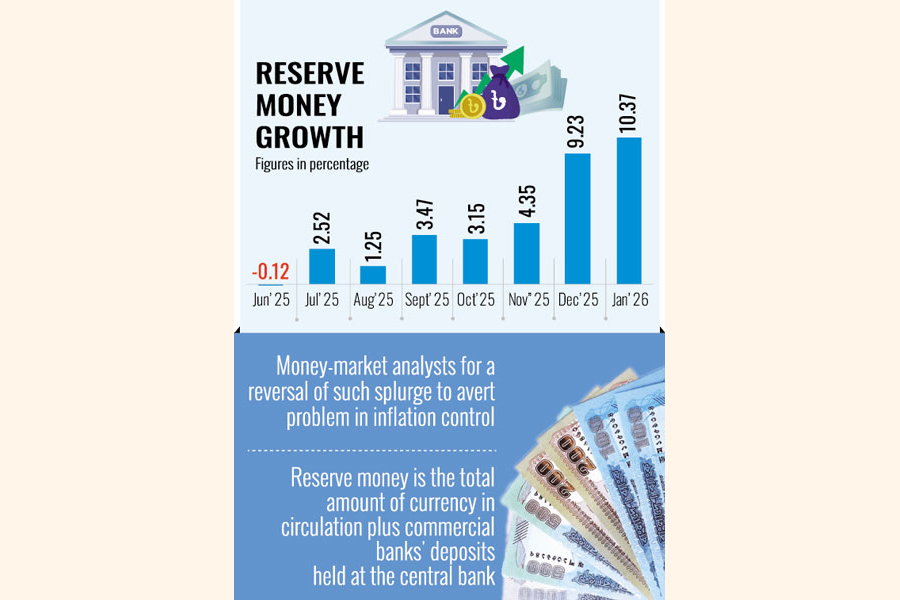
Under a persistently tight monetary-policy regime espoused by the central bank to contain growing inflation, the inflow of the inflation-fuelling reserve money dropped to a negative growth of 0.12 per cent even in June last. Since then, in a rebound, it has risen significantly in recent months, which money- market analysts believe largely contribute to the upward trajectory of inflation over the last several months.

Apart from the regular liquidity-feeding instruments of the Bangladesh Bank (BB), they say, the flow of subsidised credits or money injection through irregular arrangements keeps rising in the money market, which is contradictory to the spirit of contractionary monetary-policy stance.

As a matter of fact, the BB-guided tight monetary policy is not transmitting into the money market properly and not being able to contain the inflationary pressure at the expected level, which ultimately hurts common people through curtailing their purchasing power.

According to latest BB data, the growth of the reserve money in the post-June period stood at 2.52 per cent, 1.25 per cent, 3.47 per cent, 3.15 per cent, 4.35 per cent, 9.23 per cent and a steep 10.37 per cent in July, August, September, October, November, December and January last respectively.

Reserve money is the total amount of currency in circulation plus commercial banks' deposits held at the central bank, acting as the foundation for the entire monetary system. It is also called "high-powered money" because it forms the foundation for the expansion of bank deposits through the money-creation process.

Seeking anonymity, a BB official says the central bank, in fact, did nothing to control the higher inflation apart from continuing a higher policy rate of 10 per cent since October in 2024.

He says, "The volume of quasi-fiscal activities by the BB through which commercial banks avail credits from the regulator at subsidised rates, ranging from 0.5 per cent to 5.0 per cent, is still quite large."

On the other hand, the central banker adds, regular government borrowing from the central bank through using ways and means, amounting to maximum Tk 120 billion, and overdraft worth maximum Tk 120 billion, goes on to operate some 119 accounts at 8.0 per cent and 9.0 per cent respectively.

About the upturn in reserve money, the central banker informs that they had planned to downsize the ceiling of ways and means and overdraft but high-ups of the regulator turned down the proposal in view of the current macroeconomic context of the country.

"Certainly, it (reserve money growth) is a concern for all of us because it fuels inflation to some extent," he told The Financial Express.

The rate of inflation keeps rising for the last four consecutive months since October last. According to the data with Bangladesh Bureau of Statistics (BBS), headline inflation reached 8.29 per cent, 8.49 per cent, 8.58 per cent and 9.13 per cent in November, December, January and February last. However, the rate came down to 8.71 per cent in March last.

Apart from growing government bank borrowing and quasi-fiscal activities, Director-General of Bangladesh Institute of Bank Management (BIBM) Dr Md. Ezazul Islam notes, the regulator keeps injecting high-powered money in the form of assured repo (AR) against special bonds meant for settling accumulated arrears to independent power producers and fertiliser suppliers since February in 2024.

On the other hand, the economist says, the central bank has purchased more than $5.50 billion since July 13 last to stabilise the exchange rate and injected huge volumes of money into the market. "These all factors contributed to the rising growth of reserve money. But it is still not very harmful. If it rises further, it will be an issue of serious concern in the context of a tight monetary stance."

Founding chairman of Policy Exchange Bangladesh M Masrur Reaz says the rising growth of reserve money largely explains why the upward trajectory of inflation for the last four months here.

"It needs to be controlled because it is not such a policy to support tight monetary policy and efficient inflation management," he suggests.

However, given the ongoing fuel oil crisis in the wake of the Middle East crisis, the situation in the upcoming months, as far as inflationary pressure is concerned, remains very much fluid.

Finance and Planning Minister has already warned of rise in prices of most commodities in the coming days because of the soaring fuel oil prices.​
 

425.3pc growth of remittance inflow till April 4

BSS
Published :
Apr 05, 2026 17:35
Updated :
Apr 05, 2026 17:35

1775433648304.webp

Inflow of remittances witnessed a year-on-year growth of 425.3 percent reaching US$339 million in the first four days of April, according to the latest data of Bangladesh Bank (BB) issued.

Last year, during the same period, the country’s remittance inflow was $65 million.

During the July to April 5, 2026 of the current fiscal year, expatriates sent remittances of $26,548 million, which was $21,850 million during the same period of the previous fiscal year.​
 

Can Bangladesh attain Sustainable Development Goals by 2030?

Md. Mehadi Hasan Sohag & Muhammad Sougatul Islam

1775435373534.webp


In today’s world, reducing inequality and ensuring inclusive development have become priorities. To meet this need, the Sustainable Development Goals (SDGs) must be achieved. In September 2015, the United Nations (UN) set 17 goals and 169 associated targets to build a discrimination-free, peaceful and prosperous world by 2030. Together, they address a wide range of challenges, including poverty, hunger, health, education, inequality, and environmental sustainability. The goals and associated targets were developed through a broad international consultation process, and all the world leaders agreed to move forward this agenda.

Bangladesh is among the countries that have embraced this agenda, integrating the SDGs into its long-term planning and sectoral strategies while taking steps to adapt the targets to its national context, improve monitoring systems, and allocate resources for implementation. Yet, despite this commitment, achieving the 2030 targets will require sustained policy focus, stronger institutions, and faster progress across key areas.

SDG Index Dashboard clearly shows that significant challenges remain to reach the target. As global and domestic challenges continue to evolve, timely delivery of the SDGs remains critical for Bangladesh to ensure equitable growth, reduce disparities, and secure long-term economic and social stability.

1775435403528.webp


Between 2000 and 2015, Bangladesh demonstrated notable progress in achieving the Millennium Development Goals (MDGs), emerging as one of the leading performers among low-income countries (at least in the top 3 among South Asian countries). Despite economic constraints, the country made measurable gains in key indicators—extreme poverty declined significantly, female participation in education improved, and both under-five mortality and maternal mortality rates were reduced at a pace recognised globally. These achievements positioned Bangladesh as a widely cited “Global Success Story” by the UN.

However, the shift from the MDGs to the SDGs presents a more complex challenge. According to recent data from the SDG Transformation Center (as of 28 March 2026), Bangladesh is ranked 114th globally with an SDG Index score of 63.88, placing it behind several South Asian peers such as the Maldives (rank 53, score 73.96), Bhutan (74, 70.52), and Nepal (85, 68.58). While Bangladesh maintains a relatively strong spillover score of 96.30, its overall ranking indicates slower progress across many SDG indicators.

1775435434106.webp


Bangladesh’s SDG performance must go beyond comfortable headline rankings and confront the realities hidden within the sub-targets of the 17 goals. Aggregate scores may create an illusion of steady progress, but they often obscure deep-rooted disparities and uneven gains across sectors. It is at the level of these sub-targets that the real story unfolds. Relying on broad indices, risks masking policy failures and delaying corrective action. A data-driven examination of these indicators is therefore not just necessary, but urgent.

Over the past two decades, there has been undeniable progress toward SDG 1 (No Poverty) in reducing poverty, but the pace has slowed, and vulnerability remains widespread. While the extreme poverty rate measured at $2.15 per day shows signs of improvement, the rising poverty headcount at $3.65 per day indicates a more troubling reality—large segments of the population are still economically vulnerable.

Bangladesh’s performance on SDG 2 (Zero Hunger) reveals a very uneven landscape. The prevalence of undernourishment continues to increase, while minimum dietary diversity among young children remains stagnant, pointing to systemic gaps in food quality rather than availability. Regarding SDG 3 (Good Health and Well-being), we are far from achieving the target.

The incidence of tuberculosis stays high, and the burden of non-communicable diseases (NCDs)—including cardiovascular diseases, cancer, and diabetes—is growing, as reflected in elevated age-standardised mortality rates. Environmental health risks, especially air pollution, continue to significantly contribute to mortality. Furthermore, systemic weaknesses are evident in indicators like the Universal Health Coverage (UHC) index, which suggests limited access to comprehensive healthcare services.

Rapid urbanization is advancing faster than the country’s capacity to manage it, leaving a significant portion of the urban population living in slum conditions with inadequate housing and basic services. Poor air quality, limited access to public transportation, and gaps in essential urban services pose serious challenges to achieving SDG 11
Improvements in the literacy rate suggest progress at the surface level, yet deeper indicators reveal systemic weaknesses. To date, pre-primary participation remains limited, depriving children of foundational learning at a critical stage. High dropout rates and weak retention in primary and secondary schools, as well as substandard quality in tertiary institutions, are major challenges to achieving SDG 4 (Quality Education).

Increased female participation in education and gradual gains in labor force engagement signal positive momentum for SDG 5 (Gender Equality), yet achieving true equality remains a significant challenge. While Bangladesh has achieved meaningful gains in access to basic drinking water, these advances are increasingly undermined by groundwater contamination and poor waste management, putting SDG 6 (Clean Water and Sanitation) at risk. Moreover, inadequate sanitation coverage continues to pose a significant and unresolved challenge.

Near-universal access to electricity marks a significant milestone in Bangladesh’s progress toward SDG 7 (Affordable and Clean Energy); however, this achievement is undermined by persistent gaps in access to clean energy. A large share of the population still relies on traditional fuels for cooking, while excessive greenhouse gas emissions and the low share of renewable energy in total consumption remain major challenges.
SDG 8 (Decent Work and Economic Growth) narrative suggested by the data often appears more optimistic than the lived reality.

Although rising GDP growth and expanding financial inclusion signal progress, these gains have not translated into equitable benefits. The continued presence of modern slavery indicators, alongside weakening labor rights protections, reveals serious structural weaknesses in the labor market. Infrastructure development has accelerated in Bangladesh, with notable improvements in rural road connectivity and growing mobile broadband subscriptions. But weak performance in the logistics performance index suggests inefficiencies in infrastructure quality and service delivery (SDG 9). More critically, indicators such as low research and development (R&D) expenditure, limited academic output, and declining patent applications reveal a significant innovation deficit.

Achieving SDG 10 (Reduced Inequalities) requires a fundamental commitment to minimizing disparities across society. However, indicators such as the Gini coefficient and Palma ratio reveal a growing concentration of income and wealth within a small segment of the population, raising serious concerns about the inclusiveness of development. Despite sustained economic growth, inequality in Bangladesh continues to widen.

Rapid urbanization is advancing faster than the country’s capacity to manage it, leaving a significant portion of the urban population living in slum conditions with inadequate housing and basic services. Poor air quality, limited access to public transportation, and gaps in essential urban services pose serious challenges to achieving SDG 11 (Sustainable Cities and Communities). At the same time, SDG 12 (Responsible Consumption and Production) remains largely unmet, driven by weak waste management systems and growing plastic pollution.

Bangladesh faces a growing paradox under SDG 13 (Climate Action). Despite being one of the most climate-vulnerable countries in the world, its CO₂ emissions from fossil fuel use and cement production continue to rise, alongside increasing greenhouse gas emissions embedded in imports. These environmental pressures are further reflected in SDG 14 (Life Below Water) and SDG 15 (Life on Land). Limited marine protected areas and declining ocean health indicators highlight inadequate conservation of coastal and marine ecosystems, while unsustainable fishing practices—particularly overexploitation and trawling—pose serious threats to marine biodiversity. On land, the situation is equally concerning, with low coverage of protected terrestrial and freshwater areas and a declining Red List Index indicating growing ecological stress. Institutional challenges under SDG 16 (Peace, Justice, and Strong Institutions) further complicate progress.

Declining scores in the Corruption Perceptions Index, limited access to justice, delays in administrative processes, and restrictions reflected in the Press Freedom Index point to systemic weaknesses. Last but not least, SDG 17 (Partnerships for the Goals) highlights critical gaps in financing and global cooperation. Declining government spending on health and education, combined with weak domestic revenue mobilization, underscores fiscal constraints. The combination of the Sustainable Development Report and Bangladesh’s SDG Tracker is showing the following overall trends in the path of achieving goals.

1775435471940.webp


Meeting the complex challenges of the SDGs demands a clear break from fragmented progress and a shift toward a more coordinated, outcome-focused development model. Bangladesh must prioritize stronger institutions and coherent policies so that growth translates into fairness and sustainability. Investment in education, healthcare, and nutrition is critical for long-term resilience, while a faster transition to clean energy and climate-resilient infrastructure is no longer optional. Despite being far off track, a truly inclusive and well-aligned policy framework can still help redirect the country toward its SDG commitments and enable to reach the peak by the deadline.

  • Md. Mehadi Hasan Sohag, Assistant Professor, Department of Genetic Engineering and Biotechnology, Jagannath University
  • Dr. Muhammad Sougatul Islam, Executive Director, BioTED
 

Latest Posts

Back