[🇧🇩] Monitoring Bangladesh's Economy

[🇧🇩] Monitoring Bangladesh's Economy
1K
35K
More threads by Saif

G Bangladesh Defense

5-year plan eyes trillion-dollar economy

Govt wants to create 1 crore jobs by 2030

Rejaul Karim Byron
1779159526505.webp


The government has created a five-year plan that aims to turn Bangladesh into a trillion-dollar economy by 2034 and create 1 crore jobs by 2030, driven by an upsurge in investment.

The blueprint, which was prepared by the General Economic Division and will succeed the 8th five-year plan, aimed to accommodate the new government’s election manifesto and establish a realistic strategy to manage internal and global economic shocks, including the banking sector crisis.

It was approved at yesterday’s meeting of the National Economic Council chaired by Prime Minister Tarique Rahman.

“As a government elected by the people, we have incorporated those commitments into the proposed plan -- we are moving forward with strategies focused on recovery, transition, and reconstruction,” Finance Minister Amir Khosru Mahmud Chowdhury told reporters after the meeting.

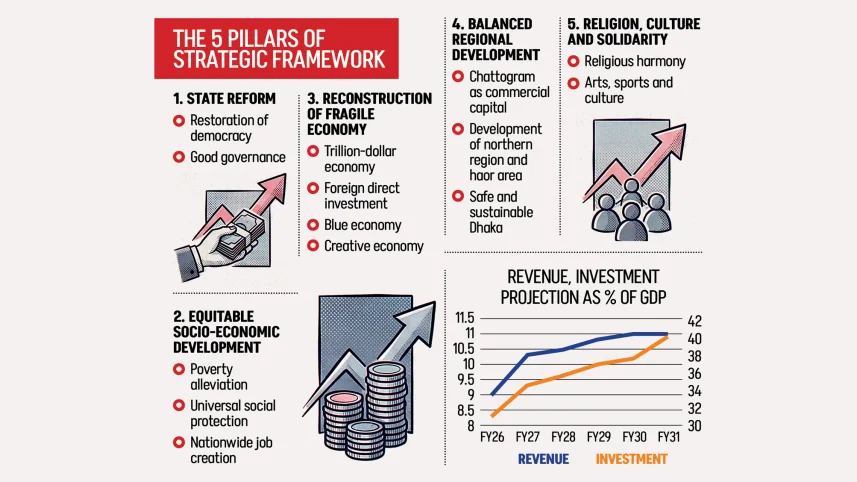
The plan rests on seven pillars: economic decentralisation, deregulation and improving business climate, investment-led growth, balanced regional development, universal social protection, job creation and skills development, and good governance and institutional reforms.

In the first 12 months, the government will focus on stabilising the fragile economy.

This involves implementing a strict monetary policy to control inflation and employing prudent exchange rate management to rebuild the delicate foreign exchange reserves.

In this phase, the government would also be reducing unnecessary government expenditure while simultaneously strengthening social safety nets to protect the vulnerable from the shocks of inflation.

It would be managing the import pressures by prioritising essential commodities and facilitating easier remittance inflows.

The government would also be taking immediate steps to resolve the liquidity crisis in the banking sector and provide emergency support to the agriculture and small and medium enterprise (SME) sectors.

In the second phase, which will conclude at year three of the five-year plan, the focus would be on rebuilding systems and institutions.

Jumpstarting investment would be the main focus in this phase. Steps would be taken to remove regulatory barriers and open up financing opportunities to restore private sector confidence.

Deep reforms would be taken in the banking sector, the issue of defaulted loans would be addressed, and systemic risks would be reduced.

Trade logistics would be developed, sector-based diversification would be pursued, and youth employment programmes would be prioritised.

In this phase, strict alignment of the national budget would be ensured with strategic planning, and domestic revenue collection would be increased.

In the final phase, which will be in the last two years of the five-year plan, growth acceleration will be prioritised.

Both public and private investment would be increased in the manufacturing and high-value-added sectors, and the export base would be widened by engaging with complex global value chains.

To lower the cost of doing business, climate-resilient energy, transport, and digital infrastructure would be designed.

The government will also ensure that the benefits of economic growth play a direct role in reducing inequality through universal social protection.

In the acceleration phase, growth will be primarily driven by private investment, which includes foreign direct investment (FDI) rising to 2.5 percent of GDP.

The government has set an ambitious but realistic revenue mobilisation plan.

It has targeted increasing total revenue by 3 percent of GDP led by digitisation and full integration across all economic sectors and developing a stronger tax culture within the country.

The macroeconomic framework projects that total revenue as a percentage of GDP will rise from 8 percent in fiscal 2024-25 to 11 percent by fiscal 2029-30.

There are specific plans for the agriculture sector and the youth.

The government plans to transform the agriculture sector from traditional methods to a high-tech, market-driven ecosystem.

The strategy envisions a central hub for agriculture that integrates digital innovation and agritech, smart farming, value-added processing, global value chain integration, and sustainable resource management. The government would also ensure the long-term viability of land and water.

One-stop service centres would be set up to provide all necessary agricultural support services to farmers, while steps would be taken to ensure efficient water and resource management.

Steps would be taken to establish direct connections between the agricultural sector and industrial manufacturing.

Bangladesh will be entering the critical phase of its demographic dividend, and special emphasis will be given to making the most of it.

Themain barrier to unleashing the demographic dividend has been the mismatch between educational outcomes and the actual demands of the labour market, coupled with a persistent digital divide between urban and rural areas.

A National Foundational Learning Mission would be launched that would mandate daily periods for reading and numeracy. Targeted remedial classes would be arranged that would group students by their actual competency level rather than just their age.

A national teacher competency framework would be put in place, shifting away from rote-learning methods toward continuous professional development and digital pedagogical training.

The government would bedigitising teacher attendance and the management of school grants, deploying school performance dashboards for better oversight, and gradually increasing the national education budget toward a target of 4–5 percent of GDP.

The Technical and Vocational Education and Training (TVET) would be modernised to ensure it accounts for a 25 percent share of education by 2030.

Mandatory internships and career counselling centres would be introduced, while industry advisory boards would ensure educational outcomes match market demands.

Youth and women would get special attention, and there would be equitable healthcare services to enhance the productivity of the national workforce.

The government also has a three-pronged approach to boosting the creative sector’s economic contribution.

About 200,000 youth (Gen Z/Alpha) would be upskilled in digital and creative arts, and the Bangladesh Creative Development Authority would be established with 64 district creative hubs.

A “Creative in Bangladesh” brand would be launched, and 100 Bangladeshi films/shows would be made for global streaming platforms like Netflix, Amazon, and Disney+.

As many as 46 vulnerable heritage sites would be climate-proofed, while 40 heritage tourism sites would be renovated. The government would also introduce the “Heritage Award”.

The stepswould ensure that the creative sector’s contribution to GDP would increase from the existing 0.17 percent to 1.5 percent by 2035.​
 

FICCI seeks business-friendly policy environment to boost investment

FE ONLINE REPORT

Published :
May 19, 2026 20:36
Updated :
May 19, 2026 20:36

1779233551748.webp


Foreign Investors’ Chamber of Commerce and Industry (FICCI) called for a predictable and business-friendly policy environment to enable investors to better anticipate tax structures and make informed investment decisions.

It also highlighted the need for a long-term budgetary roadmap.

The Chamber also stressed the importance of competitive tax policies, policy consistency, and transparency to strengthen investor confidence and enhance Bangladesh’s competitiveness among peer economies.

The demands were made on Tuesday when a delegation from the FICCI, led by its President Rupali Haque Chowdhury, met with Finance Minister Amir Khosru Mahmud Chowdhury.

They discussed the upcoming National Budget for FY2026–27 and Bangladesh’s broader economic priorities under the new government.

The delegation included Senior Vice President Deepal Abeywickrema, Vice President Mohammad Iqbal Chowdhury, and other members of the FICCI Board of Directors.

During the meeting, the two sides exchanged views on the country’s investment climate, current economic challenges, and measures needed to attract greater foreign direct investment (FDI).

The discussion served as a constructive platform for sharing private sector perspectives and exploring opportunities for closer collaboration between the government and the business community in support of sustainable economic growth.

FICCI Board members reaffirmed the Chamber’s commitment to working closely with the government to attract quality investment and contribute to Bangladesh’s long-term development goals.​
 

Reframing economic governance: from tax collection to wealth creation

Md Fazlur Rahman

Published :
May 19, 2026 23:56
Updated :
May 19, 2026 23:56

1779234468533.webp


Economic growth cannot be sustained merely through increasing taxes, tightening regulations, or expanding compliance requirements. True and sustainable national prosperity is created when entrepreneurs, businesses, industries, and productive sectors are enabled to grow, innovate, employ people, generate exports, and create taxable wealth.

In many developing economies, including Bangladesh, there is an increasing perception among entrepreneurs that businesses are being treated primarily as sources of revenue extraction rather than as strategic engines of national development.

Regulators, tax authorities, banks, auditors, and professional institutions often focus heavily on tax collection, penalties, documentation, compliance enforcement, regulatory reporting, audit formalities, and interest income generation. However, this insight does not aim to oppose taxation, regulation, auditing, or financial oversight. Rather, it seeks to reposition these functions into a growth-supportive framework where all stakeholders contribute towards national wealth creation before wealth extraction.

It should be kept in mind that an economy grows through the expansion of productive activities. Governments alone do not independently generate taxable income. Tax revenue ultimately originates from business activity, industrial production, trade, services, employment, investment, and entrepreneurship. Therefore, the principal objective of economic policy should be "how to create more taxpayers through growth," rather than merely "how to collect more tax from existing taxpayers."

In reality, when business is burdened by excessive financing costs, regulatory complexities, multiple compliance layers, unpredictable policies, harassment, weak infrastructure, delayed approvals, aggressive tax enforcement, economic expansion slows down. As a result, employment falls, consumption weakens, investment declines, bank defaults increase and eventually government revenue shrinks.

In this context, only effective economic governance can facilitate a transition from a 'collection-centric model' to a 'growth-centric model.

To strengthen our economic sector, foremost priority should be given to our entrepreneurs. Entrepreneurs are the wheel of economic development, as they take risk, invest capital, create employment, generate exports, build industries, pay taxes, support the banking systems, and drive innovation.

Yet, in practice, many entrepreneurs feel that institutions such as tax authorities, banks, utility providers, regulators, auditors, compliance agencies, and licensing authorities are primarily focused on extracting money from them. A nation cannot achieve sustainable prosperity if entrepreneurs are viewed merely as tax-paying entities rather than strategic national assets.

Right after the entrepreneurs, we need to shed light on the role of regulators. Their role is indispensable in ensuring financial stability, market discipline, consumer protection, transparency, and fair competition. However, regulation should support economic expansion, not unintentionally suppress it.

In many cases, however, regulators tend to emphasise control, punishment, excessive compliance, restrictions, and short-term revenue collection, while paying comparatively less attention to business facilitation, economic expansion, investment confidence, industrial growth, and employment generation.

In today's world, the role and philosophy of a modern regulator should evolve into that of a progressive facilitator, risk manager, economic enabler, stability provider, and growth partner. The ultimate objective should be to enhance the nation's productive capacity.

Then comes the banking sector. Undoubtedly, banks play a critical role in economic growth by channeling savings into productive investment. However lending rates often remain excessively high, risk pricing becomes unrealistic, collateral requirements are impractical, SMEs lack adequate access to finance, and restructuring support remains limited.

As a result, productive businesses suffer significantly. In many cases, banks continue to generate profits through high spreads, senior management receives substantial compensation, while entrepreneurs bear the full operational and market risk.

Consequently, the business sector weakens, leading to higher NPLs, lower investment, reduce employment, and ultimately, instability within the banking sector itself. Based on this context, it is high time to reform the banking sector by strengthening support for SME financing, long-term industrial funding, startup ecosystems, export-oriented sectors, technology investment, and agricultural modernisation.

In reframing economic governance, the roles of accountants and auditors are also inevitable. Through transparency, accountability, governance, financial discipline, and investor confidence, they can play a pivotal role in restoring good governance in the economic sector.

Nevertheless, the question still remains: are accounting and audit systems sufficiently contributing to economic growth and business sustainability?

Several challenges still persist in this field, as many businesses perceive accounting and auditing as compliance-heavy, tax-focused, documentation-oriented, and backward-looking rather than strategic. Furthermore, some audited accounts prove to be materially inaccurate, early warning systems often fail, audit quality varies, and business advisory roles remain underdeveloped.

To overcome these challenges, a modern accounting system must evolve beyond traditional bookkeeping and tax compliance roles. Accountants should become strategic financial planners, business advisors, risk analysts, productivity consultants, sustainability partners, and facilitators of corporate governance. Their effective contribution can support business survival, financial restructuring, efficiency improvement, investment planning, and national productivity enhancement.

The same principle also applies to auditing, as auditing should not become merely a procedural exercise. The true value of auditing lies in enhancing trust, improving governance, detecting risk early, strengthening sustainability and protecting stakeholders. However, if auditors fail to identify major risks, becomes excessively checklist-driven, discourage entrepreneurial flexibility, and adds cost without strategic value, then their contribution to economic growth becomes questionable.

Therefore, auditing should increasingly incorporate with sustainability assessment, business continuity evaluation, operational efficiency review, government quality measurement, and forward-looking risk analysis.

Tax policy also should be designed with careful consideration, as an effective tax system encourages investment, rewards compliance, supports business expansion, widens the tax base, promotes formalisation, and increases long-term revenue generation. In this regard, policymakers should recognise that sustainable tax revenue can only be achieved through higher economic activity.

It should also be remembered that aggressive taxation without growth may shrink business activity, encourage informality, discourage investment, and reduce competitiveness.

Therefore, the government should remain focus on ensuring a business-supportive tax policy framework. In this context, the government may consider measures such as lower taxes on productive reinvestment, startup tax incentives, export-oriented incentives, SME-friendly tax frameworks, simplified compliance systems, stable long-term tax policies, reduced harassment and discretionary enforcement, and technology-based transparent assessment mechanisms to ensure a smoother and more efficient tax environment. Moreover, the primary objective should be to grow the economy first, as sustainable tax revenue naturally follows economic expansion.

Besides, economic development requires strong collaboration among the government, regulators, banks, accountants, auditors, investors, entrepreneurs, and workers, because no single group can create prosperity alone. A country progresses when regulators facilitate, banks finance responsibly, accountants provide strategic guidance, auditors strengthen governance, entrepreneurs invest confidently, and governments ensure policy stability. To achieve these, all stakeholders must align towards one national objective: sustainable wealth creation.

What the economy requires today is a strategic and coordinated reform agenda that redefines the role of regulation, banking, taxation, auditing, and entrepreneurship in national development.

Regulatory systems must move away from an enforcement-centric mindset towards a facilitation centric approach. Excessive compliance requirements, bureaucratic rigidity, and unpredictable regulatory interventions often discourage investment and suppress productive economic activity. Introducing business impact assessments before major regulations and reducing unnecessary compliance burdens can create a more supportive and investment-friendly environment.

Likewise, banking sector reforms should focus on enabling productive financing rather than merely protecting short-term institutional interests. Lowering the cost of capital, expanding SME and startup access to credit, and encouraging long-term financing are essential to accelerating sustainable economic growth.

The accounting and auditing professions must also evolve beyond conventional compliance functions. Accountants should increasingly serve as strategic advisors to business, while auditors should strengthen governance through higher audit quality, greater independence, and forward-looking risk evaluation. Value-added audit practice can play a significant role in enhancing transparency, sustainability, and investor confidence.

Tax policy, too requires a fundamental shift in philosophy. Policies that incentivise reinvestment, industrial growth can ultimately broaden the tax base, simplify compliance systems and promote broader tax participation through economic expansion.

At the same time, a vibrant entrepreneurial ecosystem must be treated as a national economic priority. Reducing barriers to entry, supporting innovation and startups, and ensuring policy predictability can ensure the reformation entrepreneurial ecosystem.

Basically, no nation can tax itself into prosperity. National wealth must first be created before it can be distributed or taxed.

Entrepreneurs, productive businesses, and industries are not merely revenue sources-they are the engines of national growth. However, regulators must facilitate, banks must support productive investment, accountants must become strategic advisors, auditors must enhance sustainability, governments must prioritise growth-oriented policies.

A strong economy is built not through excessive extraction, but through enabling productive capacity, innovation, investment, and confidence.

The ultimate objective of all economic governance should be: creating more sustainable businesses, more employment, more productivity, and ultimately more national prosperity."​
 

Finance minister's plain disclosure on finances
Many cos facing acute capital crunch
Lack of fair competition, governance gaps to blame

FE Report

Published :
May 20, 2026 23:45
Updated :
May 20, 2026 23:45

1779329341040.webp


A candid admission comes from the finance minister that many well-established companies are facing acute capital shortages, in a crunch he attributes to lack of "fair competition" and governance gaps.

"Many big companies and banks are in serious capital shortage," Finance and Planning Minister Amir Khosru Mahmud Chowdhury said Wednesday while speaking as chief guest at the inaugural session of the first-ever Financial Accounting and Reporting (FAR) Summit held at a city hotel.

The summit was jointly organised by the Financial Reporting Council (FRC), the Institute of Chartered Accountants of Bangladesh (ICAB) and the Institute of Cost and Management Accountants of Bangladesh (ICMAB).

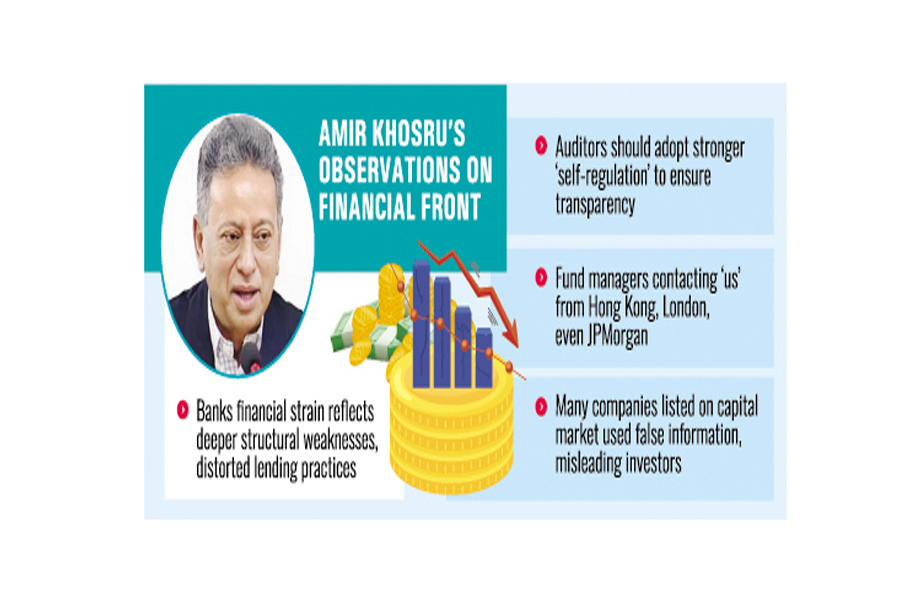
Turning to the predicament of banking sector, the finance minister said the current financial strain reflected deeper structural weaknesses, including distorted lending practices within banks.

"Depositors keep money in banks, and loan approvals were often influenced by board-level decisions," he points out, adding that auditors should adopt stronger "self-regulation" to ensure transparency.

He stresses full transparency and accountability for restoring investor confidence and achieving long-term economic stability in the country.

"Bangladesh is now at a crossroads and all depend on the institutions," the finance minister implicitly reminds about the transition following political upheavals.

Mr. Chowdhury notes that the Financial Reporting Council would continue to exist but should focus on supervision and monitoring rather than direct enforcement alone.

"Every day, fund managers are contacting us-from Hong Kong, London, even JPMorgan. But if foreign investors see that our accounting is not up to international standards, they will be discouraged," he told the meet.

The minister also recalls delegating authority for issuing export-utilisation certificates to Bangladesh Garment Manufacturers and Exporters Association (BGMEA) during his tenure as commerce minister in a previous BNP government, and says the move had improved governance after earlier allegations of corruption at the Export Promotion Bureau.

He strongly feels that Bangladesh needs a financial system built on institutional integrity.

"The current government wants a system of complete transparency and accountability."

The new custodian of exchequer alerts that Bangladesh's economic future depends on institutions such as FRC, ICAB and ICMAB. "No regulator can identify every mistake daily. Accountants and professional bodies must take the lead in self-regulation."

Mentioning that institutions have weakened over time due to past "governance failures", the minister alleges that financial irregularities and bank fund diversions were often linked to misleading accounts.

"Many companies listed on the capital market used false information. Investors were misled," he deplores.

Prime Minister's Finance and Planning Adviser Prof Rashed Al Mahmud Titumir, speaking as special guest, said weak auditing practices had contributed to financial-sector instability.

"In many cases, audit firms have become their own judges," he said through online platform, adding that regulatory gaps had deepened banking-sector vulnerabilities.

He says investors had suffered significant losses due to misleading financial statements, while banks had extended large loans based on inaccurate reports that later turned into defaults.

BGMEA President Mahmud Hasan Khan told the meet that out of 7,200 registered member-organisations only around 2,500 were now active, largely due to poor accounting practices.

"Inflated accounts can destroy organisations," he notes, adding that discrepancies between assets and liabilities were a common concern in the sector.

He also warns that lack of transparent accounting discouraged foreign buyers and reduced competitiveness in export markets. Chairman of FRC Md Sajjad Hossain Bhuiyan presented the keynote paper, titled 'Reliable Financial Reporting: Where Does It Really Matter?'

Finance Secretary Dr Khairuzzaman Mozumder chaired the inaugural session. ICAB acting president Rokunuzzaman and ICMAB president Kauser Alam also spoke at the event.

The summit featured two technical sessions attended by CFOs, auditors and policymakers from leading institutions.​
 

Revenue falls Tk 1.04 lakh crore short of target
Staff Correspondent 21 May, 2026, 00:02

1779334312614.webp

New Age file photo

The country’s revenue collection faced a shortfall of Tk 1,04,533 crore in July–April of the current 2025–26 financial year, according to National Board of Revenue data.

For the 10 months of FY26, the revised target was set at Tk 4,31,461 crore, while the revenue board collected Tk 3,26,928 crore.

The huge amount of shortfall comes at a time when, according to officials, the government may set a revenue collection target of over Tk 6 lakh crore for the NBR in the forthcoming budget, which could be at least 20 per cent higher than the target set for FY26.

In FY25, the revenue board had faced a record collection shortfall of Tk 92,625 crore. However, the shortfall in the current financial year already surpassed the previous year’s one in just nine months, and went deeper in the tenth month, indicating that the NBR would face another record shortfall at the year-end.

Meanwhile, the revenue collection witnessed a year-on-year growth of 10.6 per cent in the July-April period of FY26 to Tk 3,26,928 crore, higher from Tk 2,95,601 crore collected in the same period of FY25.

In the single month of April 2026, revenue collection also grew by 6.51 per cent to Tk 39,060 crore, up from Tk 36,604 crore collected in April 2025.

However, the collection in April fell short of its target of Tk 45,609 crore by more than Tk 6,000 crore, according to NBR data.

During the July-April period of FY26, customs collections stood at Tk 90,763 crore, 8.87 per cent higher than the Tk 83,371 crore collected in the first 10 months of FY25. However, the section missed the target of Tk 1,15,955 crore.

Revenue collection from the value-added tax section was Tk 1,26,543 crore in the 10 months of FY26, which was 11.01 per cent higher than the Tk 1,13,997 crore collected in the same period of the previous financial year, though the section also missed its target of Tk 1,61,851 crore.

Fetching a growth of 11.59 per cent, revenue collection from the income tax sector stood at Tk 1,09,622 crore in the July-April period of FY26, up from Tk 98,233 crore in the corresponding period of FY25, the NBR data showed.

However, revenue collection from income tax also fell short of the target of Tk 1,53,655 crore.

Revenue collected from indirect sources was higher than that from direct sources in July-April of FY26, according to the NBR data.

For FY26, the government set a revenue collection target of Tk 4,99,000 crore through the NBR, which was about 8 per cent of the gross domestic product.

The NBR’s average revenue collection was over Tk 32,600 crore in the 10 months of the current financial year. The revenue board has been missing collection targets over the years.

A major challenge in achieving revenue targets is restoring the normal pace of business activities, which have been sluggish for some time due to global and national political issues, compounded by the recent Middle East crisis, economists said.

The World Bank and the International Monetary Fund have remained concerned about the lower revenue collection.

Recently, the Fitch Ratings revised Bangladesh’s credit outlook to ‘Negative’ from ‘Stable’, warning that rising external vulnerabilities, weak reforms, persistent banking sector fragility and governance weaknesses were eroding the country’s ability to absorb economic shocks.

The agency also identified Bangladesh’s weak revenue collection as another major vulnerability.

Bangladesh has been struggling to finance project developments amid a persistently low tax-to-GDP ratio, one of the lowest globally.

Economists and business leaders have long argued that achieving such ambitious revenue targets would be difficult with the existing tax administration, underscoring the need for comprehensive reforms.

The interim government had introduced an ordinance to reform the revenue sector. However, the Bangladesh Nationalist Party-led government did not present it to parliament as a bill, resulting in its lapse.

NBR chairman Abdur Rahman Khan recently said that the tax-to-GDP ratio remained below 7 per cent, limiting fiscal space for health, education and social protection.

He said that online return filing and several digitalisation measures had already been introduced, and that they would enable AI-based analysis of income patterns and improve policy and enforcement.

In FY25, the country collected Tk 3,70,874 crore in revenues, down about 3.08 per cent from the Tk 3,82,678 crore collected in FY24. In FY25, the revised revenue collection target was Tk 4,63,500 crore.​
 

Growth of private sector credit a must

Published :
May 21, 2026 23:55
Updated :
May 21, 2026 23:55

The persistent decline in private-sector credit growth has emerged as one of the most pressing economic challenges confronting the government. According to the latest data available up to March, formal credit growth to the private sector fell to a historic low of 4.72 per cent, signalling a worrying slowdown in economic activity and investment momentum. Such an unprecedented contraction in investment lending reflects both the growing caution among banks amid mounting non-performing loans (NPLs) and the waning appetite of private borrowers facing an increasingly difficult business environment. Factors such as the ongoing energy crisis, high lending rates, exchange-rate volatility and a taxation regime widely viewed as unfriendly to investment have collectively undermined business confidence. Data from the Bangladesh Bank (BB), available since 2003, indicate that private-sector credit growth has never declined to such a level, even during earlier episodes of financial turbulence. The central bank reports that credit growth dropped to 4.72 per cent by the end of March, following another record low in February 2026. In reality, private-sector credit expansion has remained in single digit since August 2024, underscoring prolonged sluggishness in the largely private-sector-driven $460 billion economy.

As demand for private-sector loans continues to weaken, commercial banks have increasingly shifted their focus towards government securities, including treasury bills and bonds, which offer relatively secure returns amid prevailing economic uncertainty. For many banks, investment in government instruments has become a safer and more profitable alternative to expanding risky loan portfolios. Several stronger banks have reportedly posted improved earnings primarily through returns on government securities rather than through traditional lending activities.

Business leaders and economic analysts warn that the economy may be drifting towards stagflation - a situation characterised by slowing growth, stagnant job creation and persistently high inflation. They argue that weak appetite for new industrial investment, compounded by economic uncertainty and acute liquidity shortages in the banking sector, has significantly curtailed lending capacity. The sustained decline in credit flow to productive sectors threatens to reduce imports of capital machinery, constrain manufacturing output, and ultimately hinder the country's broader economic recovery during the current fiscal year. Concerns have also been raised regarding the lack of clear policy direction from the central bank in addressing prevailing economic challenges. Bankers point out that lending decisions are heavily influenced by policy predictability, particularly with regard to interest rates, exchange-rate management, and inflation trends. Before approving financing for new business ventures, banks must assess the broader macroeconomic environment, borrowing costs, and the likely movement of the US dollar. Under current conditions, lending has become increasingly risky and uncertain.

What appears crucial at this juncture is a coherent and confidence-building policy response from both the government and the central bank. Restoring investor confidence will require measures to improve the overall investment climate, ensure policy consistency and reduce operational bottlenecks facing businesses. Without timely and effective interventions, the continued stagnation in private-sector credit may further weaken economic recovery prospects and deepen existing vulnerabilities of the economy.​
 

Use budget tools to revive economic growth, stability

Economists suggest govt as find economy under 'significant strain'

FE Report

Published :
May 21, 2026 23:53
Updated :
May 21, 2026 23:53

Utilise the upcoming budget as a strategic instrument for reviving economic growth and restoring macroeconomic stability, economists urge the government as they find Bangladesh's economy under "significant strain".

Speaking Thursday, they said the country's macroeconomic situation continued to be fragile -- inflation remaining persistently high, private-sector-credit growth falling to a record low, and concerns mounting over a potential fiscal shortfall.

The observations were made at an event by the Policy Research Institute of Bangladesh (PRI) to launch Monthly Macroeconomic Insights, prepared by PRI's Centre for Macroeconomic Analysis (CMEA).

Dr Fahmida Khatun, Executive Director, the Centre for Policy Dialogue (CPD), attended as chief guest the event held at the PRI office with PRI Chairman Dr Zaidi Sattar in the chair.

Dr Nasiruddin Ahmed, Former Chairman of the National Board of Revenue (NBR), and Shams Mahmud, former President of Dhaka Chamber of Commerce and Industry (DCCI), shared their views on the keynote paper presented by PRI Principal Economist Dr Ashikur Rahman.

"The economy now stands at a crossroads. Growth has slowed significantly, investment momentum has weakened, inflation remains elevated, and vulnerabilities in the fiscal, financial and energy sectors continue to constrain policy space," said Zaidi Sattar in his opening remarks.

He opines that macroeconomic stabilisation alone would not be enough to restore high and sustainable economic growth, arguing that Bangladesh now needs a new phase of productivity-enhancing reforms.

To address the challenges, he proposes a series of structural reforms, including rationalising the country's "gargantuan" tariff regime, enhancing trade openness, improving the investment climate, reforming the energy sector, restructuring state-owned enterprises, promoting foreign direct investment (FDI), and increasing investment in critical infrastructure.

Dr Fahmida Khatun stresses the need for effective reforms to prevent the re-emergence of "mafia-style" dominance in key sectors such as banking, power, energy and infrastructure.

She says implementing such reforms would pose a major challenge for the government as reform processes are inherently painful and often face resistance from vested-interest groups benefiting from the existing system.

"Although they are small in number, they are highly influential. They control the state and, in many cases, are more powerful than the state itself," she told the audience in an implicit reference to oligarchs.

Referring to the budget worth Tk 9.3 trillion under consideration for the next fiscal year, she calls for a realistic and implementable fiscal framework, emphasising that budget formulation should prioritise execution capacity and efficiency rather than an expansion in size alone.

She cautions that the government must carefully assess the limited fiscal space, the inflationary and private-sector crowding-out effects of bank borrowing, and the future repayment burden associated with rising external debts.

Fahmida Khatun also recommends that the government expand development expenditure in line with the rising trend of revenue expenditure, ensuring a more balanced and sustainable fiscal structure.

Dr Ashikur Rahman says a disciplined budget anchored in macroeconomic stability, combined with sustained productivity-enhancing reforms, remains most credible pathway for restoring Bangladesh's growth momentum in the current environment.

"The next budget should prioritise policy credibility through stronger revenue mobilisation, realistic expenditure management, rationalisation of inefficient subsidies, and reduced reliance on bank financing," he says.

He also notes that medium-term growth recovery will depend increasingly on productivity-enhancing structural reforms rather than stimulus-led demand expansion. This requires a decisive policy shift toward improving economic efficiency, competitiveness, and resource allocation across the economy.

Dr Nasiruddin Ahmed stresses separating tax-policy formulation from tax administration, saying that combining the two functions within the same institution creates a "clear conflict of interest".

He also calls for the introduction of a simplified tax regime for small service providers, including bike riders, while also urging an end to harassment faced by ordinary taxpayers.

Shams Mahmud deplores that a small group of "influential oligarchs" had effectively controlled the banking sector, extracting low-cost loans and engaging in capital flight, for over a decade.

As a result, he notes, ordinary businesses are now struggling under the pressure of high interest rates and tight liquidity conditions in the financial system.

He further calls for long-term and affordable financing solutions to help the private sector navigate the challenges of LDC graduation and sustain competitiveness.​
 

Bangladesh must not repeat the mistakes of the past on revenue policy

FE RERORT

Published :
May 21, 2026 20:02
Updated :
May 21, 2026 20:02

1779419317192.webp

Pascale Meulemeester, Regional Director, Asia Pacific, Middle East & Africa, BAT

In conversation with Pascale Meulemeester, Regional Director, Asia Pacific, Middle East & Africa, BAT

Q1: Ms. Meulemeester, welcome to Bangladesh. Is this visit part of your regular market engagement, or are there specific business and policy priorities shaping your visit at this time? How does BAT view Bangladesh in terms of its strategic importance within the wider global portfolio?

Pascale Meulemeester: Bangladesh is one of BAT’s key markets globally because of its scale, long-term potential, and demographics. We are proud of our leadership position and remain focused on being a responsible, constructive partner in the country’s development journey.

As BAT approaches its 125th anniversary in 2027, our presence in Bangladesh for more than 116 years reflects the market’s importance to us. It speaks of our long-term commitment to the country, our enduring partnership with the government, and our continued contribution to the economy and the livelihoods of almost 5 million people across our value chain.

My visit also comes at an important time, as discussions around the National Budget gather momentum. We believe the current ad valorem, multi-tiered, excise framework for cigarettes is broken. It requires thoughtful reform to make the tax structure more sustainable, predictable, and better aligned with the country’s long-term revenue objectives.

Q2: Bangladesh is seeking to position itself as an attractive destination for foreign direct investment. How would you assess the current policy and regulatory environment for multinational investors?

Pascale: The new government has rightly placed a strong emphasis on attracting foreign direct investment, and that ambition is both timely and encouraging. As one of the longest-standing foreign investors in Bangladesh, we believe there are a few conditions that enable long-term investment to grow and deliver value. Chief among these are a stable business environment, consistent policy direction, and a clear long-term fiscal roadmap — all of which are essential to strengthening investor confidence and supporting sustainable economic growth.

But equally important is how policy is shaped in the first place. Achieving the right environment requires genuine inclusivity – transparent stakeholder dialogue between policymakers and the industry, where both sides work as partners. When that relationship functions well, policy decisions are better informed, more balanced, and ultimately more effective in delivering the outcomes the government is seeking.

Q3: You have spoken about the need to transition toward a specific tax structure. Drawing on your global experience, why do you believe that approach would be more effective for Bangladesh?

Pascale: Globally, there are only 17 countries with a tiered system, and only three of those have a multi-tiered ad valorem structure. The current system is not just unusual; it has not delivered real-term tax revenue growth for the past six or seven years. The price gap between the highest- and lowest-priced cigarettes is the widest we have seen. When nine out of ten consumers migrate to the bottom of the market, that fundamentally erodes tax revenues for the government, as well as threatening the sustainability of the legal industry.

As I have said, fundamental reform is needed. In practical terms, that means we must Rethink, Reset & Reform the current system. The solution involves several ingredients including moving to a specific excise system, reducing price gaps gradually and eliminating tiers over a period of time in a way all stakeholders can manage. There should be no further increases in ad valorem excise — what remains today for manufacturers to cover costs in Bangladesh is lower than anywhere else in the world.

The suggested reforms are in line with best practices from around the world, where an increasing number of countries are adopting specific excise duties. It is what Bangladesh needs for sustainable revenue growth, what the legal industry needs for viability, and uniquely, what tobacco control groups also believe is the best approach.

Q4: Critics often argue that frequent tax hikes can unintentionally fuel illicit trade and broader market distortions. In your view, how can policymakers strike the right balance between public revenue objectives, regulatory priorities, and maintaining a stable legal market?

Pascale: Illicit trade is a complex issue, and fiscal policy is one of several factors that can influence it. When the tax component of the legal retail price rises too sharply, it can create stronger incentives for unlawful activity and deepen market distortions through noncompliance.

International experience suggests price adjustments are most effective when they are moderate, gradual, and predictable. Sudden shocks, like the one in Bangladesh back in January 2025, will disrupt consumer behaviour, erode the legal industry, and put pressure on revenue ambitions.

Effective and uniform enforcement also remains essential. Stronger production monitoring, better reconciliation between output and taxes paid, and consistent oversight from NBR across all manufacturers will help protect the integrity of the legal industry.

Q5: With the upcoming National Budget, there is considerable discussion around revenue mobilisation and the possibility of further increases in cigarette prices. How do you see such measures affecting the industry, consumers, and the government’s broader revenue objectives?

Pascale: In our discussions with the Ministry of Finance and the NBR, we have consistently underscored the importance of stability. With its first budget, we ask that the new government embark on a more balanced fiscal approach - one that moves steadily beyond the limitations of the current model. We believe this budget can mark the beginning of a more considered reform journey that supports long-term revenue growth and industry sustainability.

Q6: Across your region, you have seen a wide range of taxation models. In Bangladesh’s case, what are the risks of relying so heavily on tobacco tax revenues, and what broader measures should the government consider to improve the overall tax-to-GDP ratio in a more sustainable way?

Pascale: If we look at it from a practical economic perspective, Bangladesh depends on tobacco tax revenues far more than most nations do. While tobacco-related taxes contribute close to 10% of total government tax revenue, the global average is much lower, typically around 1% to 2%.

The new administration faces a pivotal choice: it may either persist in replicating the errors of its predecessor, or acknowledge that it is unreasonable to expect different outcomes from the same actions repeatedly. It is essential to recognise that continuously relying on exhausted strategies will not yield new or improved results.

If we look at international best practices, successful countries do not improve their tax-to-GDP ratio by repeatedly targeting the same industries. They do it by increasing compliance, widening the tax base, and creating a fairer, more transparent, and more balanced taxation system.

If Bangladesh moves forward with reform gradually, moderately and transparently, it can create a more stable and effective excise framework - one that supports stronger revenues, encourages foreign investment, protects the legal economy and aligns with the country’s long-term ambitions. The opportunity is real, but so is the risk of inaction. What is required now is a clear commitment to modernisation and the discipline to avoid repeating the mistakes of the past.​
 

Latest Posts

Back