[🇧🇩] Monitoring Bangladesh's Economy

[🇧🇩] Monitoring Bangladesh's Economy
1K
44K
More threads by Saif

G Bangladesh Defense

Large-scale manufacturing sector rebounds with 14.5pc growth in June
Pickup, however, was not broad-based

1788650110576.webp


The large-scale manufacturing rebounded sharply with a 14.5-percent expansion in June, the final month of the fiscal year 2026, according to official statistics.

It provides a stronger-than-expected end to a volatile 2025-26 fiscal year marked by repeated contractions amid economic uncertainty.

The June spike in the Index of Industrial Production (IIP) of large-scale manufacturing suggests that the country's industrial sector may be regaining momentum after a prolonged period of weakness.

Large-scale manufacturing accounts for more than 11 per cent of gross domestic product or GDP of the country, making its performance an important indicator of broader economic activity.

The rebound, however, was not broad-based.

Much of the June growth came from the clothing industry, which carries a dominant 61-percent weight in the manufacturing index.

The textile sector, the second-largest component with an 11 -percent weight, remained almost stagnant during the month.

The concentration of growth in garments raises questions about the strength of the wider industrial recovery.

While the performance of the clothing industry provided a substantial liftoff to the overall index, several other manufacturing segments continued to struggle, suggesting that the recovery remains uneven.

"The manufacturing sector had a difficult fiscal year," says Dr. Zahid Hussain, an independent economist.

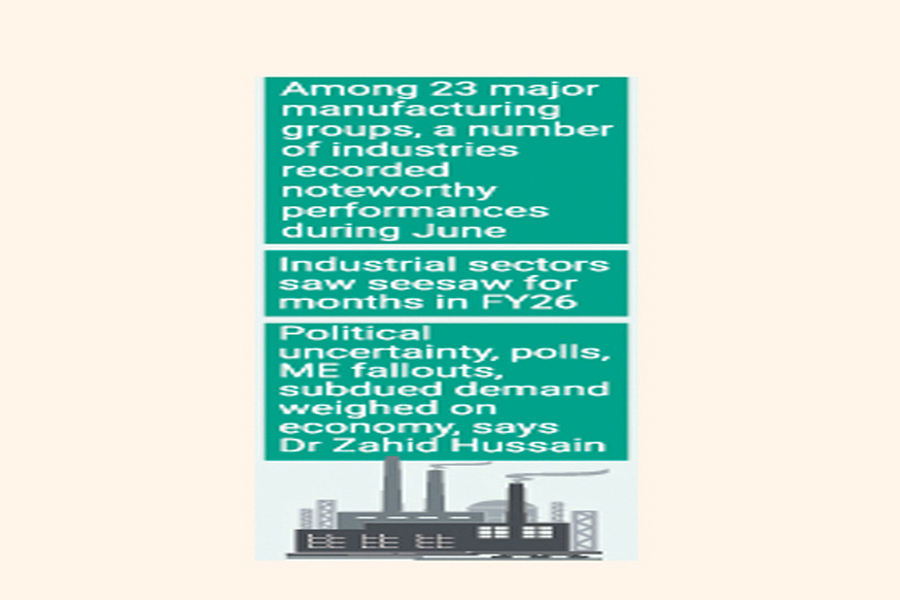
He goes on to say that industrial activity contracted in several months amid political uncertainty, the national elections and the fallout from geopolitical tensions, including the crisis in the Middle East centred on Iran.

Some industries are benefiting from stronger demand and export opportunities, while others continue to face subdued consumption, high production costs, financing constraints or weak investment.

The sharp rise in June, therefore, needs to be viewed in the context of the sector's performance over the entire fiscal year rather than as evidence of a fully established recovery.

The sector recorded negative growth in October, November, December, February, March and May. January and another month recorded virtually flat performance.

As a result, the strong June expansion came after months in which manufacturers faced weak demand, uncertainty over investment and disruptions to business activity.

Against this backdrop, the June increase of 14.5 per cent is significant.

It marks a sharp turnaround from the contractionary trend seen during much of the fiscal year and could indicate that manufacturers are responding to improving business conditions and stronger external demand, particularly for export-oriented products.

Among the 23 major manufacturing groups, a number of industries recorded noteworthy performances during June. The goodies include food products, leather, chemicals, pharmaceuticals, rubber and plastics, basic metals, electrical equipment, machinery, motor vehicles, other transport equipment, furniture and other manufacturing.

The performance of these industries points to some degree of breadth in the June recovery, although the dominant contribution from garments means the overall picture remains heavily influenced by one sector.

Several industries, meanwhile, continued to perform poorly. Among the baddies named are beverages, tobacco, wood products, paper and paper products, fabricated metal products, computers and electronics, and printing.​
 

Remittance inflow rises 15.9pc to $6.85b in FY27 through Sept 9: BB


1789107395466.webp


Bangladesh received $6.85 billion in remittances from July 1 to September 9 of fiscal year 2026-27, up 15.9 percent year-on-year, according to Bangladesh Bank data released Thursday.

The country received $5.918 billion during the same period of FY26.

Bangladeshi expatriates living in different countries sent home $1.031 billion in remittances in the first nine days of September 2026, up 1.3 percent from $1.018 billion during the corresponding period a year earlier, the central bank data showed.

On September 9 alone, the country received $127 million in remittances.

Bangladesh received $35.34 billion in remittances through formal banking channels in FY26.​
 

Inflation further edges down to 8.26pc in Aug


1789107661682.webp


Overall inflation has somewhat eased for a second consecutive month as official count put the rate at 8.26 per cent for August on account of little lower food cost.

Yet, according to official data, villagers across Bangladesh go on struggling with higher price indices with a hike in the last month again.

And the rate of non-food inflation stayed steeply high, affecting all across the board, economists say.

The point-to-point inflation rate in August had fallen to 8.26 per cent, down 0.06-percentage points from 8.32 per cent in the previous month of July, Bangladesh Bureau of Statistics (BBS) data released on Monday showed.

Inflationary pressure is particularly biting the rural people as it was registered at 8.31 per cent in the past month, 0.05-percentage-point higher than the average rate, the official data showed.

According to the BBS statistics, prior to hitting this new low in August 2026, the lowest point-to-point inflation recorded was 8.29 per cent in November 2025.

In the same period (August 2025), the inflation rate was recorded at 8.29 per cent.

Meanwhile, when Bangladeshi workers are struggling with the price-spiral pressure, their wages declined in the month of August.

The BBS calculated Wage Rate Index (WRI) was lower at 8.05 per cent from 8.22 per cent in July this year.

The wages in all the three broad sectors - industrial, agricultural and services-declined last month.

While the overall national index showed positive momentum, a divergence remains between food and non-food commodities.

Food inflation dropped notably to 7.02 percent in August 2026, compared to 7.16 percent in July 2026 and 7.60 percent in August 2025.

This reduction in food costs serves as a primary driver behind the overall relief in the general consumer price index.

Conversely, non-food inflation experienced a minor uptick, rising to 9.32 percent in August from 9.28 percent the previous month.

Although the cooling of prices was visible across both rural and urban demographic brackets, the inflationary pressure in the rural areas was higher than that in the urban areas.

The rural inflation is settled at 8.31 per cent for August, showing a minimal drop from 8.36 percent in July. However, the rate is 0.05-percentage-point higher than the overall inflation rate of 8.26 per cent.

On the other hand, the urban inflation was registered slightly lower at 8.20 per cent in August, ticking down from 8.24 percent in July.

The moving average inflation rate for the twelve-month period ending in August 2026 was estimated at 8.66 percent, reflecting a significant improvement compared to the 9.58 percent recorded during the same period in the preceding year.

Central planners and economists view this trend as a sign of stabilising of market conditions, though high non-food costs continue to pose a minor structural challenge to the economy.

World Bank's former Lead Economist at Dhaka office Dr Zahid Hussain says despite a slight fall in overall inflation, the rate is still higher than the expectation.

"The overall inflation on a point-to-point basis should be cut further for a comfortable life of the people," he adds.

Dr Hussain explains that "although the food inflation has come down, the non-food inflationary pressure is still very high. It is affecting people in their daily life".

Since the exchange rate was stable and the boro-rice production was satisfactory, the food inflation might have fallen slightly, the economist notes.​
 

Falling inflation offers little relief as wage growth lags, squeezing real incomes


1789192708353.webp


On paper, the inflation situation in Bangladesh is improving, but the squeeze on households continues as wage growth has slowed further, lowering real incomes.

Updated figures from the Bangladesh Bureau of Statistics (BBS) show overall inflation fell to 8.26 per cent in August, the second month of the 2026-27 fiscal year.

But wage growth dropped to 8.05 per cent, widening the gap between what people earn and what they pay for goods and services.

August's inflation figure marks the lowest the indicator has hit in 10 months.

Wage growth, meanwhile, has hit its lowest point in seven months.

Data reveals wage growth has now trailed inflation for four and a half consecutive years.

In January 2022, wage growth stood at 5.92 per cent, briefly outpacing overall inflation of 5.86 per cent.

But from the following month, February, onward, spending began outrunning earnings and never looked back.

This prolonged mismatch has steadily eroded the “real income”, or purchasing power, of the public, particularly low-income and limited-income groups.

A point-to-point inflation rate of 8.26 per cent in August implies that a basket of essential goods and services costing Tk 100 last year now costs Tk 108.26.

By contrast, the 8.05 per cent national wage growth rate means someone who earned Tk 100 last year now earns Tk 108.05 this year.

In other words, the cost of living has climbed faster than incomes have grown. That has forced people to either trim their spending or dip into savings.

Selim Raihan, executive director of the South Asian Network on Economic Modeling (SANEM) said: “We would have welcomed a scenario where wage growth kept pace with falling inflation.

“But the current data paints a worrying picture, inflation is placing extra strain on real wages. In effect, even as nominal income rises, higher market costs are eating it away."

With inflation outpacing wage growth for a prolonged stretch, he said real incomes were shrinking “alarmingly”.

"People's spending power is shrinking. Many are dipping into savings, others have none left to dip into."

Jahangir Alam Khan, director of the Dhaka School of Economics, said: "Prices across the board remain steep. On top of that, everyone is paying more for gas and electricity.

“The bigger issue is that even after the peak Boro harvest season, prices of rice, our staple food, haven't come down."

The economist recommended strengthening market monitoring rather than relying solely on tight monetary policy to keep inflation in check.

Inflation, Wages In Flux

During the July Uprising in 2024, headline inflation spiked to 11.66 per cent before fluctuating between 9 per cent and 12 per cent amid the political transition, while wage growth remained anchored around 8 per cent.

Fiscal 2025-26 opened with single-digit inflation that oscillated between 8 per cent and 9.5 per cent, before moderating to 8.32 per cent in July and 8.26 per cent in August.

Meanwhile, the BBS wage index hovered near 8 per cent throughout the year, easing from 8.22 per cent in July to 8.05 per cent in August.

The bulk of the national workforce operates within the informal sector, where wage-based employment predominates.

Informal Sector Bears The Brunt

The bulk of the country's workforce operates in the informal sector, almost entirely on a wage basis.

According to BBS's latest labour force survey, 84 per cent of the employed population works in the informal sector.

Roughly 88 per cent of rural workers and 74 per cent of urban workers fall into this category.

This vast, socially unprotected workforce bears the brunt of rising prices more than anyone else.

The BBS compiles its wage rate index monthly, gathering data across 44 occupational categories, including farm labourers, transport workers, fishermen, day labourers and construction workers.

As per August data, wage growth was lowest in the industrial sector at 7.97 per cent. The services sector saw wages grow 8.25 per cent, while agriculture recorded 8.07 per cent growth.

The wage rate index has its limitations. BBS's index does not represent the earnings of the entire labour market, salaried employees and relatively higher-income professionals fall outside its scope.

As a result, the index largely captures the pressure between income and inflation for lower-wage workers. It offers no clear picture of how much strain the middle class is under.​
 

Is Bangladesh's economy ageing before it grows rich?


1789253671575.webp


Bangladesh's young people aspire to quality education, dignified work, and a secure future. Yet the country faces an uncomfortable question: is Bangladesh turning its youth into economic strength or drifting toward an ageing economy before that window closes?

According to the United Nations (UN) estimates, Bangladesh's population is roughly 177.8 million, with about 65 per cent of working age. Last year, young people aged 15-24 numbered 33.3 million, but UN projections show this figure has begun declining, falling to 31 million by 2050.

Again, one in ten Bangladeshis is already 60 or older, and the UN Population Fund projects this share will exceed 13 per cent by 2050. Japan and South Korea grew rich before they grew old. Bangladesh faces the opposite risk-ageing before it gets rich.

More troubling than demographics is the productivity gap. CPD's "Bangladesh State of the Economy 2025" report, citing GED data, notes labour productivity stood at just $8.7 per hour in 2025-among the lowest in South Asia-compared with $12.4 in Vietnam, $10.7 in India, $18 in Sri Lanka, and $19.8 in China. Meanwhile, 84 per cent of employment remains informal. A demographic dividend becomes real only when this population is engaged in productive work; otherwise, it becomes a burden.

The International Monetary Fund (IMF) warned last July that, without reforms, gross domestic product (GDP) growth could slow to just 3.5 per cent in FY27 and fall below 3 per cent over the medium term. The World Bank is more optimistic, projecting 4.6 per cent growth this fiscal year, while the ADB estimates growth at 3.7 per cent in FY26, rising to around 4.5 per cent in FY27.

Despite differing numbers, all three institutions agree on one message: weak revenue collection, a fragile banking sector, and policy uncertainty prevent the economy from realising its potential. Inflation remains a concern-the ADB forecasts 8.8 per cent this fiscal year, among the highest in South Asia. These warnings should be seen as a call to reform rather than alarm bells. If reform is delayed, young people will pay the highest price because a sluggish economy cannot generate new jobs.

Since 2010, Bangladeshi startups have raised $1,126 million across more than 460 deals, mostly from foreign sources-domestic investment totals just $76 million. The real risk is year-to-year volatility: $435 million came in 2021 across 94 deals; by 2024 that dropped to just $41 million. The crisis is not just a shortage of capital but the absence of a reliable domestic investment ecosystem.

The FY27 budget introduced significant incentives for entrepreneurship, doubling allocations for women's advancement and young entrepreneurs to Tk 4.0 billion, establishing a Tk 5.0 billion fund for technology and AI ventures, exempting freelancing and content-creation income from tax, reducing startup turnover tax to zero, and granting full tax exemption to SMEs with turnover up to Tk 5.0 million. Yet the gap between announcement and implementation persists. For these funds to work, disbursement must be simple, transparent, and genuinely accessible to young entrepreneurs.

Recent months have brought a steady stream of industrial closures, hitting young workers' employment hardest. Aggressive loan recovery and banks' slow pace on restructuring have deepened this crisis.

Bangladesh Bank has announced a Tk 200 billion fund to revive shuttered factories at 7 per cent interest. But entrepreneurs complain that access is conditioned on a "clean CIB report"-meaning the firms most in need of support risk exclusion.

Compounding this is a new burden from energy costs: fuel prices hit record levels in April, and electricity tariffs rose sharply in June. Established industrial groups can pass on rising costs through higher prices; a young entrepreneur just starting cannot. For the first two to three years of operation, targeted energy subsidies for small and young entrepreneurs deserve consideration.

LESSONS FROM THE NEIGHBOURHOOD: Vietnam rose to upper-middle-income status through reform, export diversification, and skilled human capital. Sri Lanka rebounded from its 2022 crisis in three years, proving reform works with political will. India's National Skill Development programme has trained millions since 2015, while Singapore runs lifelong skills-upgrading, premised on education never being enough.

The lesson: youth development is not one ministry's task. It requires a coordinated national strategy across education, industry, the economy, and finance. Bangladesh has begun with the National Skills Development Authority.

The private sector contributes too. For instance, Prime Bank's "Empowering Youth" under PrimeAcademia links students with bankers through financial literacy, money management, and mock interviews. But isolated efforts won't solve a time-bound challenge. Skills, financing, technology, market access, and mentorship must advance together.

END NOTE: Bangladesh stands at a decisive moment. Revenue collection and banking reform must advance quickly or the IMF and World Bank's warnings will materialise. Newly announced funds and tax breaks must reach small and new entrepreneurs transparently, so opportunity is not lost in bureaucracy.

The factory revival fund requires clearer conditions and a framework to identify viable businesses. Targeted subsidies should protect small firms from rising fuel and electricity costs. At the same time, education must align with industry needs through mandatory internships and by integrating AI, data analytics, and financial literacy into curricula.

Most urgent is women's full economic participation and investment in children's nutrition and health. Without tackling child marriage, adolescent motherhood, and wage discrimination, half of the demographic dividend will remain unrealised.

Bangladesh's young population is its greatest asset, but this advantage is temporary. A sustainable, inclusive economy cannot emerge if youth remain excluded from productive work.

The writer is Banker, Development Researcher and Author​
 

Latest Posts

Back