[🇧🇩] Monitoring Bangladesh's Economy

[🇧🇩] Monitoring Bangladesh's Economy
1K
48K
More threads by Saif

G Bangladesh Defense

NBR will meet revenue target this fiscal year: Finance Minister

1791328857367.webp


Finance Minister Amir Khosru Mahmud Chowdhury today (Tuesday) expressed his confidence that the National Board of Revenue (NBR) would be able to meet its revenue collection target for the current fiscal year.

"We hope we will be able to meet the target that has been set, Insha Allah. The NBR officials are geared up, energized and working hard," he said, BSS reports.

The Finance Minister was responding to the questions of journalists after holding a meeting with National Board of Revenue officials at the NBR's Agargaon headquarters today.

Asked about the decline in VAT collection during the first one and a half months of the current fiscal year compared with the same period last year, Khosru said it was too early to draw conclusions as taxation is a gradual growth.

"Judgment cannot be made within one and a half months. There can be some problems at the beginning. Growth comes later, gradually," he said.

The finance minister also said the problems affecting revenue collection have existed for a long time and cannot be resolved overnight.

"Tax collection is slowly picking up. We have to encourage people to pay taxes. There have been problems on both sides for a long time. We are trying to ensure that people can pay taxes without being harassed," he said.

"It's working reasonably well and improving, although there is still room for further improvement," he added.

About the latest growth projections by the World Bank, Amir Khosru Mahmud Chowdhury has responded with a "wait and see" approach to the World Bank's forecast that Bangladesh's GDP growth will slow to 3.4% in FY27.

"Wait and see," Khosru replied.

In its latest South Asia Economic Update, released today, the World Bank revised down Bangladesh's GDP growth forecast for FY27 by 1.2 percentage points to 3.4%. Its forecast for FY26 was also revised down by 0.5 percentage points to 3.4%.

The World Bank projects South Asia's growth to rise to 6.9% in 2026 before moderating to 6.7% in 2027.​
 

Bangladesh to shift from IMF loans to market-based financing, says finance minister


1791330058574.webp

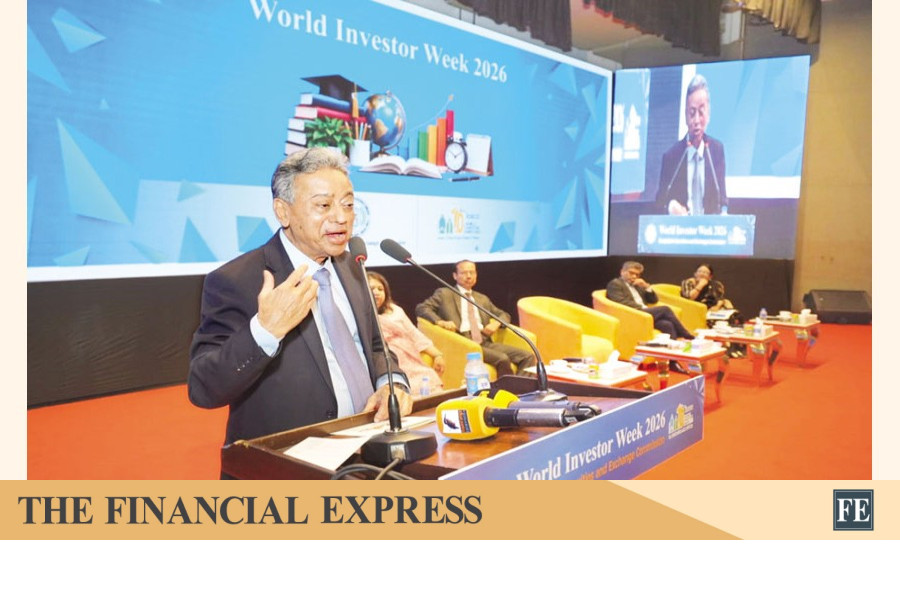
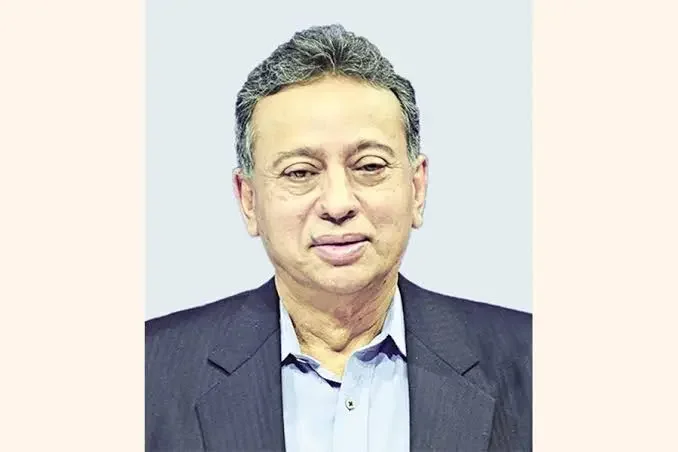
Finance and Planning Minister Amir Khosru Mahmud Chowdhury speaks at the inaugural ceremony of World Investor Week 2026 at the Krishibid Institution in Dhaka on Sunday. — FE photo

Instead of relying only on foreign loans from the International Monetary Fund (IMF), Finance Minister Amir Khosru Mahmud Chowdhury has stressed a strategy to shift toward raising capital directly through global and domestic markets with bonds, equities, and market-driven financial architecture.

He said this on Sunday at the inaugural ceremony of the World Investor Week 2026 arranged by the Bangladesh Securities and Exchange Commission (BSEC) at Krishibid Institution in the capital.

"We cannot depend on the IMF. Relying on the IMF... relying on the IMF, forget it!" the minister said as the chief guest of the programme.

He said the country's financial architecture was changing and urged the stakeholders to go for a trillion dollar economy by 2034.

Khosru spoke about his cancellation of the IMF programme, saying, "You surely saw it, right? Earlier, I cancelled the IMF programme. Your (IMF) condition is not acceptable to us."

He said the money that the IMF would give was not enough to reach a trillion dollars.

"I need 50 billion dollars every year. All of you together will give 10 billion dollars - I do not have time for that anymore," he said.

In June 2026, the government suspended the previous IMF programme as some of the conditions of the lender were no longer considered suitable for Bangladesh's current circumstances.

In his speech, the minister said they were getting a good response to the call to raise money from the local and foreign markets through bonds and equities.

He also expressed optimism that within a year, the face of the Bangladesh capital market would change.

Khosru said confidence in Bangladesh's capital market had started to improve among international investors, particularly following the government's recent engagement with Wall Street institutions during the prime minister's visit to the US.

Representatives of major global financial institutions had demonstrated a strong understanding of Bangladesh's capital market and were closely following recent developments, he said.

"They have confidence in the leadership, they have confidence in the deregulation that this government has announced, they have confidence in the clarity that is coming to this market, and they have confidence in the professionalism this market is showing right now," he said.

Many of the global institutions could become partners in Bangladesh's capital market, while a number of them were expected to visit Dhaka, he stated.

Bangladesh was also preparing to tap international capital markets, including through a proposed dollar bond issue in New York, he said.

"We have to take the plunge. We have to send the message to Wall Street," he said.

The recent engagement with global investors demonstrated that Bangladesh could no longer afford to remain isolated from international capital markets, Khosru said.

The ultimate goal was to build a credible, transparent, and professionally managed capital market capable of mobilising long-term domestic and foreign investment, while reducing the country's excessive dependence on bank financing, the minister added.

He stressed the need to reduce the cost of funds through a stronger capital market.

The minister stated the government wanted businesses to raise funds through the market rather than relying heavily on banks at high interest rates.

He further said the government could not continue financing commercial activities with taxpayers' money.

"Find your money in the market, and make money to repay the government. The government cannot run enterprises and behave like a cheque writer," the minister added.​
 

REFUND DILEMMA WITH DIGITAL PLATFORM DISABILITY
Corporates see Tk 150b VAT refunds stuck, fresh claims blocked

NBR high-ups harbour doubts over huge claim stockpiles, say scrutiny needed


1791414019413.webp


Corporate kingpins see Tk 150 billion in VAT refunds long stuck and fresh demands barred as the government revenue authority's digital platform stays dysfunctional.

National Board of Revenue (NBR) high-ups, however, harbour doubts about accuracy of such huge claim buildups and say scrutiny is needed before claim settlement.

Exporters and manufacturers deplore that they cannot also submit new applications for VAT refunds as the VAT-refund module remains disabled.

Refund of VAT, literally, remains stalled due to the disabled online module that is mandatory for submitting refund applications.

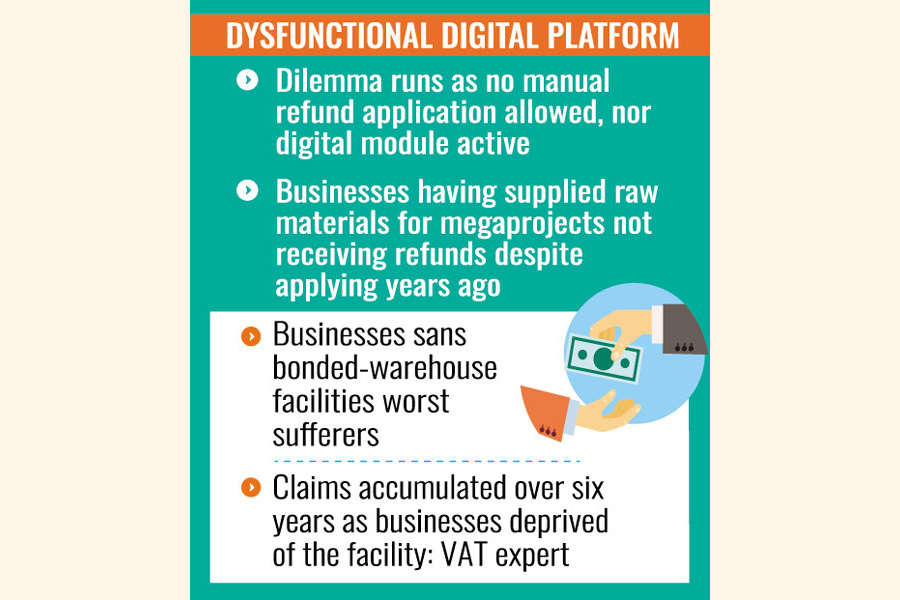
Businesses without bonded-warehouse facilities are the worst sufferers.

Since November last year, filing refund applications through the online system has been mandatory. No manual application is allowed for VAT refunds. However, no digital module is currently active for submitting refund applications.

Businesses view this dilemma as a sign of the revenue authority's unwillingness to allow VAT provided for by the law.

However, a National Board of Revenue (NBR) high-up found the existing Tk 150 billion refund claims suspicious and would need scrutiny.

A senior VAT official has said the refund claim is huge and abnormal, raising doubts that some businesses may be showing lower selling prices or lower value addition.

"Currently, we are allowing refund of Advance Tax (AT) to be claimed through applications," he said.

Naimul Huda, Executive Director of Incepta Pharmaceuticals, has said the company has a pending VAT-refund claim of Tk 120 million dating back to 2019.

"We neither give entry in the system nor claim the AT manually," he told The Financial Express.

VAT consultant Md Daud Faraizy, however, has said the VAT authority is not even allowing businesses to submit application.

"The NBR has no timeline to approve refund applications, but businesses must submit refund applications within six months, in general, of the creation of the refund," he said.

A VAT-registered manufacturer or importer can usually adjust AT in its VAT return. If an eligible surplus remains, it may apply for a cash refund under the refund rules.

Also, an unregistered importer may apply for an AT refund if the goods are for its own final use and will not be transferred to anyone else.

VAT and SD refunds claimed by exporters, deemed exporters, back-to-back LC exporters, and organisations having closed their operations in Bangladesh, on the import of raw materials remained blocked due to dysfunctional modules in the VAT online system.

Businesses find the inactive refund module a violation of existing VAT law provisions on refunds, as even the submission of refund applications remains blocked.

A number of businesses having supplied raw materials for megaprojects are not receiving their refunds despite having applied to the NBR years ago.

A senior official of the NBR says the AT-refund process has been made smoother, but VAT-refund claims by exporters and local manufacturers remain stalled as the NBR decided to investigate the claims.

VAT expert Daud Faraizy, however, has said the refund claims have accumulated over the last six years because businesses were not allowed to avail themselves of the facility.

"Now the amount has turned into a large sum, which the revenue authority finds difficult to pay," he said, explaining that if the amount were divided, the refund demand in each year would have been negligible.

In the VAT online system, it has been mentioned that businesses cannot claim refunds for VAT, except AT.

On November 11, 2025, the NBR introduced online VAT refund by establishing interconnectivity with the Integrated VAT Administration System and Bangladesh Electronic Fund Transfer Network. It scrapped the provision for manual refund application, asking all taxpayers to apply for refunds using the new module.

In the module, the NBR inserted a 27-point checklist for refund processing, including a ceiling for claiming refunds, updated return submission and other compliances.

Mr Faraizy says the law and rules allow online refund application but the provision has not been followed due to the absence of a functioning online system.

Businesses with stuck-up refund claims include Apex Yarn Dyeing Limited, Ispahani Tea, DBL Ceramics, CEAT AK Khan ltd, KSRM, Confidence group, SAMUDA, Primitak, Hawlader Yunus & Co, Ranks Telecom, Walton Hi-Tech Industries, Incepta Pharmaceuticals, Abul Khair Consumer Products, BSRM Wires, Kabir Steel Ltd, Madina Garments, SR Shipping Ltd, Kiswan Snacks, Confidence Infrastructure, Global Steel and Engineering, Protik Ceramics, Karnaphuli Shoes Industries, Fulkoli Bread and Biscuits Ltd, Banoful and Company, Universal Sweater, and Pacific Workwears.​
 

Bangladesh's stagflation trap

Why it may persist

Bangladesh is confronting a condition that policymakers may hesitate to call by its proper name: stagflation. Inflation remains stubbornly high while growth, private investment, real purchasing power and productive job creation have weakened. The Middle East war has aggravated these pressures by raising energy, transportation and import costs, but blaming the conflict mistakes an accelerator for the underlying disease.

Even if the war ended tomorrow, Bangladesh would not escape automatically. Oil prices and freight costs might fall, imported inflation could moderate, subsidy pressure could ease and the balance of payments might improve. Yet the domestic forces suppressing investment, productive employment and growth would remain. The war has intensified Bangladesh's stagflation; it did not create it.

WHY THE TEXTBOOK DEFINITION FAILS: Stagflation is usually defined as high inflation, high unemployment and stagnant or declining growth occurring together. The definition emerged from advanced economies, particularly the United States (US), where formal labour markets make measured unemployment a reasonable gauge of idle labour. Applied mechanically to Bangladesh, it misleads, because the labour market is structured differently.

Bangladesh may report a low unemployment rate, but the figure reveals little about how fully labour is used. Workers who cannot find adequate formal jobs can afford to remain openly unemployed. They sell goods, drive vehicles, farm small plots, work intermittently in family enterprises, take casual labour or accept any income-producing activity available. The survey definition compounds the problem. Following the standard ILO criterion, a person who worked even one hour during the reference week counts as employed. Someone working one hour a week thus vanishes from unemployment statistics while remaining, in any meaningful economic sense, severely underemployed.

The relevant concept is therefore labour underutilisation: disguised unemployment, irregular work, involuntary short hours, precarious self-employment and very low-productivity activity. Bangladesh's stagflation should be understood as persistent inflation alongside weak growth, depressed private investment, eroding real purchasing power, inadequate productive job creation and widespread underutilization of labour. By that standard, Bangladesh already displays stagflation's essential characteristics, however low its official unemployment rate may appear.

INFLATION EASES, BUT PERSISTS: Headline inflation eased to 8.26 per cent in August from 8.32 per cent in July, while non-food inflation rose to 9.32 per cent. Wage-index growth, at about 8.05 percent, remained slightly below overall inflation. Falling inflation is not falling prices: above 8 percent, prices are still rising rapidly, only a little more slowly, and households do not regain purchasing power already lost. Wages that merely keep pace with prices never repay that ground.

Persistent non-food inflation matters because rising costs of housing, transportation, clothing, healthcare and education show that price pressure has spread broadly. When earnings lag prices, real purchasing power falls, consumption weakens, especially among lower- and middle-income households, and businesses grow reluctant to expand. This is one of stagflation's paradoxes: inflation can coexist with weak demand when it originates in costs, supply constraints and structural weaknesses rather than excess domestic spending.

THE INVESTMENT MATRIX: Weak growth is inseparable from weak investment. The World Bank projected FY26 growth at 3.9 per cent, and IMF staff more recently projected 3.5 per cent for FY27. Such rates might look respectable in an advanced economy, but for Bangladesh the relevant question is whether growth is enough to absorb new entrants into productive work, raise productivity and incomes, and generate the investment future growth requires. An economy can stagnate even while gross domestic product (GDP) growth is positive.

Entrepreneurs do not invest simply because the central bank cuts its policy rate. They invest when the expected risk-adjusted return on a productive project exceeds the combined cost of financing, risk and the alternative uses of capital. Monetary easing moves only one element of that calculation, while the decision depends on a whole matrix. A business weighing a new factory must consider borrowing costs together with energy reliability, imported-input prices, exchange-rate uncertainty, taxation, regulatory predictability, political uncertainty and expected demand. Deterioration on several fronts can swamp the benefit of a modest rate cut.

The investor must also compare a multiyear productive commitment with the safer returns on bank deposits, government securities and other financial assets. When those returns are already high, a factory or machinery must promise substantially more to compensate for illiquidity and uncertainty. Unless other elements of the matrix improve enough to lift the expected return, a modest rate cut may leave the decision unchanged.

THE BANKING BREAKDOWN: The banking system compounds the problem. The World Bank reported nonperforming loans at 32.6 per cent of total loans by March 2026, against a South Asian average of 7.9 per cent, and the system-wide capital-to-risk-weighted-assets ratio had fallen to negative 2.6 per cent by the end of 2025. Banks are the main channel through which policy rates reach businesses, and balance sheets clogged with bad loans and impaired capital block that channel. Bangladesh Bank can lower the policy rate, but it cannot make distressed banks pass the reduction on as productive credit.

This creates a policy trap. Inflation calls for monetary restraint, while investment calls for affordable credit. Raising rates to fight inflation can suppress investment further, whereas cutting too aggressively before inflation and exchange-rate pressures subside can reignite prices and weaken the taka. Monetary policy is being asked to move in opposite directions.

WEAK INVESTMENT, WEAKER SUPPLY: Investment does more than create current demand. It expands capacity, raises productivity and generates productive jobs. When it stays depressed, capacity grows slowly, even modest increases in demand meet supply bottlenecks sooner, and prices rise. Weaker income growth and confidence then discourage investment further. In Bangladesh, inflation and stagnation are not mutually exclusive; they reinforce each other.

IMPORT COSTS AND THE FISCAL SQUEEZE: Dependence on imported petroleum, LNG, machinery and intermediate goods carries world prices quickly into domestic costs, and depreciation magnifies the effect: even at an unchanged dollar price, a weaker taka raises the domestic-currency cost. The government faces the same shock from another direction. Higher energy costs raise subsidy needs and shrink fiscal space for infrastructure, health, education and development unless revenues rise correspondingly. Bangladesh therefore confronts a three-way constraint. Protecting consumers through subsidies strains the budget, passing costs on intensifies inflation, and cutting productive public investment to pay for subsidies weakens future growth. Weak revenue mobilization makes each choice harder.

WAR AS AMPLIFIER: The war unquestionably worsens this structure, raising import costs, renewing inflationary pressure, straining external accounts and increasing subsidy needs. Yet the banking crisis, weak private investment, inadequate revenue mobilization, labour underutilisation, credit-allocation problems, regulatory uncertainty and weak business confidence all predated it.

The distinction matters because diagnosis determines policy. If war is the disease, peace becomes the implied cure. If war is an amplifier of domestic weaknesses, peace brings only partial relief. Lower oil prices, freight costs and imported inflation would help, but they would not repair distressed banks, improve credit allocation, raise investment returns, expand fiscal capacity or restore confidence. Bangladesh cannot interest-rate-cut its way out of stagflation any more than it can war-end its way out of stagflation.

WHERE REPAIR SHOULD BEGIN: Recognising the matrix does not mean everything can be fixed on the same day, but it does mean sequencing must respect the interactions. Credible resolution and recapitalization of distressed banks must come first, because until credit can flow, no other improvement reaches investors. Next comes predictability in energy supply, tax and regulatory rules and exchange-rate management, which raises the expected return side of the investor's calculation. Revenue mobilization must follow, so that subsidies need not crowd out productive public investment. Only then does a lower policy rate have a working channel through which to act. Rate cuts should be the last move, not the first.

WHY STAGFLATION (S) MAY PERSIST: The result is not a chain with a single beginning and end but a matrix of mutually reinforcing pressures: inflation affects interest rates, interest rates affect investment, banking distress weakens transmission, exchange rates and energy prices feed inflation and subsidies, fiscal weakness constrains public investment, and weak growth further discourages private investment. Correcting one variable while leaving the others largely unchanged may bring only limited improvement, if any. In compact functional form, the interaction may be represented as:

Stagflation = f(i, G, E, T, Pe)

where i = interest rate, G = government spending, E = exchange rate, T = trade conditions, and P? = energy prices.For Bangladesh, the functional relationships takes a slightly different form:

S = f(i, G, E, T, Pe, l, B)

Where I represents investment conditions and B represents banking-sector conditions that includes confidence in the credibility and independence of central bank policy actions. The functional form fits the matrix argument because these variables interact rather than operate independently.

The Middle East war may end on a particular date, but Bangladesh's stagflation need not. External shocks can vanish quickly; structural distortions cannot. Escaping the trap will require repairing the domestic structure that allowed those shocks to do so much damage.

The writer is a Professor Emeritus of Economics at Eastern Michigan University, USA, and former nuclear engineer at Bangladesh Atomic Energy Commission. He is also a Senior Fellow at the Policy Research Institute (PRI), Dhaka.​
 

Forex reserves reach $37b despite economic challenges: State minister


1791676634359.webp


State Minister for Local Government, Rural Development and Cooperatives Mir Shahe Alam today (Saturday) said the country's foreign exchange reserves had increased by US$11 billion over the past seven months to reach US$37 billion despite various economic challenges.

He also said that the country's overall debt burden had declined from 37 percent to 32 percent during the period, BSS reports.

"Foreign exchange reserves stood at US$20 billion when the then autocratic government was ousted on August 5, 2024, following the mass uprising," he said.

The state minister made the remarks while addressing a discussion on formulating strategies to install solar power systems through cooperative societies in urban and rural areas at the Samabaya Bhaban in Agargaon this afternoon.

Local Government, Rural Development and Cooperatives Minister Dr Abdul Moyeen Khan attended the programme as the chief guest.

Shahe Alam said the interim government led by Dr Muhammad Yunus had increased foreign exchange reserves to US$26 billion over two years, followed by a further rise of US$11 billion in the past seven months, bringing the total to US$37 billion.

Referring to a call by an opposition party leader to halt remittance flows, he said the appeal had failed to disrupt the inflow of remittances.

"Remittances worth Tk 7,776 crore entered the country over the past five days despite the call," he said.

The state minister said expatriate Bangladeshis understood the country's political situation, recalling that remittance flows had stopped during the Liberation War, the anti-Ershad movement in 1990 and the recent movement that led to the fall of the fascist government.

Criticising the opposition's role in parliament and outside, Shahe Alam alleged inconsistencies between its statements in the Jatiya Sangsad and its public criticism of the government.

He said opposition leaders had acknowledged in parliament that the BNP had inherited crises in the oil, gas and electricity sectors, while criticising the government over power and gas shortages in their public statements.

Highlighting the potential of solar energy to help address the country's electricity crisis, Shahe Alam said Bangladesh was currently supplying 1,872 megawatts of solar-generated electricity to the national grid.

He said the government would purchase surplus electricity generated by household solar power systems and called for coordinated initiatives through the Department of Cooperatives to expand solar energy use in both urban and rural areas.

Senior officials of the Department of Cooperatives and representatives of relevant ministries and departments attended the meeting.​
 

Latest Posts

Back