 Bangladesh Defense

Saif
Senior Member
- Joined
- Jan 24, 2024
- Messages
- 22,191
- Likes
- 9,869
- Nation

- Axis Group


Economy on pickup after a downturn
Bangladesh's economy gets on a pickup as an important indicator showed a rise in October after consecutive two months of downturn, with most major sectors performing a bit better. The country's overall Purchasing Managers' Index (PMI) score in October recorded an increase of 3.2 points from
Overall October indicator increases
Economy on pickup after a downturn
Bangladesh's economy gets on a pickup as an important indicator showed a rise in October after consecutive two months of downturn, with most major sectors performing a bit better.
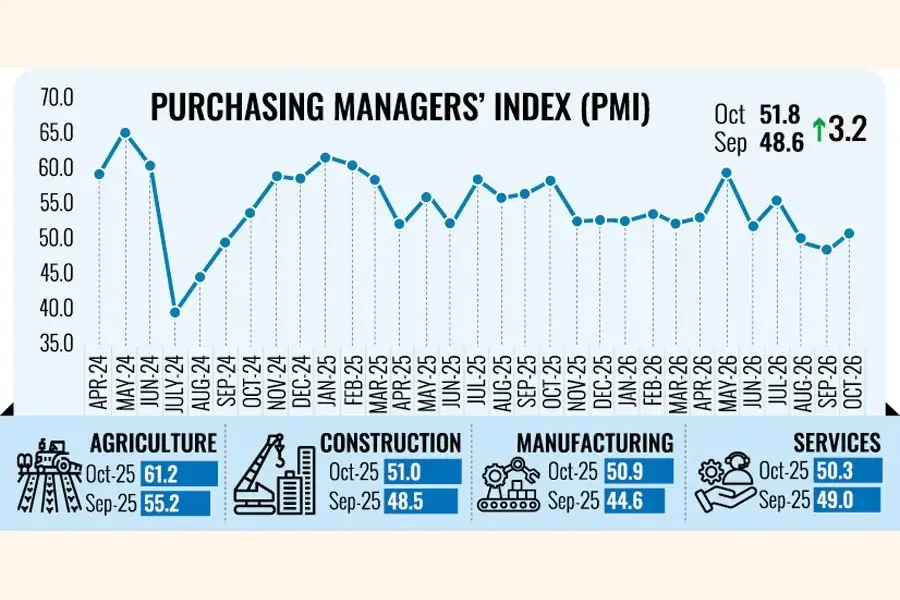
The country's overall Purchasing Managers' Index (PMI) score in October recorded an increase of 3.2 points from September to reach 51.8-an indicator that the economy is expanding.
The October PMI reading means the economy is returning onto growth trajectory after two consecutive months of contraction.
Agriculture marked faster expansion while manufacturing, construction and services also returned to expansion.
The agriculture sector recorded its fourteenth consecutive month of expansion, and at a faster rate, increasing by 6.0 points to 61.2.
The indices of new business, business activity and employment continued to expand, while order backlogs reverted to expansion. The input-cost index remained in expansion, too.
The manufacturing sector reverted to expansion at 50.9, increasing by 6.1 points.
Stocks of input purchases, stocks of finished goods and imports reverted to expansion, while employment and supplier deliveries remained in expansion.
New export orders and factory output continued to contract. Input prices recorded strong expansion, whereas order backlogs remained in sharp contraction.
The construction sector turned back to expansion at 51.0, gaining 2.5 points.
Employment returned to expansion after remaining unchanged in September, while order backlogs continued to expand. New business and construction activity remained in contraction, whereas input costs posted strong expansion.
The services sector returned to expansion at 50.3, rising by 1.3 points. Employment returned to expansion, while new business, business activity and order backlogs continued to contract. The input- cost index continued to post strong expansion.
"In terms of the Future Business Index, expansion readings were recorded across all four sectors, indicating positive expectations for business conditions," says the PMI disclosure.
"The October PMI reading marks a small but positive development as it expands after two difficult months, supported particularly by stronger agricultural and export performance."
However, the recovery remains fragile.
"New orders and business activity are still shrinking across manufacturing, construction and services, while input costs remain elevated," says Dr M Masrur Reaz, Chairman and CEO of the Policy Exchange Bangladesh.
This divergence suggests that the return to expansion has yet to translate into a broad-based strengthening of demand.
He also says: "Ensuring reliable energy supplies, easing working-capital constraints and containing further elevation in business costs will be critical to sustaining recovery."
He has further said the positive expectations for future business offer some encouragement, but translating confidence into investment and production requires more predictable operating conditions.
PMI is a monthly economic indicator that measures the health and direction of the private-sector economy.
It is derived from confidential monthly surveys of senior purchasing executives and supply-chain manages managers at private companies.
The PMI runs on a scale of 0 to 100. Above 50 signals expansion at 50 signals no change and below 50 means a contraction or slowdown.
Metropolitan Chamber of Commerce and Industry (MCCI), Dhaka and Policy Exchange Bangladesh (PEB) have successfully released it over the past two years.
MCCI and Policy Exchange devised the index with support from UK Government and technical support from Singapore Institute of Purchasing & Materials Management (SIPMM).
Economy on pickup after a downturn
Bangladesh's economy gets on a pickup as an important indicator showed a rise in October after consecutive two months of downturn, with most major sectors performing a bit better.
The country's overall Purchasing Managers' Index (PMI) score in October recorded an increase of 3.2 points from September to reach 51.8-an indicator that the economy is expanding.
The October PMI reading means the economy is returning onto growth trajectory after two consecutive months of contraction.
Agriculture marked faster expansion while manufacturing, construction and services also returned to expansion.
The agriculture sector recorded its fourteenth consecutive month of expansion, and at a faster rate, increasing by 6.0 points to 61.2.
The indices of new business, business activity and employment continued to expand, while order backlogs reverted to expansion. The input-cost index remained in expansion, too.
The manufacturing sector reverted to expansion at 50.9, increasing by 6.1 points.
Stocks of input purchases, stocks of finished goods and imports reverted to expansion, while employment and supplier deliveries remained in expansion.
New export orders and factory output continued to contract. Input prices recorded strong expansion, whereas order backlogs remained in sharp contraction.
The construction sector turned back to expansion at 51.0, gaining 2.5 points.
Employment returned to expansion after remaining unchanged in September, while order backlogs continued to expand. New business and construction activity remained in contraction, whereas input costs posted strong expansion.
The services sector returned to expansion at 50.3, rising by 1.3 points. Employment returned to expansion, while new business, business activity and order backlogs continued to contract. The input- cost index continued to post strong expansion.
"In terms of the Future Business Index, expansion readings were recorded across all four sectors, indicating positive expectations for business conditions," says the PMI disclosure.
"The October PMI reading marks a small but positive development as it expands after two difficult months, supported particularly by stronger agricultural and export performance."
However, the recovery remains fragile.
"New orders and business activity are still shrinking across manufacturing, construction and services, while input costs remain elevated," says Dr M Masrur Reaz, Chairman and CEO of the Policy Exchange Bangladesh.
This divergence suggests that the return to expansion has yet to translate into a broad-based strengthening of demand.
He also says: "Ensuring reliable energy supplies, easing working-capital constraints and containing further elevation in business costs will be critical to sustaining recovery."
He has further said the positive expectations for future business offer some encouragement, but translating confidence into investment and production requires more predictable operating conditions.
PMI is a monthly economic indicator that measures the health and direction of the private-sector economy.
It is derived from confidential monthly surveys of senior purchasing executives and supply-chain manages managers at private companies.
The PMI runs on a scale of 0 to 100. Above 50 signals expansion at 50 signals no change and below 50 means a contraction or slowdown.
Metropolitan Chamber of Commerce and Industry (MCCI), Dhaka and Policy Exchange Bangladesh (PEB) have successfully released it over the past two years.
MCCI and Policy Exchange devised the index with support from UK Government and technical support from Singapore Institute of Purchasing & Materials Management (SIPMM).
