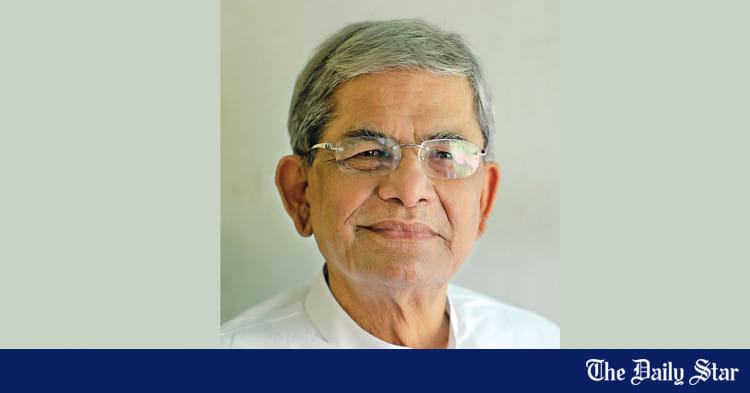
Bangladesh Nationalist Party (BNP) Secretary General Mirza Fakhrul Islam Alamgir on Monday demanded immediate withdrawal of all lawsuits filed falsely against leaders and workers of BNP and other political parties which fought against the last autocratic regime. “I reiterate my call to the i
thefinancialexpress.com.bd
Fakhrul demands withdrawal of false cases
BSS
Published :
Sep 16, 2024 23:06
Updated :
Sep 16, 2024 23:06
Bangladesh Nationalist Party (BNP) Secretary General Mirza Fakhrul Islam Alamgir on Monday demanded immediate withdrawal of all lawsuits filed falsely against leaders and workers of BNP and other political parties which fought against the last autocratic regime.
“I reiterate my call to the interim government for immediate withdrawal of the false cases against our party leaders and workers and other opposition parties,” he told at a discussion at Dhaka Reporters’ Unity (DRU) auditorium at Segun Bagicha in Dhaka.
Jatiya Samajtantrik Dal (JSD) organized the discussion titled “Bicameral Parliament: Upper House Formation”.
Mirza Fakhrul also demanded compensation for those who were killed and wounded in the movement against autocratic regime.
Fakhrul said many individuals still remained embedded in administration, who were involved in corruption and criminalization and supported the fascist regime to cling on to power.
The BNP secretary general urged the government to remove the supporters of fascism immediately after finding them out and constitute a neutral structure for ensuring a free and fair election.
In the keynote paper of the discussion, JSD proposed for constituting bicameral parliamentary system having four-year term.
As per the proposal, lower house of the parliament will have 300 seats and upper house will have 200 seats.
Lower house will be constituted with the political party representatives while the upper house will be filled up with professionals and representatives of different classes of people.
Election-time government will be constituted from upper chamber, it proposed.
About the reform proposals, Mirza Fakhrul said any reform or change should not take place without public opinion.
He said the interim government has been formed provisionally for running the state and holding a national election.
BNP believes that fundamental reforms or amendments cannot be made without the opinion of the people and that amendment should be done by the parliament, he said.
So, parliamentary elections should be held in a free and fair manner under a neutral government, he noted.
JSD President ASM Abdur Rab said a free and fair election must be held for bringing back the country’s ownership to people.
But without making central reforms, holding election will not bring result, he said adding that constitution and governance system should be amended.
Those who carried out homicide cannot be pardoned and they must be brought to justice, Abdur Rab said.
Nagorik Oikya President Mahmudur Rahman Manna said steering is in the hand of those who are now in the interim government.
They will have to take the final decision, he said.
Biplobi Workers Party general secretary Saiful Haque said after the successful revolution in Nepal, the country introduced democratic system and constituted two-chamber parliament.
JSD President ASM Abdur Rab presided over the discussion while its general secretary Shahid Uddin Mahmud Swapan and Joint General Secretary Kamal Uddin Patwari moderated it.
Jatiya Party (Kazi Zafar) leader Mostafa Jamal Haider, Bangladesh Jatiya Samajtantrik Dal leader Sharif Nurul Ambia, Gono Forum General Secretary Subrata Chowdhury, Rashtra Sangskar Andolan leader Hasnat Kaiyum, Ganosanghati Andolan executive coordinator Abul Hasan Rubel, AB Party leader Barrister Asaduzzaman Fuad and Bhashani Anushari Parishad leader Abu Yusuf Selim also spoke on the occasion.
Ganosanghati Andolan Chief Coordinator Zonayed Saki, JSD leader Mohammad Siraj Mia, Tania Rab and KM Jabir were also present, among others.
BNP Secretary General Mirza Fakhrul Islam Alamgir has called for parliament to be entrusted with any fundamental changes to the constitution or state system. He criticised the attempts to keep the interim government in power ‘indefinitely’, warning that the public would never accept su
thefinancialexpress.com.bd
Parliament will decide on constitutional changes: Fakhrul
Published :
Sep 16, 2024 23:17
Updated :
Sep 16, 2024 23:17
BNP Secretary General Mirza Fakhrul Islam Alamgir has called for parliament to be entrusted with any fundamental changes to the constitution or state system.
He criticised the attempts to keep the interim government in power ‘indefinitely’, warning that the public would never accept such a move.
Fakhrul’s comments came during a discussion on 'Bicameral Parliament: Formation of the Upper House' organised by the Jatiya Samajtantrik Dal, or JaSaD, at the Dhaka Reporters Unity auditorium on Monday.
He emphasised the need for minimal reforms in the Election Commission, judiciary, and administration to ensure free and fair elections, bdnews24.com reports.
“The interim government is here to manage the state temporarily and arrange elections. Any reform or change, particularly fundamental ones, should not be decided without public involvement. The only appropriate place for such decisions is Parliament,” remarked the BNP leader.
He highlighted his party’s stance on the need for a neutral government for elections, pointing out that the Election Commission has been dissolved and needs to be reconstituted impartially for fair elections.
Mirza Fakhrul also responded to discussions initiated by some groups about rewriting the constitution or amending it under the caretaker administration.
"Elections must be held under a truly neutral government. After the election, the newly elected representatives will decide what changes are necessary," he said.
"Only parliament can decide whether changes are needed or if the constitution needs to be rewritten entirely."
Fakhrul also criticised the Awami League government, accusing it of damaging the country's political and economic systems.
“Democratic institutions have been destroyed, the administration has been politicised, and the judiciary has been manipulated, taking it to the brink of collapse.
PEOPLE WILL NOT ACCEPT AN ‘INDEFINITE’ INTERIM GOVERNMENT
Mirza Fakhrul rejected suggestions that the interim government remain in place indefinitely.
He said, "They [the interim government] will make all the changes, reforms, everything. In that case, the public is no longer needed, and parliament is no longer needed."
Fakhrul also questioned the legitimacy of a recent survey purportedly conducted by the BRAC Institute, which allegedly suggested that most people support the interim government staying in power as long as necessary.
"I don’t know where they got this information or how they conducted this survey, but the people will never accept it," he added.
Mirza Fakhrul advised against disseminating such misleading reports and urged careful consideration to avoid creating confusion.
He expressed concern about efforts to undermine public aspirations for revolution. “Efforts to destroy these aspirations have already begun. I am surprised when I see our educated people, those who hold importance in society, making misleading statements.
“It is astonishing to hear calls for forming new parties from those who have been given responsibilities by the current government.”
He added, "Who gave them the authority to suggest creating a new party? How can we or the public think they are working neutrally when they say such things?"
BNP will write a letter to Chief Adviser Muhammad Yunus next week calling upon him to withdraw all the false and fabricated cases filed against the party in the last 18 years
www.thedailystar.net
BNP to write to CA for withdrawing false cases
BNP will write a letter to Chief Adviser Muhammad Yunus next week calling upon him to withdraw all the false and fabricated cases filed against the party in the last 18 years.
The decision came from the party's standing committee meeting held on Monday at BNP Chairperson's political office at Gulshan, chaired virtually by its Acting Chairman Tarique Rahman, said a press release yesterday.
The party also decided to prepare a list of cases filed against the party leaders and activists across the country in the last 18 years—two years of caretaker government and 16 years of Awami League regime.
In the meeting, a committee was also formed with BNP standing committee member Amir Khasru Mahmud Chowdhury as the convener and Abdul Awal Mintoo as the secretary to monitor and contact the investors and business representatives.
At the beginning of the meeting, the party secretary general informed the forum about the progress of implications of decisions taken earlier by the standing committee.
Discussion also took place in the meeting on reforming public administration, election commission, public service commission and anti-corruption Commission.
The commissions formed on the institutions have been requested to take necessary measures immediately for reformation.
BNP standing committee members Dr Khandaker Mosharraf Hossain, Barrister Muhammad Jamiruddin Sircar, Mirza Abbas, Gayeshwar Chandra Roy, Dr Abdul Moyeen Khan, Nazrul Islam Khan, Mirza Fakhrul Islam Alamgir, Sahahuddin Ahmed, Begum Selima Rahman, Iqbal Hasan Mahmud Tuku, Major (rtd) Hafiz Uddin Ahmed and professor Dr AZM Zahid Hossain attended the meeting.
Stating that the current interim government must not be allowed to fail, Bangladesh Nationalist Party acting chairman Tarique Rahman on Tuesday said that Bangladesh would advance to the...
www.newagebd.net
Interim govt must not be allowed to fail: Tarique
Staff Correspondent 17 September, 2024, 19:30
The Bangladesh Nationalist Party holds a public rally in front of its Nayapaltan central office in the capital marking International Day of Democracy on Tuesday. | New Age photo
Stating that the current interim government must not be allowed to fail, Bangladesh Nationalist Party acting chairman Tarique Rahman on Tuesday said that Bangladesh would advance to the election roadmap along with the path of reforms.
‘Some activities of this government may not be considered as a success by all. But we all have to remember that the failure of this government is the failure of all of us and the failure of the pro-democracy people of Bangladesh. So this interim government can in no way be allowed to fail,’ he said while virtually addressing a rally.
The party arranged the rally marking International Day of Democracy in front of the party’s Naya Paltan central office presided over by its secretary general Mirza Fakhrul Islam Alamgir.
Tarique, however, said that the current government must also be careful so that it did not fail on its own account.
He mentioned that the BNP launched a 31-point programme back in 2023 for bringing reforms to the state.
But those 31 points were not the last word regarding reform, he continued, the BNP believed that reforms in any field of the state or politics were a continuous and ongoing process.
Therefore, his party welcomed those changes also that were even more necessary than its own 31-point reform programme, Tarique said, adding that even if someone thought that more new political parties were needed for a better and safer Bangladesh, there was nothing wrong with that.
‘In the end, there are the people who will decide who to support or not to support. For this reason, the BNP has repeatedly emphasised the right of the people to vote,’ he added.
He said that the interim government was working to restore order in the country following the fall of Sheikh Hasina’s fascist and despotic regime.
Calling Hasina the head of the mafia clique, the BNP acting chairman said that though the fallen prime minister fled the country, their beneficiaries and evil forces continued to challenge the interim government from within the administration or hiding behind a façade of politics.
‘The people will not allow the government to fail amid various provocations from home and abroad,’ the BNP leader said, adding that the current interim government is the outcome of the supreme sacrifice of thousands of martyrs and the mass uprising of millions of people.
He urged his party people to earn the trust and admiration of people through their work.
‘I would like to say that the country will be on the electoral roadmap along the path of reforms. So, let us all earn the trust and love of the people through work. We should stand by the people and keep them with us,’ he said, adding that the reform programmes need to be carried forward keeping in mind the goal of establishing an accountable government, and a parliament formed by representatives elected by the people.
Tarique stated that without political empowerment and direct involvement of the people in the reform process, no democracy or reform is sustainable and effective.
Political empowerment of the people can only be ensured by establishing the right of voters to elect their chosen representatives through a free, fair and impartial election, he said.
The interim government had already undertaken reforms in several areas, he said, adding that his party feared that if the interim government failed to set priorities for setting agenda, conspiratorial circles might utilise opportunities to disrupt the success of the mass uprising.
Several hundred BNP leaders and activists joined the rally, triggering several hours of heavy traffic jams across different roads and alleys over a large area in the capital.
The taunts and barbs leave little room for doubt that the 33-year-old ties have soured. Since the fall of Sheikh Hasina’s government on August 5, BNP and Jamaat-e-Islami leaders have differed in private and in public on various issues, including reforms and election timeframe.
The taunts and barbs leave little room for doubt that the 33-year-old ties have soured. Since the fall of Sheikh Hasina's government on August 5, BNP and Jamaat-e-Islami leaders have differed in private and in public on various issues, including reforms and election timeframe.
BNP has made it known that it wants elections after a reasonable set of reforms. Its longtime ally Jamaat on the other hand has made it clear that it is willing to wait and allow Prof Muhammad Yunus-led interim government more time.
Experts say they have not previously seen such opposing views, that too in public, by the two parties that formed electoral alliance on multiple occasions in the past and even fought side by side to topple Hasina for years.
According to them, the two parties do not need each other anymore after the political changeover, as their "common political rival" Hasina is no longer in the scene.
BNP leaders say the rift between the two allies surfaced when Jamaat chief Shafiqur Rahman in a statement on August 26 alleged that BNP has already "grabbed 80 percent of the power".
"They [BNP] don't even need an election. They have grabbed whatever there is to grab – from footpath to begging business," Shafiqur had said.
"BNP and Jamaat came closer to face Awami League though their ideologies were different. But after the fall of the Awami League government, there is no need for them to stay together." — Prof Al Masud Hasanuzzaman, Jahangirnagar University.
Earlier on August 11, Dhaka City North unit member secretary of Jatiyatabadi Jubo Dal, the youth front of BNP, Rabiul Islam Nayan, allegedly led a mob that tried to take control of Islami Bank's main branch in Motijheel. Jamaat, which allegedly wanted to establish its dominance over the first Shariah-based bank in Bangladesh, was upset by this, according to Jamaat insiders.
The gap between BNP and Jamaat appears to have widened centering also on appointments in key government posts, as both parties seek to solidify their control over various institutions.
BNP leaders say the interim government removed pro-Awami League people from different government positions, educational institutions, banks and insurance companies. Many of these posts have been given to pro-Jamaat men.
The differences became visible soon after Prof Yunus's address to the nation on August 25, where he did not mention the election timeframe.
In his reaction the next day, BNP Secretary General Mirza Fakhrul Islam Alamgir said the chief adviser failed to address the election issue.
On the same day, the Jamaat chief said the nation will not accept any political party's demand for an election at a time when hundreds of people are still lying on hospital beds from injuries sustained during the July uprising.
As if in a direct response, Fakhrul told a press conference at the party chairperson's Gulshan office on August 28 that those who do not have public support and cannot run government have different thoughts about election. "Those who cannot afford to win are against elections," he said.
Although both parties are in favour of reforms, BNP wants a reasonable level of reforms to some institutions, while Jamaat supports sustainable reforms, according to sources in the two parties.
Multiple Jamaat leaders said they want to allow the interim government more time for the sake of their own preparations for the election. They also said they are likely to join polls on their own. Before that, they want to "brighten the party image" through extensive social work. They spoke on condition of anonymity to discuss internal party matters.
Talking to The Daily Star on August 28, Mirza Fakhrul said Jamaat is no longer their ally and that BNP is making preparations to run in the election on its own.
Saiful Alam Khan, a member of Jamaat's central executive council, denied that there are any strains in the relations between the two parties.
"The two political parties have their own perspectives and opinions, and they will speak on the basis of their opinions. That does not mean that a tense situation has been created between us," he told The Daily Star.
BNP and Jamaat became political allies in 1991, when they formed government for the first time after the fall of HM Ershad, an autocrat.
In the 1991 election, BNP won 140 seats out of the 300 and needed 11 more to form government. Jamaat, which bagged 18 seats, extended its unconditional support to BNP.
BNP formed an electoral alliance with Jamaat in 1999, and the two parties went to the polls under a common banner, and eventually formed an alliance government in 2001.
BNP and Jamaat participated in the 2008 election under the four-party alliance banner and lost heavily to Awami League.
From 2013 to 2015, they launched a joint movement against the AL government.
The relations developed some cracks over seat sharing before the 2018 election, when Jamaat was first given 25 seats, which was later revised down to 22 seats.
As Jamaat lost its registration with the Election Commission in 2018, its candidates participated in that election with BNP's electoral symbol.
In 2022, the two parties officially broke up their alliance, and started a separate yet simultaneous movement against the AL government.
In the July uprising against Hasina's 15-year rule, both parties lent support and joined the movement, but separately.
Talking to The Daily Star, several mid-ranking BNP leaders said the differences with Jamaat essentially centre around politics of power and policy.
"This is not a conflict; it is rather a difference over beliefs and policies. And this difference is permanent. Jamaat is dreaming of assuming state power and then fulfill its desire," a BNP leader said, asking not to be named.
Asked about the differences between BNP and Jamaat, Prof Al Masud Hasanuzzaman of government and politics department at Jahangirnagar University said, "It's obvious. BNP and Jamaat came closer to face Awami League though their ideologies were different. But after the fall of the Awami League government, there is no need for them to stay together."
According to him, BNP and Jamaat are the main beneficiaries of the student movement that forced Hasina to flee to India.
"Both parties are now busy with their own political calculation. So they are keeping distance for their own interest now," he said.
Fakhrul urged party members to strengthen their presence among the public, stressing that their future success depends on gaining popular support
www.thedailystar.net
We will face the same fate if we start behaving like AL: Mirza Fakhrul
BNP Secretary General Mirza Fakhrul Islam Alamgir today warned party members against adopting tactics similar to those of the Awami League, saying that they would face the same consequences as AL did.
"Today, we are breathing free air, but it will remain free only as long as we can protect it. If we start behaving like the Awami League, we will face the same fate," Fakhrul said at a public meeting held at Eidgah ground in Haripur upazila, Thakurgaon.
He urged party members to strengthen their presence among the public, stressing that their future success depends on gaining popular support, reports our Thakurgaon correspondent.
Fakhrul accused the AL government of orchestrating violence against BNP and Jamaat-e-Islami activists, alleging that "the fascist Hasina government" was responsible for the deaths of two thousand people, with many more left severely injured.
"The Awami League set up an 'Aynaghor' for BNP-Jamaat activists. People have lost their hands and legs, and in many cases, their skulls were blown up. We must ensure justice and avoid committing similar atrocities," he said.
"Don't let the victory that has been achieved in the country go to waste. Let's not lose the opportunity that is coming to heal the country and make it better," he added.
Reflecting on the hardships faced during the Awami League's rule, Fakhrul stated, "We have suffered for almost 16 years under Sheikh Hasina's regime, facing repression and imprisonment for our political beliefs. That era is ending."
He also referenced Awami League leader Obaidul Quader's comments, jokingly offering him a place in his home.
"Quader once mocked me, saying he would not flee the country. Now I say, come and take a place in my house," Fakhrul said.
Addressing religious harmony, Fakhrul emphasised the responsibility to protect religious minorities, particularly ahead of the upcoming Puja festival.
"The people of Hindu religion are our responsibility. Let no harm come to them during their worship."
He also spoke about the need for electoral reforms.
"The voting system needs to be fixed so that everyone can vote and elect representatives of their own. We should give time to the interim government," he said.
Regarding India, Fakhrul said, "We want to maintain good relations with our neighbours, but if there is injustice or oppression against us, we will protest."
BNP district unit General Secretary Mirza Faisal Amin, Treasurer Md Shariful Islam, and Haripur upazila unit President Jamal Uddin were also present in the meeting.
The BNP has formed six committees to formulate the party’s reform proposals in line with its 31-point outline aimed at reforming the constitution and state system and ensuring economic emancipation, said party sources.
www.thedailystar.net
BNP forms six panels for reforms
The BNP has formed six committees to formulate the party's reform proposals in line with its 31-point outline aimed at reforming the constitution and state system and ensuring economic emancipation, said party sources.
The party will put forward the proposals to help the interim government carry out reforms.
The BNP, which has not formed any government since 2006, is making this move at a time when the interim government has formed six commissions, led by six eminent personalities, to amend the constitution, reform the judiciary, election system, police administration, the Anti-Corruption Commission, and the public administration.
According to BNP sources, the number of panels and their size may be expanded.
The party thinks that different government organs have become almost ineffective due to the misrule of the previous Awami League government and that long-term reforms are necessary.
If the BNP is voted to power, it intends to carry out sustainable reforms. Keeping this goal in mind, the party has taken an initiative to finalise its plans from now.
Before discussing reforms with the interim government, BNP wants to determine its position on reforms so it can put forward specific sector-wise reform proposals. The party's standing committee discussed this issue in its last meeting on Monday.
Sources said BNP Secretary General Mirza Fakhrul Islam Alamgir will lead the party's panel on state reforms. The other members of the committee are BNP standing committee members Nazrul Islam Khan, Salahuddin Ahmed, Amir Khasru Mahmud Chowdhury, former bureaucrat and BNP chairperson's advisory council member Ismail Zabihullah and party media cell Convenor Moudud Alamgir Pavel.
Salahuddin will head two committees on reforms to the public service commission and public administration. The other members of the two committees are Ismail Zabihullah and former bureaucrat and BNP chairperson's adviser Bijon Kanti Sarker.
BNP standing committee member AZM Zahid Hossain will lead the panel on reforms to the education and health sectors, while Nazrul Islam Khan will head the committee on the reform to the Election Commission.
Amir Khasru Mahmud Chowdhury will be chief of the committee on reforms to economy, banking and commerce sectors. Party Vice Chairman Abdul Awal Mintoo will be its member.
Asked about the committees, Nazrul told The Daily Star that the bodies have been named in line with their tasks. He, however, refused to give details.
The six committees will finalise the BNP's stance and reform proposals after discussing the issues with different stakeholders. Those will also work to drum up public support for BNP's 31-point outline, said party insiders.
Unveiling the 31-point outline on July 13 last year, the party said it wants to implement the reform proposals to turn the country into a democratic state in the true sense.

 Bangladesh Defense