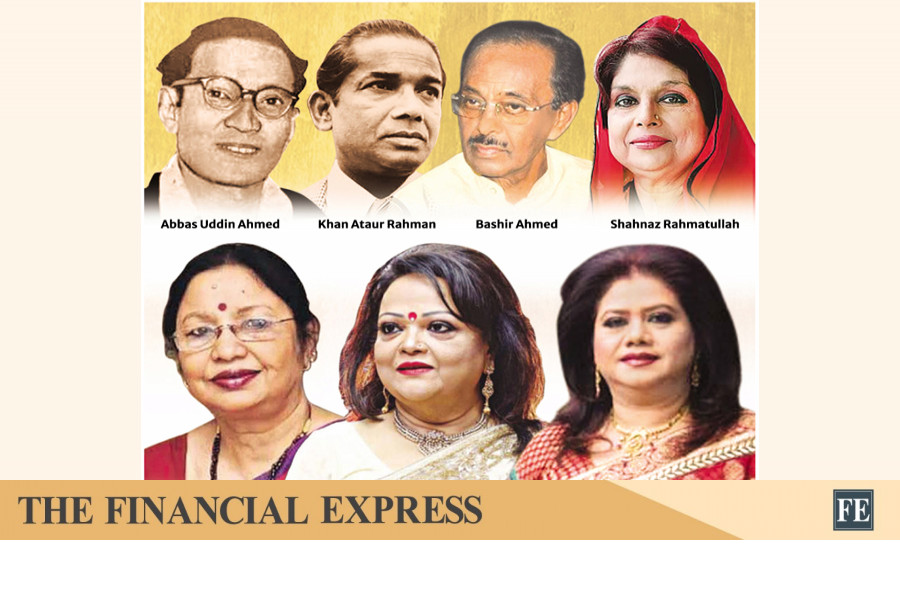
In early 1940s, the folk song composer and singer Abbas Uddin Ahmed (1901-59) met a young man named Hemanta Mukherjee (1920-89) at a Kolkata radio station. After listening to him singing, Abbas praised Hemanta profusely. “Please bless me,” Hemanta beseeched him. Abbas’
thefinancialexpress.com.bd
Legendary singers & musicians of Bangladesh
Fakhruddin Ahmed
Published :
Dec 11, 2025 23:22
Updated :
Dec 12, 2025 00:07
In early 1940s, the folk song composer and singer Abbas Uddin Ahmed (1901-59) met a young man named Hemanta Mukherjee (1920-89) at a Kolkata radio station. After listening to him singing, Abbas praised Hemanta profusely. “Please bless me,” Hemanta beseeched him. Abbas’s blessings must have worked wonders, because Hemanta trailblazed a path that led to his becoming the most influential and successful modern and Rabindra Sangeet singer in the history of Bengal. Cooch Bihar-born Abbas was already established as the foremost folk-song singer of Bengal, specialising in the local musical genre, such as Bhawaiya (“Fandey Poria Bauga Kandere”,1939), as well as Bhatiyali (“Nodir Kool Nai Kinar Nairey”), Jaari, Murshidi etc.: (“Allah Megh Dey Pani Dey Chhaya Derey Tui”, lyrics: Jalaluddin, music: Girin Chakraborty); (“Shono Momin Musalman”, lyrics: Jasimuddin). Abbas collaborated extensively with Kazi Nazrul Islam and sang many of Nazrul’s Islamic songs (“O Mon Ramzaner Oi Rozar Sheshey Elo Khushir Eid”, 1931). Abbas Uddin Ahmed’s greatest contribution to Bangladesh’s vocal music was that, he was the patriarch of Bangladesh’s First Family of Vocal Music.
There was no infrastructure for film-making in Bangladesh when Abdul Jabbar Khan bravely made Bangladesh’s first movie, ‘Mukh O Mukhosh’ (1956). There were no singers to speak of, save Abbas’s successor in folk-singing Abdul Alim (1931-74), and Mahbuba Rahman, (1935-) – both of whom sang in the film. Abbas’s teenage daughter Ferdausi Begum (Rahman) (1941-) stepped in to fill the void. Like her father, she excelled in Bhawaiya (“Sundari Kamala Nachey”) and Nazrul Sangeet. It was in the 1959 movie ‘Edesh Tomar Amar’ that Ferdausi made her singing debut in films. The movie’s music director was actor-singer-lyricist-composer Khan Ataur Rahman (1928-97), and it featured singer Farida Yasmin, a member of the illustrious Yasmin family of Bangladesh, which produced several renowned singers. Khan Ata himself would become a member of that family by marrying Farida’s younger sister and an accomplished singer herself, Nilufar Yasmin (1948-2003).
Khan Ataur Rahman: In 1960, industrialist and film producer Fazle Dossani (owner of Bangladesh’s first air-conditioned cinema halls, Gulistan and Naz, which screened only English movies, as well as Chinese restaurant Chu Chin Chow, and Baby Ice Cream), invited Bollywood singer Talat Mahmood (1924-98) in 1960 to visit the then “East Pakistan.” Talat brought with him an aspiring teenaged singer, Kolkata-born Bashir Ahmed (1939-2014). While Talat left after performing in Chittagong, Dhaka, and Mymensingh, Bashir stayed back. At Dhaka, Talat recorded two songs for the film ‘Rajdhanir Bukey’ (1961). One of the songs, “Tomarey Legechhey Etojey Bhalo” (lyrics: K. G. Mustafa, 1936-2022), was one of Talat’s best in Bangla. The music was composed by both Robin Ghosh (1939-2016) and Ferdausi, then only 19.
Ferdausi Rahman: Ferdausi had her first film-hit, “Ami Rupnagarer Rajkonya” in ‘Harano Din’ (1961), which was picturised on Shabnam (Jharna Basak, 1946-) (lyrics: Azizur Rahman, music: Robin Ghosh – Shabnam’s future husband). Fazle Dossani produced East Pakistan’s first Urdu film, a Pakistan-wide hit, ‘Chanda’, in 1962. Ferdausi showcased her talent by singing five of the eight songs in that film, two famous ones being” “Akhian Tori Rah Niharen, O Pardesia, Aa Ja.,” and “Lut Geya Khushion Ka Dera, Kho Geya, Hai Pyar Mera.” Anjuman Ara Begum (1942-2004) also sang the popular, “Chandni, Bheegi Bheag Hawa, Na Janey, Dil Kahan Kho Geya.” (lyrics: Suroor Barabankvi, music: Robin Ghosh). More Urdu melody hits by Ferdausi followed in Pakistan-wide hit “Talash” (1963): “Maine Kahan Salamalaikum,” and “Mausoom Rangela, Nasheeli Hawa.” “Talash” was Bashir Ahmed’s singing debut in films. His most famous song, “Rickshawala Matawala,” was picturised on Subhas Dutta (1930-2012), as he roamed the fairly empty streets of Dhaka on his rickshaw. Bashir’s other hit songs included: “Kanhi Na Kanhi, Kabhi Na Kabhi,” and “Kuch Apne Kanhe, Kuch Meri Sune” as well as a duet with Anjuman Ara, “Tumbhi Haseen, Dil Bhi Jawan,” (lyrics: Suroor Barabankvi; Music: Robin Ghosh). Director-Producer Zahir Raihan (the writer’s distant uncle) made one of Bangladesh’s best movies, ‘Kancher Deyal’ (music: Khan Ata) in 1963.
Bashir Amed: Bashir Amed continued to showcase his multifaceted talent in “Milan” (1964), where he sang the hit song, “Tum Salamat Raho,” (lyrics: Suroor Barabankvi), and a duet with Noorjehan, “Tum Jo Mile, Pyar Mila” (lyrics: Bashir Ahmed). Although the movie was in Urdu, Khan Ataur Rahman composed the music. Bashir Ahmed also sang a few other evergreen Bangla songs, such as, “Onek Sadher Moyna Amar,” and “Dekona Amay Tumi Kachhe Dekona” in the film Moynamoti (1969) (lyrics: Gazi Mazharul Anwar and Syed Shamsul Haque; music: Bashir Ahmed), as well as an enchanting romantic love song, “Tomar Kajol Kesh” (lyrics: Abu Hena Mostafa Kamal, music: Abdul Ahad).
Subhas Dutta produced, directed and was the lead actor of his first film, ‘Sutarang’ (1964), which was also the debut film of actress Kabori (Mina Pal, 1950-2021). The movie had two hit songs: “Porane Dola Dilo Ekon Bhromoraye” by Ferdousi, and “Amon Moja Hoyna Gaye Sonar Gaina,” by Aliya Sharafi (lyrics: Syed Shamsul Huq; music: Satya Saha, 1935-99). ‘Rupban’ (1965) led the explosion of folk-based movies in Bangladesh in the mid-1960s. There were nine searing songs by Abdul Alim (Dheu Uthechhe Shagorey) and Nina Hamid (“Dukhoje Moner Maajhe”) in the film (music: Satya Saha).
Shahnaz Rahmatullah: Shahnaz Begum (Rahmatullah) (1952-2019), with her mellifluous voice entered the music scene in the mid-1960s. Semi-classically trained, and with a honey-soaked voice, she probably had more hits than any other female singer. She is also well-known for her Urdu songs in Pakistan, especially on PTV. She sang duets with the legendary Pakistani singer Ahmad Rushdi. Shahnaz made her film-singing debut in ‘Daak Babu’ (1966) with the chorus, “Holud Baato, Mehndi Baato” (lyrics: Mohammad Moniruzzaman; music: Ali Hossain). Shahnaz’s greatest film-hit came two years later in “Shat Bhai Champa” (1968) with the megahit: “Shunen Shunen Jahanpona” (lyrics: Khan Ata; music: Amir Ali), picturised on Kabori. Her duet with Mahmudun Nabi “Ami Je Kebol Bolei Choli” was another hit in “Agantuk” (1969), as was “Tumi Sat Sagorer Opar Hotey,” with Abdul Jabbar (lyrics: Gazi Mazharul Anwar; music: Anwar Parvez), in ‘Kato Je Minoti’ (1970). Shahnaz also had non-film hits like “Shagorer Teer Theke,” “Ekbar Jete De-na Amay,” and the patriotic song, “Prothom Bangladesh Amar Shesh Bangladesh,” (lyrics: Moniruzzaman Monir; music: Alauddin Ali).
Sabina Yasmin: With her wide range and silky melodious voice, Sabina Yasmin (1954-) has been the most successful and popular female vocalist in Bangladesh’s history. Sabina’s first film-hit was in Zahir Raihan-Khan Ata collaboration “Moner Moto Bou” (1969), where her solo song, “Eki Shonar Aloye,” picturised on Suchanda (1947-) was an instant hit, as was Bashir Ahmed’s, “Amake Porate Jodi Eto Lage Bhalo.” Sabina-Bashir’s “Aha Ki Je Sundar” was another sensation. All the songs were written and composed by Khan Ata. Another of Sabina’s heart-piercing song, the lamentations of a jilted lover, “Mon Jodi Bhenge Jai” from ‘Jowar Bhata’ ((1969), picturised on Shabnam, was also written and composed by Khan Ata. Zahir Raihan-Khan Ata’s last collaboration, was ‘Jibon Theke Neya’ (1970), where Sabina also sang. That movie was more known for its political undertones (pro-Bangladeshi, anti-Pakistani). Zahir Raihan “disappeared” after independence in 1972. Sabina’s hit parade continued with “Shudhu Gaan Geye Porichay”, in ‘Obujh Mon’ (1972) (lyrics: Moniruzzaman; music: Altaf Mahmud), and continues till today. She also sang one of Bangladesh’s most famous patriotic songs, “Sab Kata Janala Khuley Daona” (lyrics; Nazrul Islam Babu; music: Ahmed Imtiaz Bubul.)
Runa Laila: Runa Laila (Sadia Islam) (1952-) has been the most versatile among all Bangladeshi singers. Although Bangla is her mother tongue, she is equally fluent in Urdu, Sindhi, Punjabi, Hindi, and English. Her formative years were spent in Pakistan where she was the top female vocalist during the late 1960s and early 1970s. She has sung duets with legends such as, Mohammad Rafi, Mehdi Hasan and Ahmad Rushdi. According to experts, Runa’s version of Sindhi Sufi Qawwali, “Dama Dam Mast Qalandar” is the most authentic. Runa’s, “O Mera Babu Chhail Chhabeela, Main To Nachun Gi,” in the film ‘Maan Ki Jeet’ (1972) (lyrics: Shabah Keranvi; music: M. Ashraf), picturised on Shabnam, is still very popular in Pakistan. I have not seen any singer in the subcontinent, or anywhere else for that matter, interpret her own songs on the stage and in music videos more accurately than Runa Laila. Runa had her first Bangla film-hit in ‘Swaralipi’ (1971) “Gaaneri Khatay Sharolipi Likhe” picturised on Babita (1953-) (lyrics: Gazi Mazharul Anwar; music: Subal Das). Under instructions from the highest authorities, the Pakistani government did not allow Runa to return to Bangladesh until 1974. She has been producing one hit after another sine then; too many to list here. A melodious spark hits the airwaves as soon as Runa starts singing. She has sung several memorable duets such as “Jakhan Akashey Chand Othey” with Bashir Ahmed in the film ‘Ruper Rani Chorer Raja’ (1979) (lyrics: Gazi Mazharul Anwar; music: Anwar Parvez). The songs from her album ‘Sadher Lau’ (1974), such as “Sadher Lau Banailo Morey Boiragee” are still super-popular, as are “Istishaner Railgarita,” and the super melodious, “Sujan Majhirey”.
A few months ago, the writer saw a video of Asha Bhonsle, Pakistan’s Abida Parvin and Runa Laila as panellists in a music conference. Everyone joined Runa as she sang “Dama Dam Mast Qalandar.” The writer felt that if only Lata Mangeshkar had been there, the panel would have been complete.
This has been a female-heavy tribute. The writer would like to finish by paying compliments to another male artiste. Mahmudun Nabi (who the writer knew) also sang some memorable songs like: “Premero Naam Bedona” from the film ‘Neel Akasher Niche’ (1968); and “Tumi Je Amar Kobita,” from ‘Darpochurno’ (1970, with Sabina Yasmin).
Dr Fakhruddin Ahmed is a Rhodes Scholar living in Princeton, New Jersey, USA.
Chondona also shared a personal insight into her late husband’s deepest artistic pride. “My personal feeling is that Ayub Bachchu would have been happier if his band LRB had received the award,” she said.
www.thedailystar.net
'It would have meant more if he could accept it with his own hands': Ayub Bachchu's wife
Zahid Akbar
Ayub Bachchu | Photo
Legendary singer, guitarist and composer Ayub Bachchu is being honoured posthumously with the Ekushey Padak for his extraordinary contribution to Bangla rock music, nearly eight years after his death. The award’s announcement has been met with pride and reflection from those close to him.
Speaking to The Daily Star, Bachchu’s wife, Ferdous Akhtar Chondona acknowledged the significance of the honour, while also expressing a subtle yet profound wish. “For an artist, receiving this honour is a huge matter,” she said. “It would have meant more if he could have accepted it with his own hands. Every artist hopes to receive such recognition while they are alive. That is when it brings the greatest joy. I thank everyone involved in honouring him.”
Chondona also shared a personal insight into her late husband’s deepest artistic pride. “My personal feeling is that Ayub Bachchu would have been happier if his band LRB had received the award,” she said. “When he worked on film songs and those songs became hugely popular, he quietly felt disappointed about not receiving a National Film Award. An award pushes an artist forward by a few more steps. He had that longing, too and spoke about it sometimes. We are deeply happy about this Ekushey Padak, and so are the people who loved him.”
Ayub Bachchu was born on 16 August 1962 in Enayet Bazar, Chattogram, and passed away on October 18, 2018. A rare all-rounder, he was simultaneously a vocalist, lead guitarist, lyricist and composer — an artist whose influence shaped the emotional charge and ambition of modern Bangladeshi band music.
His first recorded song, “Harano Bikeler Golpo”, written by Shahid Mahmud Jangi, introduced him to audiences early in his career. His debut studio album, “Rokto Golap” (1986), marked the beginning of a prolific solo recording career.
Bachchu began his musical journey with the band Feelings in 1978 and joined Souls in 1980, where he served as lead guitarist for about a decade. In 1991, he founded his own band, LRB (short for Love Runs Blind), which would become one of Bangladesh’s most influential rock groups. The band’s first release was a double album in 1992, a landmark achievement in Bangladeshi rock.
As a solo artist, Bachchu released a total of 16 albums over his four-decade career, including “Moyna” (1988), “Koshto” (1995), “Shomoy” (1998), “Eka” (1999), “Prem Tumi Ki” (2002), “Duti Mon” (2002), “Kafela” (2002), “Prem Premer Moto” (2003), “Pother Gaan” (2004), “Bhatir Gaane Matir Taane” (2006), “Jibon” (2006), “Sound of Silence” (2007), “Rimjhim Brishti” (2008), “Bolini Kokhono” (2009), and “Jiboner Golpo” (2015).
Caption Photo:Star
LRB’s discography includes seminal albums such as “LRB” (1992), “Sukh” (1993), “Tobuo” (1994), “Ghumonto Shohore” (1995), “Ferari Mon” (1996), “Amader Bishmoy” (1998), “Mon Chaile Mon Pabe” (2000), “Ochena Jibon” (2003), “Mone Ache Naki Nei” (2005), “Sporsho” (2008), and “Juddho” (2012).
Caption Photo: Shahrear Kabir Heemel
Bachchu’s catalogue of beloved songs spans decades. Among his most enduring tracks are “Cholo Bodle Jai”, “Hashte Dekho Gaite Dekho”, “Keu Shukhi Noy”, “Ferari Ei Monta Amar”, “Ekdin Ghum Bhanga Shohore”, “Bangladesh”, “Koshto Pete Bhalobashi”, “Ekhon Onek Raat”, “Ei Rupali Guitar Fele”, “Gotokal Rate”, “Shei Tara Bhora Raat E”, “Meye Tumi Ki Dukkho Cheno”, “Share Tin Hat Mati”, “Ural Debo Akashe” and “Ek Akash Tara Tui”.
In addition to his band work, Bachchu also performed notable film songs, including “Ammajan”, “Ami To Preme Porini”, “Ononto Prem Tumi Dao Amake”, and “Sagorika Ami Beche Achi”.
What many people do not know, however, is that the inspiration behind this effort came from a song by renowned Bangladeshi singer Runa Laila.
www.thedailystar.net
Runa Laila’s song inspires endangered Indian tribe to create its own alphabet
7 March 2026, 12:58 PM
UPDATED 7 March 2026, 12:58 PM
Photos: Collected
In Totopara, a small village on the Bhutan border in Alipurduar district of West Bengal, lives one of India’s oldest and most endangered indigenous communities — the Toto tribe. With a very small population and a largely isolated lifestyle, the community has long spoken its own language but historically lacked a written script, putting the language at risk of disappearing.
Several years ago, this began to change when Toto community member Dhaniram Toto developed a dedicated alphabet for the Toto language. In recognition of his contribution to preserving the tribe’s linguistic heritage, the Government of India later honoured him with the Padma Shri.
What many people do not know, however, is that the inspiration behind this effort came from a song by renowned Bangladeshi singer Runa Laila.
In an interview, Dhaniram Toto recalled that one day he was listening to the radio when he heard Runa Laila’s song “Tumi Ami Likhi Praner Bornomala” (“You and I write the alphabet of our hearts”). The line left a deep impression on him. It made him wonder: if other languages have their own alphabets, why shouldn’t the Toto language have one as well?
That question sparked years of research and effort. Eventually, he created a unique writing system for the language, now known as the “Toto script” or “Toto Alphabet”.
Another initiative to preserve the language was started by Bhakta Toto, who began documenting the endangered language using the Bengali script. His work includes collecting Toto words, writing stories, and encouraging the use of the language in early education within the community.
Image Runa Laila’s song inspires endangered Indian tribe to create its own alphabet
Despite these efforts, challenges remain. The small Toto community living along the Torsa River in Alipurduar continues to struggle to preserve its linguistic heritage. Modern education systems, the growing influence of outside cultures, and the community’s limited population all threaten the survival of the language.
Still, with renewed initiatives and the involvement of younger generations, the Toto people are continuing their efforts to protect and sustain their language and cultural identity.
Each episode moves between recollection and performance, pairing intimate conversations with live renditions of the artists’ most enduring songs.
www.thedailystar.net
‘Smritir Sur’ revisits five legends of Bangla music
18 March 2026, 11:50 AM
UPDATED 18 March 2026, 11:50 AM
This Eid, singer Agun returns to the screen with “Smritir Sur”, a tightly curated tribute to five towering figures of Bangla music—Azam Khan, Ayub Bachchu, Shafin Ahmed, Khalid, and Farida Parveen.
Produced and directed by Najmul Alam Rana, the programme assembles those who knew these artists best—their peers, collaborators, and family members. Each episode moves between recollection and performance, pairing intimate conversations with live renditions of the artists’ most enduring songs.
Photo: Collected
The segment on Ayub Bachchu features Naquib Khan of Renaissance and Golam Rahman Romel from LRB. Azam Khan is remembered by Ferdous Wahid and Labu Rahman.
For Shafin Ahmed, reflections come from his brother Hamin Ahmed of Miles and Foad Nasser Babu of Feedback. The Khalid episode features Pathik Nabi and lyricist Tarun Munshi. In the segment on Farida Parveen, guests include Shafi Mondol and Chandana Majumdar.
Agun, who has largely stayed away from hosting, said the format drew him back. “I often receive offers to host, but I don’t find anything new,” he said. “This concept felt different. While working on it, I found myself rediscovering Ayub Bachchu, Azam Khan, Shafin Ahmed, Khalid, and Farida Parveen. I believe viewers will also come to know them anew.”
The programme will air from Eid day for five consecutive evenings, from 6 pm to 7 pm, on Channel 24. It will also be streamed on the channel’s Facebook and YouTube platforms.
Dhaka is set to host six major concerts between 24 July and 1 August, featuring performers from Bangladesh and abroad, overcoming previous disruptions.
en.prothomalo.com
Six concerts in 9 days
Runa Laila Prothom Alo
There was a time when very few music events took place during the monsoon season. Over the past few years, however, concerts and live music performances have become regular features of the rainy season.
During the past two years under the interim government, various factors disrupted these events, including permit-related complications and venue shortages.
With those challenges now largely resolved, the concert scene has regained momentum. Between 24 July and 1 August, Dhaka will host six major concerts, featuring leading performers from Bangladesh and abroad.
Runa Laila: Felicitation and solo concert
On 24 July at 6:30 pm, legendary singer Runa Laila will receive a special honour at the National Theatre Hall of the Bangladesh Shilpakala Academy. Following the felicitation, she will perform 10 of her favourite songs.
The Ministry of Cultural Affairs honoured Sabina Yasmin last year and Syed Abdul Hadi earlier this year. Unlike those invitation-only events, audiences will be able to purchase tickets to attend Runa Laila's programme.
The Bangladesh Shilpakala Academy has announced that it will donate the proceeds from ticket sales to the Prime Minister's Relief Fund to support flood victims. Tickets are priced at Tk 2,000, Tk 3,000 and Tk 5,000.
“Main stage featuring Atif Aslam”
The 'Main stage featuring Atif Aslam' concert was originally scheduled for 13 December, and the organisers had completed all preparations, including ticket sales. However, security concerns forced them to postpone the event at the last moment.
The concert will now take place on 24 July. Atif Aslam has already released a video message about the event, and the organisers have confirmed that they have received all the necessary permissions.
The concert will be held at the Cricketers Academy, adjacent to 300 feet road in the capital. In addition to Atif Aslam, two of Bangladesh's prominent bands—Meghdol and Level Five—will perform. The event will run from 5:00 pm to 10:00 pm.
Atif Aslam
“Melody Mosaic: Moji & Co.”
Young musicians Vendu Das Shubho and Sanzida Mahmood Nandita have earned widespread popularity among younger audiences through both original compositions and cover songs. They regularly release their music through the Moji & Co platform.
The duo will perform at 7:30 pm on 30 July at the Yamaha Flagship Centre in Tejgaon, Dhaka. Tickets are priced at Tk 2,000. Noor's Event is organising the programme.
Two tribute concerts
Dhaka will host two tribute concerts on 31 July.
The band Warfaze will present a special 'Michael Jackson Tribute' concert in honour of the late pop icon. The event will take place at the Hall of Fame of the Bangladesh-China Friendship Conference Centre. Brandmith and Mars & Co are jointly organising the concert. Tickets are priced at Tk 1,500, Tk 2,000 and Tk 5,000.
On the same day, Butternote Café in Banani will host 'Ekdin Brishtite Bikele...', a tribute to Anjan Dutt. Performers Joy Shahriar, Ahmed Hasan Sani and Shuvro will perform songs by Anjan Dutt alongside selections from their own repertoire. Ajab Karkhana is organising the concert. Tickets cost Tk 700 in advance and Tk 1,000 at the venue.
“One true sound”
After overcoming earlier complications, acclaimed Indian singer, lyricist and composer Anupam Roy is finally set to perform in Dhaka.
His “One True Sound” concert will take place on 1 August at the United Convention Centre in Dhaka. The organisers had completed all preparations for the original concert, scheduled for 26 June at the same venue, but unavoidable circumstances led them to postpone the event.
The organisers have not yet announced the ticket prices.
Ayub Bachchu would have been 64 years old if he was alive today. Maybe he would have given us many more great songs. Maybe he would have handed guitars to new artists. Or maybe he would be playing on the stage of that dream concert on an autumn evening.
en.prothomalo.com
The concert for 1.5 million people and the unfulfilled dream of Ayub Bachchu
Ayub Bachchu with his daughter, Fairuz Safra Ayub (left), wife Ferdous Akter (centre) and son Ahnaf Tajwar Ayub (right).Courtesy of the family

 Bangladesh Defense