Home Watch Videos Wars Login

[🇧🇩] Political Activities of Jamaat-E-Islami

[🇧🇩] Political Activities of Jamaat-E-Islami
84
2K
More threads by Saif

G Bangladesh Defense

Jamaat for end to ‘monarchy rule’
Our Correspondent . Feni 31 January, 2026, 00:56

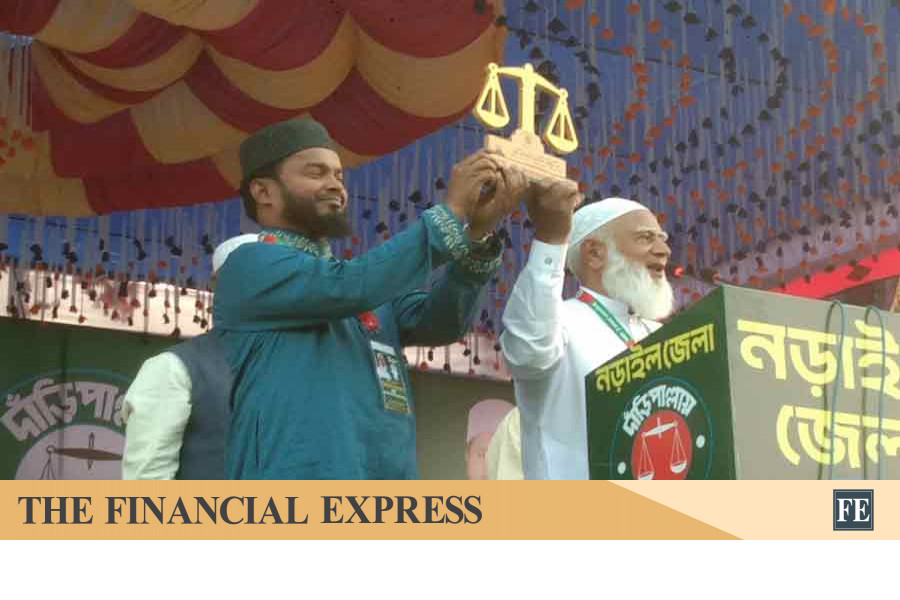
1769822880241.webp


Bangladesh Jamaat-e-Islami amir Shafiqur Rahman on Friday said that Jamaat wanted to end the ‘monarchy rule’ in the country.

‘We want to change the tradition that only the sons of the king would be king and rule the country,’ he said while speaking at an election rally on the Feni Government Pilot School premises in Feni.

He said that only becoming sons of ministers would not qualify them to be ministers, but they must have qualities to uphold the posts.

Anybody could hold the posts if they have quality to uphold the posts, Shafiqur said at the election rally.

Jamaat central leader ATM Masum, AB Party chairman Mojbur Rahman Monju and Jatiya Ganatantrik Party spokesman Rashed Prodhan, among others, spoke at the rally.

New Age Noakhali correspondent reported that Jamaat chief Shafiqur Rahman at another rally in Noakhali on Friday said, ‘People of the country have already understood that the spirit of July uprising could be implemented by our party Jamaat.’

‘So they are supporting our party and want to see us in power for implementing the July uprising spirit for the formation of a discrimination-free new Bangladesh after the Jatiya Sangsad elections scheduled for February 12,’ Shafiqur said at the election rally at Maizdi Zila School field on Friday noon.

Shafiqur said, ‘We have got a scope for forming a new Bangladesh after the victory of uprising on August 5, 2024, that came through sacrifices of lives of many youths in the uprising.’

Without mentioning the name of any political party, he said that people were not safe under a political party before the election and they would be more vulnerable if the party won in the elections and came to power.

Chaired by Jamaat’s Noakhali district amir, Yeshak Khandaker, the rally was addressed, among others, by central and local leaders of Jamaat and Jamaat-led electoral alliance.​
 
Analyze

Analyze Post

Add your ideas here:
Highlight Cite Respond

What the Jamaat ameer said is not correct

Hasan Ferdous
Published: 01 Feb 2026, 13: 16

1770081556129.webp


Bangladesh Jamaat-e-Islami’s ameer, Shafiqur Rahman, has said in an interview with Al Jazeera that a woman can never become the head of his party. Why? Because men and women are not equal. Each has distinct roles. Women give birth to children; men cannot. It is the Creator who has laid down this order. Earlier, the party had said it does not support any woman as head of government or head of state.

If one breaks down this argument, the core message that emerges is that women are not equal to men. What men can do, women cannot. Men will be the leaders of the party and the country. Women, on the other hand, are best suited to giving birth to children and raising them. Therefore, keep them confined to the home. That is deemed their most appropriate place.

That Jamaat, along with at least 30 other parties, did not field a single female candidate in any of the 300 seats in the upcoming national election makes clear just how deep this gender divide runs in their eyes.

When such an attitude becomes the basis of state or government policy, what the consequences look like can be seen clearly in today’s Afghanistan. There, citing divine decree, girls have been barred from school after the age of 12. With the exception of one or two very limited areas, participation in the workforce has been prohibited. Women have been barred from moving alone in public. Even speaking loudly has been designated a punishable offence.

In Bangladesh, where for a large part of its history the centres of power have been occupied by two women leaders of two major parties, the claim that a woman cannot be a party chief or head of government is not only laughable but also deeply antiquated. These two women leaders did not merely rule the country with authority; many of their male colleagues would even address them with the honorific “sir” before speaking to them.

At one time, women were not equal to men, and in many respects, they still are not. The reason is that women are not allowed to become equals. Both rule and discipline remain in male hands. The situation changes entirely if women are allowed to step out of the home, or if the path to competing on equal terms with men is made a little more level. It is precisely because they have been given such opportunities that Bangladeshi women are now winning football titles. They are carrying the national flag of Bangladesh to the peaks of the Himalayas. Female police officers from the country have competently carried out peacekeeping duties in war-ravaged countries such as Haiti.

Girls face many obstacles. If they are able to break through and step outside, how well they can perform is wonderfully illustrated by their success in education. In Bangladesh today, more girls than boys are accessing education. As of 2024, while the enrolment rate of boys at the primary level stood at 90 per cent, the rate for girls was 98 per cent.

In recent years, at the secondary-school level, girls have outperformed boys in the results of every major public examination. In the 2025 HSC examinations, the pass rate for girls was 8 percentage points higher than that for boys, 62 per cent compared with 54 per cent. At the next stage, university, girls are unable to progress at the same pace because of familial and social barriers.

But in countries where such barriers are comparatively weaker, girls are performing far better than boys at the top tiers of higher education. For example, in the United Kingdom, according to the latest statistics, while the pass rate for men at the graduate level in the universities there is 81 per cent, the rate for women is 86 per cent. Among 19-year-olds, 56 per cent of girls enter college, compared with only 40 per cent of boys of the same age.

Boys’ lagging behind girls has become so alarming that the UK’s Higher Education and Policy Institute has proposed not only developing new strategies to help boys catch up, but also appointing a junior minister for the purpose. Right-wing politician Nigel Farage has even proposed creating a post called “Minister for Boys.”

In fact, modern science has shown that girls are in no way inferior to men in any field, if anything, the opposite. While intelligence quotient (IQ) scores are equal for men and women, girls are better able to multitask. Similarly, girls have greater memory retention capacity, because communication between the left and right hemispheres of the female brain is comparatively more effective.

Put simply, girls have no inherent shortcomings, physically or intellectually. The reason they do not get to lead parties like Jamaat is not gender or sex; it is because they are not given the opportunity. The Jamaat ameer has cited women’s capacity for childbearing as his argument. That capacity is a biological process; it has no connection to leadership. Leadership requires strategic intelligence, managerial skill, and the ability to guide a party or a country with a cool head in times of crisis. In none of these areas are women any less capable than men.

Think of India’s prime minister Indira Gandhi in 1971. Economist Amartya Sen offers another example. In his data-driven research on the 1974 famine in Bangladesh, he showed that during that severe disaster many families survived primarily because women were in charge of running households. Through advance planning in the use of scarce food, preservation, proper distribution, and devising ways to endure for long periods, they protected their children, husbands, and relatives. Think of present-day Gaza or war-ravaged Sudan. In these regions, many may be swept away or die slowly, but those who survive often do so because of the capable leadership of the women in their families.

The Jamaat ameer, like many others, invokes religion as the justification for keeping women out of leadership. Yet from the time of the Prophet of Islam (peace be upon him), we see women in decision-making roles. We see them as commanders on the battlefield. The Jamaat ameer ought to know this better than we do.

Jamaat now speaks of women’s equal rights and makes various promises. It even claims that, to make childrearing easier, it will introduce a five-hour workday for female employees instead of eight. The problem is that it is not only women who raise children; in many cases, men must do so as well.

Why, then, are women excluded despite being equally, or in many cases more, competent? The answer lies in hierarchy and social stratification. Nearly a thousand years ago, the renowned Islamic scholar Abu Rushd made this clear. In the introduction to the Arabic translation of Plato’s Republic, he wrote that there is no difference between men and women in terms of knowledge, virtue, or fitness for leadership. The exclusion of women from leadership, he argued, stems from social conventions, not from any natural or divinely ordained rule.

A thousand years later, a Bengali woman echoed the same truth. Her name was Begum Rokeya. In Sultana’s Dream, she illustrated through allegory that women are excluded from leadership not because of religious injunctions or women’s biological nature, but simply because of rules made by men for their own convenience.

Jamaat now speaks of women’s equal rights and makes various promises. It even claims that, to make childrearing easier, it will introduce a five-hour workday for female employees instead of eight. The problem is that it is not only women who raise children; in many cases, men must do so as well. The issue is not employment, it is childcare. Recognising this basic reality, New York’s new mayor, Zohran Mamdani, has launched an initiative to provide publicly funded childcare for every family.

Jamaat in Bangladesh could adopt this wisdom if it wanted to, but will it?

* Hasan Ferdous is writer and columnist.​
 
Analyze

Analyze Post

Add your ideas here:
Highlight Cite Respond

DB detains suspect over hacking of Jamaat ameer’s X account
Detainee worked as a programmer in ICT section of Bangabhaban, police say


1770167699091.webp


The Detective Branch (DB) of Dhaka Metropolitan Police has detained a person in connection with the alleged hacking of Bangladesh Jamaat-e-Islami Ameer Dr Shafiqur Rahman’s verified X (formerly Twitter) account.

The detainee has been identified as Sarwar Alam, assistant programmer of the ICT section of Banghababan, DMP Additional Commissioner and DB chief Shafiqul Islam told The Daily Star.

A DB team carried out a drive in the Motijheel area and detained the individual, he confirmed.

He said further details were not immediately available as the team was still operating in Motijheel.

More information will be shared once the operation concludes, the DB chief added.​
 
Analyze

Analyze Post

Add your ideas here:
Highlight Cite Respond

Press owner confesses making voter seals upon orders from Jamaat leader
Staff Correspondent Lakshmipur
Updated: 05 Feb 2026, 13: 40

1770279067656.webp

Sohel Rana, the press owner and businessman who confessed in court. Prothom Alo

The owner of a printing press arrested in connection with the recovery of six illegal voting seals in Lakshmipur has given a confessional statement in court. He made the confession under Section 164 of the Code of Criminal Procedure yesterday, Wednesday afternoon. At the time, he disclosed the name of the person who had instructed him to make the voting seals.

The accused who gave the confession is Sohel Rana (40), resident of Tumchar union in Sadar upazila and the proprietor of Mariam Press.

On Tuesday afternoon, police arrested Sohel Rana from Mariam Press on Old Court Road in the town, seizing six illegal voting seals, a computer, and a mobile phone used in the operation.

Officer-in-Charge of Lakshmipur Sadar Model Police Station, Wahed Parvez, confirmed the matter of the confessional statement to Prothom Alo. He said, “Sohel Rana told the court that the seals were made on the instructions of Jamaat-e-Islami leader Saurav Hossain, also known as Sharif. On 30 January, Sharif placed the order to make the seals through WhatsApp. Sohel Rana then made the seals.”

Saurav Hossain, also known as Sharif (34), named in the confession, is the son of Md Shahjahan of Ward No. 4 of the municipality. He is the secretary of Jamaat-e-Islami in that ward. Since the incident came to light, he has been in hiding.

1770279106791.webp

The seals recovered in Lakshmipur Prothom Alo

After the incident became public, Jamaat-e-Islami expelled Saurav Hossain, accusing him of tarnishing the party’s image.

When asked about the matter, district Jamaat ameer SUM Ruhul Amin Bhuiyan said, “We expelled Saurav from the party immediately after the incident. He apparently had the seals made to ‘teach voters how to vote.’ However, this was an irresponsible act. Besides, the person from whose shop the seals were recovered is not a member of our party.”

Earlier, on Tuesday afternoon, police arrested Sohel Rana along with the voting seals. After the incident became public, Bangladesh Nationalist Party (BNP) candidate for Lakshmipur-3 constituency, Shahid Uddin Chowdhury Annie, expressed concern and held a press conference later that day. Speaking at the press conference at his main election office, he said, “We have learned that the person arrested with the seals, named Sohel Rana, is a Jamaat worker. He may even hold an official position. Six seals along with a computer have been seized. Whoever made these seals, there must certainly be many cogs behind it. There is an entire plan of election engineering at play.”

After the BNP’s press conference, Jamaat-e-Islami held a press conference at the Lakshmipur Press Club at around 10:00 pm the same night. There, Jamaat-e-Islami’s candidate for the Lakshmipur-3 constituency, Rezaul Karim, said, “BNP is spreading falsehoods by linking Jamaat with the person arrested along with the voting seals.”

A senior police official, speaking to Prothom Alo on condition of anonymity, said the recovered seals are being investigated with due seriousness. The investigation is proceeding along two lines. First, it is being examined whether the seals were made for the purpose of training or rehearsing voters. Second, it is also under investigation whether there was any plan to use them on ballot papers on election day to rig votes or for any dishonest purpose.

Officer-in-Charge of Lakshmipur Sadar Model Police Station, Wahed Parvez, said, “After the confession, we are examining the motive behind the making of the seals and whether anyone else was involved. In the interest of the investigation, the seized evidence is being examined.”​
 
Analyze

Analyze Post

Add your ideas here:
Highlight Cite Respond

Jamaat unveils manifesto with 26 priorities
Staff Correspondent 05 February, 2026, 00:08

1770280833372.webp


The Bangladesh Jamaat-e-Islami on Wednesday unveiled its election manifesto with 26 priority areas ahead of the 13th Jatiya Sangsad elections, pledging to establish a just, humane and corruption-free state through democratic governance, economic reform and social welfare.Bangladesh cultural tours

The manifesto, unveiled at a programme at a Dhaka hotel, is anchored on the principle of ‘Bangladesh’s Interest First’, under which the party vowed to build a sovereign state with zero compromise on independence, sovereignty and national interests.

It places emphasis on sovereignty, democratic reforms, youth and women’s participation, economic recovery, environmental sustainability and social justice.

Unveiling the document, Jamaat amir Shafiqur Rahman said that even after 54 years of independence, Bangladesh had failed to establish a discrimination-free society and ensure people’s rights.

‘We want to build a discrimination-free democratic country. If voted to power, we do not want to form any partisan government, nor do we support dynastic rule,’ Shafiqur said.

Referring to the July uprising, he said that Jamaat had been working to uphold his party’s spirit but alleged that leaders and activists of a political party had instead engaged in extortion across the country.

Jamaat secretary general Mia Golam Parwar jointly unveiled the manifesto.

Leaders of various political parties and diplomats from different countries stationed in Dhaka attended the programme.

Shafiqur said that the manifesto reflected the aspirations of the 2024 July uprising.

According to the manifesto, Jamaat pledged to develop all 64 district towns and around 500 upazilas and small towns as ‘planned cities’.

If elected, the party said, it would establish an independent ‘Accountability Council’, requiring the prime minister and cabinet members to submit monthly progress reports.

The party also pledged to amend Article 70 of the constitution, saying that party discipline would not be used to restrict lawmakers from acting independently in the national interests.

Jamaat proposed institutionalising service-oriented politics and providing annual state allocations to political parties in proportion to their parliamentary seats and vote share.

It also proposed introducing proportional representation and allowing political parties securing at least 10 seats or 3 per cent of the national vote to nominate observers to the Election Commission.

The manifesto pledged to enact a distinct Muslim personal law in conformity with Islamic Shariah, establish a special High Court bench on personal law, and form a Truth and Healing Commission based on restorative justice.

On youth policy, Jamaat pledged to prioritise youth leadership and meaningful participation in governance.

It also proposed six to 12 months of military training for young men and women aged between 18 and 22.

The party promised to ensure women’s safety, dignity and participation in all spheres of national life.

Jamaat, which did not field any female candidate, promised to place a ‘significant’ number of women in the cabinet and local government offices.

The party proposed establishing what it claimed would be the world’s largest women’s university by merging Eden College, Badrunnesa College and Home Economics College in Dhaka.

Other pledges included women’s health and sports centres in every district, restoration of law and order, zero tolerance for corruption, banking sector reform, justice for past state-sponsored crimes, adulteration-free food by 2030, and a ‘Three-Zero Vision’ of zero environmental degradation, zero waste and zero flood risk.​
 
Analyze

Analyze Post

Add your ideas here:
Highlight Cite Respond

Posts you haven't read yet..

Members Online

Latest Posts

Back
 
G
O
 
H
O
M
E