Bangladesh Defense

Saif
Senior Member
- Joined
- Jan 24, 2024
- Messages
- 22,319
- Likes
- 9,875
- Nation

- Axis Group

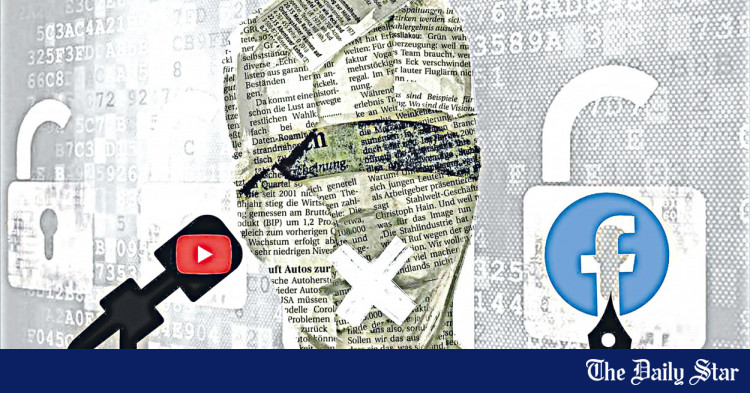
Has the media gotten out of the grip of (self-)censorship?
Failing to pursue these fundamental reforms at this critical moment would perpetuate the past practice of media suppression.
Has the media gotten out of the grip of (self-)censorship?

File Illustration: Biplob Chakroborty
In Bangladesh, the stories citizens read are often shaped not by journalistic choice alone but by an invisible force—censorship. Whether imposed directly by government actions or adopted defensively by journalists, this practice casts a long shadow over press freedom. Its roots lie in the country's legal and political framework, where repressive laws and political pressures compel journalists to avoid sensitive issues that might provoke legal repercussions or retaliation. This dynamic creates a delicate dance between journalists and the government, in which the former treads carefully so as not to cross the invisible line.
Since the regime change on August 5, 2024, there has been a surge in legal cases and intimidation against media outlets, amplifying fears and deepening the grip of self-censorship. Despite Dr Muhammad Yunus's stated commitment to press freedom, actions like the cancellation of press credentials and the incarceration of journalists send troubling signals, leaving media freedom in Bangladesh at a perilous crossroads.
The constitution of Bangladesh promises freedom of thought, conscience, and expression, alongside press rights under Articles 39(1) and 39(2), with caveats of "reasonable restrictions" for national security, public order, and morality—vague terms often misused by authorities to limit dissent and critical journalism. In addition to the constitution, the Press Council Act of 1974 supports press freedom and upholds journalistic integrity. Yet, the effectiveness of this Act is limited, and it lacks the enforcement muscle to shield journalists from legal and extra-legal threats.
For years, successive governments in Bangladesh have wielded repressive laws to penalise speech deemed, in their broad understanding, to be false, offensive, defamatory, or disruptive to law and order. Among the earliest and most contentious of these laws is the Special Powers Act of 1974, which established far-reaching state censorship by criminalising vaguely defined "prejudicial" content. This Act, and others like it, have been routinely exploited to silence dissenting voices and restrict the media's ability to report freely. Its impact is particularly alarming for two reasons: the government's expansive interpretation of what qualifies as "prejudicial" and the troubling conflation of legitimate criticism with threats to national security. These dynamics have allowed the Act to become a powerful tool for suppressing opposing views, undermining the free exchange of ideas that a vibrant democracy requires.
Subsequent laws, including the Information and Communication Technology (ICT) Act, the Digital Security Act (DSA), and the Cyber Security Act (CSA), have continued this trend. Notorious provisions like Section 57 of the ICT Act penalised digital content deemed defamatory or religiously offensive with harsh sentences, fostering a culture of fear. Subsequently, the DSA of 2018 was enacted in response to public outcry over the ICT Act, while the CSA of 2023 followed as a reaction to international criticism of the DSA. Each of these laws has drawn criticism for pulling similar language from Section 57 of the ICT Act and repackaging it to retain authoritarian control over freedom of expression under broad pretexts like defamation, "negative propaganda," or hurting religious sentiments. Hundreds of arrests were made under this never-ending cycle of repressive laws, leading to accusations that the DSA (and then CSA) was used to silence dissent and discourage investigative journalism.
Since the fall of the past regime, the sacking of journalists for reportedly being linked with the previous government, without concrete criminal charges having been brought against them, is unsettling to say the least. Most recently, the government rescinded the press accreditation of numerous journalists, effectively restricting their access to government secretariats. Previously, the ICT Adviser Nahid Islam had, on several occasions, suggested that journalists could be prosecuted and punished due to their possible nexus with the erstwhile regime. The press secretary, Shafiqul Alam, gave a similar vague message. The cancellation of press passes and the administration's statement against journalists sends an ambiguous message: while the government maintains that it supports press freedom and expresses its willingness to repeal the draconian laws, its words and actions may pressure the media to cautiously choose its contents and stories.
It is important to mention that journalists are held to high professional and ethical standards and must uphold truth and accuracy in news reporting. The current legal framework, such as the 1993 Journalists' Code of Conduct, provides a grievance procedure if journalists breach their duties. The Code prohibits maliciously distorting or slanting news in commentary and headlines, requiring clear and fair presentation without bias. Newspapers are also expected to resist and expose crime and corruption. If any newspaper, news agency, editor, or journalist breaches journalistic ethics and codes of conduct, the Press Council, under Section 12(1) of the Press Council Act of 1974, may investigate complaints and warn, admonish, and rebuke the concerned parties after giving them an opportunity to be heard. There are legal recourse available in the existing Press Council Act and the Journalists' Code of Conduct.
The persecution of journalists without any specific allegations have attracted criticism from local and international quarters, raising alarms over the actual extent of media freedom in the country. Antoine Bernard of Reporters Without Borders called on the government to "stop the current legal harassment of more than 130 journalists" who have been charged with trumped-up crimes, as well as the arrest of some journalists without prior investigations. The Committee to Protect Journalists called for guaranteeing the procedural rights of incarcerated journalists.
The interim government's stated objective to right past wrongs and implement reform seems to be out of step with the continued plight of the media landscape in Bangladesh. The gap between the government's declared goals and the actual circumstances raises serious concerns about the current state and future trends of media independence. It may also thwart the goals of the Public Media Reform Commission, which is currently undertaking the job of furthering press freedom in Bangladesh.
Protests in July and August have flagged one of the most severe failures of the media in maintaining neutrality in times of crisis, yet similar patterns of media restrictions persist. If Bangladesh is to break out of this cycle where news outlets act primarily as a mouthpiece for the government, changes must extend beyond cosmetic promises. The interim government now has an opportunity and a corresponding responsibility to show real commitment to freedom of the press, which it can do by letting the Media Reform Commission work independently and by taking tangible steps that create an atmosphere where journalists can work without fear of retribution.
Failing to pursue these fundamental reforms at this critical moment would perpetuate the past practice of media suppression and drastically reduce public expectations of meaningful democratic change. The stakes are particularly high, given Bangladesh's history of political volatility and the critical role a free press must play in guaranteeing governmental accountability and fostering robust public debate.
Sangita Gazi is a postdoctoral research scholar at The Wharton School, University of Pennsylvania.